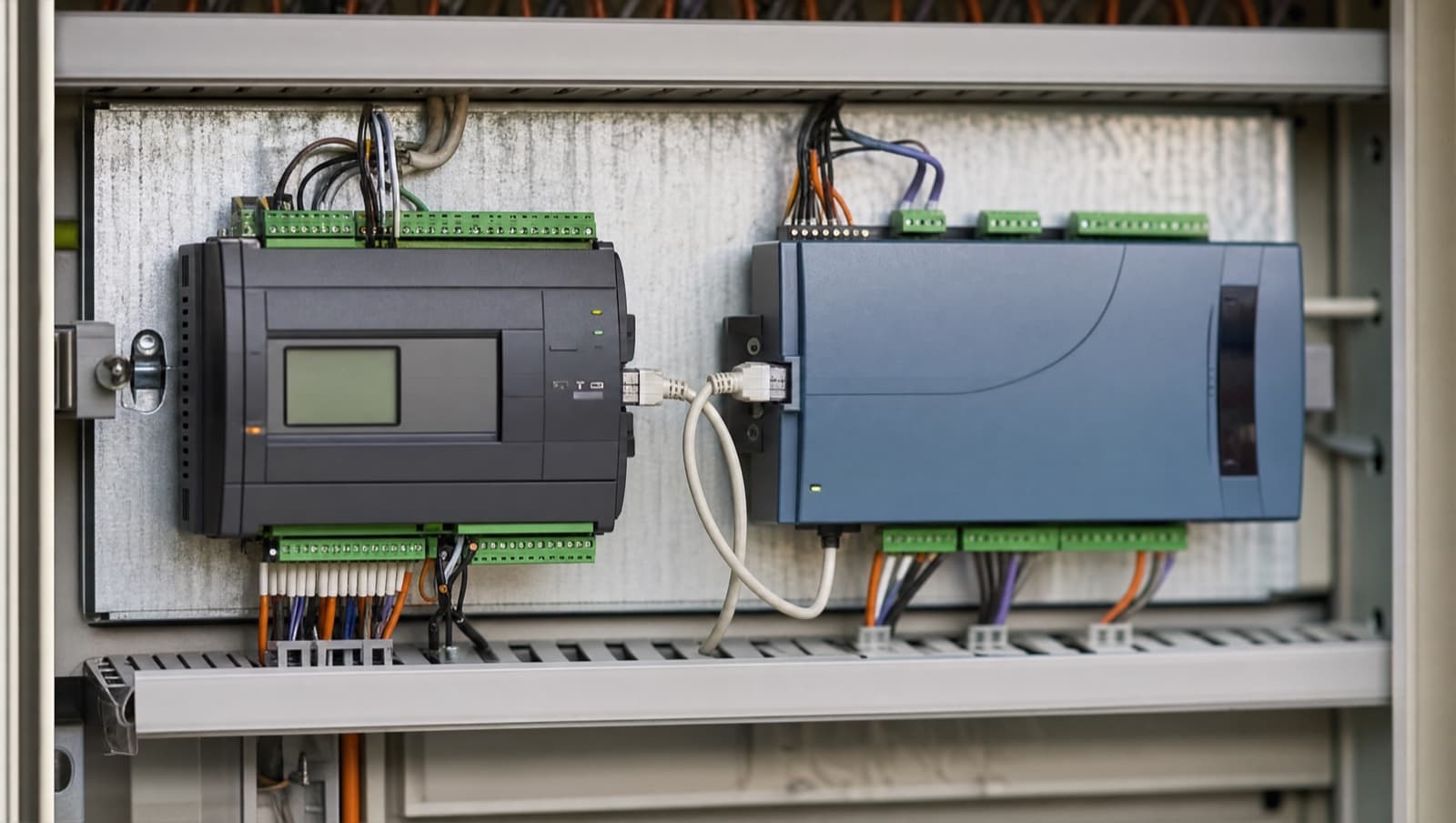
Most buildings do not need IoT sensors, AI analytics, or a digital twin to deliver energy savings and better comfort. A properly specified, commissioned, and maintained BMS has delivered those benefits since the 1990s. Smart building technology adds incremental value on top of working controls, not a replacement for a BMS that was never commissioned properly.
Every building services trade show for the past five years has had the same pitch: your building needs to be smart. It needs IoT sensors. It needs a digital twin. It needs an AI-powered analytics platform that uses machine learning to optimise energy consumption and predict equipment failures before they happen. It needs to connect to the cloud, generate dashboards, and integrate with your corporate workplace management system. And all of this will pay for itself through energy savings and improved occupant productivity.
There is some truth in that pitch. Some of those technologies genuinely deliver value in the right context. But here is what nobody at the trade show is telling you: most of the benefits attributed to smart building technology — energy reduction, comfort improvement, fault detection, optimised scheduling — are things that a properly specified and commissioned BMS has been able to do since the 1990s. The reason your building is not delivering those benefits is not that it lacks IoT sensors or AI analytics. It is that the BMS was poorly commissioned, has not been maintained, is running control strategies that were never tuned, and nobody on the FM team knows how to use it.
Before you spend six figures on a smart building overlay, it is worth asking a simpler question: is your existing BMS actually working properly? Because in our experience, the answer is usually no — and fixing the BMS delivers more value, faster, and at a fraction of the cost of bolting on new technology.
The term "smart building" has been stretched to cover everything from a thermostat with a Wi-Fi connection to a fully integrated digital twin with real-time simulation capabilities. In practical terms, the smart building technology stack typically includes several layers above the traditional BMS.
The first layer is additional sensing — IoT sensors for occupancy detection, air quality monitoring, light levels, desk usage, and other parameters that a traditional BMS might not measure. These sensors are typically wireless, battery-powered, and connected via protocols like LoRaWAN, Zigbee, or proprietary mesh networks rather than through the hardwired BMS infrastructure.
The second layer is a data integration platform that aggregates data from the BMS, the IoT sensors, the energy meters, the access control system, the lighting control, and potentially other building systems into a single database. This is sometimes called a smart building operating system or a building data platform.
The third layer is analytics — software that processes the aggregated data to identify patterns, detect faults, predict failures, optimise setpoints, and generate reports. This is where the AI and machine learning claims usually live.
The fourth layer is the digital twin — a virtual model of the building that reflects the real-time state of all systems and can be used for scenario modelling, commissioning simulation, and lifecycle management.
Each of these layers can add genuine value, but each also adds cost, complexity, and maintenance overhead. The question is not whether the technology works — it does — but whether the specific building needs it, and whether the same outcomes could be achieved more simply.
Buildings are under genuine pressure to reduce energy consumption, improve occupant experience, and demonstrate ESG credentials. The targets are real: the UK government's net zero by 2050 commitment, MEES regulations requiring minimum EPC ratings for commercial leases, BREEAM and WELL certifications demanded by premium tenants, and rising energy costs that make efficiency improvements commercially urgent.
The question is which investments actually deliver against those pressures, and which are technology for the sake of technology. This is where the distinction between a smart building and a well-controlled building becomes commercially important.
A well-controlled building — one with a properly specified, commissioned, and maintained BMS — will typically deliver 80 percent of the benefits attributed to smart building technology. Optimum start and weather compensation reduce heating energy by 15 to 25 percent. Demand-controlled ventilation based on CO2 reduces ventilation energy by 20 to 40 percent. Proper time scheduling ensures plant is not running when the building is unoccupied. Trend logging and alarm management enable the FM team to identify and fix faults before they become expensive problems. None of this requires IoT, AI, or a digital twin. It requires a competent BMS installation that is properly commissioned and actively managed.
The remaining 20 percent — the incremental benefit from smart building technology — tends to come from granular occupancy data (enabling more precise scheduling and space utilisation), cross-system integration (enabling scenarios like reducing HVAC and lighting in zones that access control shows are unoccupied), and predictive analytics (enabling condition-based maintenance rather than calendar-based maintenance). These are genuine benefits, but they are incremental improvements on a system that is already working well — not replacements for a system that is not working at all.
The most common mistake is installing a smart building platform on top of a dysfunctional BMS. The analytics platform connects to the BMS and immediately starts generating insights: the heating and cooling are running simultaneously, the AHU fresh air dampers are stuck in a fixed position, the optimum start is not working, and energy consumption is 200 percent above the design prediction. These are not insights that require AI to discover — they are basic commissioning failures that any competent BMS engineer would identify in a site visit. But because the smart building platform discovered them, the narrative becomes "the AI found these issues" rather than "the BMS was never properly commissioned."
The result is that the building owner pays for a smart building platform to tell them what they should already know, and then pays again to fix the underlying BMS issues that a proper commissioning process would have caught years earlier. The smart building platform did not add value — it added cost to a diagnosis that should have been routine.
The second common mistake is underestimating the integration complexity. Connecting a smart building platform to a BMS sounds straightforward, but in practice it requires mapping every BACnet or Modbus point to the platform's data model, configuring the polling intervals, setting up the analytics rules, and maintaining the integration as both systems are updated. If the BMS is a legacy system with limited BACnet exposure, the integration effort can be substantial. We have seen projects where the integration cost exceeded the cost of the analytics platform itself.
The third mistake is ignoring the ongoing operational cost. Smart building platforms typically require annual software licences, cloud hosting fees, and specialist support that the FM team cannot provide in-house. A BMS, by contrast, runs on local hardware with no recurring licence fees (or modest ones), and can be maintained by any competent BMS engineer. The total cost of ownership comparison over ten years often favours the BMS-only approach, even before you factor in the integration and maintenance overhead of the smart building layer.
The fourth mistake is treating the technology as a substitute for people. A smart building platform generates data, alerts, and recommendations — but someone still needs to act on them. If the FM team does not have the skills or the time to respond to the analytics output, the platform becomes expensive wallpaper. The most successful smart building implementations we have seen are in organisations that already have a strong FM team and a well-managed BMS, and are looking for incremental improvements — not organisations that are hoping the technology will compensate for operational shortcomings.
We'll assess your controls and provide a detailed quotation.
CIBSE Guide H, which covers building control systems, provides the definitive UK guidance on what a BMS should deliver. The capabilities it specifies — optimum start/stop, weather compensation, load-based control, night setback, demand-controlled ventilation, energy metering and monitoring, and alarm management — represent the baseline functionality that every commercial BMS should provide before any smart building technology is considered. If your existing BMS does not deliver these capabilities reliably, fixing it will produce more value than adding an IoT layer.
Approved Document L of the Building Regulations specifies the minimum controls requirements for building services, including time and temperature control, weather compensation on heating circuits, and metering of energy consumption. These requirements are met by a BMS — they do not require smart building technology. However, a smart building platform can help demonstrate ongoing compliance by providing continuous monitoring data and automated reporting.
CIBSE TM54 provides a methodology for evaluating operational energy performance and identifies the gap between design-stage predictions and actual consumption. The methodology works with BMS trend data — it does not require a smart building platform. If your BMS is logging the right data (energy meter readings, plant running hours, outdoor temperature, zone temperatures), you can carry out a TM54 assessment without any additional technology.
BS EN ISO 16484-5 (BACnet) is the integration standard that enables BMS data to flow to smart building platforms. If your BMS supports BACnet/IP and exposes its data points through standard BACnet services, integration with analytics platforms is relatively straightforward. If your BMS is a legacy system with proprietary protocols, integration will require gateways — and you should probably be upgrading the BMS first rather than adding an analytics layer on top of an obsolete system.
A property management company approached us about installing a smart building analytics platform across their portfolio of twelve commercial offices. They had been pitched a platform that would connect to every BMS in the portfolio, aggregate the data to a cloud dashboard, apply AI-driven fault detection, and generate monthly energy reports. The annual licence cost was substantial — high five figures — and the integration was quoted at several months of engineering time.
Before recommending for or against the platform, we carried out a BMS health check across four of the twelve buildings. What we found was consistent: BMS systems that were fundamentally sound but poorly maintained. Time schedules that had not been updated since pre-COVID occupancy patterns. Optimum start algorithms that had been disabled or never tuned. Weather compensation curves on default settings. Trend logging that was either not configured or had filled the storage and stopped recording. AHU economy cycles that were in manual override.
We recommended a different approach: spend the analytics platform budget on re-commissioning the BMS in each building, tuning the control strategies, updating the schedules, configuring the trend logging, and training the FM team. The total cost was approximately 40 percent of the analytics platform proposal, and the energy savings from re-commissioning delivered a payback within the first year. Some of the buildings may benefit from an analytics overlay in the future — but only once the underlying controls are working properly and the FM teams have the capability to act on the insights.
Almost every supplier in this market will tell you their platform integrates seamlessly with your BMS. The word doing the work in that sentence is "seamlessly", and it is worth making them define it before you sign anything. Integration is not one capability, it is three separate questions, and a vendor can be strong on one and useless on the others.
The first is protocol. Ask which protocols the platform speaks natively — BACnet/IP, BACnet MS/TP, Modbus TCP, Modbus RTU — and what happens when it meets something it does not. If the answer is a gateway, ask who supplies, configures and owns that gateway, because it becomes a piece of your infrastructure that somebody has to maintain for the next ten years.
The second is point mapping, and it is where the real cost hides. A platform that discovers BACnet objects and reads their names and units will map a building in a fraction of the time of one that needs every register entering by hand. Ask to see a point list from a comparable building and ask who produced it. On a Modbus-heavy estate — meters, inverters, packaged plant — this single question can be the difference between a week of commissioning and a month.
The third is what happens when you leave. Ask where the historical data lives, in what format you can export it, whether the graphics and control strategy remain usable without the vendor's licence, and what the system does if the cloud connection drops for a week. A platform that stops controlling the building when the internet fails is a monitoring product, not a control system — which may be fine, but you should know that before it is installed rather than during a broadband outage.
We deliberately do not publish a ranked league table of vendors here. The right answer depends on what is already in your plant rooms, and a recommendation made without knowing that is marketing rather than engineering. What we will do is sit down with your existing points list and tell you honestly which route is least painful for your building.
The right approach starts with the BMS. Before investing in any smart building technology, ensure that the existing BMS is properly commissioned, actively maintained, and delivering the control capabilities that CIBSE Guide H specifies. This includes verified optimum start, tuned weather compensation, working demand-controlled ventilation, accurate time schedules, functional trend logging, and a maintained alarm regime.
Once the BMS is delivering its full potential, evaluate the specific gaps that smart building technology could address. The gaps might be in occupancy sensing (if the BMS does not know how many people are in each zone), cross-system integration (if lighting, access control, and HVAC operate independently), predictive maintenance (if equipment failures are causing costly unplanned downtime), or portfolio-level reporting (if you manage multiple buildings and need aggregated performance data).
The evaluation should include total cost of ownership over at least five years, not just the capital cost. Include software licences, cloud hosting, integration engineering, specialist support, and the ongoing time commitment from the FM team to manage the platform. Compare this against the cost and benefit of investing the same budget in BMS improvements, re-commissioning, or FM team training.
Specify open standards — BACnet for BMS integration, standard APIs for analytics platforms, and data portability clauses in contracts. Avoid platforms that lock your building data into proprietary formats or require their hardware to access your own BMS data.
If you are being pitched a smart building platform and your BMS has not been re-commissioned in the last three years, pause. Commission a BMS health check first. The findings will either confirm that the BMS is working well and smart building technology could add incremental value, or they will reveal that the BMS has fundamental issues that should be fixed first. Either way, you will make a better-informed investment decision.
If your building is new and you are writing the specification, include the BMS control capabilities first and the smart building features second. A building that has excellent BMS controls and no IoT platform will outperform a building that has an IoT platform sitting on top of a mediocre BMS.
If you already have a smart building platform and it is generating alerts about BMS issues, do not renew the licence until you have fixed the BMS issues. The platform is telling you where the value is — in the controls, not in the analytics.
The smart building industry is not a scam — there are genuine technologies that add genuine value in the right context. But the value is incremental, not foundational. The foundation is a properly specified, properly commissioned, actively maintained BMS that delivers the control capabilities defined in CIBSE Guide H. Everything else is an enhancement.
If you are not sure whether your building needs smart technology or just better controls, Alpha Controls can help you find out. We carry out BMS consultations and energy audits that assess your existing controls, identify the gaps, and recommend the most cost-effective path to better building performance — whether that means re-commissioning the BMS, upgrading to a modern platform, or adding targeted smart building capabilities where they will actually pay back.
Get in touch or request a quote to discuss what your building actually needs.
Specialist BMS installation, commissioning, and maintenance across London and the South East. SafeContractor Approved, BCIA Member.
Our team of building automation specialists is ready to help you optimise your building's performance and efficiency.
Get in Touch