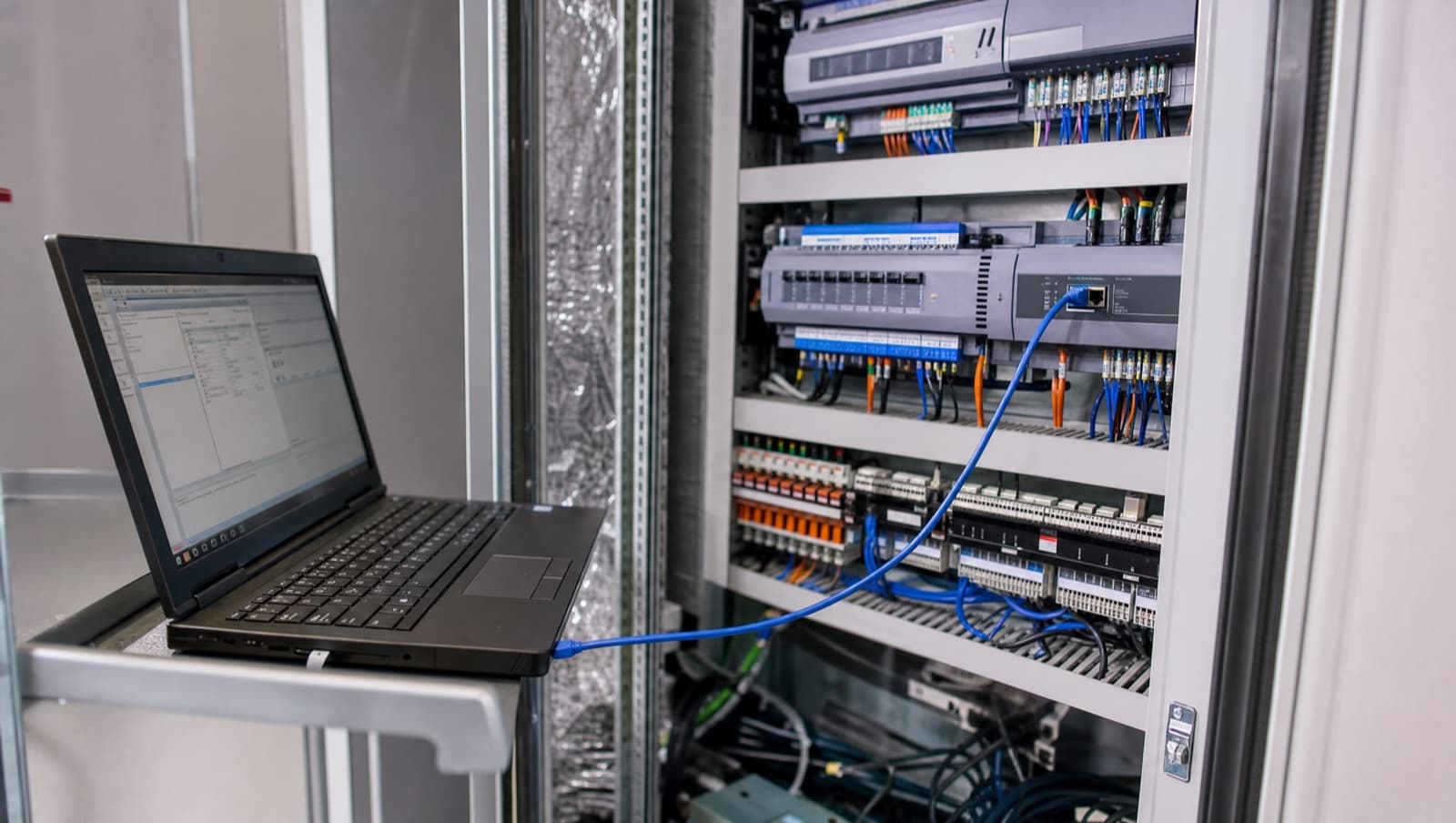

Most modern BMS installations use both BACnet and Modbus: BACnet (ASHRAE 135 / BS EN ISO 16484-5) for the controller network and supervisor communications, and Modbus (defined in BS EN 61158, developed in 1979 by Modicon) to integrate third-party plant such as chillers, boilers and variable speed drives that don't support BACnet.
BACnet vs Modbus: quick comparison
The short version, before the detail: Modbus is a simple register-based protocol that plant equipment speaks, and BACnet is a building-automation protocol designed to describe itself. That difference drives almost everything below. If you are weighing up the wider question of how open a system should be rather than choosing between these two, start with our guide to open protocol BMS systems.
| Modbus RTU / TCP | BACnet MS/TP, /IP, SC | |
|---|---|---|
| Standard | Modbus Organization spec | ASHRAE 135 / ISO 16484-5 |
| Physical layer | RS-485, or Ethernet for TCP | RS-485 for MS/TP, Ethernet for /IP |
| Data model | Numbered registers — no self-description | Named objects with properties and units |
| Device discovery | None — addresses and maps by hand | Who-Is / I-Am, devices announce themselves |
| Alarms, scheduling, trends | Not in the protocol — the BMS builds them | Native to the standard |
| Security | None built in | BACnet/SC adds TLS; MS/TP and /IP have none |
| Typical role | Meters, inverters, chillers, packaged plant | The BMS itself — controllers, field devices, supervisors |
| Commissioning effort | Higher — every register mapped manually | Lower — points discovered and self-labelled |
The practical consequence is that this is rarely an either/or on a real building. BACnet is what you specify for the BMS; Modbus is what you end up integrating because the meter, the booster set and the chiller only speak Modbus. A competent specification expects both and says who owns the register maps.
What is Modbus and where is it used in a BMS?
Modbus is the older of the two protocols, developed in 1979 by Modicon for industrial programmable logic controllers. It is simple, robust, and widely supported. It works on a master/slave model: one master device (typically a BMS controller) polls one or more slave devices in sequence, reading and writing register values. Almost every piece of mechanical plant — chillers, boilers, variable speed drives, UPS systems, generators, energy meters — supports Modbus RTU (over RS-485) or Modbus TCP (over Ethernet). Modbus is defined in BS EN 61158 as part of the fieldbus family of industrial communication standards.
The primary advantage of Modbus is universality. It is straightforward to implement, easy to debug in the field, requires no specialist hardware, and is reliable over long RS-485 cable runs. Where the register map is documented and the integration scope is simple, Modbus is often the lowest-friction option available — which is why it remains the default for connecting unfamiliar mechanical plant onto a building controller.
What are the limitations of Modbus on a BMS network?
Modbus has no built-in device discovery, no native alarm management, and no standard object model — the engineer must know which register holds which value for every device. Each manufacturer assigns register addresses differently, so integrating unfamiliar plant means obtaining and working from its specific register map, and the same physical parameter may sit at a completely different address on a different manufacturer's chiller. With no native alarm management, the master must continuously poll to detect that a fault bit has changed. The master/slave topology does not scale naturally beyond a single trunk. And there is no built-in security of any kind — any device on the RS-485 bus can read and write to any other, with no authentication whatsoever. Its simplicity is both its strength in simple applications and its limitation in complex BMS networks.
Get a Free BMS Survey
We'll assess your controls and provide a detailed quotation with energy savings estimates.
What is BACnet and why was it built for buildings?
BACnet (Building Automation and Control Networks) was developed specifically for building automation. It is formally defined in ASHRAE 135 — the standard developed by the American Society of Heating, Refrigerating and Air-Conditioning Engineers and adopted as BS EN ISO 16484-5 in Europe — and defines over 50 object types and multiple physical layer options including BACnet/IP, MS/TP, and BACnet over Ethernet. Published in 1995 and adopted as an ISO standard in 2003, it was designed to solve exactly the problems that make Modbus awkward for building control: interoperability between devices from different manufacturers, native alarm management, and a standardised object model. For a deeper dive into the BACnet standard and what open protocol really means in practice, see our article on what BACnet is and why open protocol matters for BMS.
BACnet devices expose data as objects with standard properties. A temperature sensor is an Analog Input object with a Present_Value property. A chiller's fault status is a Binary Input. Any BACnet-compliant supervisory platform can discover and read these objects without needing a custom register map.
What are the BACnet variants — BACnet/IP, MS/TP and BACnet SC?
BACnet operates in several variants suited to different parts of the system hierarchy. BACnet/IP runs over standard Ethernet networks and is used for controller-to-supervisor and controller-to-controller communications — the backbone of any modern BMS installation. BACnet MS/TP runs over RS-485 twisted pair and handles field-level connections to sensors, actuators, and smaller outstations where Ethernet infrastructure isn't practical. More recently, BACnet SC (Secure Connect) — defined in ASHRAE Addendum bj to Standard 135 — adds WebSocket transport with TLS encryption, providing the authentication and confidentiality that traditional BACnet/IP lacks; it is increasingly being specified on projects where cybersecurity is a formal requirement of the brief.
The advantage of BACnet for system-level communications is substantial. A BACnet supervisor can discover devices automatically, read standard objects without a bespoke register map, and receive alarms and events natively rather than having to poll for fault states. A building running controllers from different manufacturers — Trend IQ4s alongside Distech ECBs and a third-party metering gateway — can appear on the same supervisory platform if all are BACnet-compliant, without custom protocol translation between them. The standard is actively maintained: BACnet SC directly addresses the security concerns that have made traditional BACnet/IP a liability on networks with any internet exposure. For how BACnet sits alongside Modbus and SNMP in a critical facility, and what has to be tested before go-live, see our data centre BMS integration guide.
What are the downsides of BACnet?
The trade-off is complexity. BACnet requires a properly configured IP network — sensible VLANs, correct subnetting, a network that has been designed rather than grown organically over years of adds and changes. Engineers new to BACnet face a steeper learning curve than Modbus. And at the field device level, Modbus remains more universal — virtually any variable speed drive, chiller, or meter supports Modbus RTU; BACnet support at that level is more variable and not universal.
BACnet or Modbus: which protocol should you use for each job?
In practice, most modern BMS installations use both — BACnet for the main controller network and supervisor communications, and Modbus to integrate third-party plant that doesn't support BACnet. The breakdown by use case:
- Controller-to-supervisor communications — BACnet/IP.
- Controller-to-field device (sensors, small outstations) — BACnet MS/TP.
- Integrating chillers, boilers, VRF systems — Modbus RTU or TCP (check manufacturer data).
- Variable speed drives — Modbus RTU (universal support).
- Energy meters — Modbus TCP or BACnet/IP (both widely supported).
- Multi-site estate monitoring — BACnet/IP over VPN.
- Legacy system integration — Modbus or protocol gateway to BACnet.
What goes wrong when BMS protocols are specified badly?
The most common mistake Alpha Controls encounters is a BMS specification that says "open protocol" without stating which protocol at which network level. The contractor installs BACnet-compliant controllers that support BACnet on the field bus, but runs a proprietary protocol on the trunk — and technically meets the specification, because the field devices are open, even though the core of the system stays locked. The specification needs to state BACnet/IP on the trunk, BACnet MS/TP or BACnet/IP on the field bus, and a supervisor that connects via native BACnet, not via a proprietary wrapper with a BACnet gateway on the side. CIBSE Guide H recommends BACnet as the primary communication protocol for building control systems and explicitly addresses this partial-compliance risk, recommending that the specification require BACnet at all network levels, verified by BTL listing.
The second mistake is using Modbus for everything because it's simpler and cheaper. A BMS where the controllers, the supervisor and all the integrated devices communicate via Modbus RTU will work — but it will be slow (polling-based, sequential, limited by the RS-485 bus speed), fragile (a single device with a communication fault can stall the entire bus), and undocumented (register maps get lost, scaling factors get forgotten, nobody remembers which register holds which value). For a small single-building system with ten or twenty devices this is manageable; for a multi-building campus or a complex commercial building it becomes an operational burden that grows with every system extension.
The third mistake is failing to specify the Modbus register map as a deliverable. When a Modbus device is integrated into a BMS, the register map — the complete list of register numbers, data types, scaling factors and descriptions — must be documented and handed over as part of the O&M documentation. Without it, the next contractor cannot maintain the integration and the building owner is dependent on the original integrator for any modification. Alpha Controls includes the register map in every project handover, but we routinely find previous contractors have not — which means engineering time spent reverse-engineering register maps that should have been documented at commissioning.
How do you integrate LON, KNX and proprietary protocols?
Older buildings may have LON (LonWorks) or proprietary protocols from Johnson Controls, Honeywell, or Satchwell. These are generally harder to integrate with modern BMS platforms and often require protocol gateway hardware to bridge them onto BACnet or Modbus. The gateway approach works well but adds cost and a potential single point of failure — which is why legacy system migrations to open protocol platforms are increasingly common.
What are the key BACnet MS/TP installation rules?
BACnet MS/TP is the most common source of field-level BMS problems. The key installation requirements that are often missed:
- Daisy-chain topology only — star wiring causes reflections and communication errors. The trunk must run device-to-device in a single chain.
- End-of-line resistors — 120Ω resistors must be fitted at both ends of the trunk, and nowhere else. Missing or extra resistors cause intermittent failures. For a full guide to EOL resistor placement and supervised inputs, see our article on end-of-line resistors and VAV termination in BMS systems.
- Correct cable — use Belden 9841 or equivalent twisted-pair screened cable. Standard alarm cable will cause problems on longer trunks. All field wiring for BMS communication networks — RS-485 screened twisted pair for Modbus and BACnet MS/TP, structured cabling for BACnet/IP — must comply with BS 7671:2018 (the IET Wiring Regulations) for cable selection, segregation from power wiring, and earthing.
- Max baud rate vs trunk length — 76,800 bps trunks should not exceed 300m. At 38,400 bps you can extend to 1,200m.
- Polarity — RS-485 is polarity-sensitive. Reversed polarity on even one device will take down the entire trunk.
Alpha Controls tests all MS/TP trunks for impedance and topology before commissioning and documents end-of-line resistor positions on as-built drawings. See our BMS networking service for full detail.
How do you secure a BACnet/IP network?
BACnet/IP networks should be on a dedicated VLAN segregated from general IT traffic. Legacy BACnet has no built-in authentication — any device on the network can read and write to any BACnet device. BACnet SC (Secure Connect) resolves this for new installations, but most buildings are running standard BACnet/IP and rely on network segmentation as their primary security control. For a comprehensive look at BMS network vulnerabilities and how to address them, see our article on BMS cybersecurity.
Need help designing or troubleshooting your BMS network? Contact Alpha Controls — we design and install BACnet/IP and MS/TP networks across London and the South East.
Alpha Controls Team
Specialist BMS installation, commissioning, and maintenance across London and the South East. SafeContractor Approved, BCIA Member.