
A standard commercial BMS does not work for a data centre because it is built to maintain office comfort from a single room temperature reading, not to manage hot and cold aisles, uneven rack loads, and precision cooling. Data centres need per-aisle sensing, ASHRAE-based alarm thresholds, and integrated power and cooling monitoring or they offer no real protection.
A small colocation facility in East London — six rows of racks, two rooms, around 200kW of installed IT load — had a standard commercial BMS installed during the building fit-out. The system monitored overall room temperature from a single sensor mounted near the precision cooling unit return air. The CRAC unit ran on a fixed setpoint. There were no rack-level sensors, no hot aisle monitoring, and no alerts configured for the differential between supply and return air. When one of the CRAC units developed a compressor fault and lost 60% of its cooling capacity, the BMS registered a 2°C rise in room temperature — within tolerance for the setpoint it was watching. No alert fired. Forty minutes later a server row shut down on thermal protection. By then two further rows were approaching hardware limits.
The hardware and software weren't the problem. The problem was that a system designed to maintain 21°C comfort in an open-plan office was being used to manage a data centre environment where the core assumption — that a single room temperature reading represents the space — is fundamentally wrong. Data centres have hot and cold aisles, dense and uneven rack loads, complex airflow paths, and failure modes that a commercial office never encounters. The BMS strategy has to reflect that or it provides no meaningful protection.

Why won't a standard office BMS work in a data centre?
In a commercial office, the BMS is a comfort system. Temperature tolerances are wide — occupants are comfortable anywhere between 20°C and 25°C, a brief excursion is inconvenient but not damaging, and recovery time is measured in minutes. Equipment damage from temperature events simply doesn't happen at those ranges.
In a data centre the tolerances are tighter, the stakes are higher, and the thermal behaviour of the space is more complex. ASHRAE TC 9.9's thermal guidelines for IT equipment set the A2 class allowable inlet temperature range at 10°C to 35°C with a rate-of-change limit. The closer you operate to the upper bound, the less margin you have for any cooling system degradation before hardware starts to throttle or shut down on thermal protection. More critically, the temperature in a data centre is not uniform. Hot exhaust air leaving the rear of a rack at 45°C or more mixes with supply air through paths that depend on containment strategy, floor tile placement, and rack loading density. A single room sensor tells you almost nothing about whether individual racks are receiving adequate cooling. The same principles apply to a server room or comms room at smaller scale: the sensing has to describe the air the equipment actually draws, not the air in the middle of the room.
What should a data centre BMS actually monitor?
A properly specified data centre BMS monitors at multiple levels simultaneously. At room level: supply and return air temperatures from each precision cooling unit, room differential pressure relative to adjacent spaces, and humidity within the ASHRAE allowable range. At aisle level: temperature at multiple heights — low, mid, and top of rack — on both the cold aisle supply side and the hot aisle return side. At individual cooling unit level: run status, fault status, compressor current and operating capacity, and for variable-speed units, fan speed and differential pressure across the coil.
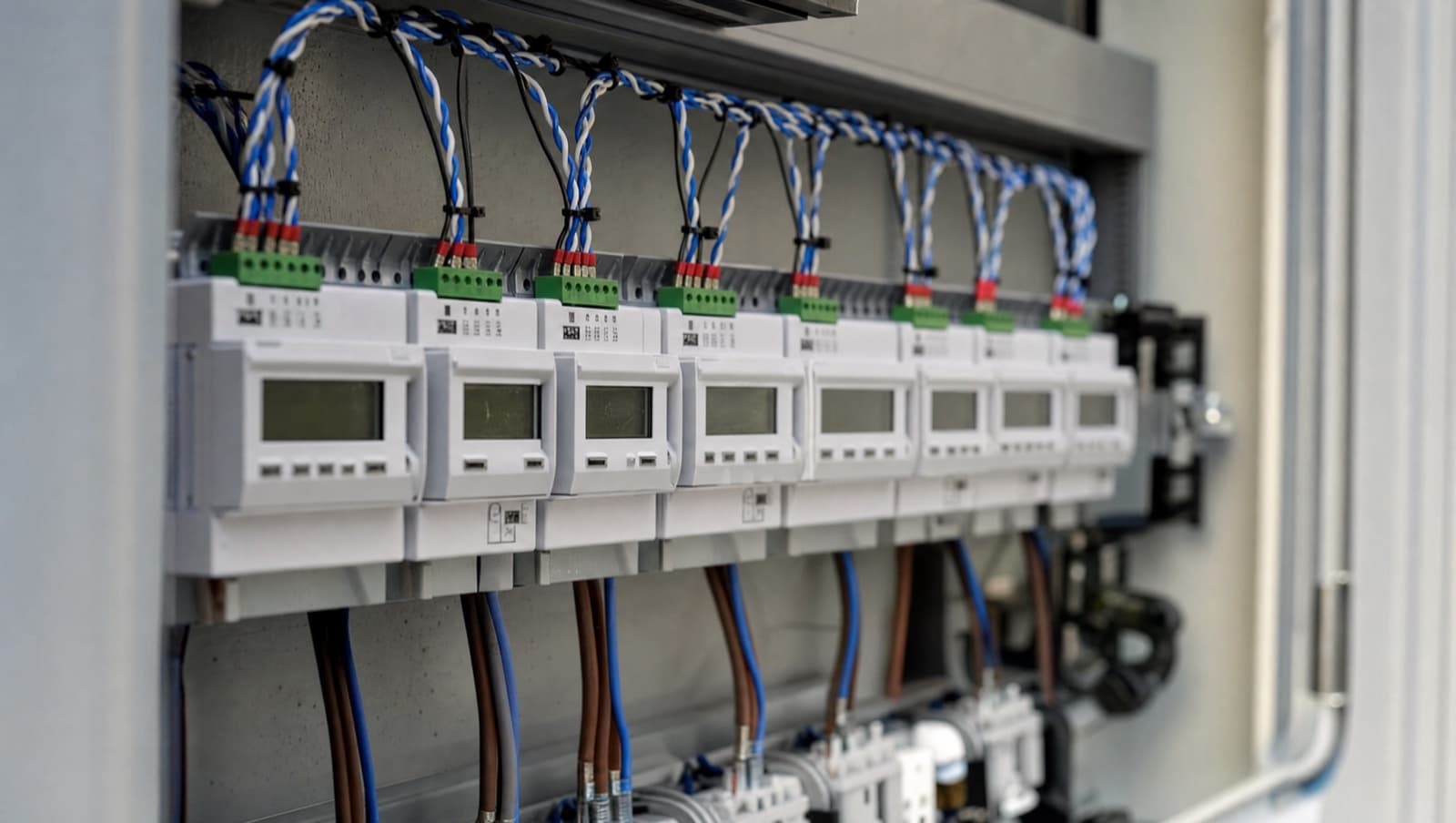
Beyond cooling, a data centre BMS should integrate with the electrical infrastructure — UPS status and battery health, generator run status and fuel level, static transfer switch position, PDU load monitoring per circuit, and earthing system alarms. In a Tier III or Tier IV facility, maintaining full situational awareness across power and cooling simultaneously is necessary to identify conditions where a second fault would cause an outage. A BMS that knows cooling status but not UPS battery state, or electrical load but not aisle temperature, is operating blind on half of the critical failure landscape. Getting UPS, PDU and generator data onto the same system as the cooling is protocol work as much as anything else — our data centre BMS integration guide covers BACnet, Modbus and SNMP and what has to be tested.
What do the Uptime Tiers and EN 50600 require?
The Uptime Institute Tier standard doesn't prescribe specific BMS configurations directly, but Tier III certification (concurrent maintainability) and Tier IV certification (fault tolerance) both require monitoring comprehensive enough to detect degraded operation before it becomes a failure, and control systems capable of routing around a failed component without human intervention. A BMS that only alarms on total failure cannot support a Tier III operational model — by the time the alarm fires, the facility may already be in a state where a second fault causes an outage.
EN 50600 — the European standard for data centre facilities and infrastructure — includes environmental monitoring requirements under its availability and physical security sections. Part 2-4, which covers environmental control, defines monitoring parameters that go significantly beyond a standard commercial BMS configuration. For data centres subject to ISO 27001 certification, the environmental monitoring records generated by the BMS feed directly into physical infrastructure controls evidence. Gaps in environmental monitoring are a finding in any serious audit. Data centre BMS networks are also high-value targets for cyberattack given the critical nature of the infrastructure they control — for a guide to BMS network security and the mitigations that matter most, see our article on BMS cybersecurity.
ASHRAE A2 is the thermal envelope most enterprise server hardware is rated to. Operating consistently close to the 35°C inlet limit shortens hardware life and means that partial cooling failure tips equipment into thermal protection shutdown with little warning. A well-configured BMS should alarm at a threshold well below the ASHRAE limit — 28°C to 30°C on the hot aisle return is a common trigger point — not at the limit itself. When the BMS fires at 34°C, you're already in the failure window.
Get a Free BMS Survey
We'll assess your controls and provide a detailed quotation.
How does a BMS control strategy affect PUE and energy cost?
Power Usage Effectiveness — total facility power divided by IT equipment power — is the primary energy efficiency metric for data centres. A PUE of 1.0 is theoretical perfection. UK commercial colocation averages around 1.45–1.55. Hyperscale cloud facilities run at 1.1–1.2. The cooling system accounts for the majority of non-IT power consumption in most data centres, and it's where BMS control strategy has the most direct impact on energy cost.
A BMS running CRAC units at fixed supply temperature setpoints regardless of actual IT load is wasting energy during low-utilisation periods. Variable-speed CRAC units controlled to maintain a defined return air temperature — rather than a fixed supply temperature — can reduce cooling energy by 20–40% by allowing setpoints to rise when IT load and heat rejection are lower. Economiser modes, where outside air is used for free cooling when ambient conditions permit, can be enabled by the BMS based on external temperature and humidity readings. These optimisations require a BMS that understands the relationship between IT load, cooling capacity, and energy consumption — not one that simply asks whether the room is above a threshold. For detail on how energy sub-metering integrates with a BMS to enable PUE tracking and consumption analysis, see our article on energy metering and sub-metering.
What usually goes wrong with a data centre BMS?
The most common BMS failures in data centre environments are: insufficient sensor density — a single room temperature sensor rather than per-aisle monitoring; alarm thresholds set to comfort ranges rather than thermal protection limits; no alarm escalation — events logged but with no automated notification path to on-call staff out of hours; CRAC units running on fixed setpoints with no load-following optimisation; and BMS and power monitoring operating as entirely separate systems with no integration between them.
A specific failure mode in smaller facilities and edge deployments is the "commissioned and forgotten" CRAC unit — configured at installation, with no ongoing BMS oversight of its performance parameters. Degrading refrigerant charge, accumulating coil fouling, and fan bearing wear all reduce cooling capacity gradually in ways that are invisible to a BMS monitoring only room temperature against a single setpoint. By the time the capacity loss is large enough to register on the room sensor, the remaining margin may be too small to absorb a secondary event. Monitoring supply-to-return temperature differential, coil pressure drop, and compressor current over time catches this degradation early.
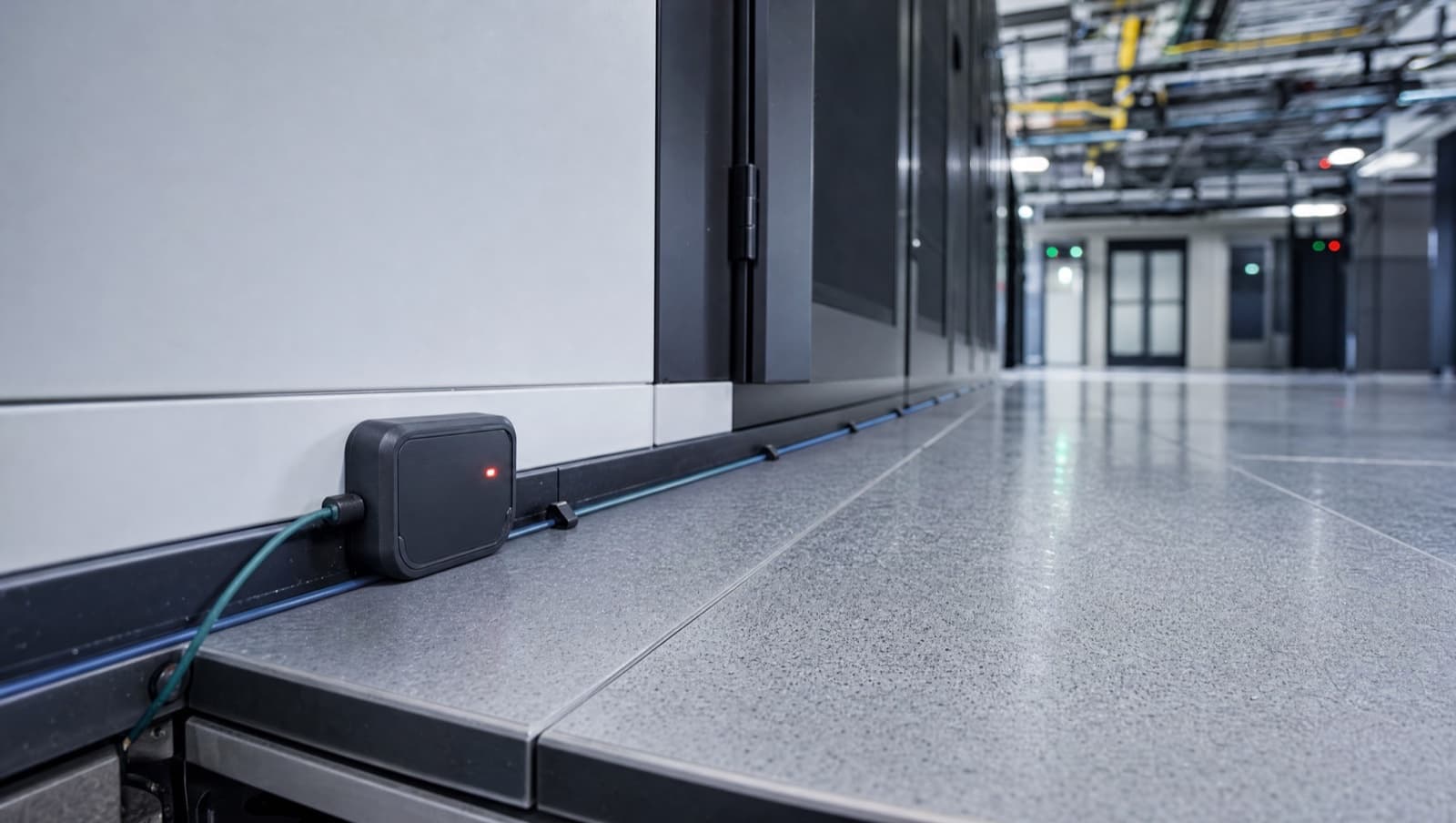
The other gap worth naming is water. Chilled water, condenser water and condensate all run in the same space as the IT equipment, and a leak under a raised floor is usually invisible until it has done its damage. Detection is only half of it: the BMS should be able to act, closing motorised isolation valves on the chilled-water circuit serving the affected zone so the volume of water at risk is limited to that zone rather than the whole floor. That means the valves have to be on the BMS in the first place, and the interlock has to be tested. Our data centre leak detection guide covers the sensing design, and alarm management covers why a leak alarm is never left to queue behind a filter reminder.
What does a well-specified data centre BMS look like?
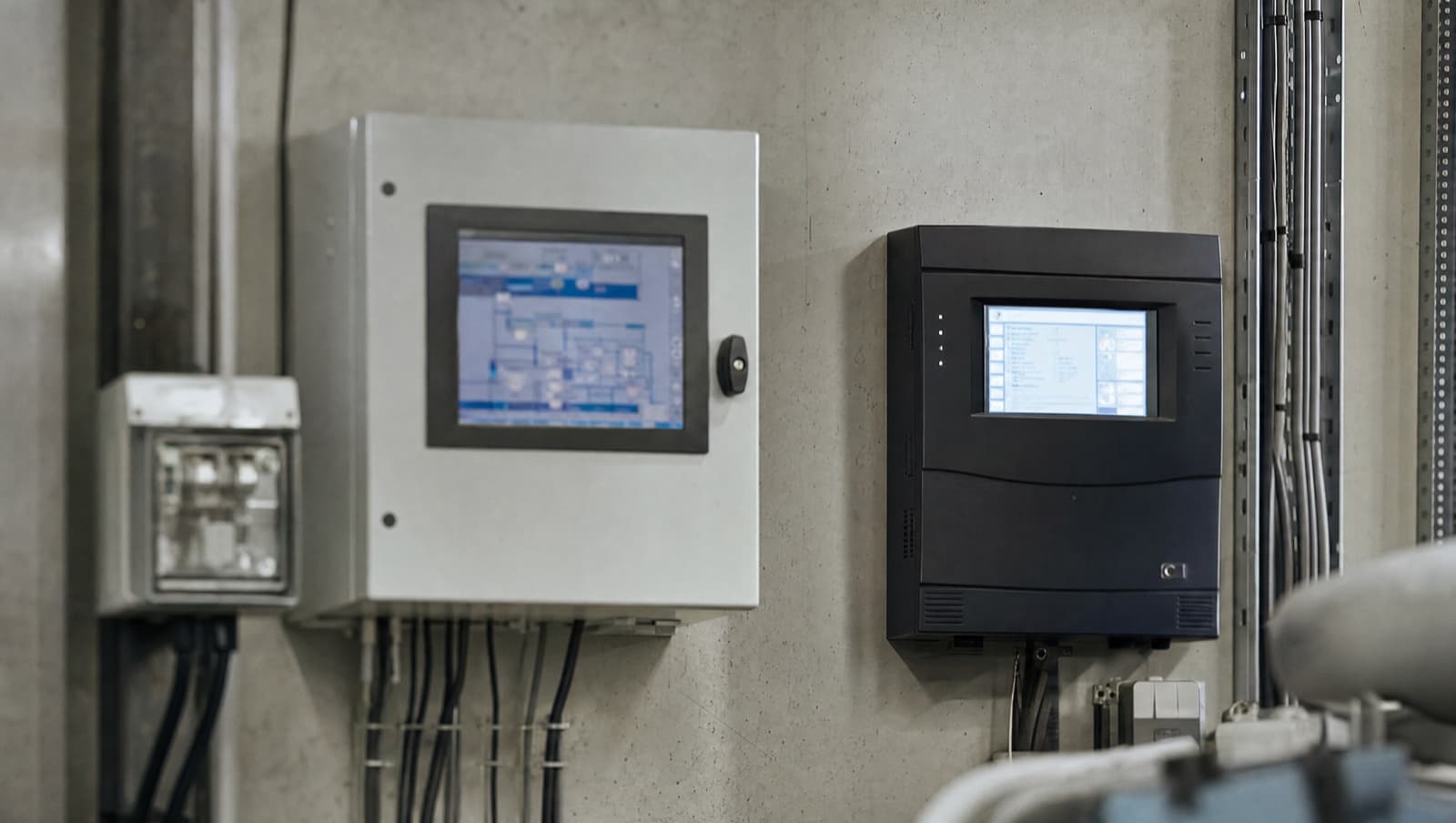
A well-specified data centre BMS covers environmental monitoring at aisle and rack level, with alarm thresholds set conservatively below equipment limits. It integrates cooling and power monitoring so that the status of all critical systems is visible from a single interface. Alarm escalation workflows include notification paths to mobile devices for out-of-hours coverage, and the trend data feeds whatever the operations team runs above it — a DCIM platform such as Nlyte, Sunbird or Vertiv TRELLIS usually takes BMS data over a REST API, SNMP or BACnet/IP alongside its own asset and capacity records. Control strategies for CRAC units are optimised rather than fixed — setpoints adjust to actual load conditions, economiser modes are enabled where equipment supports it, and the BMS logs performance data that can be used to identify degrading units before failure.
For facilities with multiple precision cooling units, load sharing distributes cooling load evenly across available units so that no single unit runs at capacity while others are underloaded. This extends equipment life and means a single-unit failure doesn't immediately exhaust remaining cooling capacity. Concurrent maintainability — the ability to take a unit offline for planned maintenance without the overall system entering a reduced-capacity state — requires a BMS that understands system-level cooling margin, not just individual unit status.
That margin usually comes from N+1 cooling: one more precision cooling unit than the IT load strictly needs. N+1 is a design intent, not a control strategy, and the BMS is what turns one into the other. Three behaviours do the work. Run-hour equalisation rotates the active and standby designation between units on a schedule, typically weekly, so every unit accumulates similar hours and the standby is exercised often enough that it will actually start when it is called on. Automatic failover starts that standby the moment an active unit faults, and the changeover has to complete before room temperature climbs towards its alarm threshold, which is a sequencing problem rather than a capacity one. Cascade sequencing then adds and removes units as the IT load moves, holding supply temperature while keeping the running units near their best part-load efficiency. A standby that has sat untouched for a year is redundancy on the drawing, not in the room.
When should you review your data centre BMS?
If your facility is running with a standard commercial BMS that was specified as part of a building fit-out rather than designed for a data centre environment, it is worth reviewing what it actually monitors and how alarms are configured. The hardware may well be capable — the question is whether the configuration, sensor placement, and control strategies are appropriate for precision cooling and continuous availability rather than office comfort.
Alpha Controls works with colocation operators, enterprise data centre teams, and commercial landlords with on-site data centre space across London and the South East. We carry out BMS configuration reviews, sensor upgrade projects to increase monitoring density, and integration work between BMS, DCIM platforms, and power monitoring systems. Our cooling-tower fan replacement and BMS control upgrade at a live data centre in Park Royal shows the kind of work involved. Contact us to discuss your requirements, or request a quote if you have a specific project in mind.
Alpha Controls Team
Specialist BMS installation, commissioning, and maintenance across London and the South East. SafeContractor Approved, BCIA Member.