Trend is the most widely installed BMS platform in the UK, and its IQ range spans three decades of hardware. The legacy IQ1 and IQ2 controllers are past end of life and need replacing. The IQ3 series is approaching end of life. IQ4, launched in 2018, is the current platform, supervised by IQ Vision.
"Trend BMS" covers a range of hardware spanning three decades, from the legacy IQ1 and IQ2 controllers that are now well past end of life, through the IQ3 series that dominated installations from the mid-2000s to the mid-2010s, to the current IQ4 and IQ Vision platforms. Trend is the most widely installed BMS platform in the UK, found in offices, schools, hospitals, universities, retail parks and data centres. The UK support ecosystem of trained integrators, spare parts suppliers and service engineers is deeper than for any competing platform. Understanding where your building sits in this range is the starting point for any maintenance, upgrade, or expansion decision.
The IQ1 and IQ2 controllers were Trend's original digital controllers, installed from the late 1980s through to the early 2000s. If your building still has IQ1 or IQ2 hardware, you're running equipment that Trend no longer supports with spare parts, software updates, or technical assistance. The IQ2 used RS-232 serial communications and Trend's proprietary protocol, so it cannot be integrated with modern BACnet systems without protocol translation gateways, and finding engineers who can program these controllers is increasingly difficult. The practical message is straightforward: IQ1 and IQ2 systems need replacing. There's no upgrade path, because the hardware architecture is fundamentally different from the IQ3 and IQ4 platforms. The good news is that the field wiring (sensors, actuators, cabling) can usually be reused when the controllers are replaced, which significantly reduces the cost compared to a full new installation.
The IQ3 series, including the IQ3xcite, IQ3, and IQ3NT controllers, was Trend's mainstream platform from approximately 2005 to 2018. It introduced Ethernet networking, web-based supervisors (the 963 supervisor), and significantly more processing power than the IQ2 range, and the IQ3xcite brought BACnet support, enabling integration with third-party systems for the first time. Many IQ3 systems are still running well across London and the South East. However, Trend has signalled that the IQ3 platform is approaching end of life: spare parts availability is declining, and new features and security updates are focused entirely on the IQ4 platform. The IQ3's 963 web supervisor runs on an embedded processor with limited memory and no support for modern security protocols like TLS 1.2, which is becoming a problem as IT departments tighten network security requirements. If your IQ3 system is working well, there's no immediate urgency to replace everything. But if you're planning expansion, adding new plant, or facing hardware failures, specifying IQ3 replacements is no longer viable; new installations should use IQ4 hardware. For a building-wide strategy, the typical approach is a phased migration from IQ3 to IQ4 over 3 to 5 years, replacing controllers as part of planned maintenance or when failures occur.
Trend IQ3 servicing is still available through Trend's network of system integrators. Alpha Controls maintains IQ3 systems across London, Kent, Surrey, and the wider South East, including software updates, controller replacements, sensor recalibration, and network diagnostics. If you need ongoing support for an IQ3 system, get in touch.
The IQ4 range is Trend's current controller platform, launched in 2018 and now well established across new installations and upgrade projects. The key improvements over the IQ3 are significant: native BACnet/IP support as standard (compliant with BS EN ISO 16484-5), a modern ARM processor with substantially more memory, support for encrypted communications (TLS 1.2/1.3), and compatibility with Trend's IQ Vision web-based supervisor. The range includes several models for different applications. The IQ4E is the standard plant controller, handling AHUs, boilers, chillers, and general HVAC applications with configurable I/O. The IQ422 is Trend's dedicated unitary controller, designed for high-volume applications like FCUs, VAV boxes, and heat pump units where you need a compact, cost-effective controller for each terminal unit. The IQ412 is a mid-range option for smaller plant rooms and standalone applications. Programming is done through Trend's SET (System Engineering Tool) software, significantly updated for the IQ4 platform with a more modern interface, improved simulation, and better diagnostics. Engineers familiar with IQ3 programming will find IQ4 familiar in concept but materially better in practice: strategies compile faster, diagnostics are clearer, and remote access for fault-finding is more reliable.
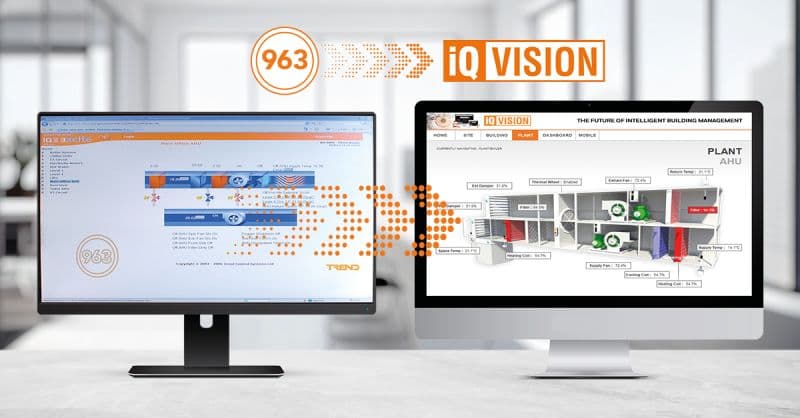
IQ Vision is Trend's current web-based supervisor platform, replacing the older 963 supervisor. It runs in a standard web browser with no plug-ins required, provides responsive graphics that work on tablets and smartphones, supports multi-site management, and includes built-in energy dashboards, alarm management, and trend logging. IQ Vision can supervise both IQ4 and IQ3 controllers, making it a useful first step in a phased upgrade: you can replace the 963 supervisor with IQ Vision while keeping the existing IQ3 field controllers, improving the user interface and remote access without touching the plant control. When the IQ3 controllers are later replaced with IQ4 units, the IQ Vision supervisor is already in place.
Trend's strength in the UK market is the combination of a deep installed base, a large network of trained integrators and service engineers, strong spare parts availability, and a well-understood technology that FM teams and building managers are familiar with. For straightforward commercial buildings, offices, retail, education and healthcare, where the priority is reliable, maintainable HVAC control with good local support, Trend is a strong default choice. Where Trend is less strong is in heavily IT-integrated buildings where the client wants REST API access, cloud analytics, or deep integration with smart building platforms. Distech's ECLYPSE series and Schneider's EcoStruxure platform are more IT-native in their architecture, with RESTful APIs and cloud connectivity built in rather than bolted on. For buildings where the IT team is heavily involved in operations, these platforms may be a better fit. For a detailed comparison, see our guide to Trend vs Distech vs Siemens BMS systems.
Trend doesn't sell directly to end users; all sales, installation, and commissioning go through their network of authorised system integrators (formerly called Trend Control Partners). When choosing a Trend integrator in London or the South East, the same principles apply as for any BMS contractor: look for controls engineering competence, documented commissioning processes, platform experience, and FM references from buildings they've installed and maintained. CIBSE Guide H: Building Control Systems emphasises that the competence of the installing contractor is as important as the platform selection; a well-commissioned Trend system will outperform a poorly commissioned alternative platform every time. The controls strategy, the commissioning quality, and the ongoing maintenance regime determine real-world performance far more than the choice of hardware.
We'll assess your controls and provide a detailed quotation.
Maintaining a Trend BMS system involves several layers. At the hardware level: regular inspection of controllers for failed indicators, checking communication status across the network, verifying power supply voltages, and inspecting field wiring for damage. At the software level: reviewing and backing up controller strategies, checking that time schedules are correct (especially after clock changes and bank holidays), verifying sensor calibration by spot-checking BMS readings against portable instruments, and reviewing alarm configurations to ensure they're still relevant. SFG20, the industry-standard maintenance specification for building services, provides detailed task schedules for BMS maintenance, including controller health checks, network communication audits, sensor calibration verification, and software backup procedures. A maintenance contract aligned with SFG20 gives you an auditable, defensible maintenance regime rather than one built on whatever the engineer feels like checking on the day.
For Trend-specific maintenance, the key tasks that get missed are: strategy backups (if a controller fails and there's no backup, the replacement needs reprogramming from scratch), network health monitoring (BACnet communication errors that degrade slowly are easy to miss until they cause a system failure), and 963/IQ Vision supervisor updates (the web interface is the main user touchpoint and needs regular attention to security patches and performance).
The decision to upgrade a Trend BMS system is usually driven by one of four triggers: hardware failure (controllers failing with no spare parts available), performance gaps (the existing system can't deliver the control strategies needed for energy efficiency or comfort), IT security requirements (older systems with no encryption can't meet modern network security policies), or expansion (new plant or building areas that need integration with the existing BMS). For buildings running IQ3 systems, the most cost-effective approach is usually a phased upgrade: replacing the supervisor first (963 to IQ Vision), then migrating controllers floor by floor or plant room by plant room over 2 to 5 years, reusing existing field wiring wherever possible. This spreads the capital cost across multiple budget years and allows the building to remain fully operational throughout.
Alpha Controls is an authorised Trend system integrator delivering installation, commissioning, maintenance, and upgrades across London and the South East. If you're running a Trend system and need support, whether that's routine maintenance, fault diagnosis, or planning a migration from IQ3 to IQ4, get in touch or request a quote.
Specialist BMS installation, commissioning, and maintenance across London and the South East. SafeContractor Approved, BCIA Member.
Our team of building automation specialists is ready to help you optimise your building's performance and efficiency.
Get in Touch