
Off-site BMS panel manufacturing means designing, building, wiring, and testing a control panel in a controlled workshop before it reaches site. It removes the dust, cramped conditions, and programme delays of on-site build, delivering pre-wired, pre-tested panels. The result is better quality, faster commissioning, and lower total project cost.
What does BMS panel manufacturing actually involve?
A BMS panel is the physical enclosure that houses the controller, the power supplies, the terminal blocks, the relays, and the interface hardware that connects the BMS to the mechanical plant. In simple terms, it's the brain of the system in a steel box. But "simple" undersells the engineering involved.
A typical AHU control panel might contain a Trend IQ4E controller, a 24V AC transformer for field device power, relay outputs for fan contactors, analogue output modules for VSD speed control, surge protection devices, and several rows of terminal blocks for connecting the field wiring — temperature sensors, humidity sensors, pressure switches, damper actuators, valve actuators, and status signals from the AHU's safety chain. That's easily 60–80 individual cable terminations in a single panel, each of which needs to be correct, labelled, and tested.
For motor control centres (MCCs), the complexity steps up considerably. An MCC might include direct-on-line starters, star-delta starters, or variable speed drives for multiple pumps and fans, along with the BMS interface hardware. Each motor circuit needs overload protection, isolation, and control wiring — and all of it needs to comply with BS EN 60204-1, the standard for safety of machinery electrical equipment, which sets requirements for circuit protection, wire sizing, clearances, and labelling.
Why does off-site panel manufacturing matter on real projects?
The fundamental advantage of off-site panel build is control. In a workshop, you have proper bench space, good lighting, clean conditions, and access to all the tools and test equipment you need. Cable routes inside the panel are planned and executed neatly — cable duct runs are straight, ferrules are crimped consistently, and every connection is torque-checked. Compare that to a site where the electrician is working in a temporary enclosure with a head torch, and the quality difference is obvious.
Programme is the other major factor. On-site panel build is sequential — you can't start wiring until the enclosure is mounted, you can't mount the enclosure until the builder's work is done, and you can't commission until the wiring is complete. That puts the BMS on the critical path of every other trade. Off-site manufacturing decouples the panel build from the site programme. While the builder is finishing the plant room and the M&E contractor is installing ductwork and pipework, the BMS panels are being built and tested in the workshop. When the site is ready, the panels arrive pre-wired, pre-tested, and ready to connect. Instead of three weeks of on-site panel build, you're looking at two days of panel mounting and field wiring termination.
BSRIA BG 11/2010 — the Soft Landings framework — emphasises that off-site manufacture and factory testing reduce commissioning time and improve handover quality. The principle is straightforward: the more work you can do in controlled conditions, the fewer defects you introduce on site, and the faster you get to a working system.
What usually goes wrong with on-site panel build?
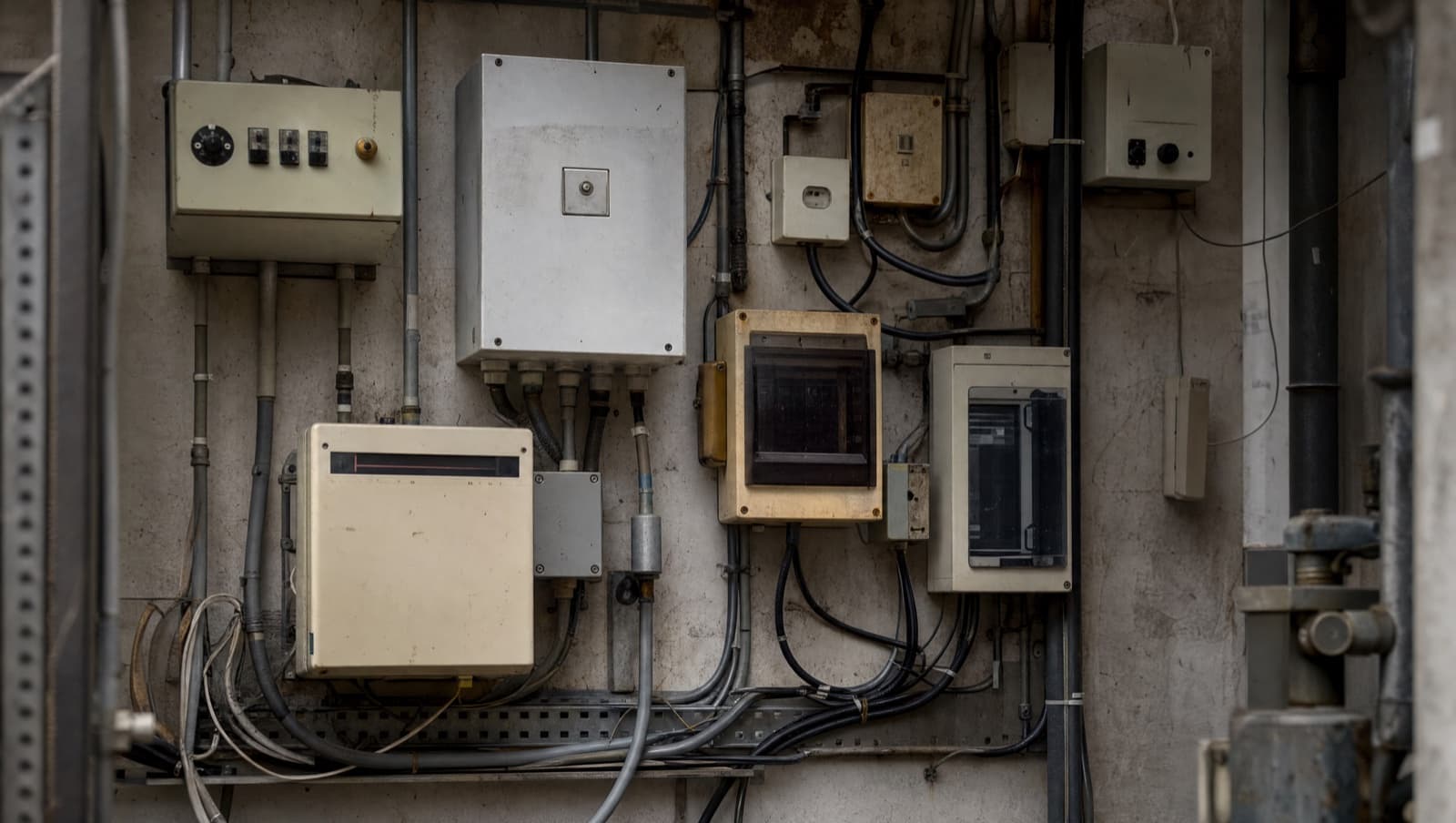
The most common problem we see — particularly on projects where someone else has done the panel work — is poor internal wiring standards. Cables crossing over each other with no containment, terminal blocks without ferrules, unlabelled or mislabelled wires, and insufficient clearance between power and control circuits. BS 7671:2018 (the 18th Edition IET Wiring Regulations) requires segregation between power circuits (Band II) and signal/data circuits (Band I), and IEC 61000-4 sets the electromagnetic compatibility requirements that underpin this segregation. In practical terms, running a 230V contactor coil wire alongside a 0–10V analogue sensor signal is going to introduce noise, and that noise shows up as unstable readings, erratic control, and false alarms on the BMS. Proper panel design eliminates this by routing power and control circuits on opposite sides of the enclosure with separate cable duct.
Another common failure is panels designed without considering maintenance access. A panel where you can't reach the terminal blocks without removing a drive, or where the controller is mounted behind a bank of relays, is a panel that nobody will want to work on for the next 15 years. Every Alpha Controls panel is designed with serviceability in mind — components arranged logically, adequate finger-safe clearance around terminals, and DIN rail layouts that allow individual components to be replaced without disturbing adjacent equipment.
Oversized or undersized enclosures are another frequent issue. An enclosure that's too small means cramped wiring, poor ventilation, and no room for future expansion. An enclosure that's too large wastes wall space and budget. The specification should define the enclosure size based on the component count plus a clearly stated spare capacity — typically 20–25% for future expansion, which is standard guidance in CIBSE Guide H for BMS panel design.
Get a Free BMS Survey
We'll assess your controls and provide a detailed quotation.
How does Alpha Controls build a BMS panel?
Every panel starts with a design drawing. We produce a full general arrangement (GA) drawing showing the component layout, a schematic wiring diagram, and a terminal schedule that maps every field cable to a specific terminal number. These drawings are issued for client or consultant approval before manufacture begins, so there's a clear record of what's being built and agreement on the design.
The enclosures we use are typically Rittal or Schneider Spacial — both are IP-rated steel enclosures with proper gland plates, cable entries, and mounting provisions. For plant room environments, IP55 is standard. For internal electrical risers or clean environments, IP41 or IP43 may be appropriate. The IP rating is specified at consultation stage based on the installation environment.
Internal layout follows a consistent standard. Power components — MCBs, contactors, transformers — are in the upper section of the panel. The BMS controller and I/O modules sit in the middle section, clearly accessible. Terminal blocks for field wiring are in the lower section, arranged in groups that match the points schedule. Cable duct separates the power and control wiring routes. Every wire is labelled with printed ferrules at both ends, matching the schematic drawing.
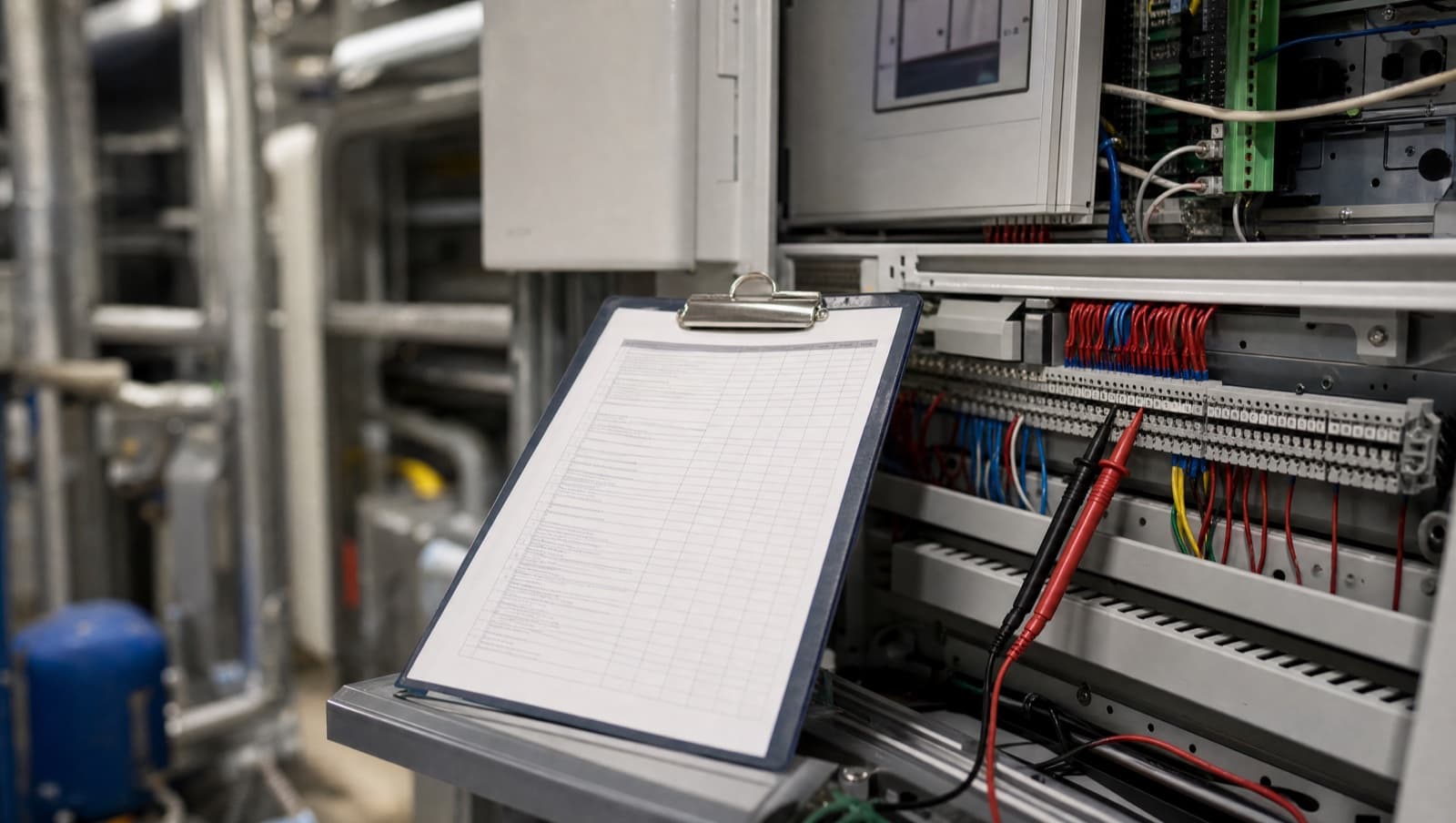
Once built, every panel goes through a factory acceptance test (FAT). We check continuity on every circuit, insulation resistance on power circuits, and functional testing of every relay, contactor, and indicator. If the panel includes a Trend IQ4E controller, we load the application software and test the I/O points using simulated inputs — resistance boxes for temperature sensors, 0–10V signal generators for analogue inputs, and switch contacts for digital inputs. The panel leaves the workshop with a test certificate and a documented test record, so the commissioning engineer on site knows that everything inside the panel has been verified.
Should you choose a bespoke panel or a standard specification?
Some manufacturers offer standard panel ranges — pre-configured enclosures for common applications like AHU control or boiler plant. These have their place, particularly on smaller projects where the application is straightforward. But for most commercial BMS work, bespoke panel design is necessary because no two plant rooms are the same.
A bespoke panel means the component count matches the actual application, the terminal allocation matches the actual field devices, and the physical dimensions fit the available wall space. It also means the design can accommodate project-specific requirements — perhaps the client wants a local HMI touch screen mounted in the panel door, or the consultant has specified a network switch within the panel for BACnet/IP connectivity, or the MCC needs a power monitoring device for energy sub-metering that feeds data back to the BMS.
At Alpha Controls, the majority of our panels are bespoke. We've built everything from single-controller FCU panels the size of a shoebox to full-height, double-door motor control centres with integrated Trend IQ4E controllers, ABB variable speed drives, and 200+ terminal connections. Each one is designed from scratch for its specific application, and each one leaves the workshop fully tested.
How much time and money does off-site panel build save?
The direct cost comparison between off-site and on-site panel build often favours off-site, even though the workshop overhead is higher, because the labour efficiency is dramatically better. An electrician working in a clean, well-lit workshop with proper tools and bench space will wire a panel in roughly 60% of the time it would take on site. Factor in the reduced snagging, the elimination of rework, and the faster commissioning, and the total project cost is typically lower.
From a programme perspective, the savings are even more compelling. If the panel build takes four weeks and it's done off-site in parallel with other trades, you've saved four weeks on the critical path. On a fast-track project, that can be the difference between hitting the handover date and paying liquidated damages.
When should you decide on panel manufacture?
Panel manufacture should be considered at specification stage, not after the project is awarded. If the specification leaves panel design to the installer, you're likely to get a panel that works but isn't optimised for the application, the space, or the client's maintenance requirements. If the specification defines the panel requirements in detail — component schedule, enclosure size, IP rating, internal layout standards, labelling requirements, and test procedures — you get competitive tender prices and a consistent quality standard regardless of which contractor wins the job.
If you're planning a BMS project and want panels that are properly designed, built to a consistent standard, and tested before they arrive on site, talk to Alpha Controls or request a quote. We handle the full process from design through manufacture and testing, and we coordinate with your installation team to make sure the panels fit the programme and the plant room. For more on how these panels connect to the wider BMS infrastructure, see our guide on what a building management system actually does.
Darren Pettit
Specialist BMS installation, commissioning, and maintenance across London and the South East. SafeContractor Approved, BCIA Member.