
A BMS installation in Kent covers field devices, controller wiring, network infrastructure, supervisory software, commissioning, and handover documentation. A single plant room takes four to six weeks; a 3,000–5,000 m² building twelve to twenty weeks. Commissioning to BSRIA BG8/2024 — every control loop tested against design intent — separates a working system from a complaint generator.
Every week we get calls from building owners and FM managers across Kent who have just inherited a BMS installation done by someone else — and it does not work properly. The sensors are in the wrong places. The control sequences were never commissioned against the actual plant. The handover documentation is a generic PDF that tells the FM team nothing about their specific building. And the original installer has either gone bust, moved on, or is quoting five figures just to come back and explain what they built.
This is not a rare situation. It is the norm. BMS installation in Kent — across Gravesend, Dartford, Maidstone, Medway, and the M25 corridor towns — suffers from the same problem as everywhere else in the South East: the gap between what gets specified and what gets installed is enormous, and nobody catches it until the tenants start complaining or the energy bills arrive.
What does a BMS installation in Kent actually involve?
A building management system installation is not a single trade activity. It sits at the intersection of mechanical services, electrical installation, IT networking, and controls engineering — and the quality of the finished system depends on how well those interfaces are managed. The BMS contractor needs to understand not just their own scope but how the plant was designed to operate, because the control strategy is only as good as the mechanical design it is built around.
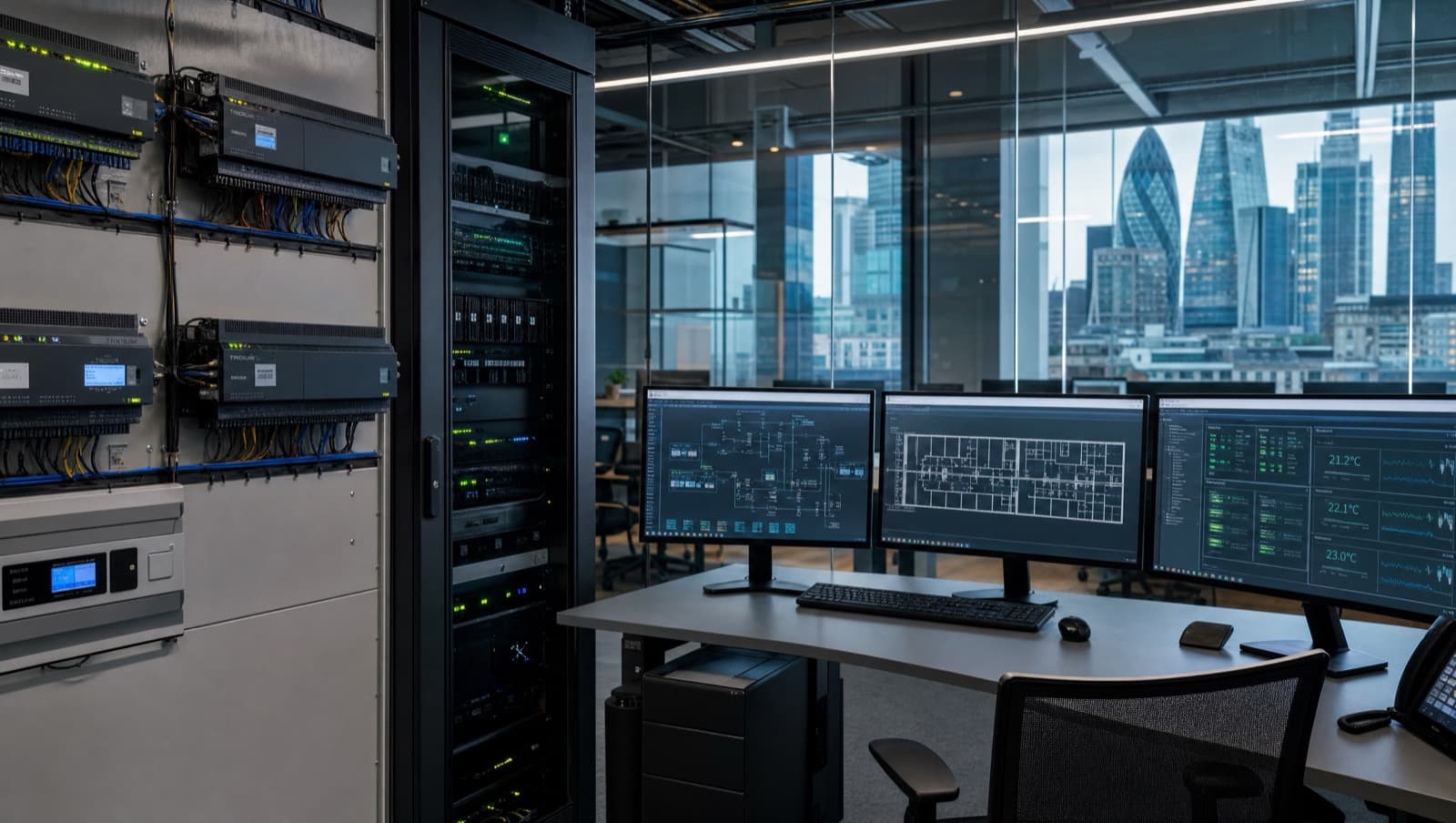
For a typical commercial building in Kent — an office block in Dartford, a distribution centre in Medway, a school in Maidstone — a BMS installation covers the following scope: field device installation (sensors, actuators, valve assemblies), controller installation and wiring (panel building, cable containment, terminations), network infrastructure (BACnet MSTP trunks or IP networking), supervisory software configuration, commissioning of every control loop against the mechanical design intent, and handover documentation. On a straightforward single-plant-room project, this takes four to six weeks from mobilisation to handover. On a multi-floor office or campus, twelve to twenty weeks is realistic.
The critical distinction that separates a good installation from a bad one is commissioning. CIBSE Commissioning Code M (2003, updated by BSRIA BG8/2024) requires that every control loop is tested against the design intent — not just checked for power and communication, but verified to produce the correct output under real operating conditions. A heating valve that opens when it should, modulates proportionally across its range, and closes fully at setpoint is a commissioned valve. A heating valve that has power and shows "online" on the supervisor is merely an installed valve. The difference between those two states is the difference between a building that works and one that generates complaints for the next five years.
Why do BMS installations go wrong in Kent?
Kent has a concentration of logistics, warehousing, and light industrial buildings along the A2, M2, and M20 corridors, alongside the commercial office stock in Dartford, Gravesend, and the Medway Towns. Many of these buildings were built in the 1990s and early 2000s with basic BMS systems — often standalone controllers with no network, no trending, and no remote access. When these buildings change hands or get refurbished, the BMS installation is frequently treated as a commodity purchase: get three quotes, pick the cheapest, and assume the result will be acceptable.
The problem is that BMS installation is not a commodity. The cheapest quote almost always means fewer commissioning hours, less documentation, and a control strategy that was copied from the last job rather than designed for this building. We regularly arrive on sites across Kent where the BMS was installed twelve months ago and find heating and cooling running simultaneously, optimisers that have never been configured, and frost protection strategies that either do not work or run the boilers all night regardless of external temperature. These are not obscure faults — they are the direct result of insufficient commissioning time in the original installation programme.
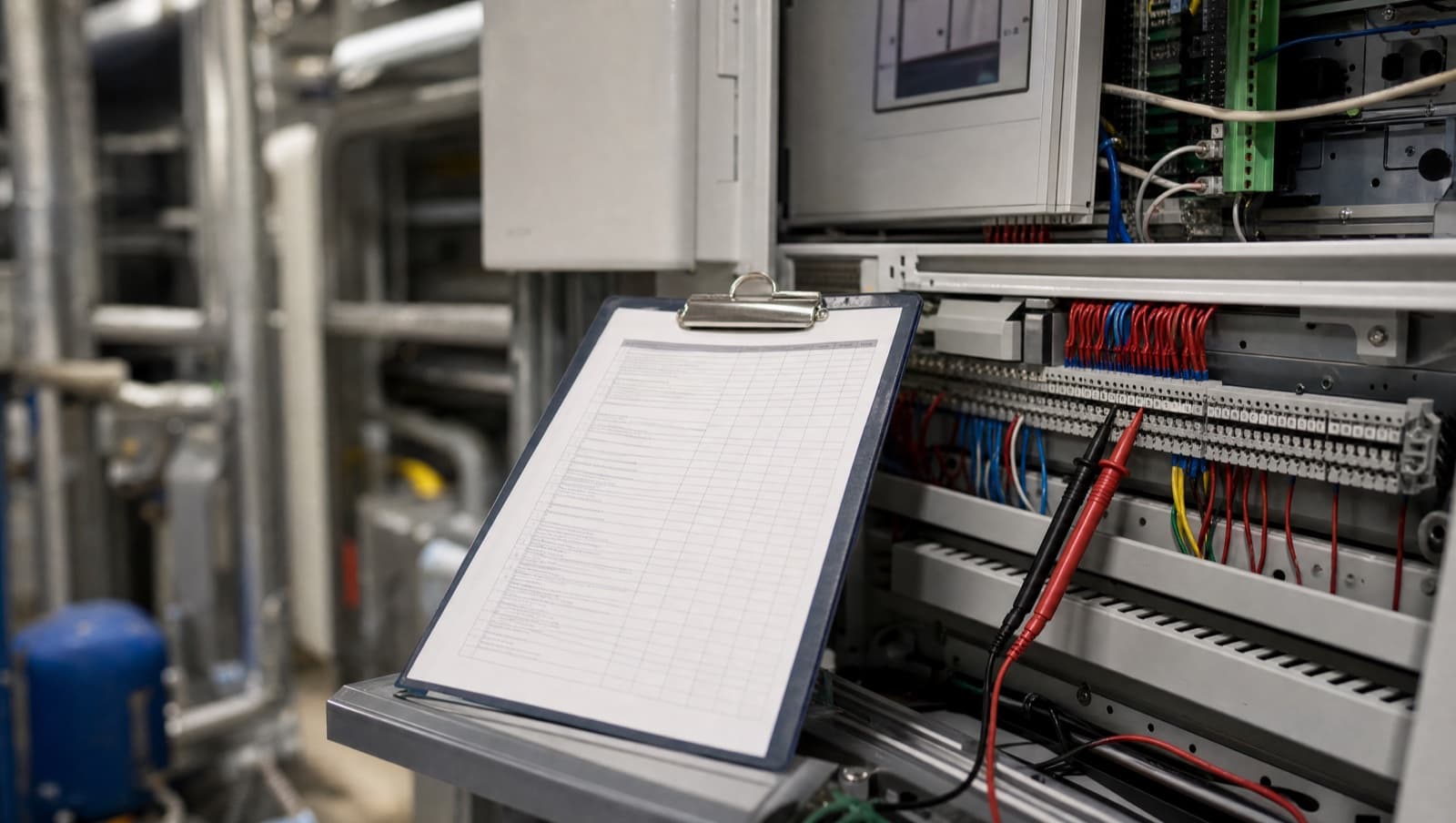
The second common failure is cable infrastructure. BMS field wiring is low-voltage signal cabling — typically screened pairs for analogue signals and twisted pairs for digital communications. BS 7671 (IET Wiring Regulations, 18th Edition, Amendment 2) requires that these cables are segregated from mains power cables to prevent electromagnetic interference. On sites where the BMS contractor has cut costs by sharing containment with the electrical contractor, we find sensor readings that drift, communication errors on BACnet MSTP trunks, and phantom alarms caused by electrical noise. Fixing this after the ceiling tiles are back up and the building is occupied costs three to five times what proper segregated containment would have cost during the original installation. We've covered what proper BMS electrical work in Kent involves — segregation, screening, and terminations — in its own guide.
What should a BMS installation cost in Kent?
Pricing transparency matters, because the range of quotes a building owner receives for the same scope can vary by a factor of three — and neither the cheapest nor the most expensive is necessarily the right choice. For a detailed breakdown of BMS installation costs across the UK, including Kent-specific considerations, see our comprehensive guide to BMS retrofit and installation costs.
As a rough guide for Kent in 2026: a single plant room BMS installation (boiler plant, AHU, or chiller controls) on a Trend IQ4 platform typically falls between £8,000 and £18,000 depending on the number of I/O points, the complexity of the control strategy, and whether the mechanical plant is new or existing. A full-building BMS installation for a 3,000–5,000 m² commercial office — covering AHUs, FCUs, boiler and chiller plant, metering, and a supervisory workstation — ranges from £45,000 to £120,000. The variables are the number of field devices, the building's existing infrastructure, access constraints (occupied buildings cost more than empty shells), and the depth of commissioning and documentation required.
What you should not accept is a quote that does not itemise commissioning as a separate line. If commissioning is buried in the installation price, it will be the first thing that gets squeezed when the programme runs late — and BMS programmes always run late, because they depend on every other trade finishing their work first.
Get a Free BMS Survey
We'll assess your controls and provide a detailed quotation with energy savings estimates.
Which standards and legislation apply to a BMS installation?
Every BMS installation in Kent must comply with a core set of standards, and the building owner — not just the installer — is responsible for ensuring compliance. The key ones are:
CIBSE Guide H: Building Control Systems (2009) is the primary UK reference for BMS design and specification. It specifies the sensor accuracy good control depends on — 0.6 K for zone air temperature measurement — and that control loops are tuned to achieve stable operation without hunting or oscillation. Any installer who hands over a system with temperature swings of ±3°C and says "that's normal" has not met the requirements of Guide H.
BSRIA BG8/2024: Model Commissioning Plan defines the commissioning process for building services including BMS. It requires a written commissioning plan before installation begins, witnessed commissioning of every control sequence, and a commissioning record that documents the as-commissioned settings — not the design settings, but the actual values programmed into the controllers after tuning. This document is part of the Building Log Book (CIBSE TM31) and should be handed to the building owner at practical completion.
BS EN ISO 16484 (Parts 1–6): Building Automation and Control Systems covers the functional requirements, hardware, and communication protocols for BMS. Part 5 specifically defines the BACnet protocol — the open standard that allows different manufacturers' equipment to communicate. For any installation in Kent where future flexibility matters (and it always does), specifying BACnet compliance to BS EN ISO 16484-5 ensures you are not locked into a single vendor's proprietary protocol.
What does a properly planned occupied-building installation look like? The Pinsent Masons office tower
One of our most technically demanding installations was the Pinsent Masons project — a 16-floor office tower requiring a complete FCU controls upgrade. The existing Trend 963 controllers had reached end of life, and the building needed a migration to Trend IQ4 controllers with new LightFi wireless occupancy sensors on every floor. The constraint was that the building was fully occupied with a law firm — weekend-only access, no disruption to the working week, and every floor had to be returned to full operation by Monday morning.
We planned the installation floor by floor, pre-building controller panels offsite to minimise on-site time. Each weekend, a team stripped out the old controllers, installed the new IQ4 panels, terminated the existing field wiring, commissioned the FCU control loops, and verified operation before the office reopened. The LightFi sensors — wireless devices that detect occupancy through changes in the WiFi signal environment — were installed without any ceiling tile removal, reducing the disruption further. The project ran over fourteen weekends with zero complaints from the building occupants. That is what a properly planned BMS installation looks like in an occupied commercial building.
How do you spot a good BMS installation?
A well-installed BMS has several characteristics that are immediately apparent to anyone who knows what they are looking at. The panel wiring is clean, labelled, and follows a consistent convention — every terminal strip is numbered, every cable is tagged at both ends, and the panel layout matches the as-built drawing mounted on the panel door. The field devices are installed in the correct locations — temperature sensors on return air ducts (not supply), pressure sensors downstream of filters, CO₂ sensors at breathing height in the occupied zone, not hidden behind a ceiling tile. For more on what constitutes proper BMS design and installation practice, our article on what a building management system actually is covers the fundamentals.
The commissioning records show that every control loop was tested — not just "checked" or "witnessed", but tested under real conditions with the plant running. The trend logs on the supervisor show stable control from day one, not weeks of oscillation while someone remotely tunes PID loops from an office fifty miles away. And the handover documentation includes an operation and maintenance manual that is specific to this building — not a generic product manual for the controller hardware, but a document that explains how this building's control strategy works, what the critical alarms mean, and what the FM team should check on a weekly, monthly, and quarterly basis.
When should you bring in the BMS contractor?
If you are planning a new-build project in Kent and the M&E design includes BMS, bring the controls contractor into the conversation early — at RIBA Stage 3, not Stage 5. The control strategy should inform the mechanical design, not be bolted on after it. If you are retrofitting or upgrading an existing building, get a proper survey done before anyone quotes. A controls survey that maps the existing infrastructure, identifies reusable wiring and devices, and defines the control strategy for the new system costs £500–£1,500 and saves ten times that in avoided rework. For more on what an upgrade programme involves, see our guide to retrofitting legacy buildings with modern BMS.
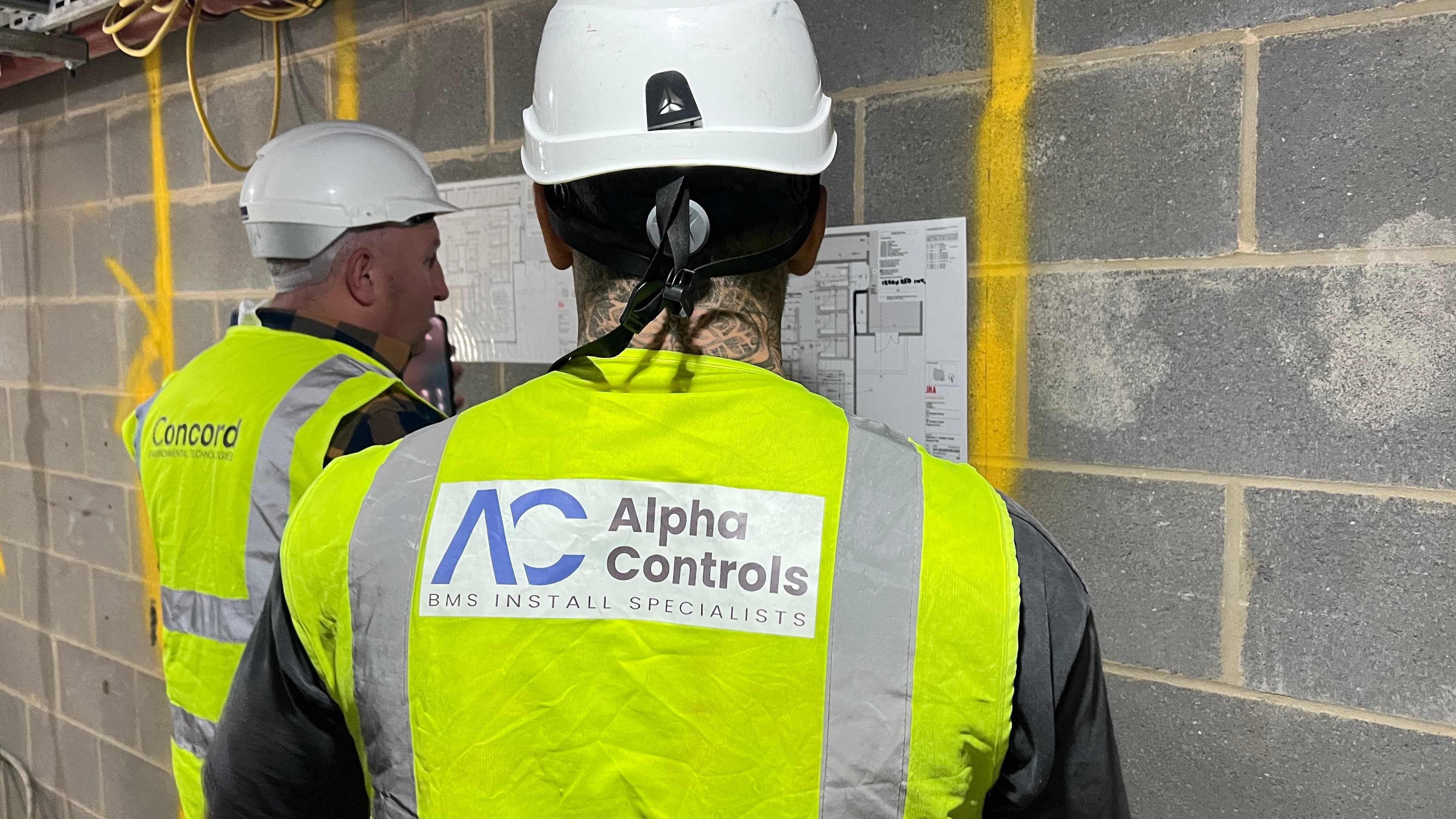
Alpha Controls is headquartered in Gravesend, Kent — we are local to the county and cover every town from Dartford to Dover. We install Trend, Distech, and Siemens BMS platforms for M&E contractors, FM companies, and building owners across Kent. Our BMS installation services in Kent page has the full scope of what we offer, or request a quote to discuss your specific project.
Frequently Asked Questions
How long does a BMS installation take in Kent?
A single plant room installation typically takes four to six weeks from mobilisation to handover. A full-building installation for a 3,000–5,000 m² commercial building takes twelve to twenty weeks depending on the number of systems, access constraints, and whether the building is occupied during installation.
Do you work as a subcontractor to M&E contractors?
Yes — a significant proportion of our work in Kent is as a specialist BMS subcontractor on new-build and refurbishment projects. We provide competitive pricing, clear installation programmes that align with the main contractor's schedule, and the commissioning documentation needed for building handover.
What BMS platforms do you install?
Our primary platform is Trend IQ4, which is the most widely installed BMS in UK commercial buildings. We also install Distech Controls (EC-BOS and ECLYPSE series) and Siemens Desigo CC. All installations are BACnet-compliant to BS EN ISO 16484-5 for open protocol interoperability.
Can you install a BMS in an occupied building without disruption?
Yes — we regularly install and upgrade BMS systems in occupied offices, schools, hospitals, and retail premises. This requires phased installation planning, out-of-hours working where necessary, and a control strategy that maintains building services continuity during the changeover. Our Pinsent Masons project (16 floors, weekend-only access) is a good example of this approach.
What should I look for in a BMS installation quote?
Commissioning should be itemised as a separate line — not buried in the installation cost. The quote should specify the commissioning standard (BSRIA BG8), the number of commissioning days, and the handover documentation deliverables. If a quote does not mention commissioning at all, it will not include adequate commissioning.
Alpha Controls Team
Specialist BMS installation, commissioning, and maintenance across London and the South East. SafeContractor Approved, BCIA Member.