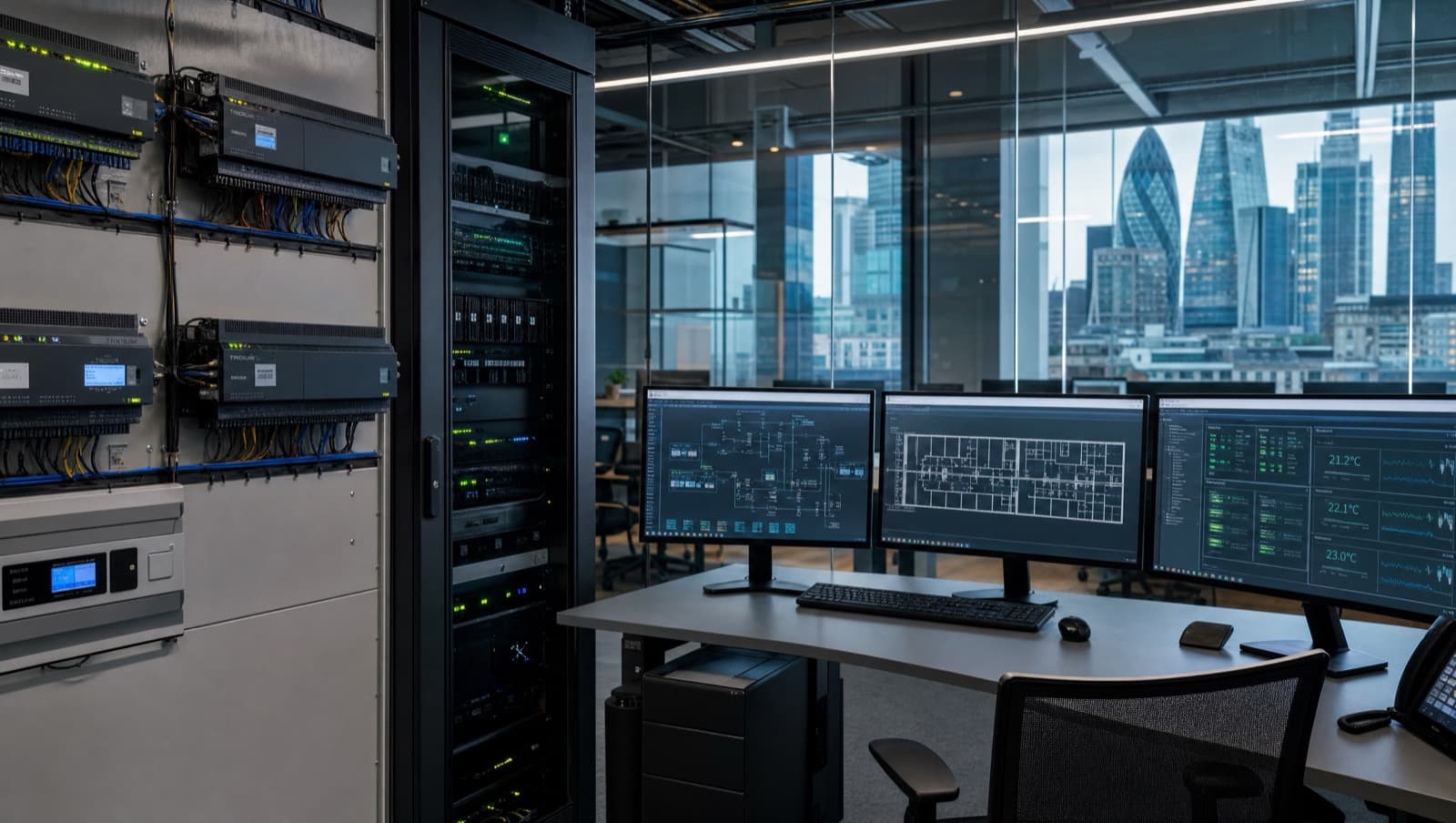

BMS contractors in the UK fall into five distinct types that people routinely conflate: the controls manufacturers (Trend, Distech, Siemens), who design and supply hardware but don't install it directly; systems houses and approved partners, who are manufacturer-trained and do the actual installation and commissioning; independent BMS contractors, who may work across multiple platforms; electrical contractors, who handle the wiring but rarely the controls logic; and main or building contractors, who package the whole job as one line in a bigger fit-out. Knowing which one you're actually hiring is what stops a project going wrong.
We see this confusion play out constantly on tenders and in FM handovers. A building owner asks "who installed our BMS?" and gets an answer that's actually the name of the M&E main contractor, who subcontracted the controls to someone else, who's since gone out of business or moved on to different work. Nobody currently on the account can tell you who actually wrote the control logic. That's not a rare edge case in UK commercial buildings — it's closer to the norm on anything more than about fifteen years old, and it usually traces back to a BMS installation that was priced and subcontracted without anyone asking that question at the outset.
The Confusing Landscape: Who's Who in BMS
Manufacturers like Trend, Distech and Siemens design and manufacture the controllers, sensors and software platform. They train and accredit installer partners, but as a rule they don't turn up on site and wire your panel — they sell through a channel. That channel is where the real variation in quality sits.
Systems houses and approved partners are companies accredited by a manufacturer to design, install and commission on their platform. This is where most competent BMS work in the UK actually happens. Accreditation means the manufacturer has trained their engineers and, in most cases, checks their design work against manufacturer standards before it goes on site.
Independent BMS contractors cover a spread — some are accredited on one platform and effectively function as a systems house, others work across several manufacturers and specialise in migration or multi-vendor integration work. Worth checking which one you're actually talking to before you assume cross-platform experience means cross-platform competence.
Electrical contractors handle first and second fix cabling and often the containment for BMS field wiring, but the controls logic — the actual programming that decides what the system does — is a different skill set entirely. A good electrical contractor wiring to a BMS engineer's design is normal and sensible. A good electrical contractor writing the control philosophy themselves is a red flag. We worked field wiring for the MSFD system at 155 Tooley Street alongside the wider electrical package, and that split of responsibilities — electrical contractor on cable, BMS specialist on logic and commissioning — is exactly how it should work when it's coordinated properly.
Main or building contractors on larger fit-outs will often package BMS as one line item inside the mechanical and electrical package, subcontracted down two or three levels before it reaches an actual installer. Each layer adds margin and distance from accountability, which is where documentation quality tends to fall apart first.
None of this means one type of contractor is inherently better than another — a good electrical contractor and a good main contractor both have their place. It means the label on the company doesn't tell you what you're getting, and the only way to find out is to ask directly who's doing the controls design, who's doing the panel build, and who's signing off commissioning. If those are three different names on three different invoices with no single point of accountability, that's worth flagging before the contract is signed, not after.
For a plainer explanation of what the system itself is doing once any of these parties has installed it, see our piece on what a building management system is.
Who You Need for Which Job
New BMS installation on a manufacturer's platform: a manufacturer-accredited systems house or approved partner, full stop. Retrofit or upgrade of an existing system: whoever installed it originally if they're still trading and any good, otherwise an independent or systems house experienced in migration work — our work moving legacy Trend 963 controllers to IQVISION is exactly this category. Pure cabling and containment on a job where the controls design is already specified: an electrical contractor working to that design, ideally under BS 7671:2018+A2:2022 Section 528, which governs the segregation of BMS control wiring from power cabling — get this wrong and you end up with induced interference on sensor signals that reads as a controls fault when it's actually an electrical installation problem. Whole-building fit-out: usually structured through a main contractor, but insist on knowing who the actual BMS subcontractor is and get them named in the contract, not buried as "controls package TBC."
In practice, most of our work sits across that first and second category — new installation and retrofit — on commercial buildings across London and Kent, where the electrical and controls scopes are coordinated from the same team rather than handed to separate subcontractors who've never spoken to each other before the job starts.
The Pain Points of Getting It Wrong
Vendor lock-in is the most common complaint we hear from FM teams and building owners. It happens when one contractor holds all the licences, passwords and proprietary knowledge for a system, and nobody else can service it without going through them — at whatever rate they choose to charge, because there's no competitive pressure once you're locked in. This isn't always deliberate; sometimes it's just what happens when a small local installer never wrote anything down and is the only person who remembers how the plant room actually works.
The vanished-installer problem is the sharper version of the same issue: the company that installed the system closes, gets bought out, or simply stops doing BMS work, and the documentation goes with them. We've picked up buildings still running IQ1 and IQ2-era Trend controls with no usable records at all — no control narrative, no point schedule, nobody able to say with confidence what a given output actually does without physically tracing it. Every change becomes an investigation before it can become a fix.
Then there's the panel that's accreted four different brands over twenty years, because every time something failed nobody wanted to touch the existing kit, so a new controller from whatever brand the latest contractor happened to stock got bolted in alongside it. You end up with a panel that's part Trend, part something else entirely, wired by three different standards of workmanship, with no single person able to explain the whole system end to end. It's one of the most common states we find buildings in when we're called in for a survey, and it's expensive to unpick precisely because nobody planned for it to happen.
M&E packages lumping BMS in as a line item is where a lot of this starts. When controls are priced and subcontracted as an afterthought inside a bigger mechanical and electrical tender, the pressure is on price, not on documentation or long-term serviceability — and the BMS is usually the smallest line item in the package, so it gets the least scrutiny. By the time the building is in use and something drifts out of setpoint, tracing the fault back through two or three subcontract layers to whoever actually wrote the logic can take longer than fixing it would have taken in the first place.
The cost of all this rarely shows up as a single bad invoice. It shows up as a maintenance contractor charging a premium because they know you have no alternative, as an FM team paying for a full resurvey before any upgrade can even be scoped, or as a building running years past when it should have been recommissioned because nobody was confident enough in the existing documentation to touch it.
Get a Free BMS Survey
We'll assess your controls and provide a detailed quotation with energy savings estimates.
How Open Protocol Keeps You Free
BS EN ISO 16484-5 is the standard that defines BACnet, the open communication protocol used across building automation. Specifying BACnet-compliant hardware and an open, documented points database means any competent BMS contractor — not just the one who installed it — can pick up the system, understand its point structure, and service or extend it without needing proprietary access from the original installer. That's the practical difference between an open-protocol system and a closed, proprietary one: the open system doesn't hold you hostage.
This doesn't mean every job needs to be multi-vendor from day one. It means specifying open protocol at the outset, keeping the points database documented in a format that isn't locked inside one company's software licence, and treating that documentation as something you own, not something the installer keeps on their own server as unstated leverage.
What a Healthy Contractor Relationship Looks Like
Three things: you own the documentation, not the contractor. The system is specified and commissioned to open protocol wherever the platform allows it. And it passes what we'd call the any-competent-contractor test — if your current maintenance company disappeared tomorrow, could a different accredited contractor pick up your control narrative, point schedule and as-built drawings and carry on servicing the system within a day, not a month of investigation? If the honest answer is no, that's the gap to close, and it usually starts with commissioning a proper documentation review rather than waiting for the current contractor to leave the market.
That relationship should also be a planned one rather than reactive-only — a contractor turning up only when something's broken has no reason to flag drift early, keep documentation current, or push back when a setpoint's been left wrong for months. Our guide to BMS maintenance contracts covers what a properly structured contract should include, and our piece on reactive versus planned maintenance sets out why the planned model is the one that actually protects you from the lock-in problem this post is about — a contractor doing regular planned visits has every incentive to keep your documentation current, because they're the one relying on it.
If you're further back in the process and trying to work out which type of BMS installation company to bring onto a project in the first place, our companion guide on choosing a BMS installation company covers accreditation, commissioning standards and the cost models to expect. Between the two posts you should be able to walk into a tender knowing exactly who you're talking to and what to ask them.
Getting a Straight Answer on Your System
Alpha Controls is an independent BMS contractor with Trend-, Distech- and Siemens-trained engineers, covering Kent, London and the South East, handling design, panel build, installation, commissioning and maintenance in-house. If you've inherited a system with patchy documentation, mixed brands on the panel, or a maintenance contract you're not sure is being delivered, get in touch or request a quote for a straight site survey — call 01474 552200 or email info@alphacontrols.io.
Alpha Controls Team
Specialist BMS installation, commissioning, and maintenance across London and the South East. SafeContractor Approved, BCIA Member.