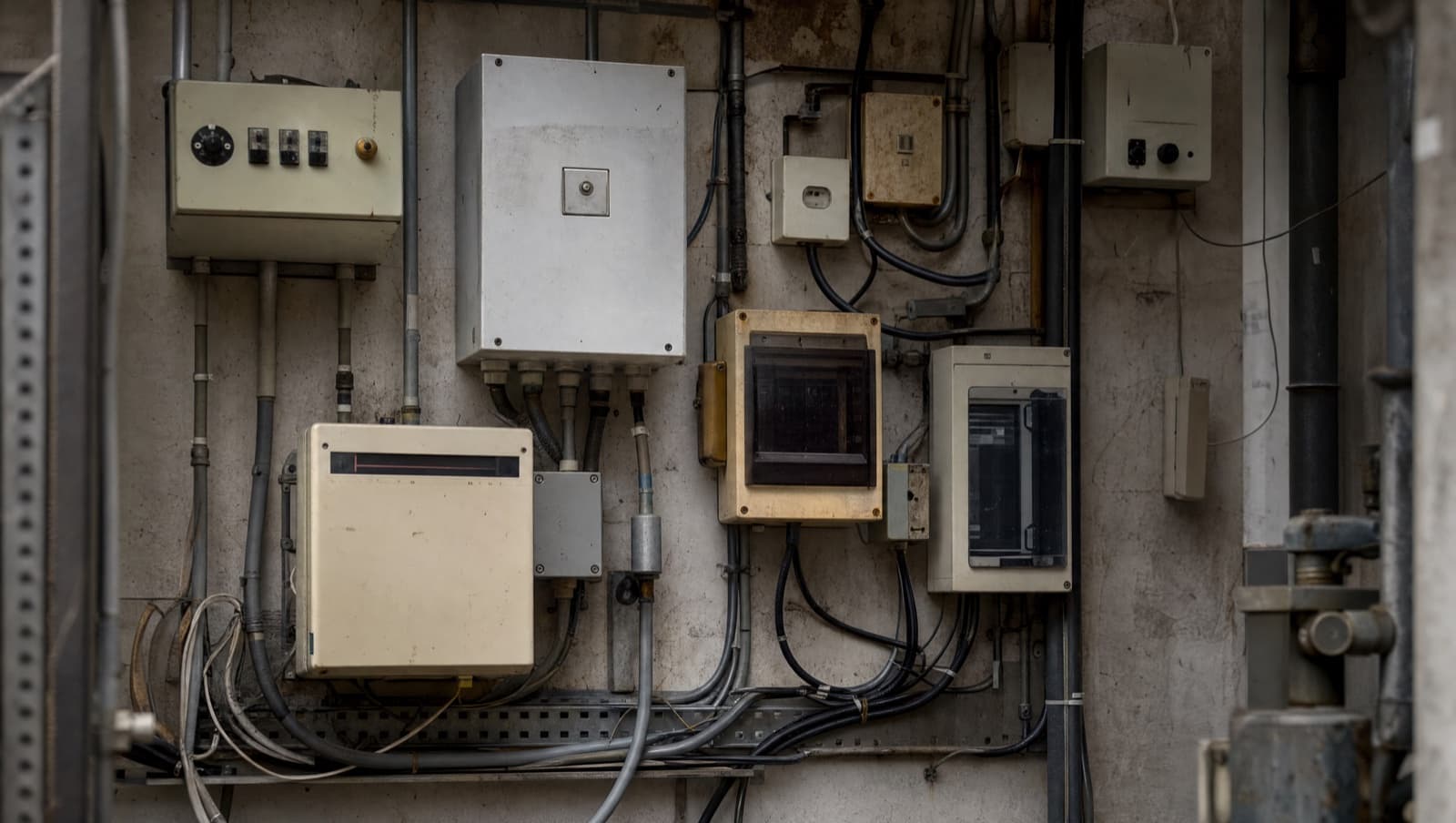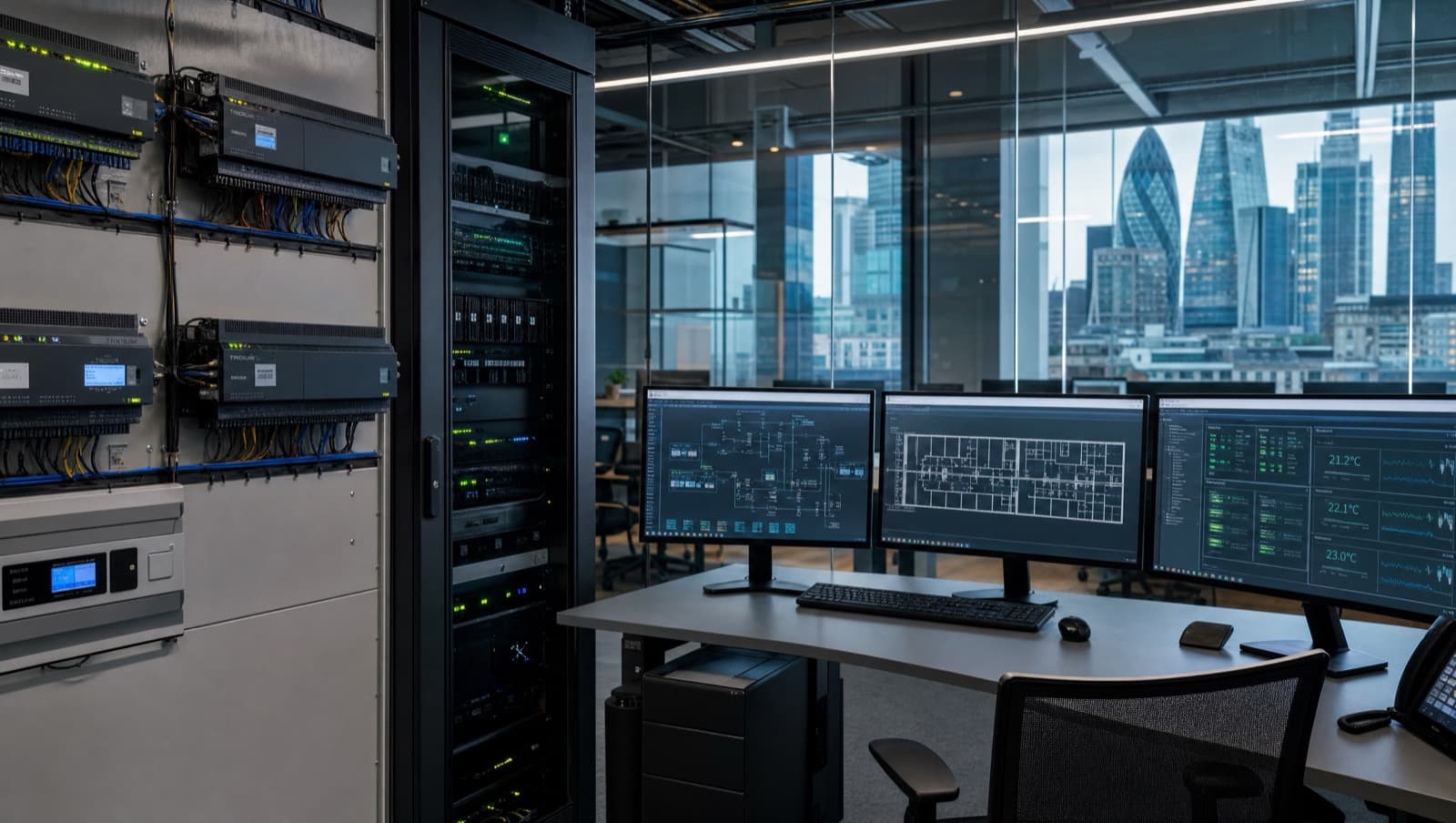

We've lost count of the number of London commercial buildings we've walked into where the controls strategy on paper looks fine — the right controllers, a sensible sequence of operation — and yet nothing behaves properly on site. Nine times out of ten the problem isn't the strategy. It's that the electrical contractor on the original fit-out treated the BMS as a bolt-on, pulled cable wherever was quickest, and left the panel wiring for someone else to make sense of later. We've opened panels that were tidy, fully labelled and passed their electrical inspection without issue — and still didn't function, because whoever wired them had never seen the point schedule and had no idea what half the terminals were actually for.
BMS electrical work in London covers panel building and wiring, containment installation through risers and plantrooms, field cable pulling to every controlled device, screen terminations and segregation from mains power. It's specialist work — a BMS electrical contractor has to understand controller I/O and network topology as well as the wiring regs, and on multi-floor commercial buildings that usually means coordinating tightly with the M&E contractor and working around live tenants. Get the wiring wrong and the mechanical side of the system never gets a fair test.
What BMS Electrical Work Actually Covers
Panel wiring comes first: building the BMS panel from a schematic, terminating incoming supplies, wiring in the controller and I/O modules, and labelling every core so a commissioning engineer isn't reverse-engineering it weeks later. Then it's field wiring — running cable from panels and riser cupboards out to every device on the point schedule, through containment sized and routed for the run, not squeezed in wherever there's space in an already-congested riser.
Cable selection is where a lot of London jobs come unstuck, mostly because of scale. A 16-storey commercial building with hundreds of fan coil units means hundreds of individual field terminations, and any inconsistency in cable type or screening compounds across the whole floor plate. Analogue sensor loops and BACnet MS/TP network cabling need screened, low-capacitance twisted pair, landed and screened correctly at one end per the controller manufacturer's guidance. Damper and actuator wiring — particularly on life-safety systems like motorised smoke and fire dampers — needs its own containment discipline entirely, separate from general control cabling, given what's riding on it working correctly.
Testing is not optional on jobs at this scale. Every field device gets loop-tested back to its panel or riser cupboard before commissioning starts — continuity confirmed, insulation resistance checked, and the core landed at the panel verified against the core landed at the device. On a building with hundreds of FCUs, skipping that step on even a small percentage of points means the commissioning engineer is left chasing dozens of individual faults floor by floor instead of tuning a working system.
Why It Matters More Than People Think
In a London commercial building with a live tenant base, a wiring fault doesn't stay quiet. It shows up as a floor that's too hot on a Monday because the weekend shutdown sequence didn't bring the FCUs back online properly, or as a facilities manager fielding complaints because a sensor loop is reading garbage due to induced interference. CIBSE Guide H sets out that BMS point schedules should be fully documented and traceable to the physical wiring on site — when the wiring doesn't match the schedule, no one can verify the strategy is actually doing what the design intended, which matters for BREEAM reporting as much as it does for tenant comfort.
It matters even more where the wiring is tied to life safety. On systems involving motorised smoke and fire dampers, the field wiring from the panel to the actuator and back isn't optional-quality work — it has to be right first time, because the failure mode isn't a cold office, it's a damper that doesn't open on an alarm signal.
What Usually Goes Wrong On Site
The recurring faults on London jobs are rarely exotic. They're basic electrical discipline that got skipped under programme pressure:
- Control cabling run through the same containment as lighting and power circuits in congested risers, with no segregation and no thought given to interference near VSDs.
- No slack left at FCU or riser panel connections, meaning any future maintenance visit means re-pulling cable through a ceiling void instead of simply reconnecting.
Beyond that, we regularly find BACnet MS/TP networks wired as a star rather than a proper daisy chain across floors, which causes intermittent communications drops that are genuinely painful to trace in a live building. We also see screens landed at both ends of a cable run, creating earth loops that present as noisy or drifting sensor data and get misdiagnosed as a faulty device. And junction boxes for damper and actuator field wiring left unlabelled or badly documented, which turns a routine fault-find into a half-day job with a multimeter and a set of as-built drawings that don't match what's actually there.
Get a Free BMS Survey
We'll assess your controls and provide a detailed quotation with energy savings estimates.
The Standards That Actually Apply
BS 7671:2018+A2:2022 (IET Wiring Regulations, 18th Edition) governs any electrical work in a London commercial building, and Section 528 is the one that matters most for BMS installers: it requires segregation between Band I circuits — extra-low-voltage control and data cabling — and Band II circuits — low-voltage mains power — unless every cable in the shared containment is insulated for the highest voltage present. On congested London risers this is the requirement that gets ignored most often, simply because there isn't always room to run separate containment without planning for it from day one.
For panel work, BS EN 60204-1 sets the standard for conductor identification, colour coding and terminal marking on control panels — the same discipline that applies to any machine control panel applies equally to a BMS panel. Where analogue signal cabling runs near variable speed drives, the IEC 61000-4 EMC series is the relevant guidance for screened cable and earthing practice to avoid drive-induced interference corrupting sensor readings. And on any BACnet network, BS EN ISO 16484-5 sets out the cabling topology requirement — daisy chain with end-of-line termination at both physical ends of the trunk, not a star and not mid-run termination.
Working Around Live Tenants and Restricted Access
Most of our London work happens in occupied commercial buildings, which changes how the electrical work has to be planned. Riser and ceiling void access is often restricted to specific windows — early mornings, evenings, or weekends — particularly on floors with tenants in occupation during standard hours. Containment runs and field wiring get phased around those windows rather than completed in one continuous push, and any isolation of existing circuits has to be coordinated with the building's facilities team so nothing goes down unexpectedly on a floor that's live.
That phased approach makes labelling and documentation even more important than on a single-visit job. If a team is back on site three weeks later to finish a floor, and the panel and field labelling from the first visit isn't consistent, they're starting from scratch working out what's already been done instead of picking up where the last visit left off.
London Jobs Where This Mattered
At 20 Gresham Street we picked up containment and tray installation through a basement plantroom for trench-heating control wiring, in a space where earlier works had left junction boxes poorly routed and control cable sharing tray with power feeds. Re-routing and properly segregating that run before it was buried behind finishes saved a much more expensive fix later. At 155 Tooley Street we handled the field wiring for a motorised smoke and fire damper installation — actuator wiring, junction boxes and panel connections — where the standard was non-negotiable given the life-safety function, and every termination was tested and documented before handover.
We've also delivered phased FCU controls upgrades across a 16-storey Central London office — 360 fan coil units on Trend controllers with a weekend-only shutdown strategy — and floor-by-floor FCU wiring and riser panel connections at 90 Whitfield Street, including dedicated leak-detection BMS cabling. At 1 Eversholt Street we installed metering and BMS network cabling as part of a wider controls upgrade. Different buildings, same lesson each time: the wiring discipline underneath the strategy is what determines whether the system actually works once the contractor's gone.
What Good BMS Electrical Work Looks Like
Good BMS electrical work in a London commercial building starts with containment designed for segregation from day one, not squeezed in around it. Every panel and field core is labelled against the point schedule. Screened cable is used consistently across every analogue and network run, terminated correctly at one end, with enough slack at every FCU, damper and riser panel connection to allow maintenance without re-pulling cable through a live ceiling void. Network cabling follows proper daisy-chain topology floor to floor with EOL resistors correctly fitted, and damper or life-safety field wiring is tested, labelled and documented to a standard that doesn't leave anything to guesswork.
That's the difference between a BMS electrical contractor and a general electrical team doing BMS wiring as a sideline — understanding that every termination has to serve commissioning, fault-finding and, on some systems, life safety, not just pass a first-fix inspection. It's exactly what our BMS electrical service is built around.
When To Get Someone To Check It
If you're taking over FM on a London building, inheriting a system from a previous contractor, or dealing with a BMS that's never quite worked since handover, get the electrical side checked before assuming the controller strategy needs re-tuning. Drifting sensor readings that track lighting or power loads, dampers that respond inconsistently, or a BACnet network dropping out intermittently are classic wiring symptoms, not software ones — and catching them early is a fraction of the cost of a full retrofit once the fault has been "worked around" for a year. A short site survey is usually enough to tell you which one you're dealing with before committing to a bigger piece of work.
Get It Wired Right First Time
BMS electrical installation in London commercial buildings is specialist work, and it's the part of a project most likely to be rushed under programme pressure. If you're planning a new install, taking on an inherited system, or chasing a fault that doesn't add up, request a quote or get in touch and we'll take a proper look at what's happening behind the panel door. Read more on our approach to BMS installation in London commercial buildings, or see how our panel building and electrical work fits together on live sites.
Alpha Controls Team
Specialist BMS installation, commissioning, and maintenance across London and the South East. SafeContractor Approved, BCIA Member.