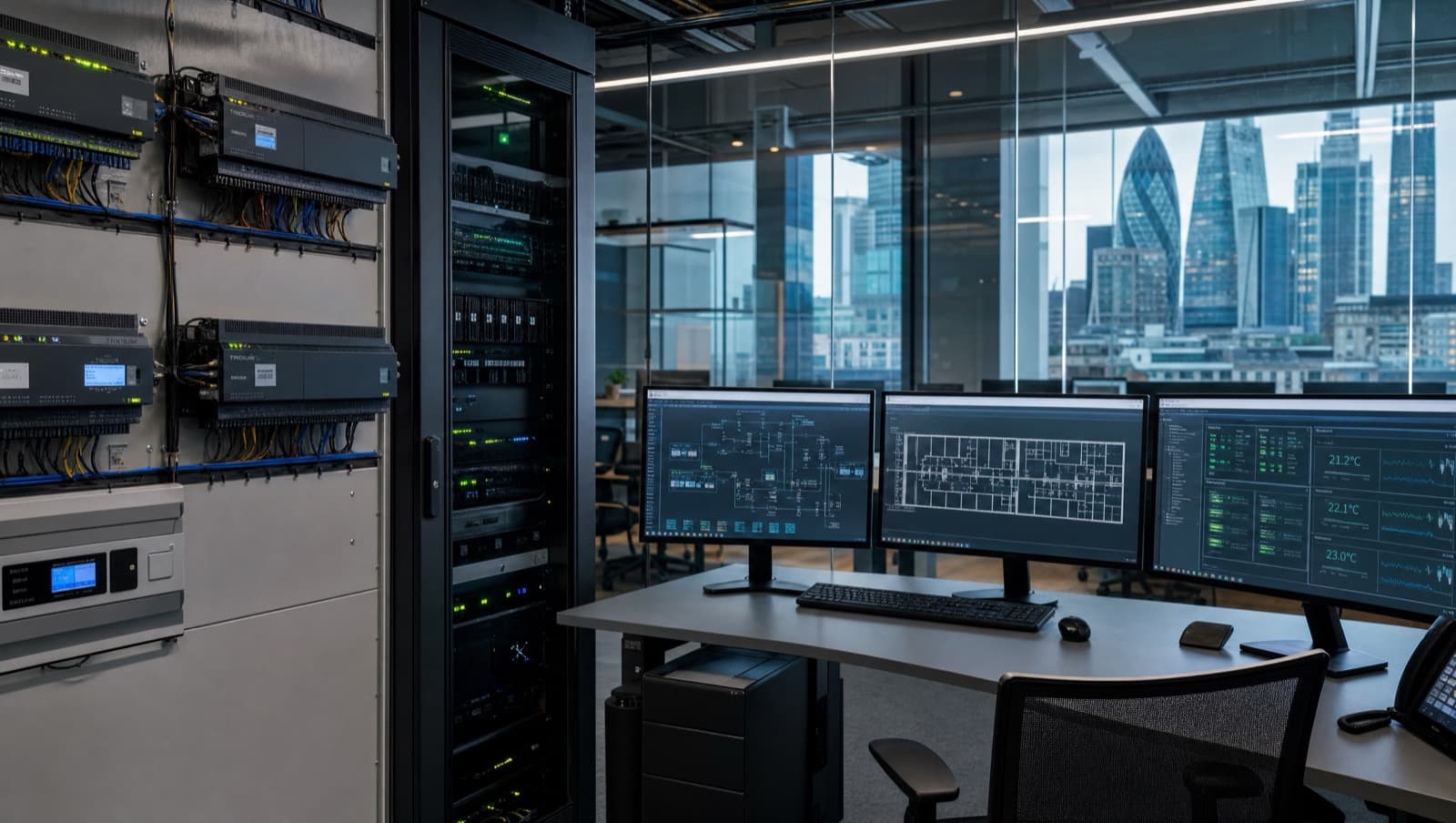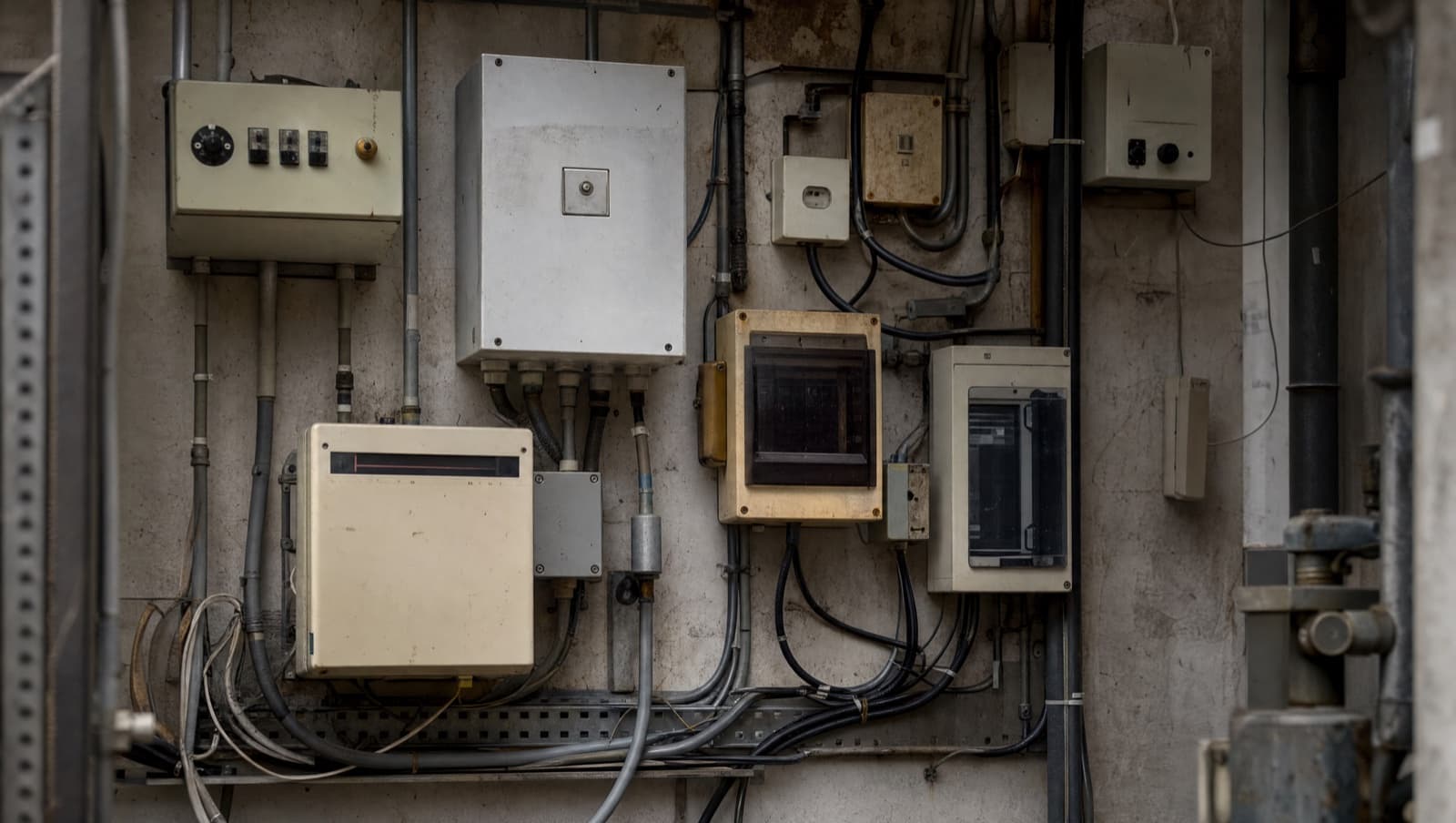

BMS field wiring connects the controller panel to every sensor, actuator, contactor and meter in the building. Done right, it uses the correct cable for each device, keeps signal and power circuits segregated under BS 7671:2018, terminates with ferrules and torque-checked screws, and is tested before commissioning. Done wrong, signals drift and communications fail.
What does BMS field wiring involve?
BMS field wiring covers everything between the controller panel and the devices it controls or monitors. In a typical commercial building, that includes temperature sensors (room, duct, pipe, and outside air), humidity sensors, pressure sensors and switches, CO2 sensors, valve actuators (2-port, 3-port, and butterfly), damper actuators, fan contactors and motor starters, status and alarm contacts, meters and sub-meters, and any third-party equipment that integrates via hard-wired signals.
Each device type has its own wiring requirements. A Pt1000 resistance temperature sensor needs a two-core screened cable, typically 1.0mm² or 1.5mm², with the screen earthed at the panel end only to avoid ground loops. A 0–10V analogue valve actuator needs a three-core cable (signal, common, and 24V AC supply), again screened. A fan contactor might need a volt-free contact pair for run status and a separate pair for trip alarm. Digital inputs from flow switches, frost stats, or fire damper end switches are simpler — two-core unscreened is usually adequate — but the routing still matters.
BS 7671:2018 Section 528 sets out the requirements for segregation of circuits. Extra-low voltage signal cables (Band I) must be segregated from mains voltage power cables (Band II). In practice, this means separate containment — you can't run a 230V fan supply cable and a sensor signal cable in the same trunking or conduit. On site, this is one of the most frequently violated requirements, particularly when the BMS wiring is done by the general electrical contractor rather than a specialist BMS installer. The result is electromagnetic interference on analogue signals, which manifests as unstable temperature readings, drifting humidity values, or valve actuators that hunt back and forth instead of holding position.
How do you wire BACnet and Modbus integration?
Hard-wired field devices are only part of the picture. Modern BMS installations increasingly rely on network integration to communicate with intelligent third-party equipment — variable speed drives, heat pumps, chillers, energy meters, and room controllers that have their own processors and speak a protocol rather than offering simple analogue or digital signals.
The two dominant protocols in commercial BMS are BACnet and Modbus. BACnet (BS EN ISO 16484-5 / ASHRAE 135) is the international standard for building automation communication and comes in several flavours: BACnet/IP runs over standard Ethernet infrastructure and is the preferred choice for backbone communication between supervisory stations and controllers. BACnet MS/TP runs over shielded twisted-pair RS-485 cabling and is typically used for field-level communication between controllers and intelligent devices. The MS/TP variant requires careful attention to bus topology — it must be a daisy-chain, not a star, with 120-ohm termination resistors at each end of the bus and proper addressing of every device on the trunk.
Modbus RTU, defined under BS EN 61158, is the other common protocol, particularly for energy meters, power analysers, and some HVAC plant. Like BACnet MS/TP, it runs over RS-485 and requires daisy-chain topology with end-of-line termination. We've covered the practical differences in depth in our Modbus vs BACnet comparison guide, but the key point for wiring and integration is that both protocols are sensitive to cable quality, cable length, termination, and grounding. A poorly wired RS-485 bus is one of the most common causes of intermittent communication failures in BMS systems.
For BACnet/IP integration, the wiring is standard Cat6 Ethernet, but the network configuration requires coordination with the building's IT team. Trend IQ4E controllers need static IP addresses, and the BMS traffic should ideally sit on a dedicated VLAN separated from the corporate network. This is both a performance measure and a cybersecurity requirement — IEC 62443, the standard for industrial control system cybersecurity, recommends network segmentation as a baseline security control for building automation systems.
What usually goes wrong with BMS wiring?
The list is long, and the same problems recur on projects where the wiring was done by a general electrician rather than a BMS specialist.
Incorrect cable types are common. Using standard twin-and-earth for analogue sensor circuits instead of screened cable. Using Cat5e instead of Cat6 for BACnet/IP runs that exceed 90 metres. Using unshielded cable for RS-485 bus runs in electrically noisy environments near VSD switchgear. Each of these shortcuts creates problems that don't show up until commissioning — and sometimes not until weeks after handover, when the FM team starts seeing unexplained alarm spikes or control instability.
Poor termination quality is another persistent issue. Ferrules not used on stranded conductors going into spring or screw terminals. Cable screens left floating instead of being connected to the panel earth bar. Cables pulled too tight around corners, damaging the insulation. Terminal screws not torque-checked, leading to high-resistance connections that cause intermittent faults. These are basic workmanship issues, but they account for the majority of BMS commissioning delays.
Labelling failures are endemic. Every cable should be labelled at both ends with a reference that matches the panel terminal schedule and the points schedule. On too many projects, we find cables with no labels at all, or labels written in marker pen that have smudged beyond legibility within six months. Alpha Controls uses printed cable labels and ferrules as standard, and every cable is photographed at termination for the as-built records.
Get a Free BMS Survey
We'll assess your controls and provide a detailed quotation.
How do you integrate third-party systems with a BMS?
One of the more technically demanding aspects of BMS wiring is integrating equipment that wasn't specified as part of the BMS package. A chiller with a Modbus RTU interface that needs to be monitored and controlled from the Trend IQ4E. A set of ABB variable speed drives with BACnet MS/TP cards that need to report speed, current, and fault status. A power monitoring system — perhaps Schneider EcoStruxure — that needs to share energy data with the BMS supervisor.
Each integration requires its own scope of work: the correct cable type, the correct protocol configuration, register mapping (for Modbus) or object binding (for BACnet), and point-to-point testing to verify that every data point reads correctly and every command executes as expected. The Trend IQ4E handles both BACnet and Modbus natively, which simplifies the controller side, but the field wiring and protocol configuration still need to be right.
CIBSE Commissioning Code M emphasises that integration testing should be treated as a distinct commissioning activity, separate from the testing of individual controllers. The BMS might work perfectly in isolation, but if the integration points aren't tested end-to-end — sending a command from the supervisor, through the controller, out via Modbus to the chiller, and verifying the chiller responds correctly — then the system hasn't actually been commissioned.
Why do registered electrical contractors matter for BMS wiring?
BMS wiring is electrical installation work, and under Part P of the Building Regulations (in domestic settings) and BS 7671 more broadly, it must be carried out by competent persons. For commercial buildings, the expectation is that the wiring contractor holds a recognised competent person scheme registration — NICEIC, NAPIT, or equivalent. Alpha Controls is not NICEIC registered. We carry out BMS and controls wiring to BS 7671:2018, and where the work requires certification that only a registered contractor may issue, we arrange it through an appropriately registered electrical contractor.
This matters for several practical reasons. Insurance policies on commercial buildings typically require that electrical work is carried out by registered contractors. Building control sign-off for refurbishment projects requires evidence of electrical compliance. And in the event of a fire or electrical incident, the question of whether the wiring was installed by a competent, registered contractor will be the first thing the investigation looks at.
What does good BMS wiring look like?
Good BMS wiring is wiring you can trust for the next 15 years. Every cable is the correct type and specification. Every termination is secure, ferrule-crimped, and torque-checked. Every cable is labelled at both ends with printed labels. Screens are earthed at the panel end only. Segregation between power and signal circuits is maintained throughout the cable route. RS-485 buses are correctly terminated and addressed. BACnet/IP networks are on dedicated VLANs with static IP addressing. And every circuit has been tested and documented before the commissioning engineer touches the system.
The test documentation should include point-to-point continuity test results, insulation resistance test results for power circuits, and network communication test results for every protocol integration. This documentation isn't bureaucracy — it's the evidence that the wiring phase was done right, and it's invaluable when a fault occurs three years later and the maintenance engineer needs to trace a circuit.
Who should carry out the BMS wiring phase?
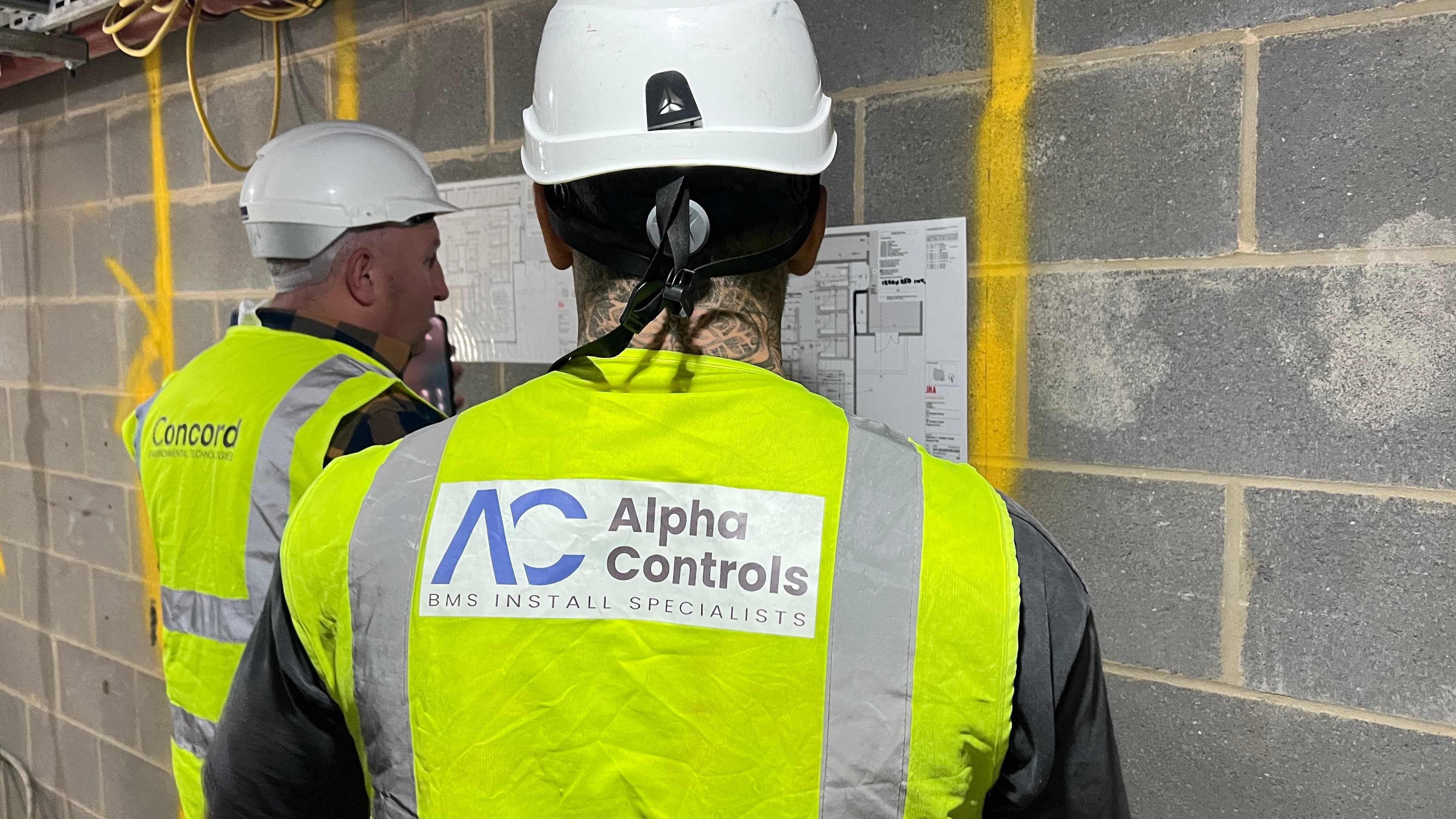
If you're managing a BMS project, the wiring and integration phase is where you need a contractor who understands both the electrical standards and the controls application. A general electrician can pull cables and make connections, but they may not understand why a sensor needs a screened cable, or why an RS-485 bus must be daisy-chained, or why the BMS traffic can't share a network switch with the office Wi-Fi.
Alpha Controls handles BMS wiring and integration as a specialist service across London, Kent, and the South East. Our wiring is installed to BS 7671:2018, the 18th Edition of the IET Wiring Regulations. Alpha Controls is not NICEIC registered; where certification from a registered contractor is required, we arrange and coordinate it through one. If you're planning a project and want the field wiring done to the right standard, get in touch or request a quote. For context on what comes after the wiring is done, read our post on BMS consultation and energy audits or explore the full Trend BMS guide.
Darren Pettit
Specialist BMS installation, commissioning, and maintenance across London and the South East. SafeContractor Approved, BCIA Member.