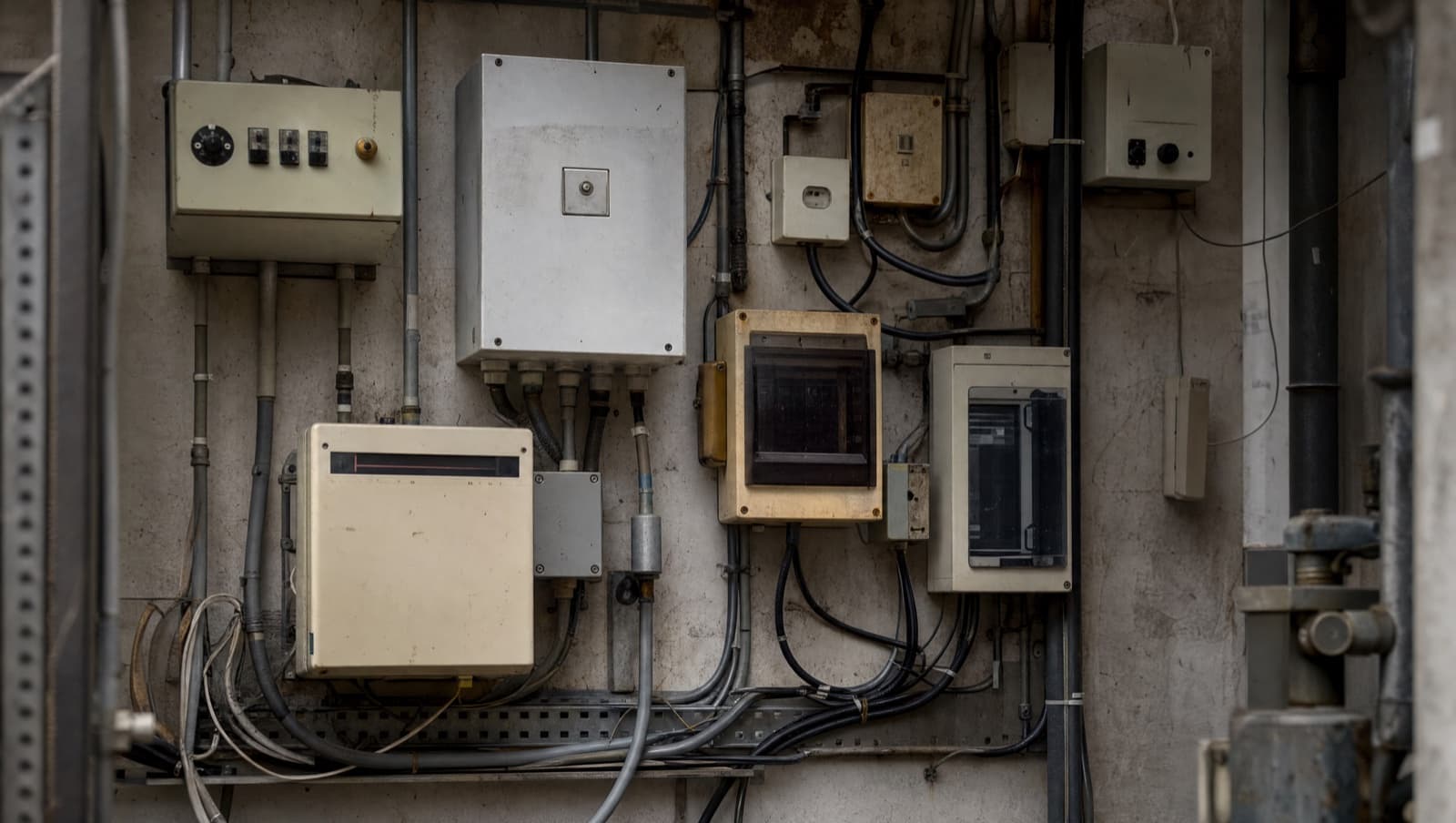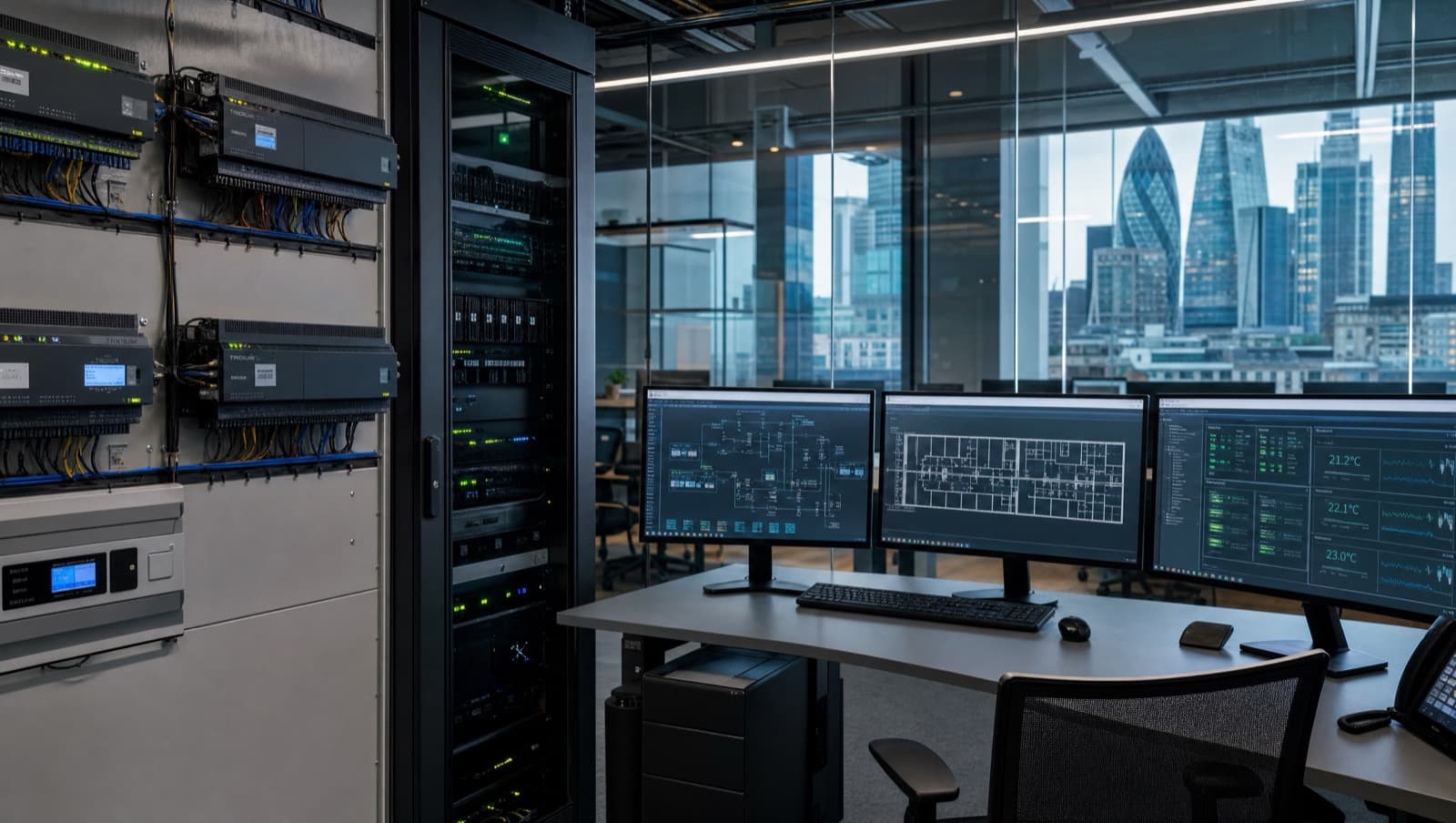

We get called into a lot of Kent sites where the mechanical side of a BMS install is fine — the controllers are the right ones, the strategy makes sense on paper — but nothing actually works, and the reason is nearly always electrical. Someone treated the BMS wiring as an afterthought. A general electrical contractor pulled some cable, terminated it to whatever looked right, and left the commissioning engineer to find out three weeks later that half the points are dead or crossed. We've walked onto sites where the panel was wired neatly, passed its inspection, and still didn't work — because the person wiring it had never seen a point schedule and had no idea what the cores were actually supposed to be doing.
BMS electrical work in Kent covers panel building and wiring, containment installation, field cable pulling, screen terminations and the segregation of control cabling from mains power. It's a specialist trade, not general electrical work with extra steps — a BMS electrical contractor needs to understand controller wiring diagrams, sensor loop types, and network topology as well as the wiring regs. Get it wrong and the mechanical strategy underneath it never gets a fair chance to run properly.
What BMS Electrical Work Actually Covers
On a typical job this starts with panel wiring — building out the BMS control panel from a schematic, terminating incoming supplies, wiring in the controller, I/O modules, relays and any local switching, and labelling every core so the commissioning engineer isn't guessing later. From there it's field wiring: running cable from the panel out to every device on the strategy — dampers, actuators, valves, sensors, VSDs — through containment that's been sized and routed properly, not just clipped along whatever's nearest.
Cable selection matters more than people expect. Analogue sensor loops and BACnet MS/TP network runs need screened, low-capacitance cable — typically Belden-type twisted pair — while power feeds to actuators are a different cable entirely. Terminations need to be done properly at both ends, screens landed correctly (usually at one end only, per the controller manufacturer's guidance, to avoid earth loops), and cores identified so a fault six months later doesn't mean tracing blind. On most of our Kent jobs we're also pulling containment through plantrooms and risers from scratch, which means coordinating with the M&E contractor on site rather than working around them.
Testing matters as much as the installation itself. Every field device should be loop-tested back to the panel before commissioning starts — continuity checked, insulation resistance confirmed, and the core landed at the panel verified against the core landed at the device. Skip that step and you end up with two dampers swapped on the schedule, and nobody notices until the commissioning engineer starts driving points and watches nothing move where it's supposed to.
Why It Matters More Than People Think
A BMS lives or dies on its field wiring. You can spec the best controller on the market and it won't compensate for a sensor reading garbage because its screen isn't terminated, or a damper that won't drive because two cores got swapped at commissioning. For FM teams and building owners the consequence isn't abstract — it's tenant complaints about temperature, plant running when it shouldn't, and engineers spending hours on call-outs chasing wiring faults instead of tuning strategy.
It also affects how the building performs against energy targets. CIBSE Guide H sets out that BMS point schedules and control strategies should be documented and traceable back to physical wiring — if the wiring doesn't match the schedule, no one can verify the strategy is doing what it's supposed to, and that undermines everything from BREEAM credits to basic energy reporting.
What Usually Goes Wrong On Site
The most common fault we find on Kent jobs isn't a bad controller — it's basic electrical practice that a BMS-aware installer would never let through. We see the same handful of issues repeatedly:
- Control and power cables run in the same containment with no segregation, causing interference on analogue signals near VSDs and pumps.
- No slack left at FCU or damper connections, so any future maintenance means re-pulling cable rather than reconnecting.
Beyond those two, we regularly find MS/TP network runs wired as a star instead of a daisy chain, which breaks BACnet communications intermittently and is a nightmare to diagnose remotely. We also find screens terminated at both ends — creating earth loops that show up as noisy, drifting sensor readings that look like a faulty device but aren't. And unlabelled cores in a panel that was wired by someone who wasn't going to be the one commissioning it, which means the engineer who comes in afterward is working blind with a multimeter for half a day before touching any strategy.
Get a Free BMS Survey
We'll assess your controls and provide a detailed quotation with energy savings estimates.
The Standards That Actually Apply
BS 7671:2018+A2:2022 (the IET Wiring Regulations, 18th Edition) is the baseline for any electrical work on a Kent site, and Section 528 is the one that matters most for BMS: it requires segregation between Band I circuits — extra-low-voltage control and data cabling — and Band II circuits — low-voltage mains power — unless every cable in the containment is insulated to withstand the highest voltage present. On a lot of the jobs we're called in to fix, that segregation simply wasn't done.
For panel wiring specifically, BS EN 60204-1 sets out conductor identification, colour coding and terminal marking requirements for electrical equipment on machines and control panels — the same discipline applies to a BMS panel as it does to any control panel, and it's the difference between a panel an engineer can service quickly and one they have to reverse-engineer. Where a network is BACnet MS/TP, BS EN ISO 16484-5 covers the cabling topology requirements — daisy-chain wiring with end-of-line termination resistors at both physical ends of the trunk, not a star topology and not termination in the middle of the run. Where sensor cabling runs near VSDs or pumps, as it does on most Kent plantroom jobs, the IEC 61000-4 EMC series sets out the screened cable and earthing practice needed to stop drive-induced noise corrupting the signal.
Working Around Occupied Kent Sites
A lot of our Kent work happens on buildings that don't stop for the contractor — schools running a full timetable, industrial units along the Thames corridor still operating shifts, offices with staff in every day. That changes how the electrical work has to be sequenced. Containment runs through occupied areas need to be planned around access windows, cable pulled and terminated in phases rather than in one continuous run, and any isolation of existing circuits coordinated properly with the client so nothing goes down unexpectedly. It's a different discipline to wiring a building during a ground-up fit-out where the whole floor is a blank canvas. At a Ramsgate secondary school we re-cabled the 24V window actuators and reinstated the BMS cabling during a roof replacement.
It also means documentation matters more, not less. On a phased job spread across several visits, if the panel and field labelling isn't consistent from day one, whoever's on site for the next phase is starting from scratch trying to work out what's already been done.
A Kent Job Where This Mattered
We picked up controls extras and BMS wiring work at a secondary school in north-west Kent where the existing field wiring hadn't been segregated from lighting and small power circuits sharing the same containment runs. Sensor readings were drifting throughout the day in a pattern that tracked almost exactly with occupancy-driven lighting loads switching on and off — classic induced interference. Re-routing the affected control cable into its own containment, away from the power runs, and re-terminating the screens correctly resolved it without touching a single line of controller strategy. The fault had nothing to do with the BMS logic and everything to do with how the cable had been pulled.
We're a Gravesend-based BMS contractor with Trend-trained engineers, and this is the pattern we see across most of our Kent work — Dartford, Maidstone, Sevenoaks, Tunbridge Wells, Medway, and the industrial units along the Thames corridor. The controller and the strategy are rarely the problem. The wiring underneath it is.
What Good BMS Electrical Work Looks Like
Good BMS electrical work starts with a panel schematic that's actually followed, not treated as a rough guide. Every core in the panel and in the field is labelled to match the point schedule. Containment is sized and routed with segregation designed in from the start, not retrofitted after someone notices interference. Screened cable is used on every analogue and network run, terminated at one end per the manufacturer's guidance, and there's enough slack at every device connection to allow for maintenance without re-pulling cable. Network cabling follows proper daisy-chain topology with EOL resistors fitted correctly, and the whole thing is tested and documented before the commissioning engineer even sets foot on site.
That last part is what separates a BMS electrical contractor from a general electrician doing BMS wiring as a side job — understanding that the wiring has to serve the commissioning process, not just pass a visual inspection. It's the standard our BMS electrical team works to on every Kent job.
When To Get Someone To Check It
If you're inheriting a BMS installation on a Kent site — a fit-out handover, a change of FM contractor, or a system that's never worked properly since day one — it's worth getting the electrical side checked before assuming the controller strategy is at fault. Symptoms like sensors drifting at the same time every day, dampers or valves that won't respond consistently, or a BACnet network that drops out intermittently are all classic signs of a wiring issue rather than a software one. Catching it early, before a full retrofit, usually means a fraction of the cost. A short site survey is normally enough to tell you whether you're looking at a wiring fault or a genuine strategy problem, before committing to a bigger piece of work.
Get It Wired Right First Time
BMS electrical installation in Kent is a specialist job, and it's usually the part of a project that gets the least attention until something stops working. If you're planning a new install, inheriting an existing system, or chasing a fault that doesn't make sense, request a quote or get in touch and we'll take a proper look at what's actually going on behind the panel door. You can read more on our approach to BMS installation across Kent or see how we handle control cabling and containment on live sites.
Alpha Controls Team
Specialist BMS installation, commissioning, and maintenance across London and the South East. SafeContractor Approved, BCIA Member.