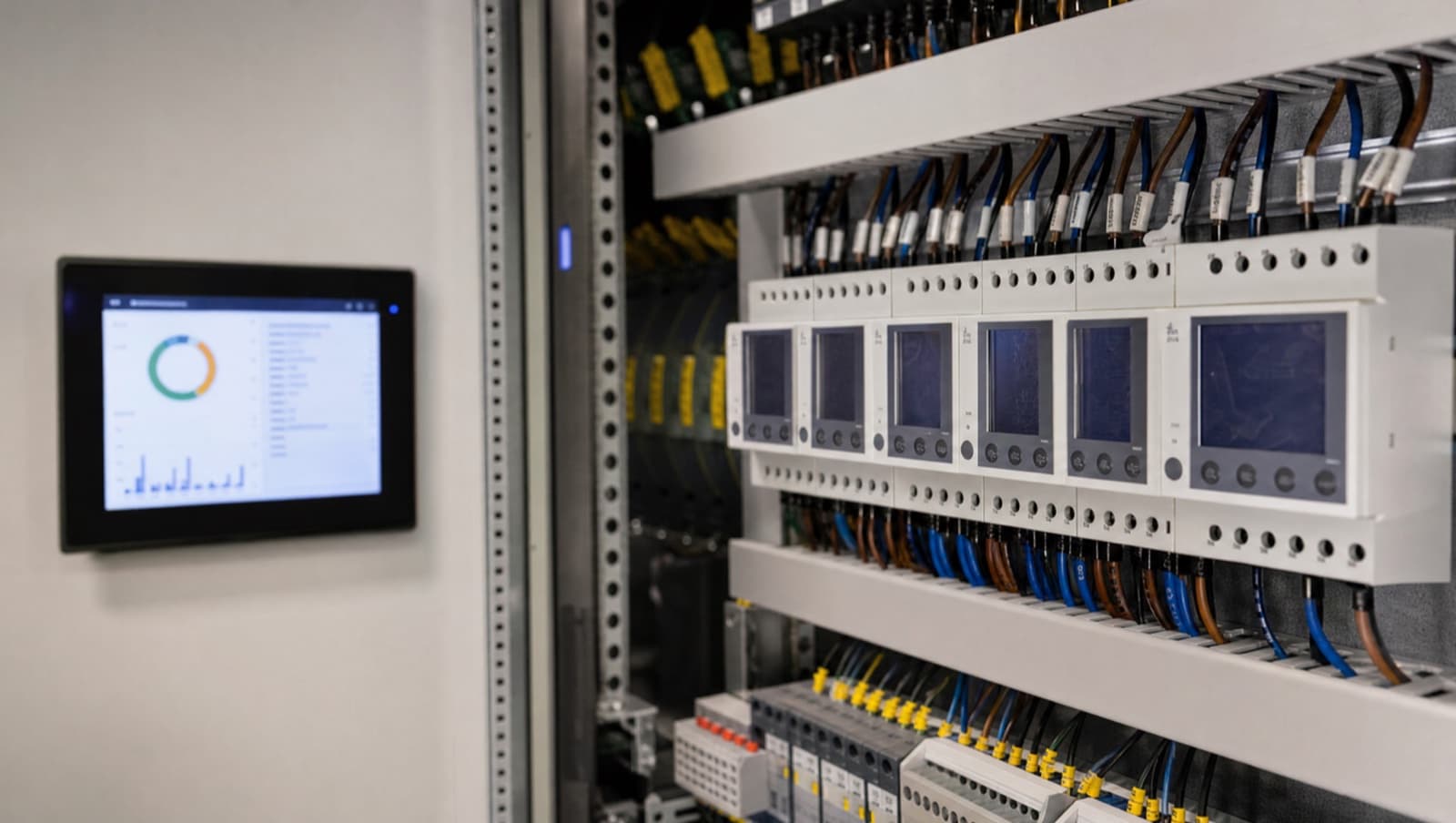

Property and building management companies in London and Kent need a specialist BMS maintenance partner with named controls engineers, defined response times, and genuine platform expertise across Trend, Distech, Schneider, and Siemens. A well-maintained building management system controls heating, cooling, ventilation, lighting, and metering, and is one of the most cost-effective routes to a better EPC rating.
If you manage a commercial property portfolio in London or Kent, you already know the pressure is building. Tenants expect comfortable, well-controlled environments. Landlords want energy costs down. Regulations — particularly MEES — are tightening every year. And somewhere in the middle of all of this sits a building management system that nobody on your team fully understands, maintained by whoever was cheapest on the last tender.
That's the reality for most property management companies in London and building management companies in Kent. The BMS is the single system that touches every mechanical and electrical service in the building — heating, cooling, ventilation, lighting, metering — and yet it's routinely the least understood and worst maintained piece of infrastructure on site.
This post is for property managers, building managers, and FM leads who know something isn't right with their BMS support — but aren't sure what good looks like.
Why do property management companies need a specialist BMS contractor?
A BMS is not a fire alarm. It's not a lift. You can't just call any M&E contractor and expect them to diagnose a faulty optimiser routine, trace a comms dropout on a Trend LAN, or reconfigure an AHU sequence after a plant replacement. BMS work requires specific platform knowledge — whether that's Trend, Siemens, Distech, or Schneider — and practical experience with the way these systems behave in occupied commercial buildings.
Most property management companies in Kent and London end up in one of two traps. Either they bundle BMS maintenance into a general M&E contract where nobody on the team has controls experience, or they rely on the original installer who may have moved on, been acquired, or simply lost interest in a small maintenance contract. In both cases, the building drifts. Schedules slip. Sensors fail without anyone noticing. Energy consumption creeps up. Tenant complaints increase. And by the time someone flags it, the cost to fix is significantly higher than it would have been with proper ongoing support.
The smarter approach — and what we see from the better-run building management companies in London — is to have a dedicated BMS maintenance partner with named engineers, defined response times, and genuine platform expertise. Not a generalist. Not a subcontractor three layers removed from the actual controls.
What do building management companies in Kent and London typically get wrong?
We've taken over BMS maintenance on dozens of buildings across the South East, and the same problems come up again and again. Time schedules set years ago that no longer match occupancy patterns — heating running from 5am when the building doesn't open until 8. Optimum start disabled because someone didn't understand it. Sensors drifting by 3-4 degrees with no recalibration programme in place. Trend alarms suppressed rather than investigated. Damper actuators failed-open on AHUs, dumping fresh air into the building at full rate in January.
None of this is unusual. It's what happens when a BMS doesn't have a competent set of eyes on it regularly. The system still runs — it just runs badly. And the property manager gets the complaints, the high energy bills, and eventually the difficult conversation with the landlord about why the EPC rating has slipped.
The other common mistake is treating BMS maintenance as purely reactive. Something breaks, you call someone, they fix it. That model doesn't work for building controls because the whole point of a BMS is proactive management — optimising plant operation, reducing energy waste, maintaining comfortable conditions without running everything at full capacity. If your maintenance contract is just break-fix, you're paying for a BMS but not actually using it.
How does MEES affect commercial property in London and Kent?
This is where it gets urgent. The Minimum Energy Efficiency Standards (MEES) regulations are tightening on a trajectory that will catch a significant number of commercial buildings in London and Kent off guard. Currently, commercial properties in England and Wales require a minimum EPC rating of E to be legally let. By 2027, that rises to Band C. By 2030, Band B.
The numbers are stark. Research from the Better Buildings Partnership and JLL estimates that around 58% of London office stock currently sits below Band B. That's more than half the commercial office space in the capital facing a compliance cliff within the next four years. For property management companies in London, this isn't a theoretical problem — it's a ticking clock on every building in the portfolio that hasn't been upgraded.
Here's what matters for BMS: a well-commissioned, properly maintained building management system is one of the most cost-effective ways to improve an EPC rating without major capital expenditure on plant. Optimum start/stop, weather compensation, demand-controlled ventilation, LED lighting schedules, accurate metering — these are all BMS functions that directly affect the energy model. CIBSE Guide H — the industry reference for building control systems — makes clear that control strategy is fundamental to achieving design energy performance, and that poorly configured controls are one of the most common reasons buildings underperform against their rated efficiency.
If you're a building management company in Kent or London with MEES deadlines approaching on your portfolio, the BMS should be the first thing you look at — not the last.
Get a Free BMS Survey
We'll assess your controls and provide a detailed quotation.
What does a proper BMS maintenance contract include?
A good BMS maintenance contract for a property management company isn't just a line item that says "BMS — quarterly visit." It should be specific, measurable, and aligned with the actual needs of the building. Here's what we include as standard on our managed contracts, and what you should be looking for from any BMS partner.
Planned preventative maintenance visits — typically quarterly for standard commercial buildings, monthly for complex or multi-system sites. Each visit should include a full review of time schedules against current occupancy, sensor spot-checks against calibrated reference instruments, alarm log review and investigation of recurring faults, trending data analysis for drift and anomalies, and a written report with recommendations. Beyond the planned visits, the contract should define emergency response times (we work to 4-hour response for critical faults across London and Kent), remote monitoring capability, and a clear escalation path.
BSRIA BG 54/2018 — BMS Life Cycle Management sets out a structured framework for exactly this. It covers the full lifecycle from design through operation to eventual replacement, and critically, it defines what "good" BMS maintenance looks like in operational terms. The guide makes the point that BMS components have defined service lives — typically 10-15 years for controllers, 5-7 years for sensors and actuators — and that a maintenance strategy should include planned replacement before failure, not just repair after breakdown. If your current BMS maintenance contract doesn't reference lifecycle planning, it's incomplete.
How does a dedicated BMS partner help with a multi-site portfolio?
For property management companies in London managing multiple buildings, one of the biggest operational gains from a dedicated BMS partner is consistency across the portfolio. Different buildings, different ages, different BMS platforms — but one team that knows all of them, one set of standards for reporting, one point of contact when something goes wrong.
We manage multi-site portfolios for several property and facilities management companies across the South East. The value isn't just in the individual site visits — it's in the cross-site intelligence. When we see a particular sensor type failing early on one building, we can proactively check and replace across the portfolio before it becomes a fault. When a firmware update causes issues on one controller platform, we know to hold off on the others until the fix is confirmed. That kind of joined-up thinking only comes from a partner who understands the portfolio as a whole, not just individual buildings in isolation.
For building management companies running mixed portfolios — some Trend, some Siemens, some Distech — having a single BMS contractor who can work across platforms is particularly valuable. It eliminates the coordination overhead of managing three separate specialist firms and gives you a single source of truth for controls performance across the estate.
Which areas does Alpha Controls cover for BMS support?
Alpha Controls is based in Kent, which puts us in an ideal position to serve both the Kent commercial property market and Central London. Our engineers are regularly on site across Canary Wharf, the City, West End, and Southbank, as well as throughout Kent, Surrey, and the wider South East.
For building management companies in Kent, we're local. Response times are fast, site knowledge is deep, and we're not charging London travel rates to reach you. For property management companies in London, we offer the same platform expertise and response commitments as any London-based firm, typically at a more competitive rate — because we're not carrying Central London overheads.
We work across Trend, Distech, Schneider, and Siemens platforms. Most of our engineers hold manufacturer-specific accreditations, and we carry common spares for all four platforms so that first-visit fix rates stay high.
What does a real BMS project look like? The Pinsent Masons 16-floor FCU upgrade
To give you a concrete example of what this looks like in practice: we recently completed a full FCU controls upgrade at the Pinsent Masons office — a 16-floor commercial building requiring weekend-only access to avoid disruption to the legal practice operating across the building during the week.
The project involved replacing legacy fan coil unit controllers with new Trend controllers across all 16 floors, integrating LightFi wireless sensors for occupancy-based demand control, and commissioning the entire system floor-by-floor within the weekend access windows. Every floor had to be handed back operational by Monday morning — no exceptions.
This is the kind of project that separates a specialist BMS contractor from a generalist. The access constraints alone required detailed programming and logistics planning. The Trend controller configuration had to be templated and pre-loaded to minimise on-site commissioning time. The LightFi integration needed careful coordination between the wireless sensor network and the Trend BMS to ensure occupancy data fed through correctly to the FCU control sequences.
The result: a fully modernised controls layer across the building, demand-driven FCU operation reducing energy consumption, and zero disruption to the tenant. That's what good BMS project delivery looks like for a property management company at Pinsent Masons — and it's the standard we hold ourselves to on every job.
Which standards govern BMS support? CIBSE Guide H and BSRIA BG 54/2018
Two standards are particularly relevant for property and building management companies evaluating their BMS support arrangements.
CIBSE Guide H: Building Control Systems is the definitive UK reference for BMS design, specification, and operation. It covers everything from control strategies and system architecture to commissioning and handover requirements. For property managers, the key sections are those dealing with operational performance — specifically, the guidance on how control systems should be maintained and monitored post-handover to ensure they continue delivering the design intent. Guide H is clear that a BMS left unmanaged after commissioning will degrade in performance, and that regular review of control strategies is essential to maintaining energy efficiency and occupant comfort.
BSRIA BG 54/2018: BMS Life Cycle Management takes a more practical, lifecycle-oriented approach. It provides specific guidance on maintenance frequencies, component replacement intervals, and the total cost of ownership for BMS installations. The guide recommends that BMS controllers be budgeted for replacement every 10-15 years, with sensors and actuators on shorter cycles. For any property management company holding buildings long-term, this lifecycle perspective is essential for accurate budgeting and avoiding the "surprise" capital expenditure that comes from running systems to failure.
When should you review your BMS support arrangements?
If you're a property management company or building management company in London or Kent and any of the following apply, it's time to review your BMS support arrangements: your current BMS contractor is a generalist M&E firm with no named controls engineers; you haven't had a proper BMS health check in over 12 months; your energy costs are rising without a clear explanation; tenant comfort complaints are increasing; you have buildings approaching MEES Band C or Band B deadlines with no upgrade plan; or you're managing a multi-site portfolio with inconsistent BMS performance across buildings.
The cost of poor BMS maintenance compounds over time. Every month of suboptimal control is a month of wasted energy, unnecessary wear on plant, and missed opportunities to improve the building's EPC rating before the regulatory deadline hits.
How to get specialist BMS support in London and Kent
Alpha Controls provides specialist BMS maintenance, commissioning, and project delivery for property and building management companies across London and Kent. Whether you need a single-site maintenance contract or portfolio-wide BMS support, we'd be happy to have a conversation about what's not working and how we can help.
Get in touch here or request a quote to discuss your requirements. No hard sell — just a straightforward conversation about your buildings and what they need.
Frequently Asked Questions
How much does BMS maintenance cost for a property management company in London?
It depends on the size and complexity of the portfolio, but for a typical single commercial building in London with a Trend or Distech BMS, you're looking at between £3,000 and £8,000 per year for a planned maintenance contract with quarterly visits and emergency call-out cover. Multi-site portfolios benefit from economies of scale. The real question isn't the cost of maintenance — it's the cost of not maintaining, which shows up as higher energy bills, shorter plant life, and failed EPC ratings.
Can one BMS contractor manage buildings with different control platforms?
Yes — and for property management companies running mixed portfolios, this is the ideal setup. Alpha Controls works across Trend, Distech, Schneider, and Siemens platforms. Having one contractor who understands all the systems in your portfolio means consistent reporting, faster cross-site fault diagnosis, and no coordination overhead between multiple specialist firms.
What's the difference between BMS maintenance and BMS monitoring?
Monitoring means watching — typically via a remote connection to the BMS head-end — for alarms, trends, and anomalies. Maintenance means acting: planned visits, sensor recalibration, schedule reviews, software updates, and component replacement. You need both. Monitoring without maintenance just means you find out about problems faster but still can't fix them. A good BMS contract includes both elements as standard.
How do I improve my building's EPC rating through the BMS?
Start with the low-hanging fruit: ensure optimum start/stop is active and correctly configured, review all time schedules against actual occupancy, check that weather compensation is enabled on heating circuits, verify that demand-controlled ventilation is working (not overridden), and confirm that metering data is accurate and feeding into the energy model. These are all BMS functions that directly impact the EPC calculation, and in many buildings, they're either disabled, misconfigured, or have never been set up properly in the first place.
Do building management companies in Kent need a London-based BMS contractor?
No — and in most cases, a Kent-based specialist will give you better service at a lower cost. Alpha Controls is based in Kent and covers the entire South East including Central London. For Kent-based properties, you get faster response times, lower travel costs, and a team that knows the local building stock. We work with several building management companies in Kent and FM companies across the county who value having a local BMS partner with genuine platform expertise.
Alpha Controls
Specialist BMS installation, commissioning, and maintenance across London and the South East. SafeContractor Approved, BCIA Member.