
BMS lifecycle planning manages building controls as long-life assets: a register of every controller and supervisor, each scored by obsolescence risk and operational criticality, funded across several financial years in priority order. It replaces reactive, failure-driven upgrades — where an emergency callout can cost three times a planned job — with a costed, defensible programme.
Ask most facilities teams when their next building management system upgrade is happening and you get the same answer: when it breaks. That is not a plan — it is a queue, and everything in it is waiting for a failure to jump to the front. The controller that dies in February takes the whole heating call with it, the emergency callout costs three times a planned job, and the budget it comes out of was earmarked for something else. BMS lifecycle planning is the discipline that gets an estate off that treadmill: knowing what controls hardware you own, how close each part of it is to the end of its usable life, and which upgrades to fund in which financial year — before the panel forces your hand.
This is a portfolio decision, not a plant-room one. When a single panel has already failed, you are choosing between repair, retrofit and replacement on that system. For an immediate repair, retrofit or replacement decision, see our end-of-life BMS guide. Lifecycle planning sits a level above that: it is how a facilities director looks across ten buildings, or ten plant rooms in one building, and decides the order and the budget for the whole programme.
Start with a building-controls asset register
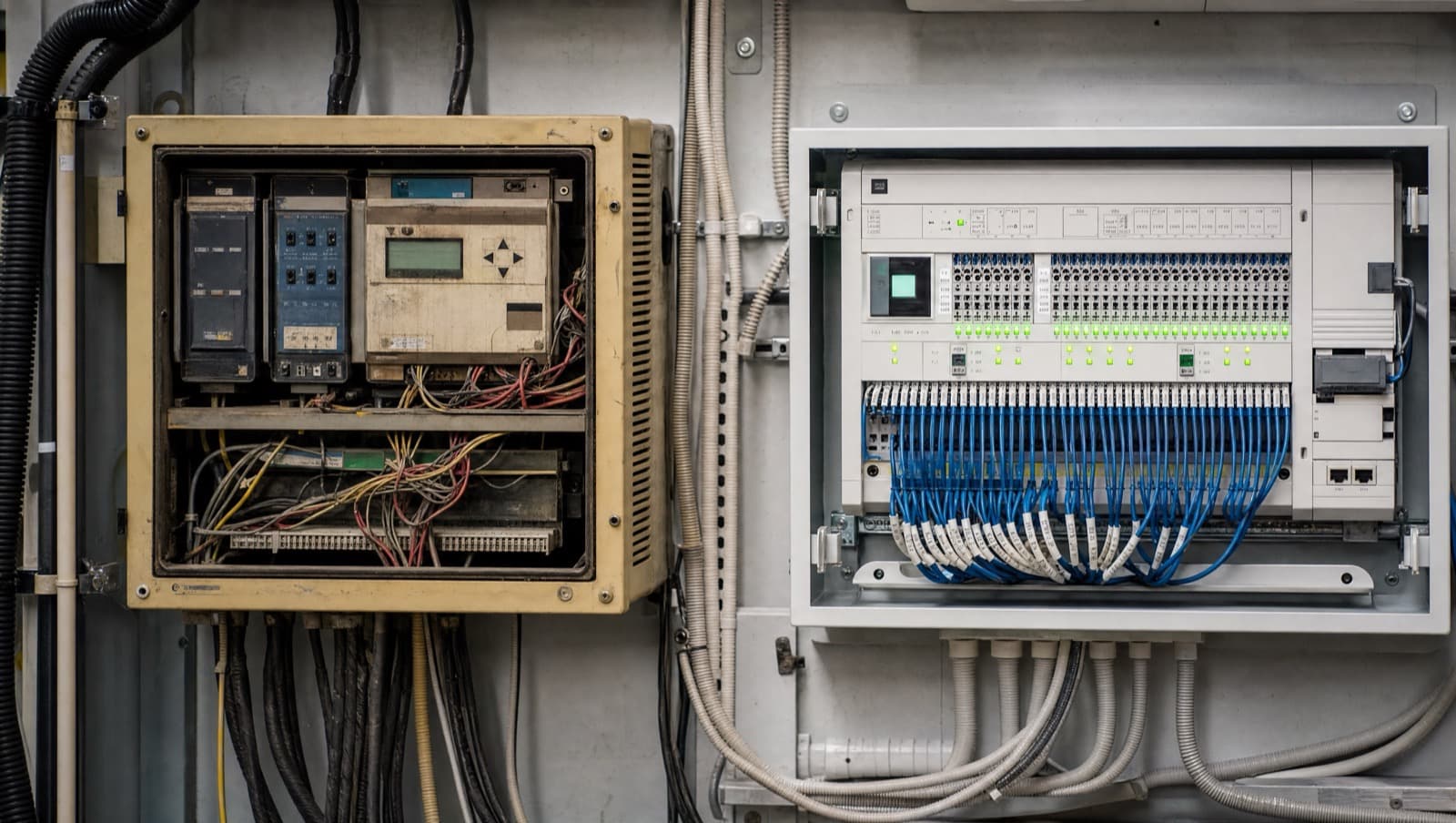
You cannot plan the replacement of assets you have never listed. The foundation of any BMS lifecycle strategy is a controls asset register — a single record of every supervisor, every controller, and the network that ties them together, across every building in scope. Most estates do not have one. They have a maintenance contract, a folder of commissioning documents from whenever the system went in, and a collective memory that walks out of the door when an engineer retires.
A useful register captures, per site and per system, the information you need to make a funding decision rather than a guess:
- Head-end and supervisor: make, software version, the operating system it runs on, and whether either is still supported by the manufacturer.
- Field controllers: range, approximate age or install date, quantity, and whether replacements are still manufactured or only available refurbished.
- Network and protocol: is the system on an open protocol such as BACnet, a proprietary bus, or a mix — and can it reach the IT network.
- Documentation: whether a current points list and network diagram actually exist, or whether every fault starts with an investigation.
- Plant served and its own remaining life, so you never spend twice by upgrading controls onto a boiler due for the scrapyard.
Building this once is a survey exercise; keeping it current is a habit. The register is the document every later decision references, and the one that stops a controls strategy resetting to zero every time a person leaves.
Understand the three obsolescence clocks
Obsolescence in a BMS is not one deadline — it is three, running at different speeds, and lifecycle planning means tracking all three per asset. The first is hardware and spares: can you still buy a replacement controller or output card, or are you sourcing used units and hoping. The second is software and operating-system support: is the supervisor running on an OS the manufacturer still patches, and does the front end still receive updates. The third is people and skills: is there anyone, in your team or your supply chain, who can competently engineer this specific system without breaking something else.
A system can be fine on two clocks and finished on the third. Serviceable field controllers can sit behind a head-end nobody can safely log into; a modern graphics package can be talking to controllers that stopped being made a decade ago. The software clock matters more than most registers admit, because an unpatchable supervisor on the operational network is a live security exposure, not just an efficiency one — the same asset ages on the hardware clock and the cyber clock at once. That overlap is worth reading alongside our guide to BMS cyber security, because obsolescence and exposure are frequently the same panel.
Score every system by risk and criticality
Once the register exists, lifecycle planning becomes a prioritisation problem: with a fixed budget, which systems get done first? The honest answer is not "the oldest" — age alone is a weak signal. A twenty-year-old system controlling a comfort-only office floor is a lower priority than a twelve-year-old one holding temperature in a server room or a care setting. The two dimensions that actually rank a programme are obsolescence risk and operational criticality.
Obsolescence risk is the register data turned into a score: unsupported software, unavailable spares, proprietary networks and lost documentation each push a system up the list. Operational criticality asks what happens to the building, its occupants and its income if that system stops — a plant room serving a data hall, a hospital ward or a single-let tenant with an uptime clause scores far higher than a store cupboard's fan coil. Multiply the two and you get a defensible ranking that a finance director can read: the systems in the top-right of that grid are the ones a reactive failure would hurt most and are least able to be quickly fixed, so they are the ones to fund first.
The point of scoring is not precision to two decimal places; it is consistency. A repeatable method applied across the estate lets you compare a school boiler house against a commercial reception and defend the order to whoever signs the cheque.
Get a Free BMS Survey
We'll assess your controls and provide a detailed quotation with energy savings estimates.
Turn the ranking into a phased, multi-year programme
A ranked list is not yet a plan — a plan attaches it to money and to years. The value of lifecycle planning is that it spreads controls capital expenditure across several financial cycles instead of colliding with a single one, and it groups work so that engineers are not mobilised to the same building five times. Grouping upgrades by building, by floor or by plant system keeps mobilisation costs down and lets you take a whole risk down in one visit rather than chipping at it. Once a system reaches the front of that queue, the choice narrows to the retrofit-or-replace decision on a single BMS upgrade.
A common and effective shape is head-end first: replacing the supervisor and front end across the estate early gives you modern graphics, alarming and trending on day one and ends the "nobody logs in" problem, then field controllers migrate progressively as budget and access allow, building by building, over the following years. The building stays occupied and operational throughout, and each year's spend is known in advance rather than discovered when something trips. That predictability is the entire commercial argument: planned controls work is specified, competitively priced and scheduled around the building; a reactive replacement is an emergency callout at a premium, on the coldest week, with whoever is available. Tracking that programme across many buildings is easier with a single supervisory view — see our guide to scalable multi-site BMS management for how to monitor an entire portfolio from one platform.
Where the standards set your direction of travel
Lifecycle planning is not only defensive. The regulatory and standards landscape is steadily raising the floor for what commercial controls are expected to do, which means an upgrade programme is also a compliance and performance programme. BS EN ISO 52120-1:2022 classifies building automation and control systems from Class D up to Class A, and for offices its calculation factors attribute around 30% lower thermal energy to Class A than the reference Class C, and roughly 51% higher to Class D. Those are the standard's attributed calculation factors rather than a guaranteed saving for any one building, but they give a lifecycle plan a target: a great many 1990s and 2000s systems are still operating at Class C or D functionality, and the register should record where each system sits so the programme can move it up.
New-build policy already points the same way. Since 15 June 2022, Approved Document L Volume 2 (2021 edition) has required new non-domestic buildings in England with heating or air-conditioning output over 180 kW to have a building automation and control system fitted. Regulation is asking for more controls capability over time, not less, which makes a plan to keep an estate's controls current a plan to keep it compliant. And the commercial-property trigger is now dated: the government's June 2026 interim response on MEES confirmed its intention that privately rented commercial buildings over 1,000 m² reach EPC B by 2031 where cost-effective, dropping the earlier 2027 EPC C milestone. That is a confirmed policy intention still subject to secondary legislation, not yet law — but it turns controls strategy into a portfolio sequencing decision with a real horizon, and controls upgrades are among the most cost-effective levers for an EPC band because they change how existing plant is run rather than replacing the plant. The BCIA has been campaigning specifically for wider adoption of Class A controls in UK non-domestic buildings for this reason, and with the built environment responsible for around 25% of UK carbon emissions according to the UK Green Building Council, the direction is not in doubt.
Make it a cycle, not a one-off
A lifecycle plan written once and filed is just a survey with ambitions. The discipline is the annual review: revisiting the register each year, ageing every asset forward, recording any end-of-support notices that have landed, adjusting the risk scores, and rolling the programme on. Manufacturers issue end-of-life letters, spares lead times stretch, a key engineer moves on — each of those is a signal that belongs in the register, moving a system up or down the queue before it becomes an emergency. Maintenance frameworks such as CIBSE Guide M and the SFG20 maintenance standard give the planned-preventive backbone this sits on; lifecycle planning is the strategic layer above the maintenance schedule, deciding not just how to keep each system running but when to stop keeping it running and replace it instead.
Done well, this is what separates an estate that never has a controls crisis from one that lurches between them. The systems get replaced in a good year, at a fair price, before they fail, in the order that risk dictates — and the budget line is a known number in a spreadsheet rather than a shock in February. If your systems are already showing their age, our guide to the signs a BMS needs recommissioning is a useful first read, and if you want a broader primer, what a building management system actually is sets the context. When you are ready to turn a plant-room walk into a costed multi-year programme, get in touch and we will help you build the register and the sequence behind it.
Alpha Controls Team
Specialist BMS installation, commissioning, and maintenance across London and the South East. SafeContractor Approved, BCIA Member.