
A school BMS upgrade typically costs between £15,000 and £120,000 and cuts HVAC energy bills by 25-40%. Funding routes include Salix interest-free loans, the DfE Condition Improvement Fund, School Condition Allocation, and the Low Carbon Skills Fund. Most installation happens during the six-week summer holiday to avoid disrupting teaching.
Alpha Controls has delivered BMS upgrades for schools, colleges, and universities across London and the South East. Everything in this guide comes from that experience — not theory, not manufacturer brochures, not a general commercial building guide repurposed with the word "school" dropped in. For a broader introduction to what a BMS does in education buildings and the ventilation standards that apply, see our guide to BMS for schools and education buildings.
How much does a school BMS upgrade cost in the UK?
A school BMS upgrade costs £15,000 to £120,000 in the UK, depending on the size and complexity of the school. A single-form-entry primary school with one boiler, a few radiator circuits, and no mechanical ventilation typically costs £15,000 to £30,000 for a full BMS upgrade. This covers a new outstation controller, room temperature sensors, motorised valve actuators on heating circuits, an outside air temperature sensor for weather compensation, and a web-based supervisor for the site manager. The scope is straightforward because the mechanical systems are simple.
A two or three-form-entry primary school with multiple boilers, underfloor heating zones, or a kitchen extract system adds complexity. Budget £25,000 to £45,000. The additional cost comes from more zone valves, more sensors, and potentially CO2 monitoring in classrooms for BB101 compliance.
A secondary school or large academy with multiple buildings, air handling units, sports hall ventilation, catering extract, and IT suite cooling typically costs £50,000 to £120,000. The scope includes multiple outstation controllers networked together, demand-controlled ventilation in teaching spaces, integration with existing fire alarm panels for AHU shutdown, and a centralised supervisor with remote access for the estates team. For a detailed breakdown of BMS upgrade costs across all building types, see our BMS retrofit cost guide for the UK.
What is included in a school BMS upgrade cost?
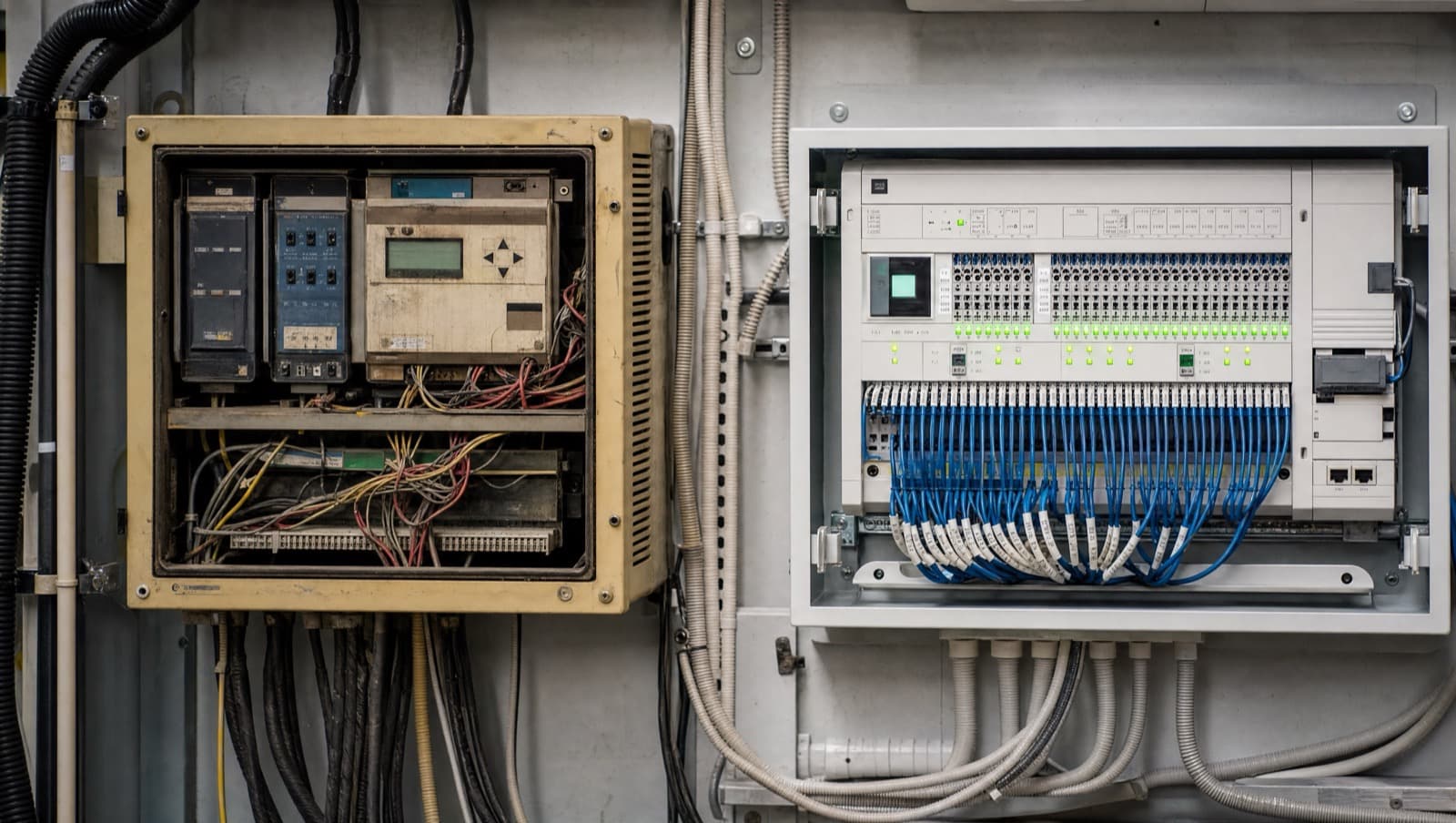
A typical school BMS upgrade quotation includes: new DDC controllers to replace obsolete outstation hardware, room temperature sensors in each controlled zone, CO2 sensors in classrooms for BB101 demand-controlled ventilation, motorised valve actuators on heating circuits, an outside air temperature sensor for weather compensation and optimum start, cabling between controllers, sensors, and actuators, a web-based supervisor with remote access capability, full commissioning including setpoint tuning and schedule programming, term date calendar setup, training for the site manager, and a 12-month defects liability period. Items not typically included but sometimes required are: new cabling containment or trunking, asbestos surveys or removal in older buildings, structural alterations to plant rooms, and electrical supply upgrades to panels. Alpha Controls provides fully itemised quotations so there are no surprises.
What does a college BMS upgrade cost?
FE college BMS upgrades typically cost £30,000 to £100,000 depending on campus size and the diversity of building types. Colleges with specialist spaces — workshops with local extract ventilation, IT suites with dedicated cooling, laboratories with fume cupboards, catering kitchens, and sports halls — require more zones and more complex interlock sequences than a standard classroom block. A single college building of 2,000-3,000 square metres typically costs £40,000 to £70,000. Multi-building campuses should budget £80,000 to £150,000 for a phased upgrade.
What does a university BMS upgrade cost?
University campus BMS upgrades are typically planned as multi-year phased programmes. A single faculty building costs £50,000 to £150,000 depending on the number of plant items, laboratories, and specialist spaces. A campus-wide programme covering 10-20 buildings over three to five years runs from £500,000 to £2 million. The summer recess provides the primary installation window, with each summer tackling two to four buildings. For our detailed guide to planning a university BMS upgrade around the academic calendar, see our article on university BMS upgrades during the summer recess.
How do schools fund a BMS upgrade?
Funding is the biggest barrier to school BMS upgrades, but several funding routes exist specifically for energy efficiency improvements in education buildings. Alpha Controls provides the technical specifications, energy savings calculations, and carbon reduction data required for all of the following funding applications.
Can Salix Finance fund a school BMS upgrade?
Salix Finance provides interest-free loans to public sector organisations for energy efficiency projects. BMS upgrades are one of the most commonly funded project types because the energy savings are well-documented and payback periods are typically 3-7 years. Salix requires a completed application form with project specification, energy savings calculations showing annual kWh and cost savings, carbon reduction data in tonnes of CO2e per year, and evidence that the project achieves a simple payback of 12 years or less. A BMS upgrade with a 4-year payback and 30% energy saving is a strong Salix application. Alpha Controls has supported multiple successful Salix-funded BMS projects in schools.
Does a school BMS upgrade qualify for Condition Improvement Fund (CIF) funding?
The DfE Condition Improvement Fund provides capital grants for academy trusts and sixth-form colleges to address building condition needs. BMS upgrades qualify under energy efficiency and health and safety categories — particularly where the existing controls are contributing to overheating, poor ventilation, or excessive energy consumption. CIF applications are competitive and require a strong evidence base linking the BMS upgrade to measurable improvements in building performance. Successful applications typically include thermal imaging showing poor zone control, CO2 monitoring data demonstrating inadequate ventilation, and energy benchmarking data showing the school above DfE consumption benchmarks.
Can maintained schools use School Condition Allocation (SCA) for a BMS upgrade?
Local authority maintained schools receive School Condition Allocation funding from the DfE. This can be used for BMS upgrades where the work falls within the definition of maintaining and improving school buildings. The decision to fund a BMS upgrade from SCA sits with the responsible body — either the local authority or the school governing body depending on the funding agreement.
What is the Low Carbon Skills Fund (LCSF)?
The Low Carbon Skills Fund provides grants for feasibility studies into decarbonisation projects. If a school is considering a BMS upgrade as part of a wider decarbonisation plan — for example, alongside heat pump installation or solar PV — an LCSF-funded feasibility study can establish the business case and specification at no cost to the school. The study outputs feed directly into capital funding applications.
Can a school fund a BMS upgrade from energy savings?
Schools spending £80,000 to £120,000 per year on energy that achieve a 30% saving through BMS optimisation free up £24,000 to £36,000 per year. Against a BMS upgrade cost of £40,000 to £60,000, the payback is under two years. Some academy trusts fund BMS upgrades directly from operational budgets on this basis, treating it as an investment with a guaranteed return rather than an expense. Schools with genuinely failed hardware rather than merely dated hardware should read how to decide a BMS upgrade: retrofit or replace.
When should a school BMS upgrade be installed?
The summer holidays provide the longest uninterrupted access window for school BMS upgrades — typically six weeks from mid-July to early September. This is enough time for a complete single-building BMS upgrade including controller replacement, sensor installation, cabling, commissioning, and snagging.
What does the summer holiday installation timeline look like?
A typical summer installation programme runs as follows. Weeks one and two: strip out existing controllers, install new outstation hardware, run cabling between controllers and field devices. Week three: install room sensors, valve actuators, and duct-mounted sensors. Week four: terminate all cabling at controllers, power up and commission point-by-point. Week five: programme time schedules, optimum start parameters, weather compensation curves, alarm thresholds, and frost protection setpoints, then handover and train the site manager. Week six: snagging, final documentation, and a buffer for anything that overruns. This is a realistic programme for a single secondary school building. Primary schools with simpler systems can be completed in three to four weeks. Multi-building secondary schools or colleges may require two consecutive summers.
What BMS upgrade work can be done during term time?
Some BMS upgrade work can be done during term time without disrupting teaching. Plant room work — controller installation, panel wiring, boiler integration — happens behind closed doors and does not affect occupied spaces. Cabling through service risers and ceiling voids can proceed during term time if access is managed carefully. The work that must wait for holidays is classroom sensor installation (requires ceiling access and may generate dust), AHU commissioning (requires airflow measurement and balancing with occupied spaces empty), and any work that requires heating or ventilation systems to be shut down for more than a few hours.
When should a school start planning a summer BMS upgrade?
To install during the summer holidays, planning should start in January. The timeline works backwards: January to February for site survey, specification, and quotation. March for funding application submission (if applicable). April to May for design finalisation, procurement, and panel manufacture. June for pre-installation preparation (materials delivery, access arrangements). July to August for installation and commissioning. September for first-week-of-term verification — confirming the system operates correctly with the building fully occupied.
Get a Free BMS Survey
We'll assess your controls and provide a detailed quotation.
What energy savings does a school BMS upgrade deliver?
Schools with properly configured BMS systems typically reduce HVAC energy consumption by 25-40% compared with fixed-timer controls. The DfE benchmarks school energy consumption at 55-110 kWh per square metre per year for gas heating and 15-35 kWh per square metre per year for electricity. Schools operating above these benchmarks are almost certainly wasting energy through poor controls.
Where do the savings come from?
The five largest energy savings from a school BMS upgrade are, in order of impact. First, holiday scheduling: automatically switching to frost protection during all school holidays eliminates the single biggest waste — heating an empty building to 21 degrees for 13 weeks of the year. This alone saves 15-20% of annual gas consumption. Second, optimum start: replacing a fixed 06:00 heating start with an algorithm that calculates the latest possible start time based on outside temperature and building thermal mass. On mild autumn and spring mornings, heating might not start until 07:30 or later. Third, weather compensation: reducing boiler flow temperature on mild days so the heating system works proportionally rather than at full output regardless of conditions. Fourth, demand-controlled ventilation: matching fresh air delivery to actual classroom occupancy via CO2 sensors rather than running fans at full speed all day. Fifth, after-hours shutdown: ensuring all plant returns to setback mode at the end of the school day rather than running until a fixed evening time.
What real savings numbers can a school expect?
A medium secondary school with 8,000 square metres of floor area spending £95,000 per year on energy (£65,000 gas, £30,000 electricity) can typically expect annual savings of £24,000 to £38,000 from a BMS upgrade. That represents a payback of 2-4 years on an upgrade cost of £60,000-£90,000. The savings are higher in schools with older, poorly controlled heating systems and lower in schools that already have some level of automated controls.
Does a school BMS upgrade help with BB101 compliance?
Yes. Building Bulletin 101 (2018) sets CO2 limits for general teaching spaces that depend on how the room is ventilated. With mechanical ventilation, the daily average CO2 during the occupied period should be below 1,000 ppm and should not exceed 1,500 ppm for more than 20 consecutive minutes in a day. With natural ventilation, the daily average should be below 1,500 ppm and should not exceed 2,000 ppm for more than 20 consecutive minutes in a day. Meeting these requirements without a BMS means running ventilation at maximum design flow rate continuously — wasting energy by delivering full fresh air to half-empty classrooms. A BMS with CO2 sensors in each teaching space delivers demand-controlled ventilation that meets BB101 while minimising energy consumption. The BMS also logs CO2 data for compliance evidence — proving that the school maintained air quality standards throughout the year.
Does a school BMS upgrade improve the EPC rating?
Yes. Adding BMS controls — optimum start, weather compensation, zone control, demand-controlled ventilation — directly improves the SBEM calculation used for commercial EPCs. A school with basic timer controls and a single thermostat will score significantly worse than the same building with a properly configured BMS, even if the plant is identical. Controls upgrades alone can shift an EPC rating by one to two bands. This matters for schools that are leased rather than owned and must meet MEES requirements, and increasingly for academy trusts reporting on sustainability targets. For full detail on how BMS upgrades affect EPC ratings and the current MEES trajectory, see our MEES update and EPC guide.
What signs tell you a school needs a BMS upgrade?
The most common indicators that a school BMS needs upgrading are: the existing controllers are more than 15 years old and spare parts are becoming difficult to source; the heating system runs on simple seven-day time clocks with no weather compensation or optimum start; there is no way to programme holiday schedules — the site manager manually switches off the heating at the end of each term; the school has no CO2 monitoring in classrooms and cannot demonstrate BB101 compliance; energy bills are above DfE benchmarks despite reasonable building fabric; and different parts of the building are consistently too hot or too cold, indicating poor zone control.
How does a multi-academy trust manage BMS across multiple schools?
Multi-academy trusts can connect BMS systems across all their schools to a single centralised supervisor dashboard. This allows the estates team to monitor temperatures, energy consumption, and alarm status across every school from one screen. It also enables standardised scheduling (all schools switch to holiday mode on the same date), energy benchmarking between schools (identifying which buildings are underperforming), and remote diagnosis of faults by the BMS contractor without visiting every site. Alpha Controls provides multi-site BMS monitoring solutions for academy trusts, including standardised alarm policies, reporting templates, and a single point of contact for maintenance across all schools in the trust.
What happens during a school BMS survey?
Alpha Controls provides free BMS surveys for schools across London and the South East. A typical survey takes half a day for a primary school and a full day for a secondary school. The survey covers an inspection of all existing controllers, sensors, and actuators noting age, condition, and manufacturer; a review of the current control strategy including time schedules, setpoints, and alarm configuration; identification of plant items not currently connected to the BMS; an assessment of cabling infrastructure and containment routes; a review of the building fabric and heating system to understand the control requirements; and a discussion with the site manager about operational problems and priorities. The survey outputs a written report with a recommended scope of work, budgetary cost estimate, expected energy savings, and a suggested installation programme. There is no charge and no obligation.
What BMS platform is best for schools?
Trend Controls and Distech Controls are the most commonly installed platforms in UK education buildings. Trend has the largest installed base and the widest pool of trained service engineers. Distech offers modern web-based interfaces that are particularly user-friendly for non-specialist site managers. The best choice depends on existing infrastructure — extending an existing platform is usually more cost-effective than replacing it.
How long does a school BMS upgrade take?
A complete school BMS upgrade takes three to six weeks on site, with most work scheduled during the summer holidays. A primary school can be completed in three to four weeks. A secondary school typically takes five to six weeks. Multi-building schools may require work across two consecutive summers. Most occupied-space work — classroom sensor installation and final commissioning — is scheduled inside the holidays, while plant room, riser, and ceiling void work can proceed in term time without disrupting lessons.
Alpha Controls provides BMS upgrades for schools, colleges, and universities across London, Kent, Essex, Surrey, and the South East. Request a free survey or call us on 01474 552200 to discuss your school's BMS upgrade.
Alpha Controls Team
Specialist BMS installation, commissioning, and maintenance across London and the South East. SafeContractor Approved, BCIA Member.