
A university BMS upgrade during the six-week summer recess replaces ageing controllers, sensors, actuators and supervisory software while buildings are empty, giving uninterrupted access to deliver a full strip-out to commissioning. It is the most cost-effective estates intervention available, typically cutting energy consumption 15–30% across upgraded buildings.
UK universities spend upwards of £400 million a year on energy. That figure comes from Centrica Business Solutions’ sector analysis, and it’s been climbing since the energy crisis made every kilowatt-hour more expensive. A large campus can burn through £200,000 a month on gas and electricity alone. And yet, every summer, the same thing happens: the buildings empty, the six-week recess opens up, and the estates team spends it firefighting reactive maintenance instead of delivering the controls upgrades that would actually bring those bills down.
Meanwhile, the legislation is tightening. MEES deadlines are approaching. Net zero commitments — many self-imposed, some sector-mandated — are running out of runway. The universities that used last summer to upgrade their building management systems are already seeing 15–30% reductions in energy consumption across upgraded buildings. The ones that didn’t are another year behind, with one fewer summer window before the deadlines bite.
A university BMS upgrade during summer recess isn’t optional anymore. It’s the single most cost-effective intervention an estates team can make, and the window to do it is narrower than most people think.
What does a university BMS upgrade during summer actually involve?
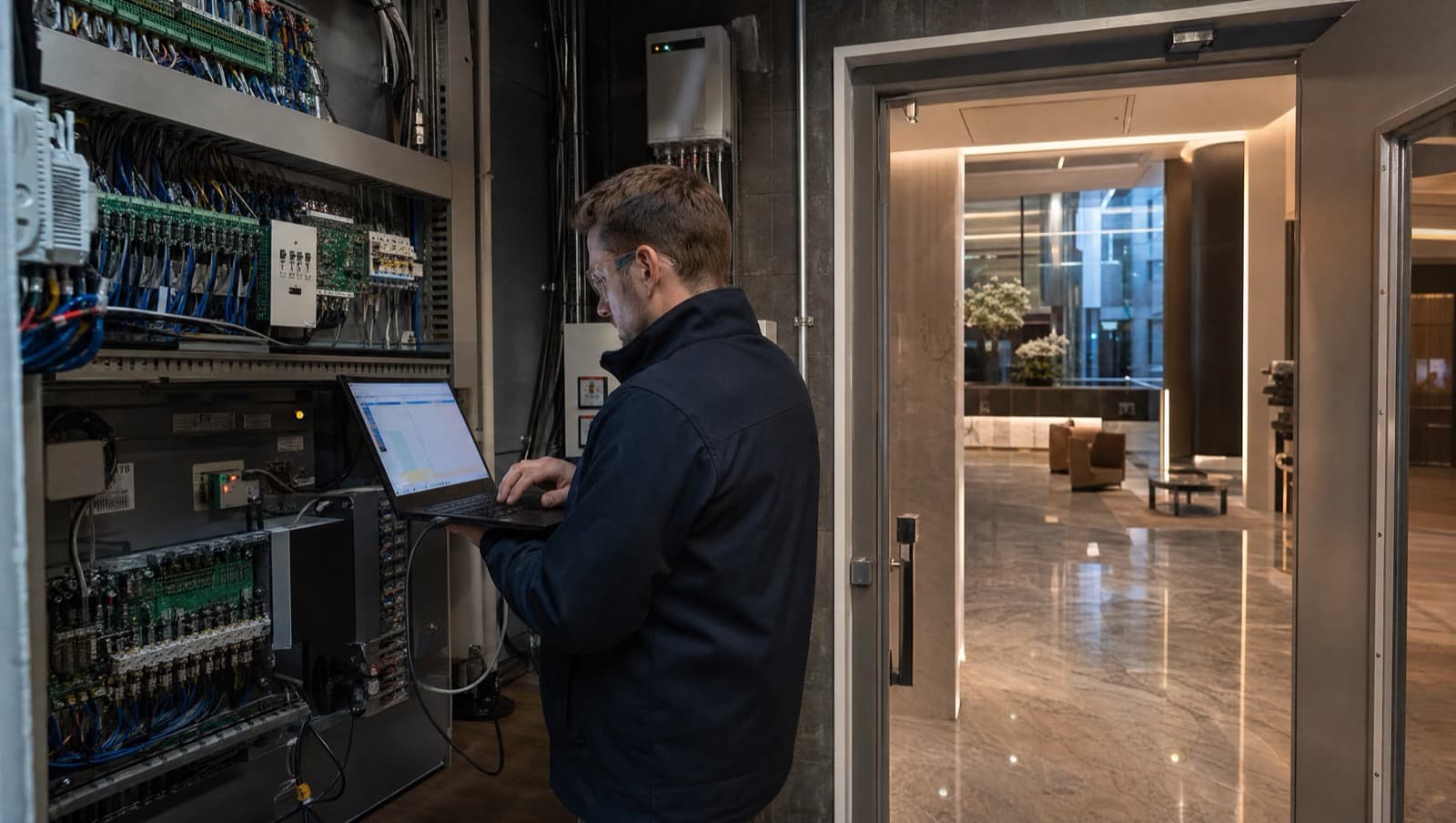
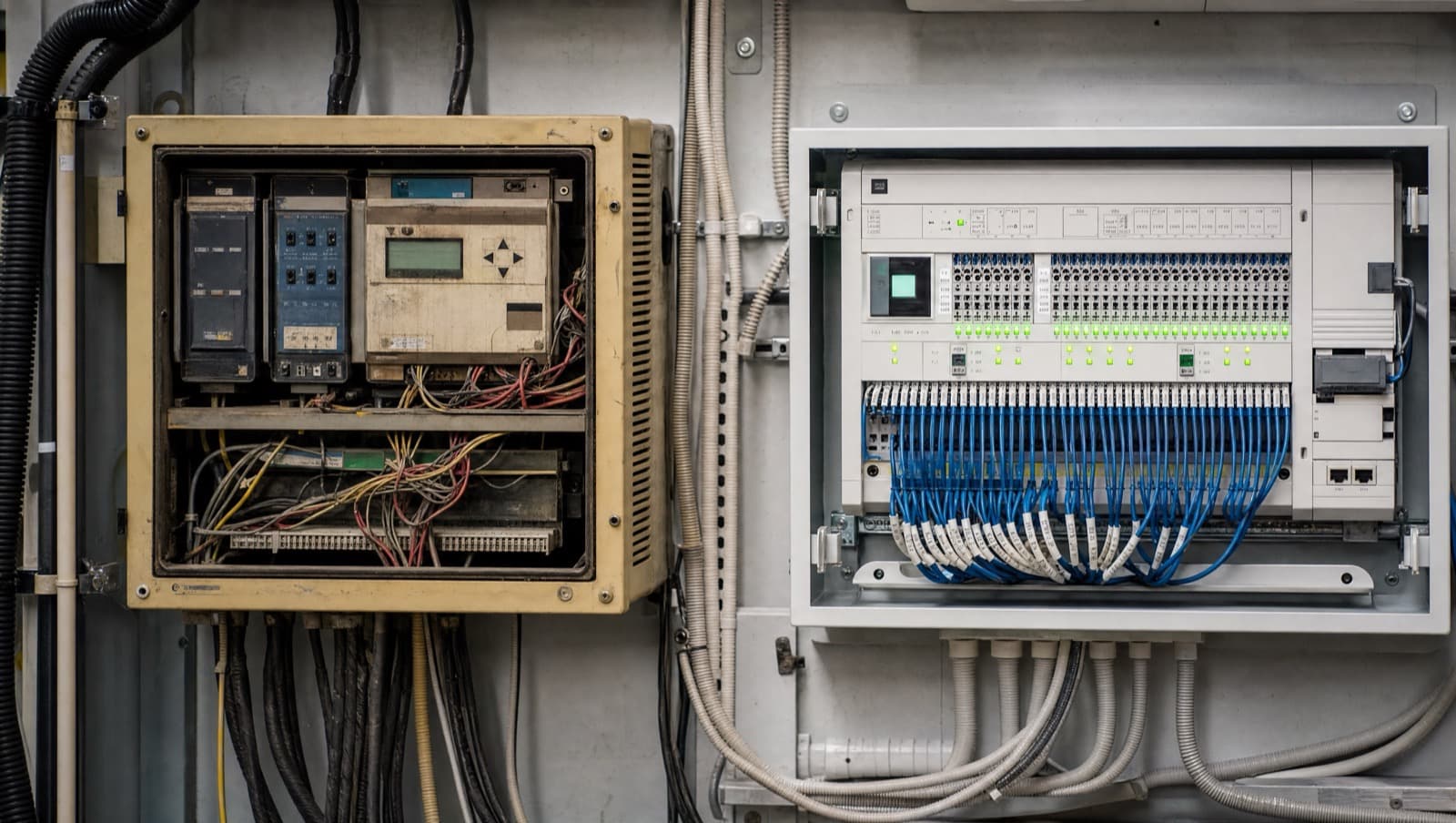
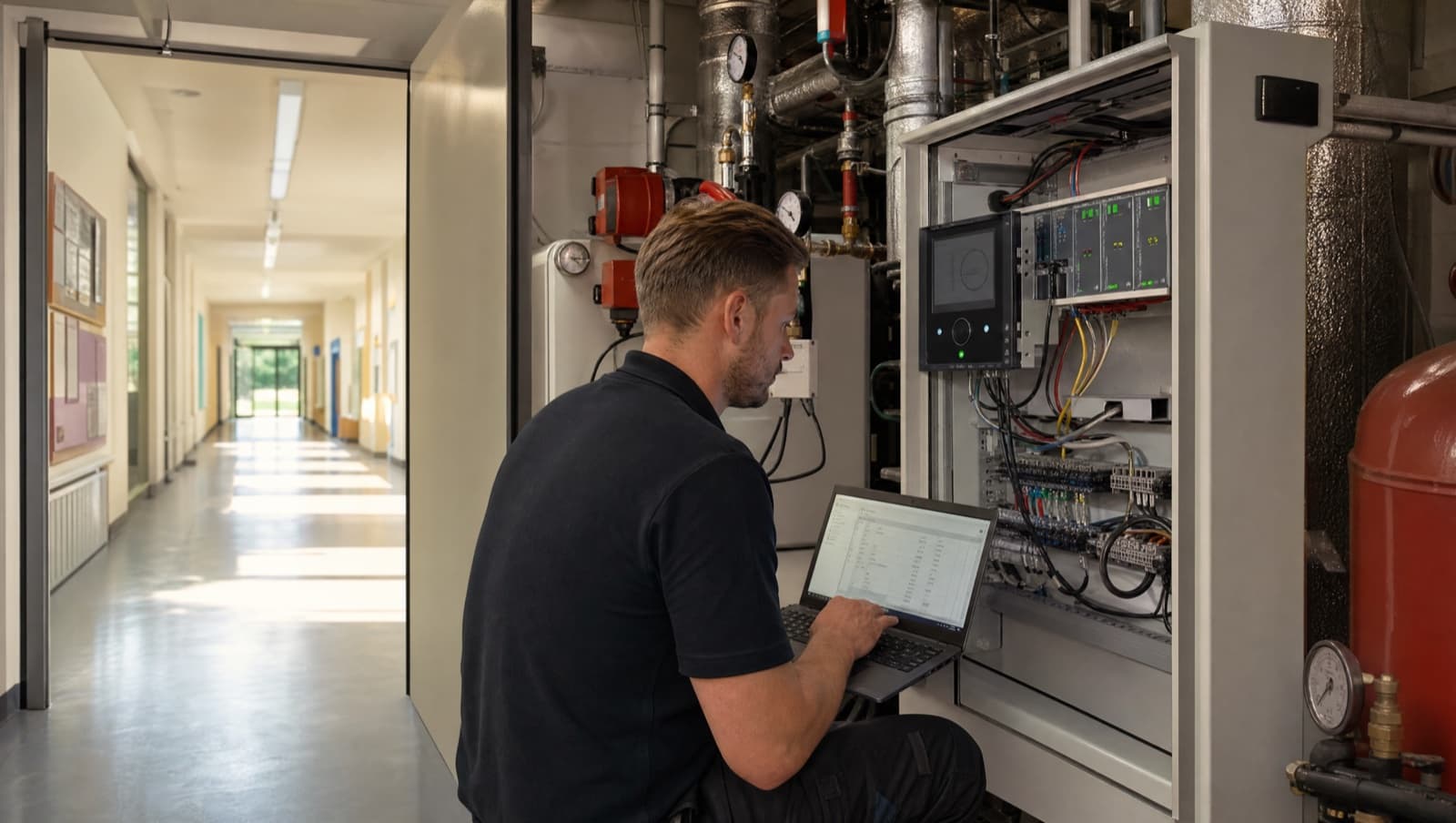
A summer BMS retrofit on a university building means replacing or upgrading the controllers, sensors, actuators, and supervisory software that govern how heating, cooling, ventilation, and lighting operate. In practical terms, that’s stripping out ageing Trend IQ3 or legacy Honeywell controllers from the plant room, installing current-generation Trend IQ4 or IQ4E controllers with BACnet/IP as standard, replacing seized valves and corroded sensors, re-commissioning the control loops, and connecting the building to the campus enterprise BMS so the estates team can actually see what it’s doing.
For a typical university lecture building — say a 1970s or 1980s block with gas-fired heating, no cooling, mechanical ventilation, and a mix of lecture theatres, seminar rooms, and offices — the work involves auditing every zone, mapping the existing pipework and ductwork against the control strategy, identifying what can be retained and what needs replacing, and then delivering the physical upgrade within the six-week window. That retain-or-replace audit is the same one every building faces, campus or not; we set it out in full in our BMS upgrade decision guide for legacy systems.
Why does summer recess matter for a BMS upgrade?
The reason summer matters is access. During term time, lecture theatres are booked back-to-back. Plant rooms share corridors with teaching spaces. Noise restrictions, fire alarm isolation requirements, and the sheer logistics of working around 2,000 students make anything beyond minor repairs impractical. Summer recess gives you uninterrupted access to every room, every riser, every ceiling void. Miss it and you’re waiting twelve months.
How much energy can a university BMS upgrade save?
The numbers are hard to ignore. CIBSE Guide F (Energy Efficiency in Buildings, 2012) establishes that improved controls and BMS optimisation alone can typically deliver 15–20% reductions in energy consumption, with payback periods of two to five years. For universities, where buildings are frequently over-heated during low occupancy and heating runs through weekends and vacations on default schedules, the savings tend to sit at the higher end of that range. Industry data from BMS retrofit studies in higher education shows savings of 15–35% depending on the age and condition of the existing systems.
For a university spending £2 million a year on energy, a 20% reduction is £400,000 annually. That’s not theoretical — it’s the direct result of optimum start control calculating the latest possible boiler fire-up time, weather compensation reducing flow temperatures on mild days, demand-controlled ventilation ramping down when lecture theatres are empty, and proper scheduling that actually follows the academic calendar instead of a timeclock set in 2009.
Get a Free BMS Survey
We'll assess your controls and provide a detailed quotation with energy savings estimates.
How does a BMS upgrade support carbon and net zero targets?
HESA (the Higher Education Statistics Agency) reported that UK universities were responsible for 1.4 million tonnes of CO₂ emissions in 2023–24. The sector target set by Universities UK calls for a 78% reduction in Scope 1 and 2 emissions by 2035. Individual institutions have gone further — the University of Liverpool targets net zero on Scope 1 and 2 by 2035, Swansea University is committed to at least 70% reduction by 2030. The AUDE Estates Management Report estimates the total cost of achieving net zero across the entire higher education estate at approximately £40 billion. A BMS upgrade won’t solve that on its own, but it’s the foundation that everything else — heat pumps, fabric improvements, renewable generation — sits on top of. Without accurate metering, trend data, and intelligent control, you can’t measure progress, verify savings, or justify the next round of capital investment.
Beyond the energy bill, there are the estates directors and FM teams dealing with the daily reality. A building without proper BMS control means reactive callouts every Monday morning — the boiler didn’t fire, the lecture theatre was freezing, the office block was 28 degrees because someone hit the override last Thursday and nobody reset it. A properly commissioned BMS eliminates that. It gives the FM team visibility, alarms, and the data they need to manage buildings proactively instead of chasing complaints.
What usually goes wrong with university BMS upgrades?
The most common failure is appointing a contractor who has never worked on a campus before. University buildings aren’t offices. They have complex ventilation systems serving labs with fume cupboards. They have lecture theatres that go from empty to 300 occupants in ten minutes. They have server rooms needing year-round cooling adjacent to teaching spaces needing seasonal heating. A contractor who treats a university like a commercial office will miss the ventilation interlocks, under-specify the control strategy, and deliver a system that doesn’t respond to the actual occupancy patterns.
The second failure is poor commissioning — or no commissioning at all. We see this constantly. A contractor installs new controllers over summer, does basic point-to-point checks, hands over the O&M manual, and disappears. Nobody comes back in October to tune the heating loops under real winter load. Nobody checks whether the optimum start algorithm is actually calculating correctly or just defaulting to a fixed pre-heat time. Nobody verifies that the weather compensation curve matches the building’s actual thermal response. CIBSE Guide H (Building Control Systems, 2009) is explicit that a BMS should be closely monitored and fine-tuned for at least twelve months after installation, because control loop tuning done in summer bears no relation to winter performance. BSRIA’s Commissioning Responsibilities Framework (BG 88/2025) reinforces this by establishing clear roles for seasonal commissioning verification, not just installation sign-off.
The third failure is leaving systems in override. This is endemic in universities. Somebody overrides the heating to manual during a cold snap in January. The override is never removed. The system runs in manual for the next three years, consuming energy as if it had no BMS at all. A proper university BMS upgrade includes an override management strategy — time-limited overrides that automatically revert, alarm notifications when overrides persist beyond 48 hours, and regular audits of override status across the campus.
The fourth failure is not considering the academic calendar during procurement. University procurement follows OJEU rules for significant contracts. The tender process alone can take three to six months. If the estates team starts thinking about a summer BMS upgrade in April, they’ve already missed the window. The procurement needs to start in the autumn term for delivery the following summer.
Which standards and legislation require university BMS upgrades?
The regulatory landscape has shifted substantially, and universities are caught in the crossfire of multiple overlapping requirements.
MEES (Minimum Energy Efficiency Standards) regulations under the Energy Efficiency (Private Rented Property) (England and Wales) Regulations 2015 currently require a minimum EPC rating of E for all let commercial properties. The June 2026 interim response settled the direction: private rented commercial buildings over 1,000 m² are expected to reach EPC B by 2031, with the previously proposed interim C milestone dropped and the direction of travel unchanged. We’ve covered what the June 2026 update means for commercial buildings in detail.
Approved Document L (Conservation of Fuel and Power, 2021 edition) requires that all new and replacement heating systems include weather compensation, optimum start/stop control, and zone-based time and temperature control. Every university building that has a boiler replaced or a heating system refurbished triggers Part L compliance. Installing a new boiler without a BMS to deliver these control functions is non-compliant from day one.
CIBSE Guide F (Energy Efficiency in Buildings, 2012) specifically identifies education buildings as a sector where control improvements yield above-average returns because of extreme occupancy variability. The Guide establishes benchmark energy consumption figures for different building types and states that BMS optimisation is consistently one of the most cost-effective measures for closing the gap between actual and benchmark performance.
CIBSE TM54 (Evaluating Operational Energy Performance of Buildings) provides the methodology for calculating actual operational energy use. Universities are increasingly expected to demonstrate that their buildings perform as designed — not just that the design calculations achieved the required rating. Without trend data from a functioning BMS, this demonstration is impossible.
The Climate Change Committee’s 2025 report warned that decarbonising public buildings requires a strategic, coordinated plan and long-term funding. The government’s Carbon Budget Delivery Plan, published in October 2025, includes non-domestic buildings as a priority sector. Universities, as significant public sector energy consumers, are firmly in scope.
The Public Sector Decarbonisation Scheme has allocated over £2.5 billion since 2020 for energy efficiency improvements in public sector buildings, with BMS upgrades explicitly eligible. Phase 4 funding continues into 2026. Universities that haven’t applied are leaving substantial capital funding on the table.
How does Alpha Controls deliver university BMS upgrades?
University of the Arts London — Cabinet Heater Retrofit with Trend IQECO
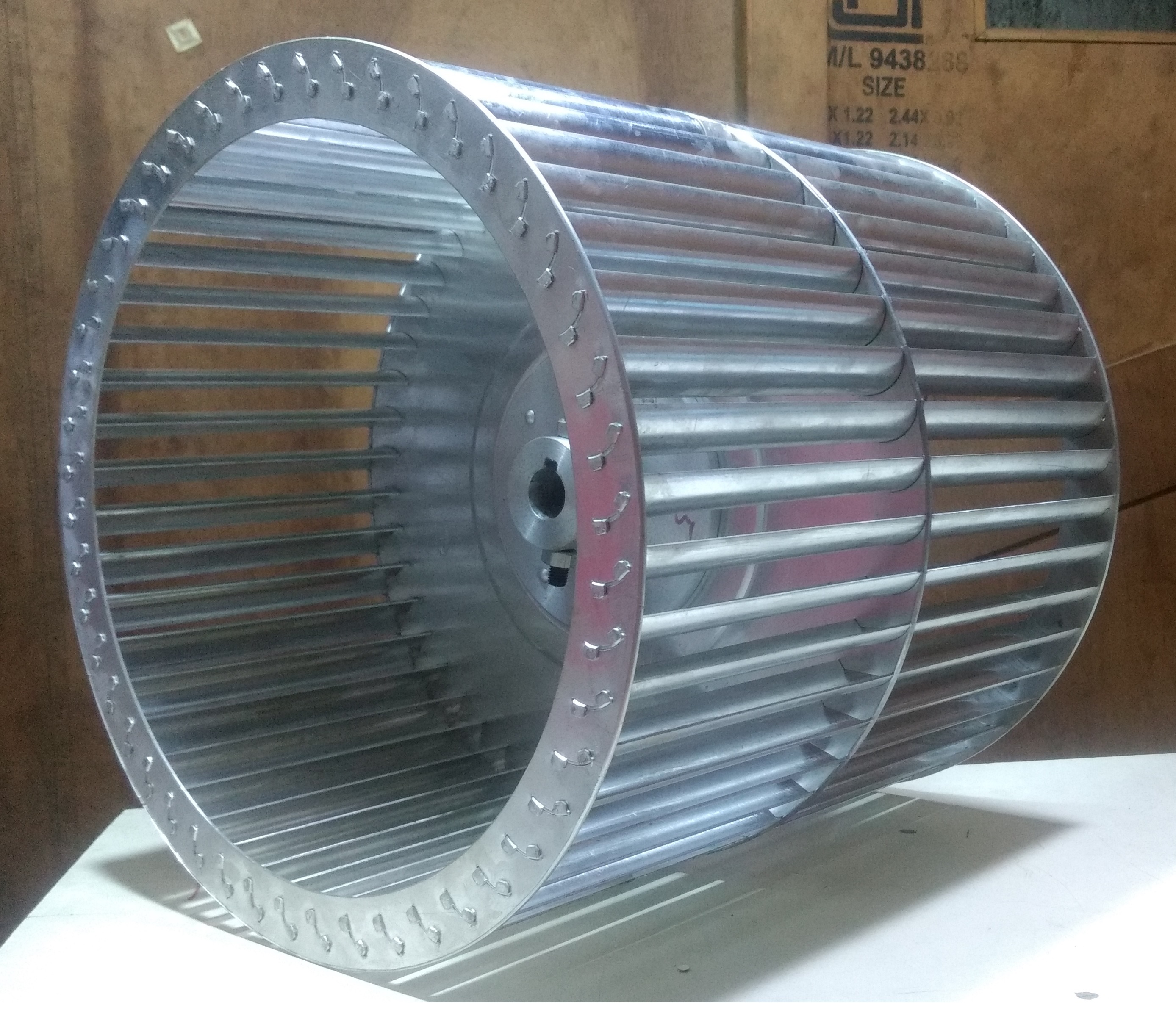
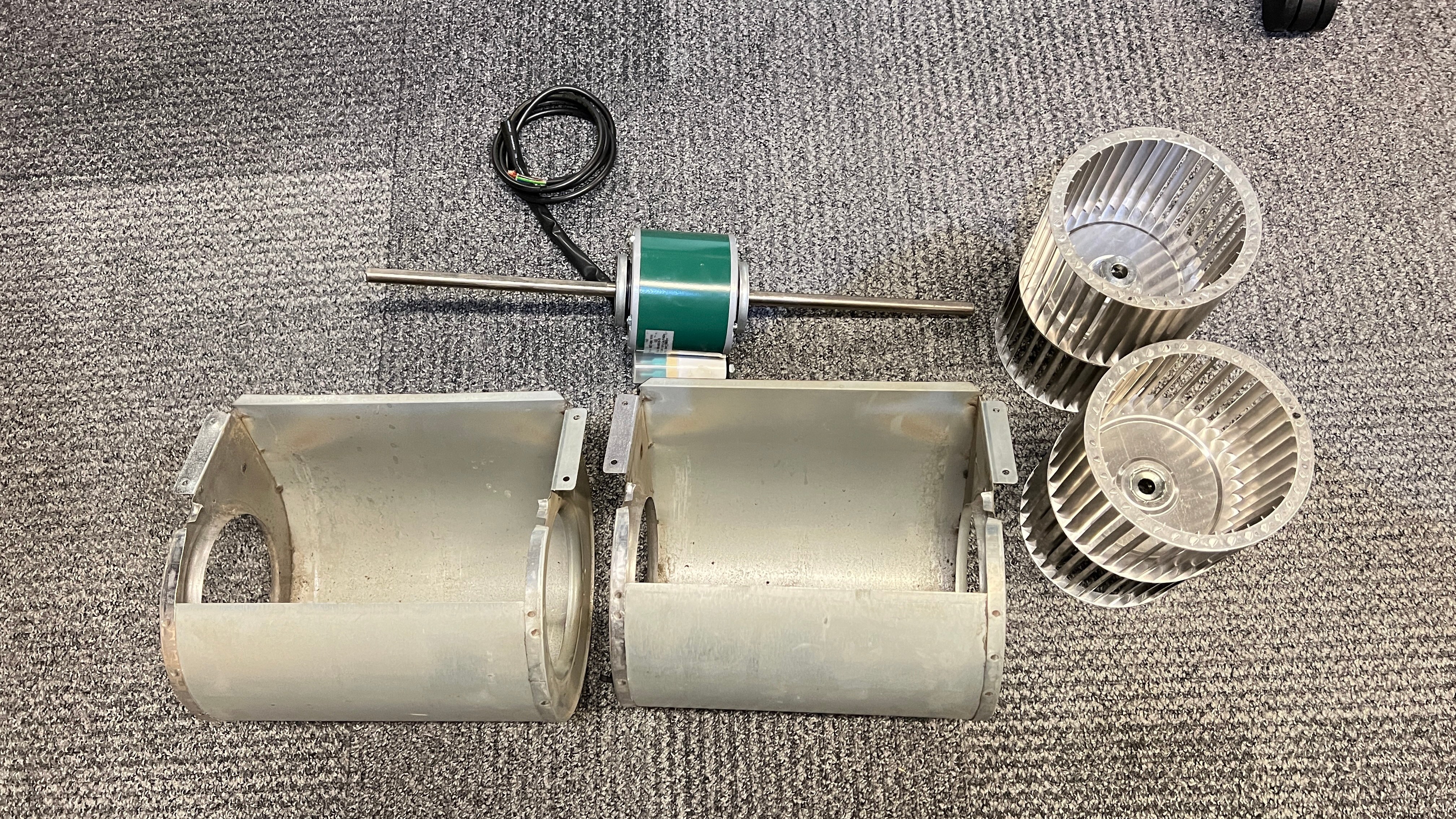
At UAL’s Central London campus, Alpha Controls delivered a comprehensive retrofit of over 100 cabinet unit heaters across six floors of teaching blocks. The existing fan deck impellers and motors had seized, the legacy Trend controllers were unreliable, and the temperature sensors had drifted beyond useful accuracy. The building was fully occupied — teaching ran every day.
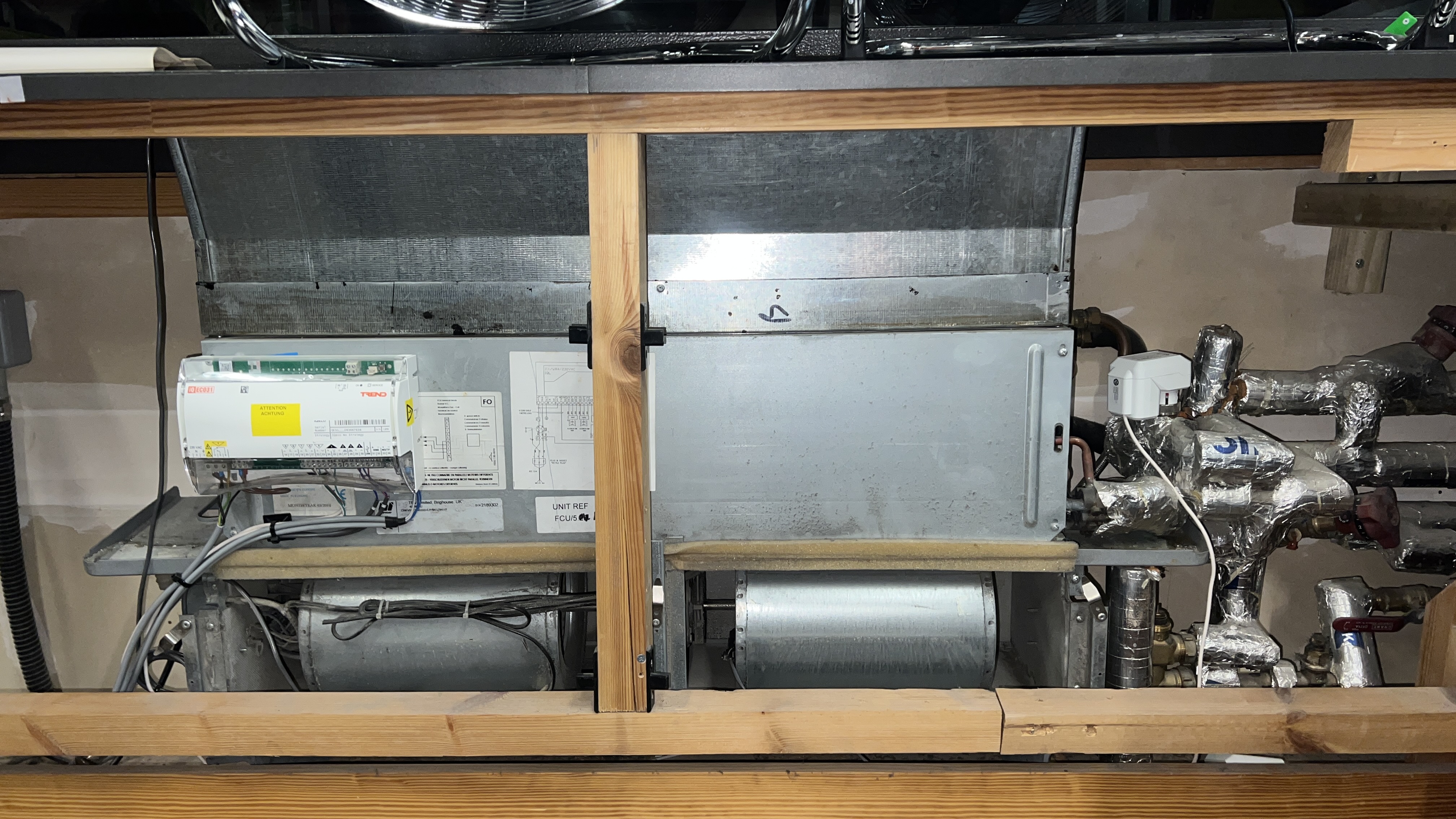
The scope covered the removal and refurbishment of every cabinet heater housing, filter, centrifugal fan impeller, and blower wheel. New dual-shaft motors were fitted within the existing impeller housings to maintain airflow compatibility. Alongside the mechanical work, the entire control network was upgraded to Trend IQECO controllers, with new temperature sensors installed for accurate zone feedback across every teaching space. All cabling used existing routes to keep the installation clean and minimise disruption.
The critical constraint was timing. Every piece of work was carried out after 8pm to avoid disrupting teaching activities. Each evening, systems were isolated, components stripped out, replaced, tested, and recommissioned — with full operation restored before the next morning’s classes. Alpha Controls coordinated with campus security for after-hours access, equipment transport, and on-site parking in restricted central London conditions. The project progressed floor by floor without a single day of teaching disruption.
The result: over 100 heaters restored to full operation with modern Trend IQECO control, improved airflow regulation, better temperature accuracy, and full visibility through the existing Trend BMS supervisor. A project that demonstrates what’s possible when access is managed properly and the contractor understands the difference between a commercial office and a live university campus.
London Metropolitan University — Campus-Wide Metering Network
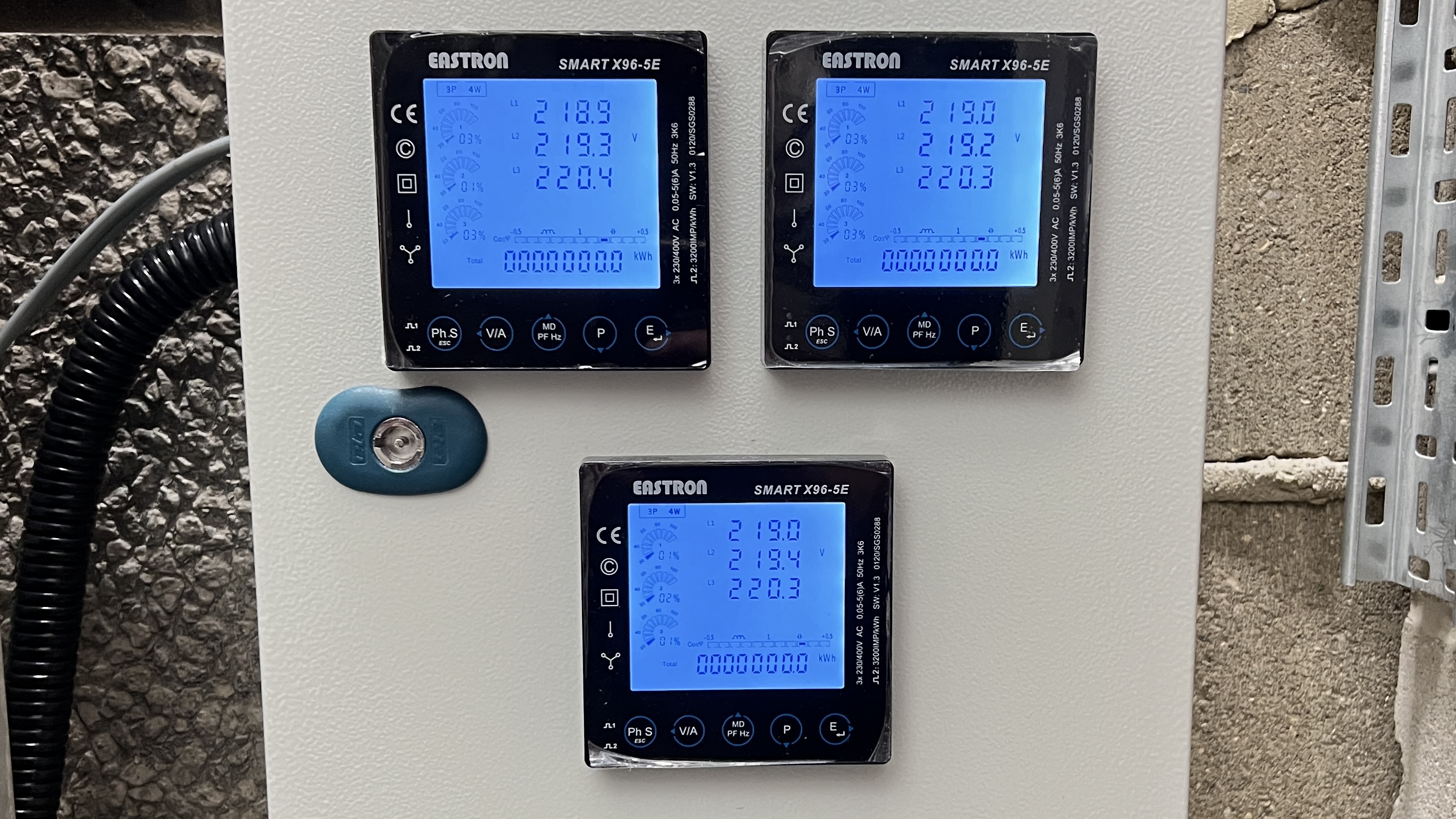
At London Metropolitan University’s Holloway Road campus, Alpha Controls delivered a comprehensive metering hierarchy survey and upgrade across the entire North Complex. The campus includes over fifteen buildings — the Science Centre, Learning Centre, Tower, Harglenis Building, Tech Tower, Graduate Centre, and blocks C, D, F, G, J, P, and S — each with its own plant configuration and metering challenges.
The survey mapped every fiscal meter, sub-meter, and AMR (Automatic Meter Reading) point across the campus, identifying failed meters, meters without AMR connectivity, and gaps where no metering existed at all. The work covered gas, electrical, and heat metering hierarchies. Plant rooms contained a mix of equipment — Ideal Concord CXA boilers at 81A Benwell Road, three Wessex Modumax 220kW units in the Tower, Hamworthy Purewell boilers in D Block, and Evomax units in the Harglenis Building. Each had different metering requirements and different states of existing instrumentation.
Alpha Controls produced detailed metering hierarchy drawings for every building, mapping existing fiscal and sub-meters to their associated plant, identifying recommended new electrical, gas, and heat sub-meters, and specifying virtual meters for the university’s energy management platform. The deliverable gave LMU’s estates team, for the first time, a complete picture of where energy was being consumed, where the metering gaps were, and what needed installing to achieve full campus visibility.
This is exactly the kind of foundational work that makes everything else possible. Without accurate sub-metering, you can’t verify BMS savings, you can’t identify the buildings burning the most energy, and you can’t report credibly against net zero targets. The cost of a BMS retrofit only translates into verified savings when you have the metering infrastructure to measure the before and after.
What does a properly planned university BMS upgrade look like?
A well-executed summer BMS retrofit starts twelve months before the install date. The estates team identifies target buildings in the autumn, commissions surveys before Christmas, runs procurement in the spring, and has contractors mobilised the day term ends. That level of planning is the difference between a clean six-week delivery and a panicked scramble that runs into September.
The phased approach matters, especially on multi-building campuses. You don’t upgrade every building in one summer. You prioritise based on energy consumption, EPC rating, condition of existing controls, and alignment with other planned capital works. A building already scheduled for a boiler replacement is the obvious candidate — add the BMS upgrade to the same project and you get Part L compliance, optimised installation costs, and a single mobilisation.
Post-occupancy monitoring is non-negotiable. The BMS isn’t finished when the contractor leaves site. It’s finished when it’s been through a full heating season and a full cooling season with real occupancy, and the control loops are tuned to deliver stable, efficient performance. A good contractor builds this into the programme from the start — not as an extra, but as part of the core scope.
Staff training is the part everyone forgets. The best BMS in the world is useless if the estates team doesn’t know how to use it. That means hands-on training — not a two-hour session with a PowerPoint deck, but actual time in front of the supervisor interface, adjusting schedules, acknowledging alarms, interpreting trend data, and understanding how to make changes without breaking the control strategy. The estates team should feel confident operating the system the day after handover.
Integration testing across the campus network is what separates a building upgrade from a campus upgrade. Every new building brought into the enterprise BMS should be visible on the central dashboard immediately, with consistent alarm priority levels, standardised naming conventions, and trend logging that feeds directly into the university’s energy reporting. If the new building is an island that requires a separate interface, you haven’t integrated it — you’ve just added another system to manage.
When should a university start planning its summer BMS retrofit?
The window is shorter than it looks. If you’re reading this in summer 2026, the earliest realistic delivery is summer 2027. That gives you autumn 2026 for building surveys, winter for procurement, and spring for pre-staging. Trying to compress that into three months guarantees compromises — rushed surveys, emergency procurement, incomplete factory configuration, and a delivery programme that eats into September.
For MEES compliance, the timeline is tighter still. With the interim C milestone dropped, the working horizon is EPC B by 2031 for buildings over 1,000 m² — and the arithmetic has not relaxed for large campuses. A BMS upgrade delivered in one summer window, commissioned through the following winter, and re-assessed for EPC the next spring consumes a full academic cycle; an estate with a dozen buildings needs several such cycles before 2031.
For net zero targets, the maths is straightforward. Every year you delay a BMS upgrade is another year of avoidable energy waste and avoidable carbon emissions. A university with a 2030 interim target and a 2035 net zero commitment needs its BMS infrastructure in place now, because the bigger capital projects — heat pump installations, fabric upgrades, renewable generation — all depend on the metering, monitoring, and control platform that only a modern BMS provides.
The Public Sector Decarbonisation Scheme funding won’t last forever. Phase 4 is live now. Universities with shovel-ready BMS projects — buildings surveyed, scopes written, costs estimated — are in the strongest position to secure funding. Those starting from scratch will be competing for the final allocations.
How do you get a university BMS upgrade started?
The six-week summer window is the single best opportunity to upgrade building controls on a university campus. It offers uninterrupted access, no disruption to teaching or research, and enough continuous time to deliver a complete installation from strip-out to commissioning. But it requires planning that starts a year in advance, procurement that respects the university’s tender rules, and a contractor who understands the difference between a commercial office and a campus lecture building.
If your university estate has buildings running on legacy controllers, timeclock schedules that haven’t changed in a decade, or EPC ratings that won’t meet the incoming MEES thresholds, the time to start planning is now — not next spring when it’s already too late for next summer.
Get in touch to discuss a campus BMS survey, or request a quote for a summer 2027 delivery programme. We’ll walk your buildings, assess what needs upgrading, and give you a phased programme that fits your academic calendar, your procurement rules, and your net zero commitments.
FAQ
How much does a university BMS upgrade cost per building?
Costs vary significantly depending on building size, the condition of existing controls, and how much field equipment needs replacing alongside the controllers. For a typical university teaching block, expect £40,000 to £120,000 for a full controls upgrade including sensors, actuators, controllers, supervisor software, and commissioning. Larger buildings with complex ventilation — laboratories, sports centres, libraries — can run higher. The campus enterprise integration layer adds £20,000 to £50,000 on top. Most universities phase their investment across multiple summers.
Can a full BMS upgrade really be completed in six weeks?
Yes, with proper planning. The key is front-loading the work: surveys completed months in advance, controllers factory-configured and pre-tested, panels pre-wired in the workshop, and all materials on site before day one. The six weeks are for physical installation, commissioning, and handover. The design, procurement, and preparation happen in the preceding nine months. What you cannot do in six weeks is the seasonal commissioning — that requires return visits in the following heating and cooling seasons.
What energy savings can a university expect from a summer BMS retrofit?
CIBSE Guide F benchmarks suggest 15–20% savings from controls improvements alone. In university buildings with legacy timeclock schedules, no weather compensation, and no demand-controlled ventilation, savings of 20–30% are realistic in the first full year. For a building spending £150,000 per year on energy, that’s £30,000 to £45,000 in annual savings, with a typical payback of three to four years on the controls investment.
Does a BMS upgrade help with MEES compliance for university buildings?
Yes. The National Calculation Methodology used for commercial EPCs explicitly scores control systems. Optimum start control, weather compensation, zone-based scheduling, and demand-controlled ventilation all improve the EPC rating. We’ve seen university buildings move from EPC D to C, or C to B, through controls upgrades alone — no fabric improvements or plant replacement needed. For buildings that are leased or sub-let, this is directly relevant to MEES compliance.
How does a BMS upgrade support university net zero targets?
A modern BMS provides the metered, trended energy data that net zero reporting requires. Without it, carbon reduction claims are based on estimates rather than measurements. The BMS also delivers the operational savings — optimised scheduling, weather compensation, demand-controlled ventilation — that reduce Scope 1 and 2 emissions directly. And critically, it provides the monitoring platform that future interventions (heat pumps, solar PV, battery storage) need for verification and optimisation.
Alpha Controls Team
Specialist BMS installation, commissioning, and maintenance across London and the South East. SafeContractor Approved, BCIA Member.