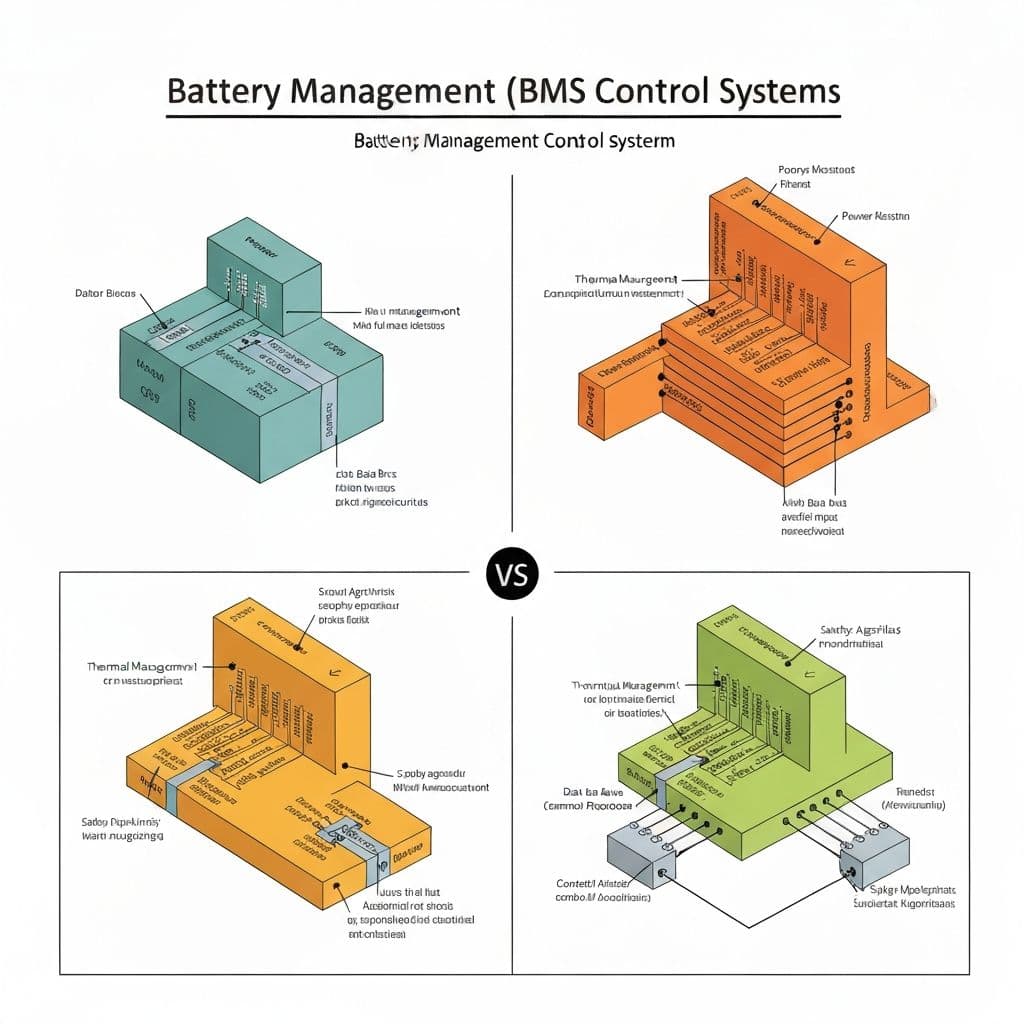

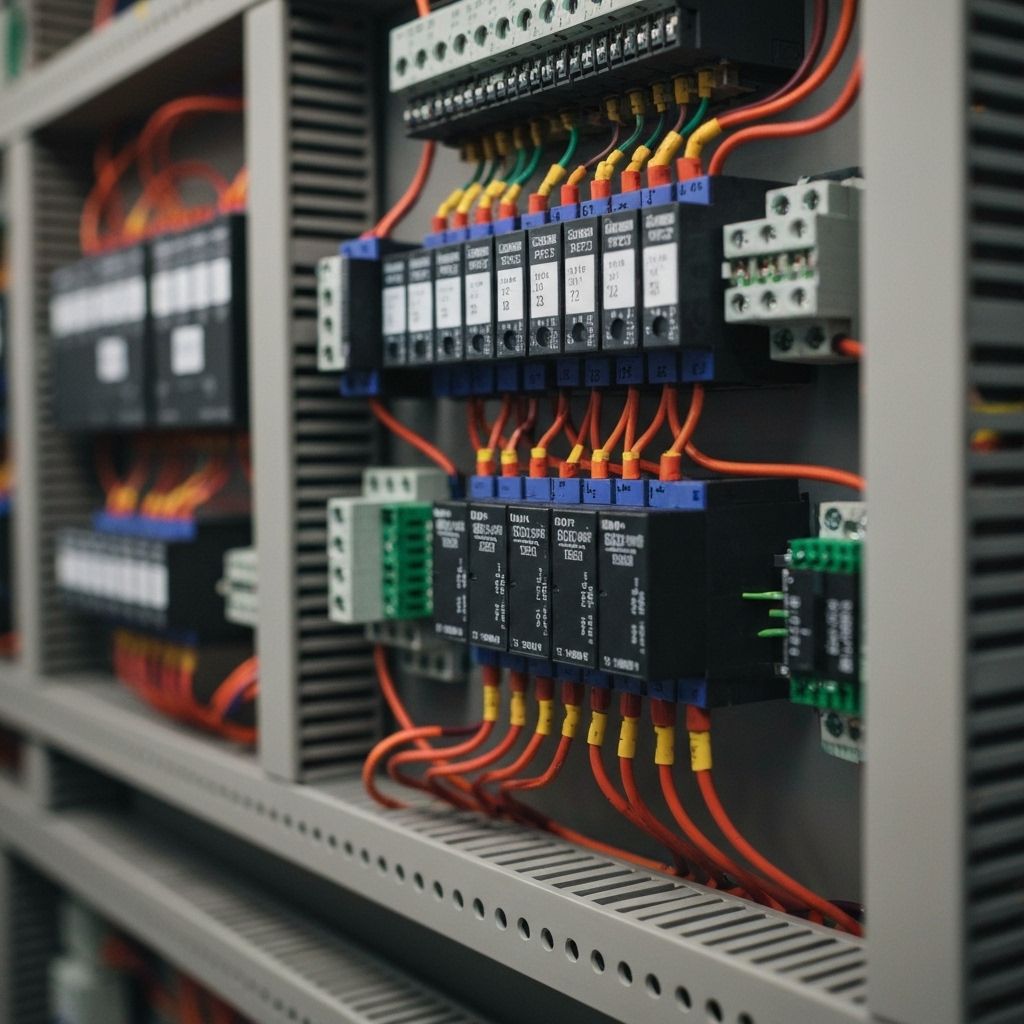
Wire run indication from a volt-free contactor auxiliary contact (normally open) to a BMS digital input, wire fault circuits from overload auxiliary contacts as normally closed for fail-safe integrity monitoring, and feed the BMS digital output through the Auto terminal of the Hand-Off-Auto switch. All control wiring falls under BS 7671:2018.
It's one of those wiring configurations that trips up BMS engineers who haven't done it before — and causes expensive mistakes when it's wired incorrectly on a live site. Run indication, fault monitoring, and Hand-Off-Auto switching form the backbone of how a BMS monitors and controls mechanical plant. Get them right and the system is responsive, diagnosable, and safe. Get them wrong and you end up with plant that appears to be running when it isn't, fault alarms that never clear, or — worst case — a BMS digital output driving a motor starter directly without an intermediate relay, which is both a wiring standards violation and a controller failure waiting to happen.
The practical wiring approach for run, fault, and HOA circuits on Trend IQ4 controllers covers the common errors and how BS 7671 applies to control panel wiring. All BMS field wiring — including the 24V AC/DC control circuits for run, fault, and HOA contacts — falls within the scope of BS 7671:2018 (the IET Wiring Regulations, 18th Edition); control circuit wiring must be selected for the voltage and current it carries, appropriately segregated from power wiring, and terminated in accordance with the manufacturer's specifications.
What is run indication on a BMS and why does it matter?
Run indication tells the BMS that a piece of plant — a fan, a pump, a compressor — is actually running, not just that the BMS has commanded it to run. This distinction is important. The BMS digital output might be energised and the contactor commanded closed, but if there's a blown control circuit fuse, a tripped overload, or a seized motor, the plant won't actually be running. Without run indication, the BMS has no way to know. It will sit there believing the AHU supply fan is on, running its ventilation control sequences against a building that's getting no fresh air. On a school roof replacement in Ramsgate we wired the kitchen and toilet extract fans back to the BMS for run and fault monitoring. They had never been on it before.
The standard method for run indication is a volt-free auxiliary contact wired from the motor contactor to a digital input on the BMS controller. The contactor's auxiliary contact closes when the contactor pulls in — meaning the motor is actually energised — and opens when it drops out. This is wired as a normally open contact to the BMS digital input: no current through the input when the plant is off, current through when the plant runs. The BMS digital input reads the state of this contact and generates the run status point accordingly.
When should you use a current switch instead of an auxiliary contact?
Current switches — clamp-on current sensors that detect actual current flow in the motor cable — are an alternative where auxiliary contacts aren't available or where the verification needs to be at the motor circuit level rather than the contactor level. They're more installation work but provide confirmation that the motor is actually drawing current, not just that the contactor is closed. On high-priority plant where false run status would have significant consequences, current switches are the more robust option.
Why are BMS fault circuits wired normally closed?
Fault circuits monitor for conditions that have taken the plant out of service — motor overload trips, thermal protection activations, loss of control circuit supply, phase failure on three-phase equipment. The critical wiring principle here is that fault circuits should be wired using normally closed contacts: when the plant is healthy, current flows through the fault monitoring input. When the plant trips, the contact opens and current stops. This is the fail-safe convention. Where the plant is a VSD-driven fan, it is usually the drive's fault relay that lands here, and interpreting the code behind that contact is covered in our AHU fan VSD fault-finding guide.
The reason for normally closed fault wiring is circuit integrity monitoring. If the fault indication wiring breaks — a loose terminal, a cut cable — the BMS sees exactly the same condition as a fault: no current through the digital input. In a normally open fault circuit, a broken wire looks identical to a healthy plant and you'll never know the fault monitoring has failed until you need it. This is not just good practice — it's the principle behind BS 7671 requirements for protective and monitoring circuits in control systems, and it's what BSRIA BG8 commissioning guidance requires for plant fault interfaces.
In practice, overload relay auxiliary contacts are wired normally closed to the BMS fault input. When the motor trips on overload, the relay opens, the fault input loses its signal, and the BMS generates a fault alarm. The plant is then interlocked off — the BMS will not attempt to restart the plant until the fault has been acknowledged and reset, preventing damage from repeated trip-restart cycles.
Get a Free BMS Survey
We'll assess your controls and provide a detailed quotation with energy savings estimates.
How does a Hand-Off-Auto switch interface with the BMS?
Hand-Off-Auto switching gives operators a physical means of overriding BMS control without accessing the BMS software. In Hand, the plant runs continuously regardless of BMS commands — useful for maintenance testing or temporary manual operation. In Off, the plant is de-energised regardless of BMS demand. In Auto, the BMS digital output controls the contactor through the HOA switch in the circuit.
The wiring sequence for a standard HOA configuration on a Trend IQ4 controller has the BMS digital output feeding the Auto terminal of the HOA switch. The Hand terminal is wired to energise the contactor directly, bypassing the BMS output. The common from the HOA switch feeds the contactor coil. In this arrangement, the BMS digital output only controls the plant when the switch is in Auto — in Hand, the contactor is energised independently of whatever the BMS is doing.
Why should HOA switch status be wired back to the BMS?
The HOA switch position itself should be wired back to the BMS as digital inputs — one input for Hand, one for Off, or a combined status that the BMS decodes. This is where many installations fall short. Without HOA status feedback, the BMS has no way to know whether it's in control of the plant or whether someone has put the switch in Hand and walked away. The BMS might be cycling through its energy-saving schedules believing it's turning plant on and off, while the plant is actually running flat-out in Hand because a maintenance engineer left the switch in the wrong position three weeks ago. This is a real scenario that increases energy consumption and shortens plant life, and it's entirely preventable with two additional digital input connections.
What are the most common BMS run, fault and HOA wiring mistakes?
The mistakes that appear most often on panel inspections and commissioning reviews follow a consistent pattern. BMS digital outputs wired to drive motor contactors directly — without an intermediate relay — are a persistent problem on smaller installations where the control panel has been put together quickly. A Trend IQ4 digital output is rated for a small pilot load, not for directly switching a contactor coil, and wiring it this way risks controller damage when the inductive load of the contactor causes voltage spikes that exceed the output rating. An intermediate 24V relay with a rated contactor coil output is the correct approach.
Fault circuits wired normally open rather than normally closed are common on older installations and on sites where the original wiring was done without reference to control system standards. The fault appears to be working — the BMS generates a fault alarm when the plant trips — but the circuit integrity monitoring is absent and broken wiring will go undetected. Rewiring to normally closed contacts is straightforward on a scheduled maintenance visit and is worth doing when faults are identified.
HOA status not wired back to the BMS is almost universal on budget installations. The additional two digital inputs and wiring are omitted to save cost, and the consequence is invisible manual override that can persist for weeks without anyone realising the BMS has lost control of the plant.
If you are inheriting a Trend system and want the wider context — which controller generations are still supported, where IQVISION fits, and what a realistic upgrade path looks like — our complete guide to Trend BMS systems covers the whole range.
Segregation of ELV control wiring from 230V power circuits in the same panel trunking is a BS 7671 requirement that is routinely ignored on site. Control wiring — the volt-free contacts, the analogue sensor cables, the BMS comms — should be in separate trunking from power cables, or separated by a physical barrier, to avoid induced noise and to meet the wiring regulations requirements for ELV segregation. IEC 61000-4 sets the electromagnetic compatibility requirements that determine why BMS signal cables must be screened and segregated from power cables — unscreened signal wiring running parallel to 230V or 400V cables in the same trunking is one of the most common sources of spurious BMS faults on refurbished sites. For the full picture of segregation, screening and containment practice, see our guides to BMS electrical work in Kent and London.
Where can you get BMS run, fault and HOA wiring done right?
Alpha Controls designs and builds BMS control panels from our panel manufacturing facility, serving commercial buildings across London, Kent, and the South East. If you're reviewing an existing installation and have questions about run, fault, or HOA wiring, or if you're specifying a new panel, get in touch or explore our panel manufacturing service.
Alpha Controls Team
Specialist BMS installation, commissioning, and maintenance across London and the South East. SafeContractor Approved, BCIA Member.