
Yes, legacy Belimo VAV actuators can be integrated with Trend IQ412 controllers without a gateway or protocol conversion. Older Belimo units use a 0-10V or 2-10V analogue signal that the IQ412 drives directly through its analogue output channels. Get the wiring, common reference, and output scaling right and the retrofit works cleanly. For the wider picture of what sits at this layer, see our BMS field devices and field equipment list.
Can you keep old Belimo VAV actuators when upgrading to Trend IQ4?
On a mid-2000s commercial office in central London — seven floors of VAV-controlled air conditioning with Belimo actuators that had run reliably for nearly twenty years — the BMS front end had been updated twice, but the field devices (actuators, pressure sensors, room temperature units) were all original. The facilities manager wanted to upgrade the controller network to a modern Trend IQ4 platform without ripping out anything that didn't need to go. The answer was yes — the legacy Belimo 0-10V actuators could be retained — but only if the wiring and control philosophy were handled correctly.
What signal do old Belimo VAV actuators use, and can the IQ412 drive it?
Older Belimo VAV actuators — the LMB24, SM series, and similar — use a 0-10V or 2-10V analogue control signal for damper positioning. The actuator receives a DC voltage from the controller: 0V corresponds to fully closed, 10V to fully open (or in some configurations, 2V to 10V across the full travel range). This is a simple, proven interface that the Trend IQ412 can drive directly through its analogue output channels. No gateway, no protocol conversion, no additional hardware required.
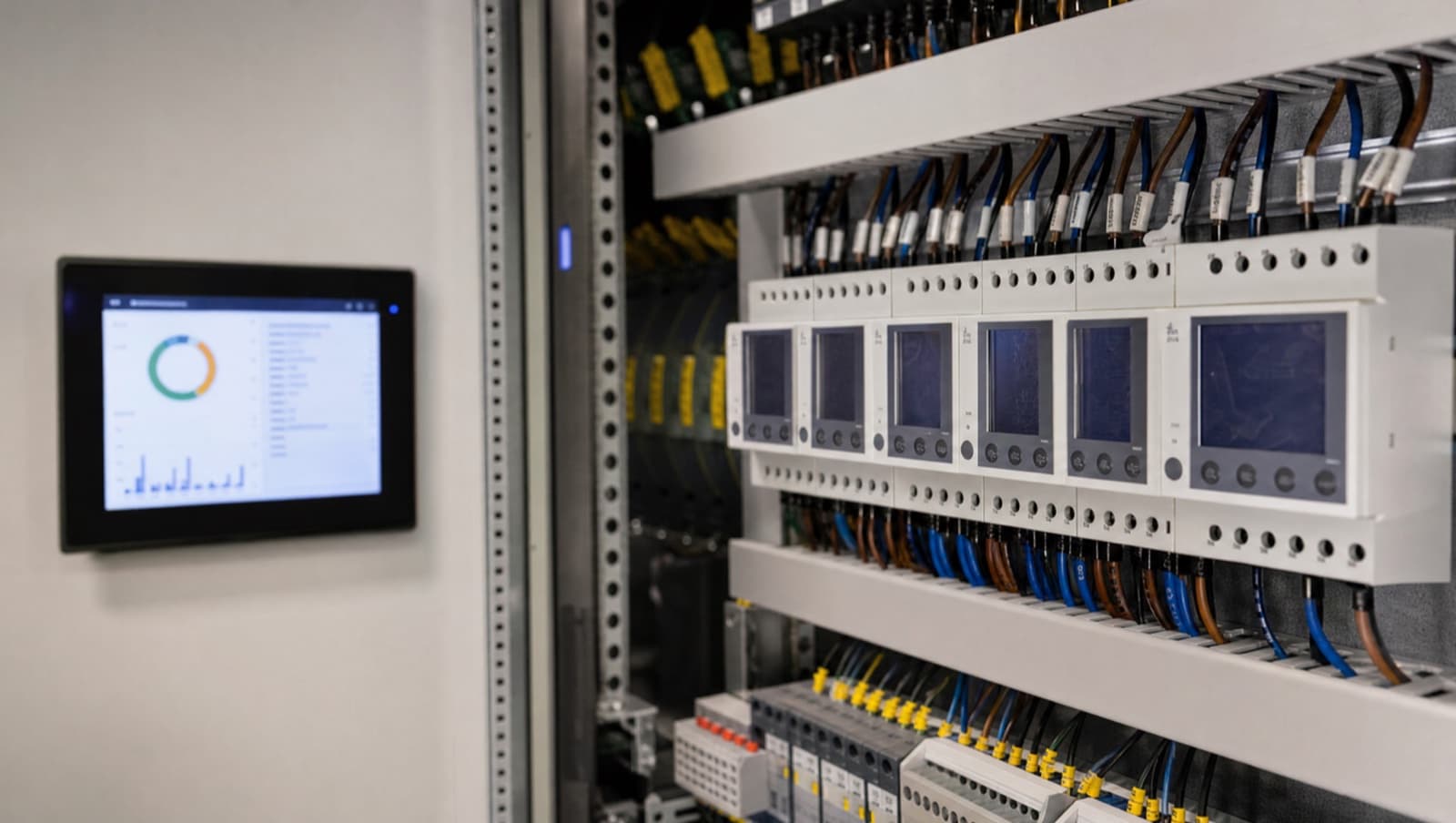
The IQ412 is a compact universal controller with a mix of analogue and digital I/O, running on the BACnet MS/TP trunk and supervisable through a Trend IQVISION front end. The Trend IQ412 communicates on a BACnet MS/TP network using the protocol defined in ASHRAE 135 (adopted in Europe as BS EN ISO 16484-5); each controller on the MS/TP segment must have a unique MAC address, and end-of-line termination resistors must be fitted at both physical ends of the RS-485 bus. For a VAV zone, a typical I/O assignment would use one analogue output to drive the actuator control signal, one analogue input for the actuator position feedback (where the Belimo unit provides a 0-10V feedback signal — not all variants do), a second analogue input for the room temperature sensor, and optionally a third analogue input for a velocity pressure (airflow) transducer if the design uses pressure-independent VAV control. For a full breakdown of how analogue and digital I/O is configured on Trend controllers, see our guide to inputs and outputs on Trend IQ4NC and IQ ECO 412 controllers.
How do you wire a Belimo actuator to a Trend IQ412?
Power for both the IQ412 controller and the Belimo actuator comes from a 24VAC supply — the controller and actuator can share a common transformer where the VA rating is sufficient, or run from separate supplies where the zone count makes a shared supply impractical. The actuator's 24VAC terminals connect to the supply; the controller's power terminals connect to the same supply or a dedicated one for the controller network.
The control signal wiring runs from the IQ412's analogue output terminal (AO1 in a standard single-zone application) to the Belimo actuator's control input — terminal 3 on most Belimo units — with the common terminal returning to the controller's COM terminal. If the actuator provides a position feedback signal, this runs from the actuator's feedback output back to an analogue input on the IQ412 (AI1), with common again sharing the controller's COM. The room temperature sensor connects to a second analogue input (AI2), configured to match the sensor's output type — typically 0-10V or a resistive NTC/PT1000 element depending on the sensor installed.
Get a Free BMS Survey
We'll assess your controls and provide a detailed quotation with energy savings estimates.
Why does my damper position erratically after a Belimo retrofit?
One wiring point that catches engineers out: the Belimo actuator's common terminal must share the same reference as the IQ412's analogue output common. If the actuator and controller are powered from separate transformers with isolated secondaries, the commons must be linked. Failure to do this produces erratic damper positioning — the actuator will move, but the control signal voltage at the actuator terminal is not what the controller is outputting, because the reference voltages differ. All field wiring between the Trend IQ412 controller and the Belimo actuators — the 24V supply and the 0–10V or 2–10V signal cable — must comply with BS 7671:2018; signal cables should be screened twisted pair, segregated from 230V power wiring, with the screen earthed at one end only to avoid circulating currents that introduce noise onto the signal.
How do you program the IQ412 in Trend Tool for a Belimo actuator?
In Trend Tool, the IQ412's analogue output for the actuator signal is configured with a 0-10V output range. If the Belimo actuator operates on a 2-10V range — check the datasheet for your specific model — the output scaling needs to reflect this, mapping the controller's 0-100% demand to the 2-10V physical range so that the actuator reaches its fully closed position at the correct signal level. An actuator that expects 2V minimum and receives 0V from a misconfigured controller will not close fully, resulting in minimum airflow through a "closed" damper and the associated energy waste and temperature control problems.
The control loop is a standard PID sequence in Trend's application programming environment. Room temperature measured at AI2 is compared to the zone setpoint; the PID output drives AO1 to modulate the VAV damper. Where an airflow (velocity pressure) sensor is fitted and wired to the controller, the sequence becomes pressure-independent — the temperature loop sets an airflow setpoint and the damper is modulated to hold the measured airflow whatever the duct pressure is doing, which improves stability when multiple zones are varying demand simultaneously. For a basic retrofit without airflow measurement, where the temperature loop positions the damper directly within minimum and maximum position limits, control is pressure-dependent: the airflow at a given damper position varies with duct pressure, and the airflow sensor is optional.
The actuator position feedback at AI1, configured as 0-10V scaled to 0-100% travel, allows the BMS to confirm that the actuator has reached its commanded position and to generate an alarm if there's a significant discrepancy between command and feedback — which is the earliest warning of a failing actuator or a mechanical obstruction in the damper assembly.
Should you retrofit or replace Belimo actuators during a Trend upgrade?
Retaining existing Belimo actuators and integrating them with new Trend controllers is cost-effective when the actuators are in good condition, when the existing 24VAC wiring infrastructure can be reused, and when the building owner's priority is modernising the controls platform without the disruption of replacing field devices across every zone. On a 200-zone VAV system, the cost difference between a controller-only upgrade and a full actuator replacement can easily be £40,000 to £80,000 — a significant factor when the actuators are functioning correctly and have years of service life remaining.
The case for replacing actuators at the same time as the controllers is strongest when the existing devices are showing signs of wear — gearbox slip, inconsistent positioning, slow travel times — or when the building is undergoing a wider mechanical refurbishment that provides access to ceiling voids without additional disruption costs. In those circumstances, fitting new Belimo actuators with BACnet or DALI communication capability (rather than analogue control) gives a cleaner integration and removes a class of analogue calibration issues from the ongoing maintenance picture.
What are the most common Belimo-to-IQ412 commissioning faults?
The most frequent commissioning fault in Belimo-to-IQ412 integrations is incorrect output scaling, producing dampers that won't fully close or won't fully open. This shows up immediately during loop testing if the engineer is watching the feedback signal — the commanded position and the feedback disagree at the limits of travel. The second most common fault is a floating common, producing erratic damper behaviour that appears to be a control loop issue but is actually a wiring reference problem. Both are straightforward to diagnose with a calibrated DC voltmeter and a clear understanding of what the analogue output should be reading at each end of its range.
On older Belimo actuators where the position feedback is not available or not wired, the only indication of actuator failure is a temperature fault in the zone — the BMS sees the temperature diverging from setpoint but has no visibility of whether the damper is at the commanded position. Adding feedback wiring during a retrofit, even where the original installation omitted it, is worth doing — the diagnostics value over the next ten years of maintenance is considerable. For guidance on VAV network wiring and correct RS-485 termination, see our article on end-of-line resistors and VAV termination in BMS systems. For practical wiring and commissioning notes applicable to Trend BMS installations, see our guide to BMS wiring, run/fault, and HOA on Trend systems.
Who can carry out a VAV retrofit and Trend IQ4 upgrade?
For the wider picture, our guide to what a VAV system is and how VAV boxes work explains the control loops these actuators sit inside, and our VAV box problems fault-finding guide sets out the order to diagnose a zone that will not behave. If you are wiring new TROX VAVs rather than keeping old actuators, our TROX and Sontay VAV installation write-up maps the TROX compact controller cores to a Trend panel and covers the 0–10 V versus 2–10 V check.
Alpha Controls carries out VAV system retrofits and Trend IQ4 upgrades across commercial buildings in London and the South East. If you're planning a controller replacement that involves retaining existing field devices, we're happy to review your existing I/O schedule and actuator specifications before the design is finalised. Get in touch to discuss your project.
Alpha Controls Team
Specialist BMS installation, commissioning, and maintenance across London and the South East. SafeContractor Approved, BCIA Member.