
For most commercial buildings, Cat6 handles 1 Gbps to each desk over the full 90-metre permanent link and suits standard offices today. Cat6a supports 500 MHz and delivers 10GBASE-T at the full 100-metre channel, making it the future-proof choice where 10 Gbps, Wi-Fi 6E/7 or high-power PoE is planned.
We get asked this on almost every commercial cabling job we quote: should we go Cat6 or Cat6a? On the face of it, both run a gigabit network, both use RJ45 connectors, and both look virtually identical on a cable tray. So why does anyone pay more for Cat6a, and is it actually worth it in your building? The answer depends on what you're doing now, what you're planning in five years, and how much pain you'll accept if you need to upgrade later. We've installed structured cabling in offices, schools, data centres and multi-tenanted commercial buildings across the UK, and this decision comes up every single time. Let's break it down properly.
What is the difference between Cat6 and Cat6a cabling?
Both Cat6 and Cat6a are twisted-pair copper cabling standards defined under TIA/EIA-568 and the European equivalent, BS EN 50173-1. The key difference is bandwidth and frequency range. Cat6 supports frequencies up to 250 MHz and can handle 10 Gigabit Ethernet (10GBASE-T), but only over very short distances, typically 37 to 55 metres depending on alien crosstalk conditions. For most practical purposes, Cat6 is a 1 Gbps cable rated to the full 90-metre permanent link distance defined in BS EN 50173-1.
Cat6a, by contrast, supports frequencies up to 500 MHz and delivers 10GBASE-T at the full 100-metre channel length. That's not a marginal improvement, it's the difference between a cable that can handle next-generation switching and one that can't. BS EN 50173-1:2018 classifies Cat6a as Class EA, and it's this classification that matters when specifying structured cabling to current standards.
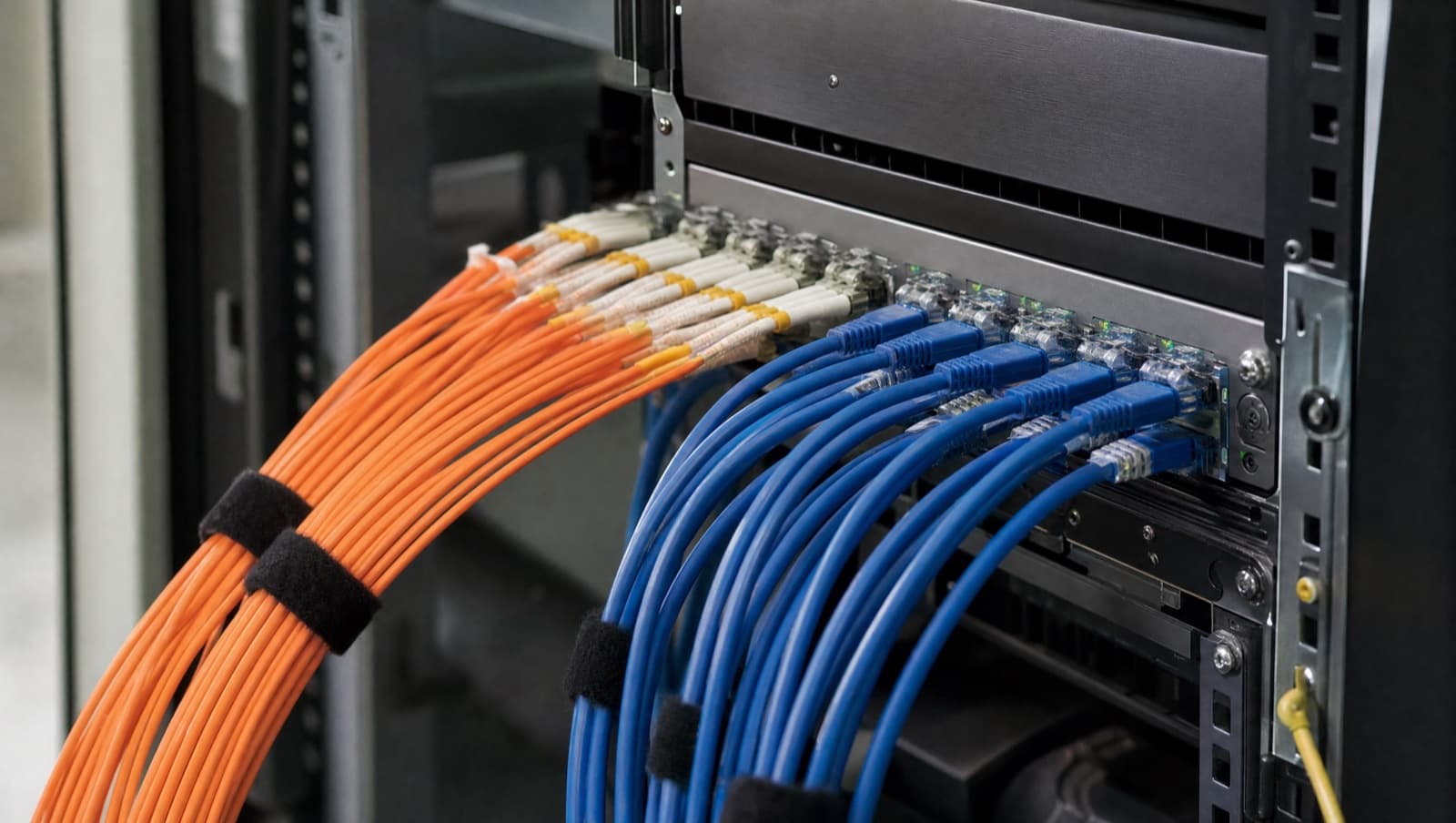
The physical difference is that Cat6a cables are thicker, heavier, and have tighter twist rates with improved shielding against alien crosstalk (AXT). Shielded (F/UTP or S/FTP) variants are common in Cat6a, though unshielded versions exist. This matters on site because Cat6a takes up more space in containment, has larger bend radii, and requires more careful termination.
Is Cat6 good enough for a commercial office, or do you need Cat6a?
If you're fitting out a standard office floor with VoIP phones, laptops docking over Ethernet, and a Wi-Fi 6 access point every 10 to 15 metres, Cat6 will do the job today. No question. A well-installed Cat6 infrastructure running 1 Gbps to each desk is more than adequate for most office tenants in 2025.
But here's the catch: cabling is the one part of your network infrastructure that you cannot easily upgrade. Switches get swapped every 5 to 7 years. Access points get replaced when the next Wi-Fi standard drops. But the cable in the ceiling void, behind the dado trunking, running through fire-stopped penetrations? That stays for 15 to 25 years. If you install Cat6 today and need 10 Gbps backbone capacity in 2030, which is entirely plausible with Wi-Fi 7 access points requiring multi-gig uplinks, you're looking at a full re-cable. And re-cabling a live, occupied building is expensive, disruptive, and often physically constrained by existing containment.
There's also the Power over Ethernet (PoE) consideration. Modern PoE devices, particularly Wi-Fi 6E/7 access points, LED lighting controllers, CCTV cameras, and building sensors, draw significantly more power than the VoIP phones of ten years ago. IEEE 802.3bt (PoE++) can deliver up to 90W per port, but higher power means more heat in the cable bundle. Cat6a handles this better because the larger conductor gauge and improved construction dissipate heat more effectively. BS EN 50173-1 acknowledges the de-rating effect of temperature on cable performance, and bundled Cat6 cables running high-wattage PoE in enclosed containment can exceed their thermal limits, degrading performance below spec.
What commonly goes wrong with Cat6 and Cat6a installations?
The most common mistake we see is cost-driven Cat6 installations in buildings that clearly need Cat6a. A developer fits out a new office building, chooses Cat6 to save a few pounds per drop, and within three years the tenant's IT team is asking why their multi-gig switches aren't performing as expected. The answer is in the ceiling.
Another frequent problem is poor termination. Cat6a is less forgiving than Cat6, the tighter performance margins at 500 MHz mean that a sloppy termination, too much untwist at the jack, or a cable that's been kinked during installation will fail a Fluke test. We've been called in to remediate Cat6a installs done by general electricians who treated it like standard power cabling. Every single terminated point needed re-doing.
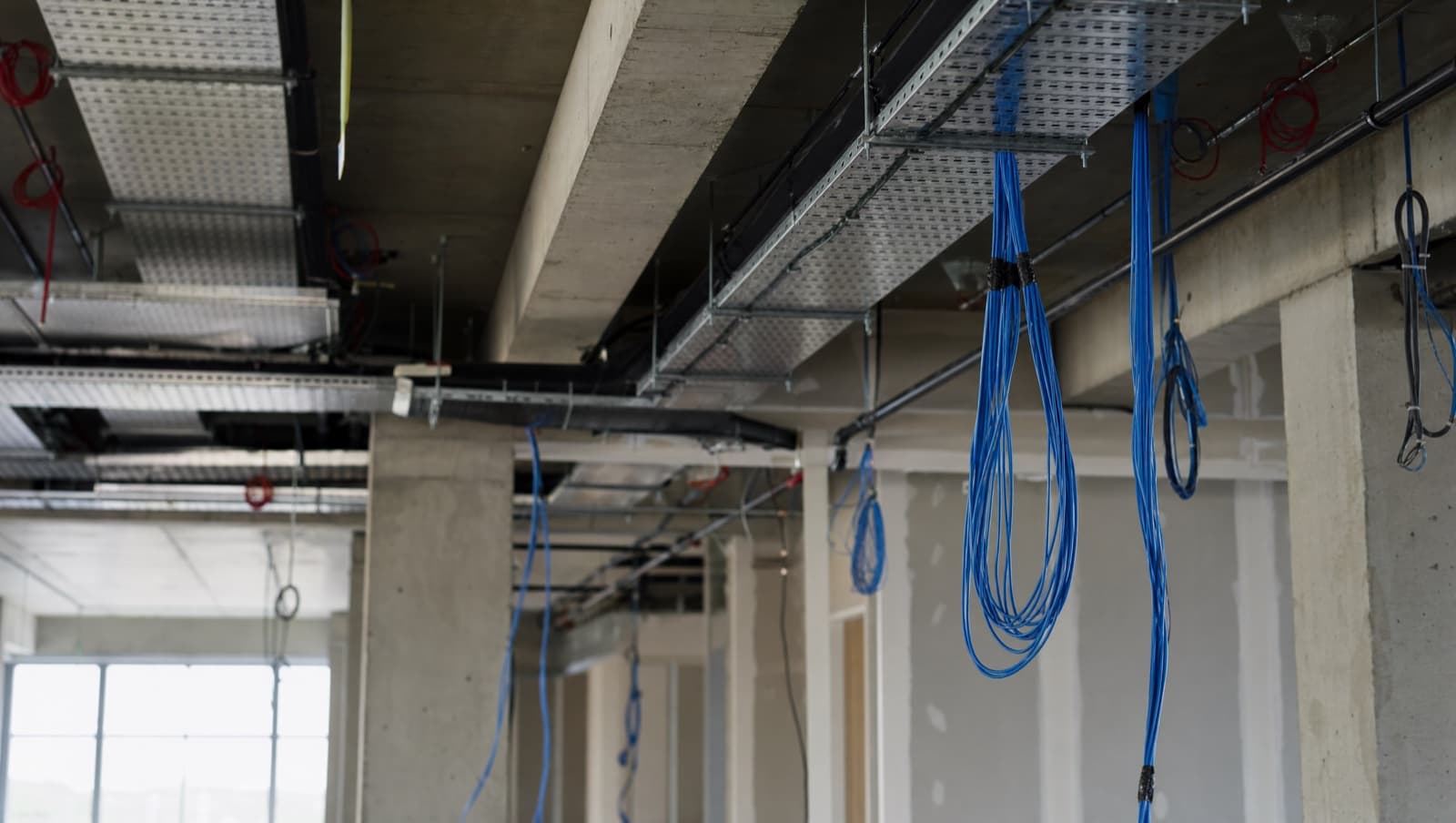
We also see problems with containment planning. Cat6a cables have an outside diameter of roughly 7.5 to 8mm compared to Cat6's 5.5 to 6mm. That doesn't sound like much, but when you're running 48 cables through a 150mm x 75mm trunking section, the fill ratio changes significantly. TIA/EIA-569 recommends no more than 40% fill in cable pathways, and Cat6a eats into that allowance fast. If containment isn't sized for Cat6a from the start, you end up with overfilled trays, tight bends, and cables that fail certification because they've been crushed.
Get a Free BMS Survey
We'll assess your controls and provide a detailed quotation.
Which standards apply to commercial structured cabling in the UK?
The primary standard for structured cabling in the UK is BS EN 50173-1:2018, which defines performance classes for balanced cabling. Class E (Cat6) and Class EA (Cat6a) are both covered, but the standard makes clear that Class EA is the minimum recommendation for new installations supporting 10GBASE-T applications.
BS 6701:2023 covers telecoms equipment and infrastructure installation. It requires that all cabling installations are tested and certified to the relevant class, with results documented and retained. If a contractor tells you they don't need to test every link, they're wrong, BS 6701 is explicit about this.
For installations in shared or multi-tenanted buildings, BS EN 50174-2:2018 covers cabling installation planning and practices, including separation distances from power cables, earthing and bonding requirements for screened cabling, and environmental classification. If you're running shielded Cat6a (F/UTP or S/FTP), the bonding requirements in BS EN 50174-2 are critical, an unbonded screen is worse than no screen at all, because it acts as an antenna rather than a shield.
What does a real Cat6a commercial upgrade look like?
We recently completed a full structured cabling install for a five-storey commercial office in central London. The client initially specified Cat6 across all floors to keep costs down. During the design review, we flagged that their planned Wi-Fi 6E deployment would require 2.5 Gbps uplinks to each access point within 18 months, and their building automation system, including IP-connected HVAC sensors, BMS controllers, and access control, would benefit from a converged network running PoE++ devices.
We re-specified Cat6a throughout, increased the containment sizing from 100mm to 150mm trunking, and installed screened (F/UTP) cable with full bonding back to the comms room earth bar. The additional cost was around 15% more than Cat6, roughly an extra eight to ten pounds per drop including the upgraded patch panels and outlets. For a 400-drop installation, that was about three to four thousand pounds total. The client now has a 10 Gbps-ready infrastructure that will last well beyond 2040, with headroom for whatever switching and wireless technology comes next.
What does a well-specified Cat6a installation include?
A well-specified Cat6a installation starts at the design stage. Containment is sized for the larger cable diameter. Comms rooms have adequate patch panel space, Cat6a panels are physically larger and need proper cable management behind. Every cable is labelled at both ends following a consistent naming convention. Fire stopping is specified for the right cable diameter. And critically, every single link is tested with a Level V channel adapter on a Fluke DSX-5000 or equivalent, certified to Class EA, with results exported and stored.
The patch panels should be tool-less or use the correct punchdown tooling for the specific module. The cables should have at least 3 metres of service loop at the comms room end. The containment should maintain separation from power cables per BS EN 50174-2, a minimum of 200mm from unscreened power cables in parallel runs, or 50mm with metallic separation.
When should you make the Cat6 vs Cat6a decision?
If you're planning a new-build fit-out, a floor refurbishment, or a technology refresh in any commercial building, this is the moment to make the Cat6 vs Cat6a decision properly. Retrofitting later costs three to five times more than getting it right at first fix, once you factor in the disruption, containment modifications, and re-certification.
If you're running a multi-tenanted building and you want to future-proof for the next generation of tenants, Cat6a is the answer. If you're a single-occupancy office with 20 desks and no plans to grow, Cat6 might be acceptable, but even then, the price difference is marginal enough that Cat6a is worth it for peace of mind.
Should you choose Cat6 or Cat6a for a commercial building?
The cabling you put in today will outlast every switch, every access point, and every server in your building. Cat6a costs a little more upfront, but it removes the biggest risk in network infrastructure: the cable itself becoming the bottleneck. If you need help specifying structured cabling for a commercial project, or you want a second opinion on what's already been quoted, get in touch with our team. We design, install, test and certify to BS EN 50173 and BS 6701, and we'll make sure you don't have to rip it all out in five years.
Alpha Controls Team
Specialist BMS installation, commissioning, and maintenance across London and the South East. SafeContractor Approved, BCIA Member.