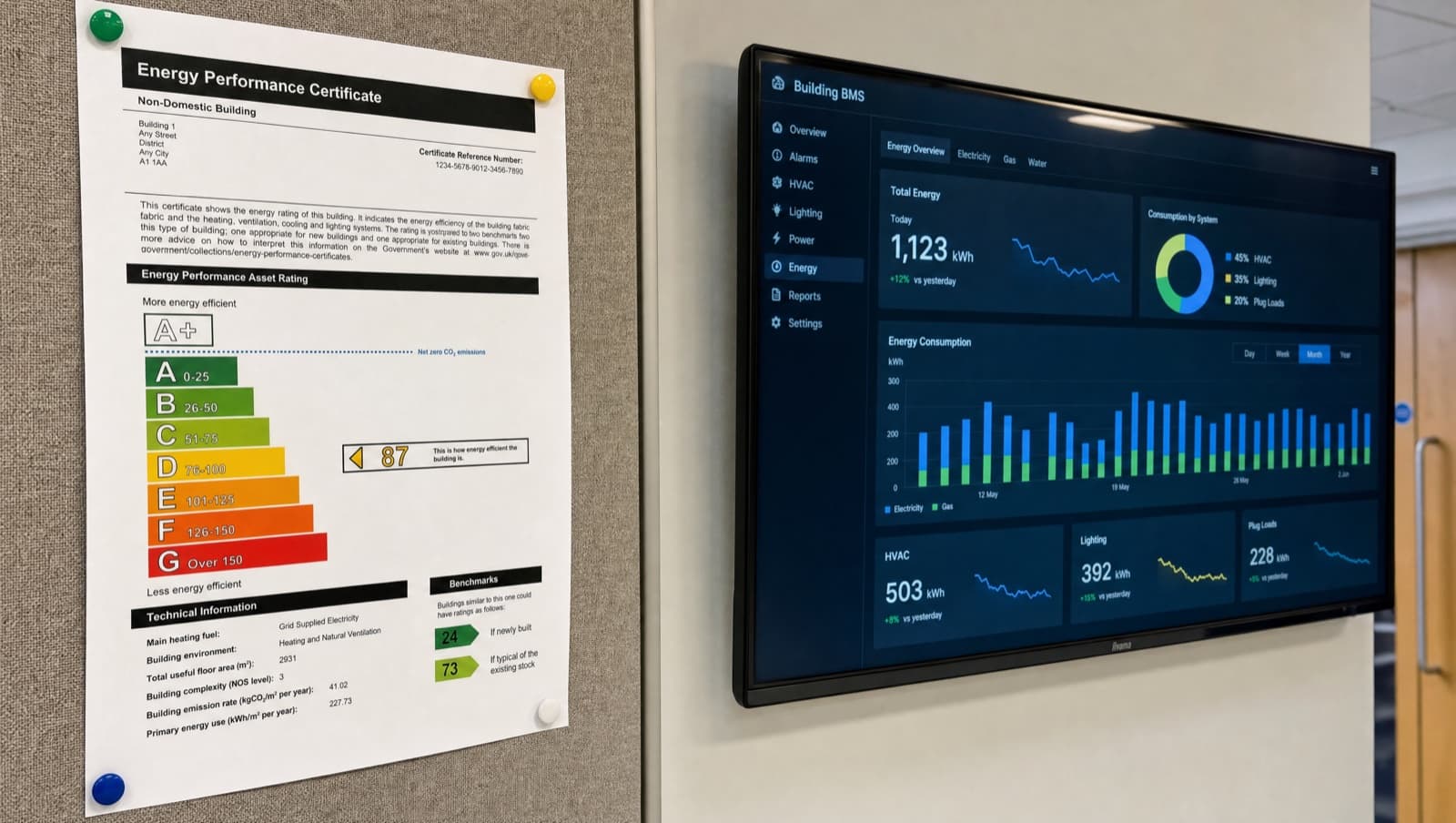

The UK Net Zero Carbon Buildings Standard (UKNZCBS), published as Version 1 in March 2026 by CIBSE and seven partner bodies, is the UK's first agreed definition of a net zero carbon building. Verification requires 12 months of measured, metered in-use energy data — not design estimates — which makes your metering strategy and BMS the evidence base for compliance.
Here's the situation nobody in the net zero conversation wants to say out loud: most commercial buildings in the UK could not prove their energy performance right now if they had to. Not because they're performing badly — plenty aren't — but because the data trail doesn't exist. The main fiscal meter tells you what the whole building used. Beyond that, it's a patchwork: sub-meters that were installed at fit-out and never commissioned, landlord and tenant loads tangled through the same distribution boards, a BMS head-end that shows kWh figures nobody has ever validated against the utility bill.
For years that didn't matter much. Net zero commitments were made at portfolio level, ESG reports were built on floor-area estimates and design-stage models, and nobody checked. The UK Net Zero Carbon Buildings Standard ends that. It's built specifically to close the performance gap between what buildings were designed to do and what they actually do — CIBSE's own performance gap research puts real consumption at typically 1.5 to 2.5 times the design prediction — and the only currency the Standard accepts is measured, metered, in-use data. If your building can't produce twelve clean months of it, the building doesn't get verified. It really is that blunt.
What Is the UK Net Zero Carbon Buildings Standard?
The UK Net Zero Carbon Buildings Standard is a cross-industry standard that defines, for the first time, what "net zero carbon" actually means for a UK building — and provides a route to verify the claim. It was developed by CIBSE together with the Better Buildings Partnership, BRE, IStructE, LETI, RIBA, RICS and UKGBC, with over 350 technical experts involved in drafting it.
The timeline matters because it tells you how close this is. A pilot version launched in September 2024. Through 2025, a pilot testing programme put it through its paces on 216 real-world projects across 134 building owners. Version 1 was published on 10 March 2026, and verification services open in Summer 2026. This is no longer a consultation document — it's a live standard you can register buildings against, free to access at nzcbuildings.co.uk.
It covers 13 sectors — offices, retail, homes, schools, healthcare, hotels, data centres, higher education, storage and distribution among them — with separate limits for new build and retrofit. It's voluntary, in the same way BREEAM and NABERS are voluntary: nothing forces you to use it, until your investors, your tenants' green lease clauses, or your planning authority start asking for it.
What Does the Standard Actually Require?
Four things, and a building must satisfy all of them independently — you cannot trade a good score on one against a failure on another.
First, operational energy: the building must perform within an Energy Use Intensity (EUI) limit, in kWh/m² per year, specific to its building type, with limits tightening year on year. Under the pilot version, new homes started at 45 kWh/m²/yr for houses and 40 for flats in 2025, converging on 35 kWh/m²/yr by 2040 — and every one of the roughly 30 building types and subtypes has its own trajectory. Second, embodied carbon: upfront carbon limits that also ratchet down over time — the pilot set new-build office shell and core at 475 kgCO₂e/m², falling to 35 kgCO₂e/m² by 2050. Third, the building must be free of fossil fuel combustion. Fourth, it must meet a minimum level of on-site renewable generation where applicable.
Offsetting gets no free pass. Offsets are permitted only for genuinely residual emissions after the mandatory reduction requirements are met — you cannot buy your way past an EUI limit.
How Does UKNZCBS Verification Work — and Why It Runs Through Your Metering
This is the part the architecture and development press has largely skipped over, and it's the part that lands on our desk.
A building cannot be verified at practical completion. Verification as "net zero carbon aligned" requires twelve months of measured, in-use performance data under normal occupied conditions — and then annual re-verification to keep the badge. There is an optional "Practical Completion on-Track" check for new builds, and Version 1 added landlord-only and tenant-only verification routes for offices, recognising that in a multi-let building the landlord doesn't control the tenants' energy. But the destination is always the same: metered evidence, assessed by a third party.
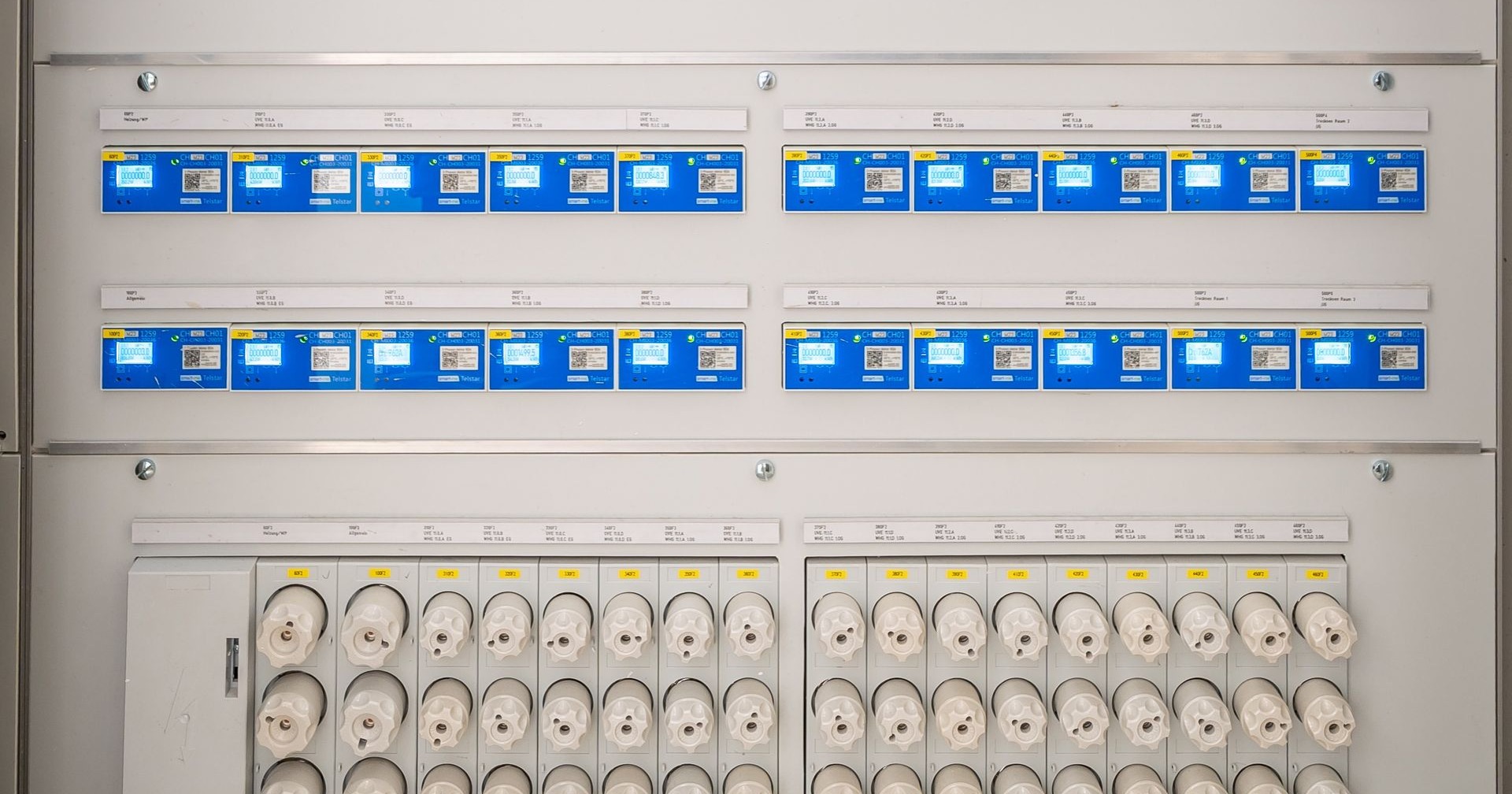
Think through what that means in practice. Your metering has to be complete enough to capture the building's actual energy use. Landlord and tenant loads have to be cleanly separated — a verifier working a landlord-only route can't untangle a riser where tenant small power runs through landlord boards. Plant-level consumption has to be visible, because a whole-building number with no breakdown fails the plausibility check that in-use metrics are subjected to. And the data has to be consistent, retained, and retrievable across the full twelve months — one dead meter, one BMS head-end rebuild that wipes the trend logs, one unlogged comms failure, and your evidence year restarts.
A building can be operating efficiently and still be unable to demonstrate it. That's the trap. The Standard doesn't verify how your building performs; it verifies what your data proves. Those are only the same thing when the metering and the building management system behind it were designed, commissioned and maintained properly.
Get a Free BMS Survey
We'll assess your controls and provide a detailed quotation.
What Usually Goes Wrong
The pilot programme gave us an honest preview. More than a third of pilot participants reported they couldn't gather or submit all the data the Standard asked for on the embodied carbon side. That's experienced, motivated early adopters — and they couldn't produce the evidence. In-use energy data is the same story with different actors.
The failures we walk into on site are consistent. Sub-meters installed at fit-out to satisfy Part L, then never commissioned: the meter is on the wall, the CT is around the wrong cable, or all three phases are clamped in the same direction, and the kWh figure in the head-end has been quietly wrong for five years. Meters that exist electrically but were never mapped into the BMS, so the data was never trended and there is no history to submit. Landlord and tenant circuits mixed at the distribution board because a fit-out contractor tapped the most convenient supply. Trend logs configured with 30-day rolling buffers, so the "twelve months of data" the Standard wants was overwritten eleven months ago. And the classic: a BMS running in hand, overrides everywhere, long overdue a recommissioning — consuming energy in ways the design model never predicted and the data can't explain.
And the drift never stops on its own. Industry commissioning studies consistently find commercial buildings operating 15–30% above their design energy performance within five years of handover, as sensors go out of calibration, control sequences get overridden during one bad week and never restored, and occupants fight the system — CIBSE Journal documented a schools case where occupants cranked room setpoints to 30°C heating and 14°C cooling in the belief it worked faster, then opened the windows anyway.
None of these are exotic. Every one of them is a routine finding on a metering survey, and every one of them is fatal to a UKNZCBS verification year.
The Standards Already Pointing the Same Way
The UKNZCBS doesn't arrive in a vacuum — the regulatory scaffolding around metered performance has been assembling for years.
Approved Document Part L 2021 (Volume 2, non-domestic) requires new buildings over 500m² to have energy metering capable of assigning at least 90% of estimated annual consumption to end-use categories — heating, cooling, ventilation, lighting, small power — and automatic meter reading for buildings over 1,000m². CIBSE TM39 provides the metering strategy methodology it leans on. If your building was built or refitted to Part L 2021 and the metering can't do this, it was never compliant to begin with.
CIBSE TM54 (2022) is the design-stage counterpart: a methodology for predicting operational energy that forces you to model everything — regulated and unregulated loads, lifts, IT, catering, and crucially the behaviour of the controls — and to present a range rather than a single flattering number. The UKNZCBS is, in effect, TM54's day of reckoning: the prediction finally gets checked against the meter.
And NABERS UK Design for Performance runs the same logic for offices: commit to a target star rating (minimum 4.0 stars) at design stage, then prove it with twelve months of metered energy data, with the metering boundary between landlord and tenant services agreed up front. Buildings already on a NABERS UK pathway will find UKNZCBS verification familiar. Buildings that skipped all of this will find it brutal.
MEES sits underneath all of it — the MEES trajectory toward EPC B by 2031 for larger buildings is calculated, not measured, but it's dragging the same buildings toward the same controls and metering upgrades.
What This Looks Like on a Real Building
We did a 16-floor fan coil unit controls upgrade at the Pinsent Masons building in London — Trend controllers throughout, LightFi occupancy and air-quality sensors integrated, all delivered in weekend-only access windows because the building stayed fully occupied throughout. The point of that story here isn't the FCUs. It's that the upgrade gave the building floor-by-floor visibility of what its HVAC was actually doing, with every point trended and logged.
That's the difference between a building that can face a measured-performance standard and one that can't. When someone asks that building "prove your energy performance for the last twelve months," the answer is a data export, not a shrug. Retrofitting that capability is entirely doable — we do it constantly, on live buildings, out of hours — but it takes a season of clean data before the evidence clock even starts. Which is exactly why the timing section below matters.
What Good Looks Like
A building ready for UKNZCBS verification has a metering strategy, not just meters. That means a TM39-aligned metering schedule that says what each meter covers and why; MID-approved meters where the data feeds billing; clean separation of landlord and tenant loads at the infrastructure level; and plant-level sub-metering on the significant consumers — chillers, boilers or heat pumps, AHUs, DHW. Sub-metering done properly is the foundation the whole evidence chain stands on.
It has commissioned metering: every meter point-to-point verified, CT ratios confirmed, readings reconciled against the fiscal meter so the tree actually adds up. It has a BMS trending every meter at a sensible interval, with retention configured in years, not days, and backups that survive a head-end replacement. And it has someone — in-house or a maintenance contractor — reviewing the data monthly, so a failed meter is a two-week annoyance rather than a discovered-at-year-end disaster that voids the submission.
None of this is exotic engineering. It's disciplined commissioning and data hygiene, which is precisely why it's so often missing.
When to Act
Work the timeline backwards. Verification opens in Summer 2026. It requires twelve months of clean, metered, in-use data. A building that gets its metering and BMS in order in late 2026 starts its evidence year in early 2027 and can verify in 2028. A building that waits to see whether clients ask for it will be two years behind the one that didn't — and by then the asking will be coming from investors and green lease clauses, not from us.
The survey is the cheap bit. A metering and controls audit tells you whether your data trail would survive third-party scrutiny, what's broken, and what it costs to fix. If you're planning any controls work in the next year anyway — MEES-driven upgrades, plant replacement, a recommissioning — folding the UKNZCBS metering requirements into that scope costs a fraction of doing it as a standalone project later.
The Bottom Line
The UK Net Zero Carbon Buildings Standard changes the question from "is your building efficient?" to "can you prove it?" — and the proof lives in your metering and your BMS. Version 1 is published, verification opens Summer 2026, and the twelve-month evidence requirement means the buildings that verify first are the ones getting their data infrastructure right now.
If you want to know whether your building could survive a UKNZCBS verification year — or you already know it couldn't and want it fixed — get in touch or request a quote. We'll start with the meters, because that's where the Standard will.
Frequently Asked Questions
What is the UK Net Zero Carbon Buildings Standard?
The UKNZCBS is the UK's first cross-industry standard defining what a net zero carbon building is, developed by CIBSE, BRE, RIBA, RICS, UKGBC, LETI, IStructE and the Better Buildings Partnership. Version 1 was published in March 2026. It sets operational energy and embodied carbon limits for 13 building sectors, requires fossil-fuel-free operation, and verifies buildings against measured in-use performance data.
Is the UK Net Zero Carbon Buildings Standard mandatory?
No — it's voluntary, like BREEAM or NABERS UK. But it's expected to become the reference definition investors, tenants with green lease clauses, and planning authorities use when someone claims a building is net zero. A voluntary standard that your funders ask for stops being voluntary in practice.
How is a building verified under UKNZCBS?
Verification requires twelve months of measured, metered in-use energy data under normal occupied conditions, assessed by a third party — design-stage estimates don't count, and a building cannot be fully verified at practical completion. Buildings then re-verify annually to keep their "net zero carbon aligned" status. Version 1 added landlord-only and tenant-only routes for offices.
What does UKNZCBS mean for BMS and metering?
Everything runs through the data. The building needs complete, commissioned sub-metering with landlord and tenant loads separated, plant-level consumption visible, and a BMS trending and retaining every meter for the full evidence year. A building can perform efficiently and still fail verification if the metering can't prove it.
When does UKNZCBS verification open?
Verification services open in Summer 2026, following the pilot testing programme that ran across 216 real-world projects during 2025. Because verification needs twelve months of in-use data first, buildings preparing their metering and controls in 2026 are realistically verifying from 2027–2028.
About Alpha Controls
Alpha Controls delivers BMS installation, commissioning, metering and maintenance across London and the South East. We work with Trend, Distech, Schneider, and open-protocol systems on commercial offices, higher education, healthcare, and mixed-use developments. If you want a metering and controls audit ahead of a UKNZCBS or NABERS UK pathway, get in touch or request a quote.
Alpha Controls Team
Specialist BMS installation, commissioning, and maintenance across London and the South East. SafeContractor Approved, BCIA Member.