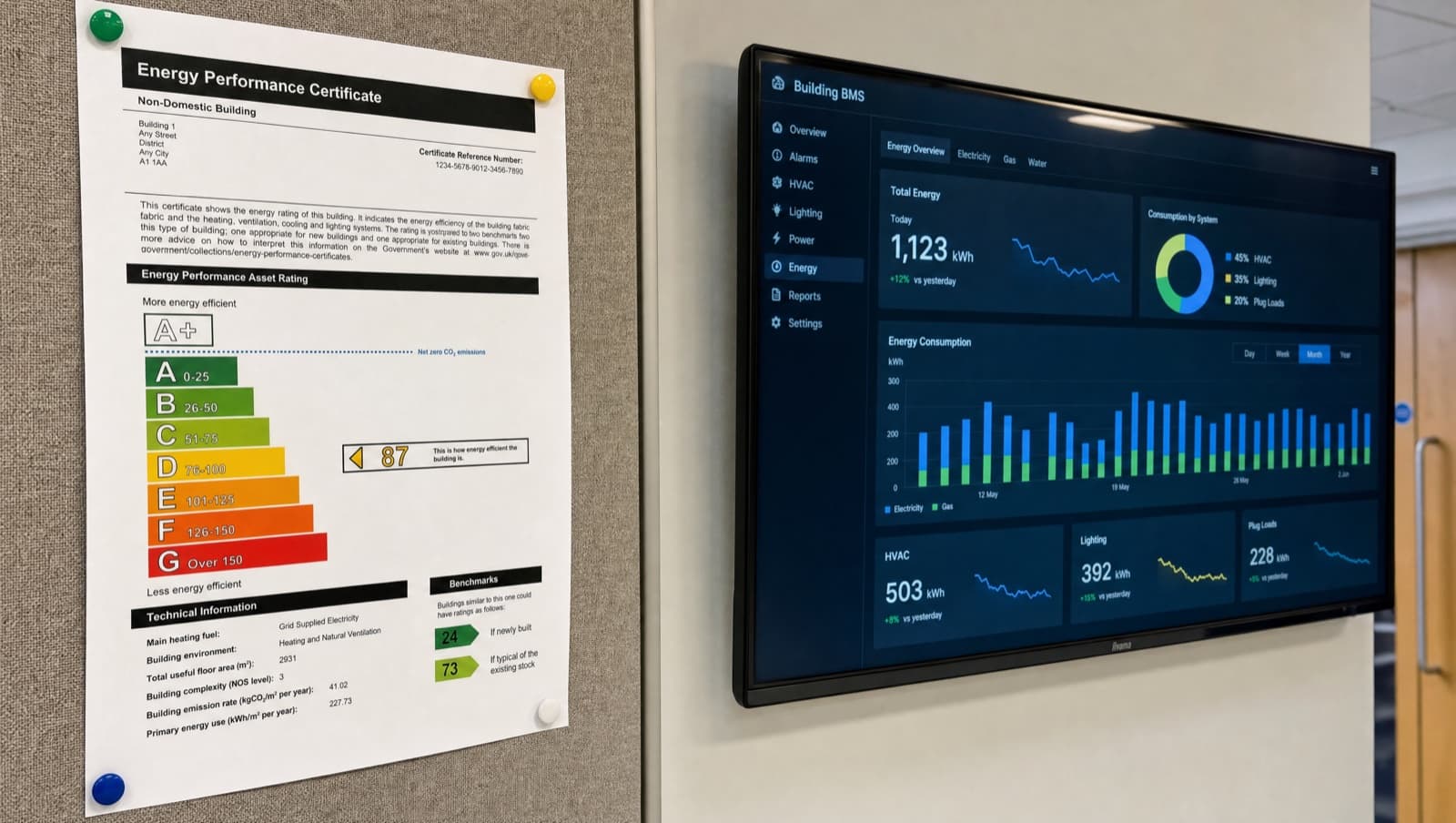

Under MEES, commercial property in England and Wales must currently meet EPC Band E to be let; following the June 2026 government interim response, buildings over 1,000 m² are expected to reach Band B by 2031 — the proposed 2027 Band C milestone has been dropped, and smaller buildings remain at the Band E minimum. A well-configured BMS is a major SBEM scoring factor and can lift a building one to two bands through controls alone, avoiding fines of up to £150,000.
What is MEES and why does it matter for commercial landlords?
The Minimum Energy Efficiency Standards Regulations 2015 (as amended by the 2023 amendment) make it unlawful to let commercial properties in England and Wales below EPC rating E — a threshold the June 2026 interim response now tightens to Band B by 2031 for buildings over 1,000 m², with the previously proposed 2027 Band C milestone dropped. The MEES framework derives from powers in the Energy Act 2011, which gave the Secretary of State authority to set minimum energy performance requirements for rented property; unlike voluntary schemes such as BREEAM, MEES compliance is a legal requirement with civil penalties of up to £150,000 for non-compliant lettings. Since April 2023, it has been unlawful to let commercial property below EPC Band E. The upcoming deadlines are significantly more demanding:
- June 2026 — the government interim response dropped the proposed 2027 Band C milestone, retaining the seven-year payback test and exemptions framework
- 2031 — private rented commercial buildings over 1,000 m² in England and Wales must reach EPC Band B, where cost-effective; smaller buildings stay at the Band E minimum
Properties that cannot meet these thresholds will be unlettable — a significant financial risk for landlords with portfolios of older commercial stock. Buildings currently rated D or E will require substantial investment to comply, and the 2027 deadline is closer than it appears when design, procurement, and construction lead times are factored in.
How do BMS controls affect an EPC rating?
A commercial EPC is calculated using SBEM (Simplified Building Energy Model), which assesses the building's theoretical energy performance based on fabric, systems, and controls. The BMS and controls configuration is a significant scoring factor. SBEM awards credit for:
- Weather-compensated heating controls
- Zone-by-zone temperature control (individual room control vs single-zone)
- Optimum start controls
- Time scheduling of HVAC plant
- Variable speed drives on fans and pumps
- Heat recovery on air handling units
- Demand Controlled Ventilation (CO₂-based fresh air control)
A building with poor controls — an on/off boiler, no weather compensation, no zone control — will score significantly worse than the same building with a properly configured BMS, even if the physical plant is identical.
How much can BMS upgrades improve an EPC rating?
The improvement depends on the starting point. A building currently rated E with basic controls can typically gain one to two EPC bands through controls improvements alone, without changing boilers, chillers, or building fabric. The highest-impact changes in SBEM are:
- Weather compensation — replacing on/off boiler control with modulating weather-compensated control
- Individual zone control — adding individual FCU thermostats or VAV controls
- Heat recovery — enabling a heat recovery section on AHUs if physically present but bypassed
- VSDs on fans and pumps — replacing fixed-speed motors with variable speed drives
- Demand Controlled Ventilation — CO₂-controlled fresh air instead of constant full-flow ventilation
Sub-metering is also increasingly important for demonstrating actual energy performance to EPC assessors and auditors. For a guide to how energy metering integrates with a BMS and the savings data it unlocks, see our article on energy metering and sub-metering. For buildings where MEES compliance sits within a broader decarbonisation strategy, our article on the path to net zero with BMS technology covers how controls improvements align with carbon reduction targets.
Get a Free BMS Survey
We'll assess your controls and provide a detailed quotation.
Do BMS upgrades pay for themselves?
The financial case has two components. First, compliance value: the cost of the BMS upgrade weighed against loss of rental income from an unlettable property. For a property generating £150,000/year in rent, six months unlettability costs £75,000 — often more than the BMS upgrade. Second, energy savings: a well-configured BMS reduces HVAC energy by 15–30%, delivering a standalone payback of 2–5 years regardless of MEES. For realistic budget figures on what a BMS upgrade or retrofit costs, see our guide to BMS retrofit costs in the UK.
What is the process from EPC assessment to compliance?
Reaching the target band follows five clear stages:
- Current EPC review — obtain the SBEM calculation file to identify which systems score poorly
- Controls audit — site survey to understand current BMS capabilities and feasible upgrades
- Gap analysis — working with your EPC assessor, identify which controls measures reach the target band
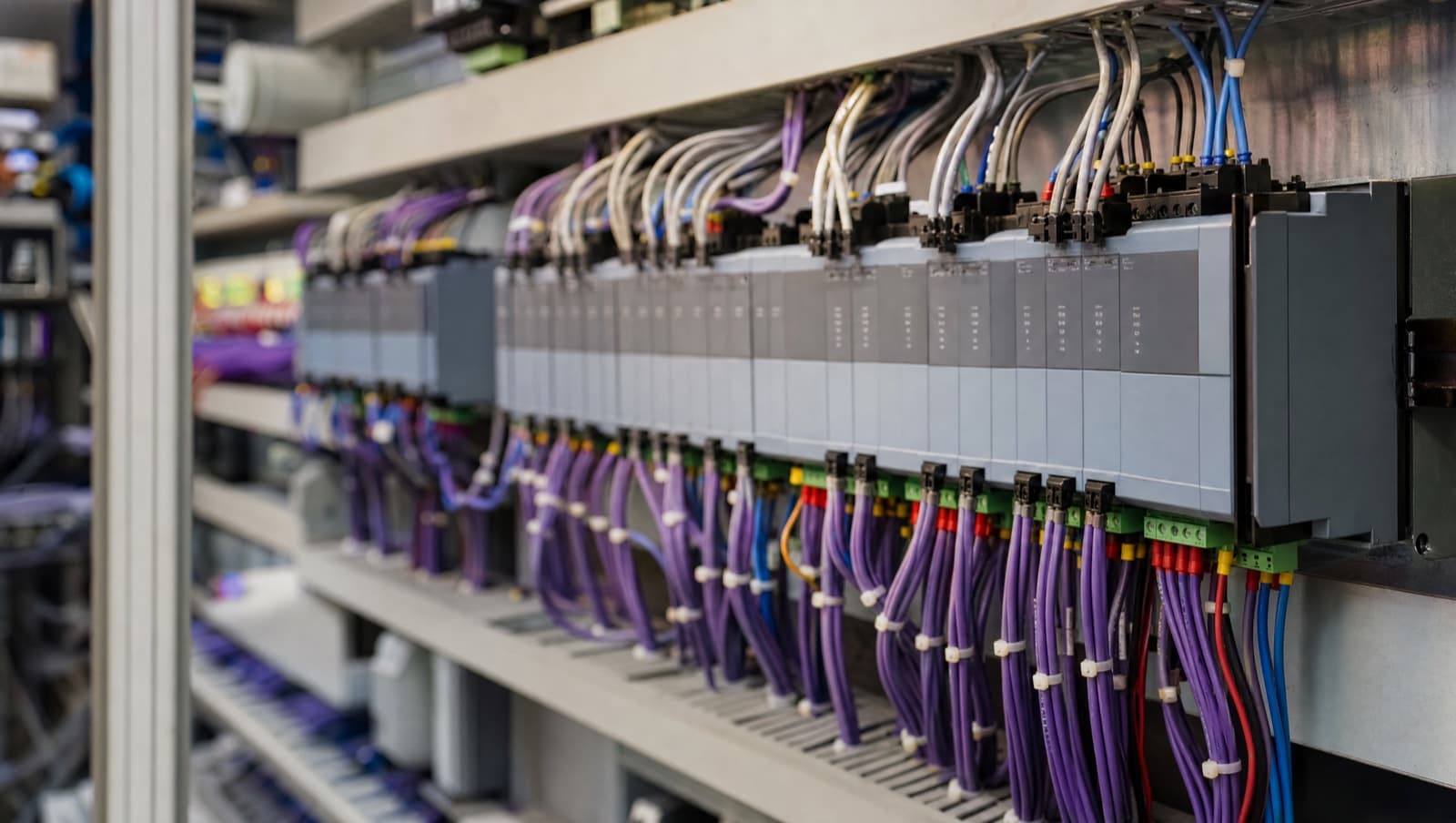
- Design and installation — panel design, installation, and commissioning
- New EPC assessment — updated rating issued with controls upgrades in place
Why shouldn't landlords leave MEES upgrades until 2026?
The run-up to 2031 will create a surge in demand for M&E contractors and BMS engineers. Lead times for BMS design, panel manufacture, and commissioning are already extending. Buildings beginning the process in 2025–2026 will have far more flexibility on programme and cost than those leaving it to the final year.
Alpha Controls provides MEES compliance support for commercial landlords across London, Kent, Essex, and across the South East. Contact us for a free initial consultation on your portfolio's compliance position.
Alpha Controls Team
Specialist BMS installation, commissioning, and maintenance across London and the South East. SafeContractor Approved, BCIA Member.