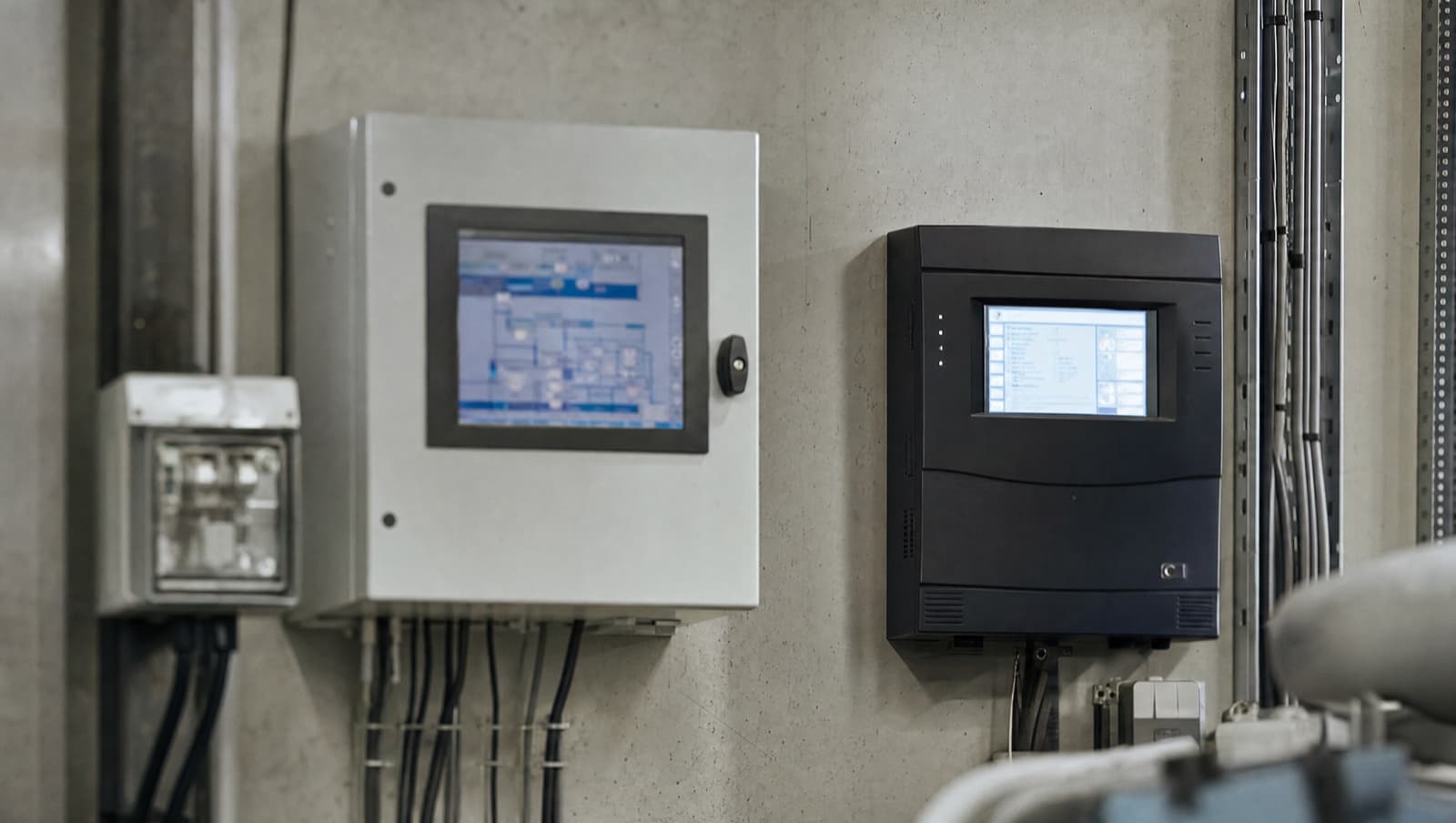

Siemens Desigo CC and Honeywell Enterprise Buildings Integrator are both enterprise head-end platforms that integrate HVAC, fire, access and security under one front end. Desigo CC suits mixed-vendor estates and modern BACnet plant; EBI suits large single-vendor campuses and security-led sites. For a 10-year FM contract, engineer availability and licence structure usually decide it, not features.
Siemens Desigo CC and Honeywell Enterprise Buildings Integrator regularly appear on the same shortlist. Both integrate HVAC, fire, access and security, both run on a Windows server with SQL underneath, and both will give you a polished operator front end with maps, alarms, trends and schedules. On paper they look interchangeable. They are not. The differences that actually bite show up two and three years into an FM contract — when a licence needs renewing, when a controller dies on a Friday night, and when the consultant who specced it has long since moved on. We get called in to inherit both platforms, and the questions clients wish they'd asked at tender stage are almost never about the headline feature list.
What is the difference between Siemens Desigo CC and Honeywell EBI?
Both are supervisory platforms — the top layer of a building management system that sits above the field controllers and presents everything to the operator. They are not controllers themselves. Desigo CC talks to Siemens field plant (Desigo PXC controllers, the older Synco range, fire panels) and to any third-party BACnet or OPC kit. EBI talks to Honeywell field plant (the Excel and Spyder controller families, ComfortPoint, Notifier and Gamewell fire, Pro-Watch access control) and to third-party systems through its own integration drivers.
The honest summary is this: Desigo CC was built around open BACnet from the start and tends to behave well in a mixed-vendor estate. EBI grew out of Honeywell's process and security heritage, and it is strongest where security, access control and life-safety sit alongside HVAC on one platform — large campuses, hospitals, airports, secure facilities. Neither is wrong. They are aimed at slightly different buildings, and a lot of the pain we see comes from a platform being specified for the wrong type of estate.
Which one integrates third-party plant better?
This is where Desigo CC usually has the edge, and it comes down to how each platform treats BACnet. Desigo CC was designed as a native BACnet supervisor under BS EN ISO 16484-5 (the international BACnet standard, also published as ASHRAE 135). When you point it at a third-party BACnet controller — a Trend IQ4, a Distech ECLYPSE, a Schneider MP-C — it reads the object list and you build your graphics and alarms from genuine BACnet objects. There is no translation layer pretending to be something it isn't.
EBI integrates third-party plant too, but historically it leans on its own driver and channel architecture, and BACnet integration sits alongside Honeywell-native protocols rather than being the first-class citizen. In a building that is 90% Honeywell field kit, this is a non-issue and EBI is excellent. In a building that has accumulated three or four vendors over twenty years of refurbishments — which is most commercial estates in the UK — Desigo CC tends to absorb the mixed plant with less friction.
The practical test we apply on site: open the integration and look at how a third-party point arrives at the head end. If it comes through clean as a BACnet object with its native units and alarm flags intact, future engineers can work with it. If it has been mapped point-by-point through a custom driver with no documentation, every change becomes archaeology. We have walked into both platforms where the integration was done well and where it was done badly — the platform matters less than the engineer who set it up, but Desigo CC's BACnet-first design gives a careful engineer fewer ways to make a mess.
What does it cost to license and renew Desigo CC vs EBI?
Both are commercial, point-licensed platforms, and the licence model is where FM budgets get caught out. We won't quote figures here because they move constantly and depend on point count, channels, redundancy and the partner agreement — but the structure is what matters for a long contract.
Both platforms typically license by the number of monitored points or objects, with additional cost for add-on modules: redundancy, advanced reporting, mobile access, extra integration drivers. The trap is that the building grows. A floor gets refurbished, a hundred new points get added, and suddenly you are over your licensed point band and the system either won't take the new points or quietly degrades. We have seen both happen. The thing to nail down at tender is: what is the point count today, what is the realistic point count in five years, and what does it cost to step up a band — because that step-up is rarely cheap and is almost never budgeted for.
The second trap is software assurance and version support. Both Siemens and Honeywell tie ongoing support, security patches and version upgrades to a maintenance agreement. Let it lapse and you are running an unsupported supervisor on an ageing Windows Server, which is both a cyber-security exposure and a problem the day you need a major upgrade. For HVAC head-end platforms, CIBSE Guide H (Building Control Systems) is clear that the management and maintenance regime is part of the system design, not an afterthought — and that includes keeping the supervisor patched and supported across its life. Budget the maintenance agreement for the full contract term, not just year one.
Get a Free BMS Survey
We'll assess your controls and provide a detailed quotation.
Can you get engineers to support either platform in the UK?
For a 10-year FM contract, this is the question that should decide the tender, and it's the one that gets the least attention. A supervisor is only as good as the pool of engineers who can work on it. Both Siemens and Honeywell run partner and approved-integrator networks, and access to the engineering tools — the parts you need to add points, edit graphics, change alarm logic — is generally gated behind partner status and training. This is deliberate, and it is the single biggest lock-in risk on either platform.
What this means in practice: if your incumbent integrator goes bust, gets bought, or simply becomes unresponsive, you need to know there is more than one firm in your region who can pick up the engineering. For mainstream Siemens and Honeywell plant in the UK there usually is — both have decent coverage — but it is worth confirming at tender that the head-end version you are buying is one that multiple local partners actively support, not a niche configuration only your original integrator understands. We are independent, and we are regularly called to inherit Desigo CC and EBI systems where the original installer has vanished. The jobs that go smoothly are the ones where the system was built to a recognisable standard with proper documentation. The painful ones are where someone built a clever, undocumented configuration that only made sense to them.
What goes wrong with these platforms on site?
The failures are rarely the platform itself falling over — both are mature and stable. The failures are operational. The most common one we inherit is graphics and alarms that no longer match the plant: a chiller was replaced, an AHU was re-controlled, and the head end was never updated, so the operator is looking at a screen that lies. BSRIA BG 11/2010 (Soft Landings) exists precisely to stop this — it pushes for proper commissioning, documentation and a handover that the FM team can actually use — and the buildings that ignored it are the ones where the supervisor drifts out of step with reality.
The second common failure is licensing and point-count creep, covered above — new points that can't be added because the licence band is full. The third is the unsupported, unpatched server: a Desigo CC or EBI box running on an out-of-support Windows version, no longer receiving security updates, sitting on the building network as an open door. The fourth, and the most frustrating, is lost engineering access — nobody has the credentials, the project backup, or the licensing dongle, so even a simple change becomes a rebuild. None of these are platform faults. They are lifecycle and handover faults, and they apply equally to Desigo CC and EBI.
What does a good Desigo CC or EBI installation look like?
A good installation on either platform shares the same characteristics. The integration is clean — third-party plant arrives as proper BACnet objects, not undocumented mapped points. The graphics match the plant exactly and are updated whenever the plant changes. There is a documented point schedule, a current project backup held by the client (not just the integrator), and clear licensing records so nobody is hunting for a dongle in three years. Alarms are prioritised and meaningful, not a wall of nuisance alerts the operator has learned to ignore. The server is patched, supported under a live maintenance agreement, and segregated on the network in line with sensible BMS cyber-security practice. And critically, more than one firm in your region can engineer it.
Get those right and both Desigo CC and EBI will serve a building well for a decade. Get them wrong and the platform choice barely matters — you'll be paying for the same problems either way.
When should you decide between them?
Decide at specification stage, before the head end is bought, and decide based on the estate you actually have rather than the feature comparison. If your building is mostly Honeywell field plant, or security and access control are central to how you run the site, EBI is the natural fit. If you have a mixed-vendor estate, modern BACnet controllers from several manufacturers, and HVAC is the priority, Desigo CC usually integrates with less friction. Either way, lock down the licence growth path, the maintenance agreement, the documentation requirement and the local engineer availability before you sign — because those four things, not the front-end features, determine whether the platform survives the contract.
If you've inherited a Desigo CC or EBI system you don't fully understand, or you're specifying a head end for a new estate and want an independent view rather than a single-vendor pitch, that's exactly the kind of work we do. We engineer and support both platforms and we'll tell you straight which one fits your building and your contract. Get in touch or request a quote and we'll take a look at what you've got.
Darren Grix
Specialist BMS installation, commissioning, and maintenance across London and the South East. SafeContractor Approved, BCIA Member.