
Your BMS should manage trace heating and frost protection because standalone thermostats fail silently — a stuck contact or broken cable means the pipe freezes with no warning. A BMS-managed system monitors, alarms, and logs every zone, raising an immediate fault when current stops flowing. Retrofit costs £300 to £600 per zone.
Every winter, UK facilities managers deal with the consequences of burst pipes caused by inadequate frost protection. A single burst pipe in a plant room can cause £10,000 to £50,000 in water damage. A burst in a riser serving multiple floors can shut down a building for days. The irony is that most of these buildings have trace heating installed — it is just not monitored, not maintained, and nobody knows whether it is actually working until the pipe bursts and proves it was not. This is exactly the class of gap a plant room refurbishment with proper controls closes. The problem is almost always the same: trace heating cables are controlled by standalone thermostats that fail silently. The thermostat sticks, or the cable develops a fault, or someone switches off the isolator during summer maintenance and forgets to switch it back on in October. Nobody notices because the BMS — which monitors everything else in the building — is not connected to the trace heating system. For our full trace heating and leak detection service, see our leak detection and trace heating services page.
What Is Trace Heating and When Is It Needed?
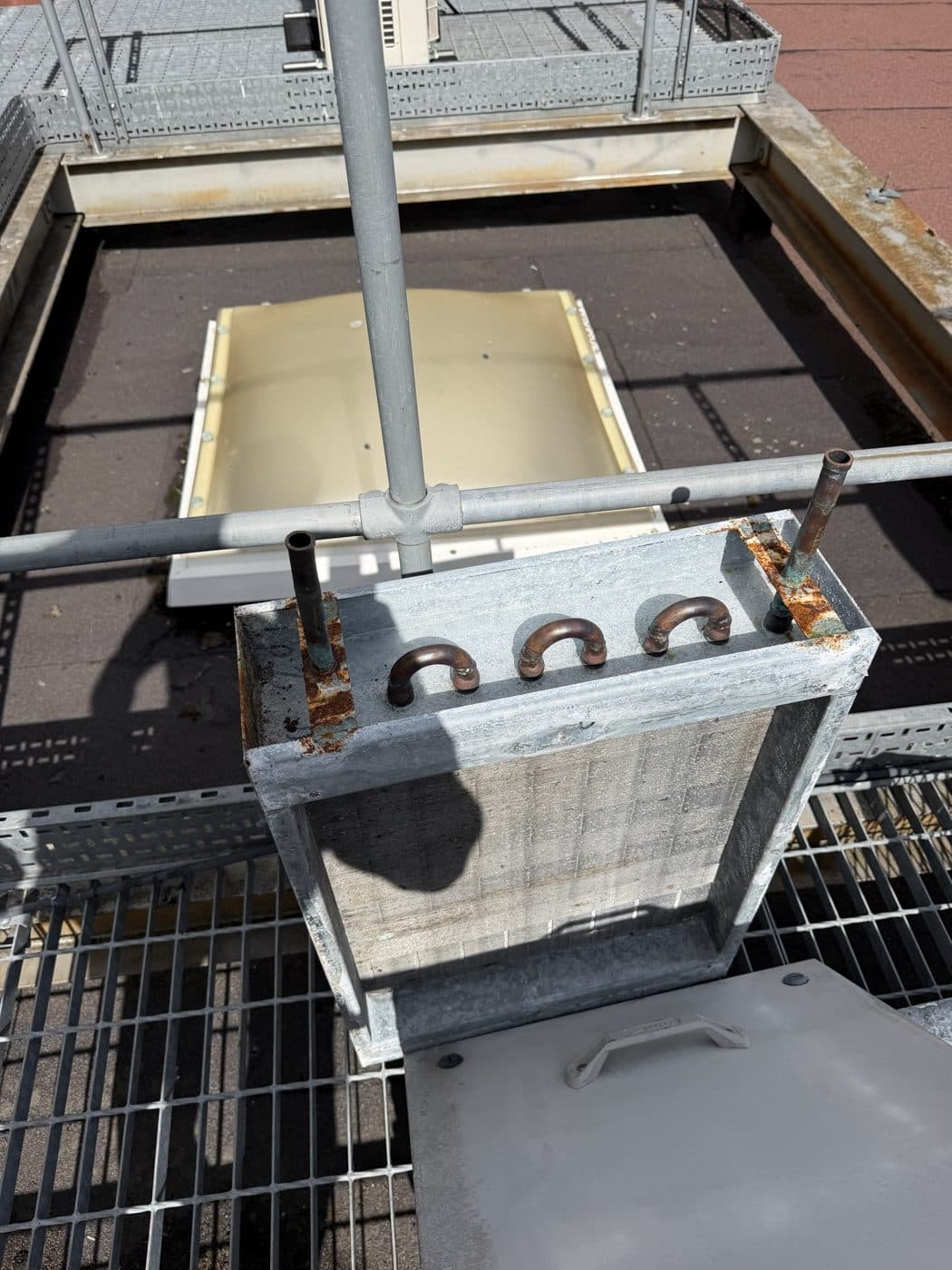
Trace heating is an electrical heating cable attached to the surface of a pipe, vessel, or piece of equipment to maintain it above a specified temperature. In commercial buildings, trace heating is most commonly used for frost protection on exposed external pipework (condensate drains, overflow pipes, external water supplies), frost protection on pipework in unheated areas (roof voids, loading bays, car parks, external plant decks), frost protection on fire sprinkler pipework in unheated zones, and maintaining flow temperature on domestic hot water circulation loops to prevent Legionella growth in dead legs.
BS 8580-1:2019 (Water Quality — Risk Assessments for Legionella Control) identifies trace heating as a control measure for maintaining DHW temperatures in circulation systems. HSE Approved Code of Practice L8 requires that hot water systems maintain 50 degrees C at outlets — trace heating on distant circulation branches helps achieve this.
Why Are Standalone Thermostats Not Good Enough for Trace Heating?
Most trace heating installations in UK commercial buildings are controlled by standalone pipe-mounted thermostats. The thermostat switches the trace heating cable on when the pipe temperature drops below a setpoint (typically 5 degrees C) and off when it rises above. This works fine when the thermostat is functioning correctly, the cable is intact, and the power supply is connected. The problem is that standalone thermostats provide no monitoring, no alarm on failure, and no evidence that the system is operational.
Common failure modes that go undetected with standalone control are: thermostat contact failure — the thermostat sticks open, the cable never energises, the pipe freezes. Cable break — the heating cable develops an open circuit fault, the thermostat calls for heat but no current flows, the pipe freezes. Cable earth fault — partial insulation breakdown causes the cable to trip its RCD or MCB, and nobody notices because it is on a dedicated circuit in a remote distribution board. Power isolation — the circuit is switched off during summer maintenance work and not reinstated before winter. With a BMS, every one of these failures generates an immediate alarm.
How Does BMS-Managed Trace Heating Work?
BMS-managed trace heating replaces standalone thermostats with a control strategy that monitors, alarms, and logs the entire system. The BMS reads pipe temperature sensors at each trace heating zone and energises the cable via a contactor when the temperature approaches the frost threshold. A current transformer (CT) on the cable supply circuit verifies that current is actually flowing when the cable is commanded on — confirming the cable is intact and the power supply is live. If the BMS commands the cable on but the CT reads zero current, an alarm is raised immediately: "Trace heating zone X — cable fault or power failure."
The BMS also monitors the pipe temperature trend. A pipe that is dropping towards the frost threshold despite the trace heating being energised indicates either insufficient cable output (degraded cable, inadequate specification) or an environmental change (missing insulation, increased air flow over the pipe). The BMS catches this trend before the pipe reaches freezing point.
Get a Free BMS Survey
We'll assess your controls and provide a detailed quotation.
What Does BMS Trace Heating Integration Cost?
Retrofitting BMS control to an existing trace heating installation typically costs £300 to £600 per zone. Each zone requires: a pipe temperature sensor (£30-£50), a current transformer on the cable supply (£40-£80), a contactor for BMS switching (replacing the standalone thermostat) at £60-£120, cabling back to the nearest BMS outstation (variable, depends on distance), and BMS point commissioning, graphics, and alarm setup. A building with 10 trace heating zones would typically cost £4,000 to £8,000 for full BMS integration. Against the cost of a single burst pipe incident (£10,000-£50,000), the payback is immediate.
What Should Your BMS Do for Frost Protection Beyond Trace Heating?
Trace heating is one element of a comprehensive frost protection strategy. The BMS should also be managing frost stat protection on heating plant — a frost stat on the AHU coil or boiler flow pipe that fires the heating system if the temperature approaches freezing, regardless of the time schedule. Without this, a boiler that is scheduled off overnight during an unexpected cold snap allows the building to freeze. It should manage frost protection setback temperatures — during unoccupied periods, the BMS should maintain a minimum space temperature of 5-8 degrees C across all zones, not simply switch off all heating. It should also handle anti-freeze monitoring on chilled water systems — if the chilled water circuit does not contain glycol, the BMS should prevent the chiller from operating when outside temperatures approach freezing, and alarm if the chilled water flow temperature drops below 4 degrees C.
CIBSE Guide H recommends that all BMS installations include frost protection as a mandatory control sequence, not an optional extra. The guide specifies that frost protection should override all time schedules and setback modes — a building that is scheduled off for a bank holiday weekend must still be protected against frost.
When Should Trace Heating and Frost Protection Be Checked?
Trace heating and frost protection should be checked every autumn before the first cold weather arrives. Alpha Controls recommends an October checklist: verify all trace heating circuits are energised and drawing current, check pipe temperature sensors are reading correctly, test frost stats on all AHU coils and heating plant, verify the BMS frost protection sequences operate correctly by manually simulating a low temperature, check that anti-freeze concentration in chilled water circuits is adequate, and review the BMS alarm routing to confirm frost alarms reach the right people out of hours.
Alpha Controls provides trace heating BMS integration, frost protection audits, and winter readiness checks across London, Kent, Essex, and the South East. Request a free survey or call 01474 552200.
Frequently Asked Questions
How much does trace heating BMS integration cost?
Retrofitting BMS control to existing trace heating costs £300 to £600 per zone, covering a pipe temperature sensor, current transformer, contactor, cabling, and BMS commissioning. A building with 10 zones costs £4,000 to £8,000 total. The payback is immediate compared with the cost of a single burst pipe (£10,000-£50,000).
Can existing trace heating cables be connected to a BMS?
Yes. The existing cable stays in place. The standalone thermostat is replaced with a BMS-controlled contactor, a pipe temperature sensor is added, and a current transformer is fitted to verify the cable is drawing current when energised. No changes to the heating cable itself are required.
What temperature should frost protection be set to?
Trace heating frost protection typically activates at 5 degrees C pipe temperature and deactivates at 10 degrees C. BMS frost stats on heating plant typically activate at 3-5 degrees C. Space temperature frost protection (heating setback during unoccupied periods) should maintain a minimum of 5-8 degrees C. These setpoints should be reviewed during commissioning based on the specific building and pipe exposure.
When should trace heating be checked each year?
October is the ideal time — before the first frost but early enough to repair any faults found. The check should verify all circuits are energised and drawing current, sensors are reading correctly, and BMS alarms are routing to the right people. Alpha Controls provides autumn frost protection audits as a standalone service or as part of a BMS maintenance contract.
Alpha Controls Team
Specialist BMS installation, commissioning, and maintenance across London and the South East. SafeContractor Approved, BCIA Member.