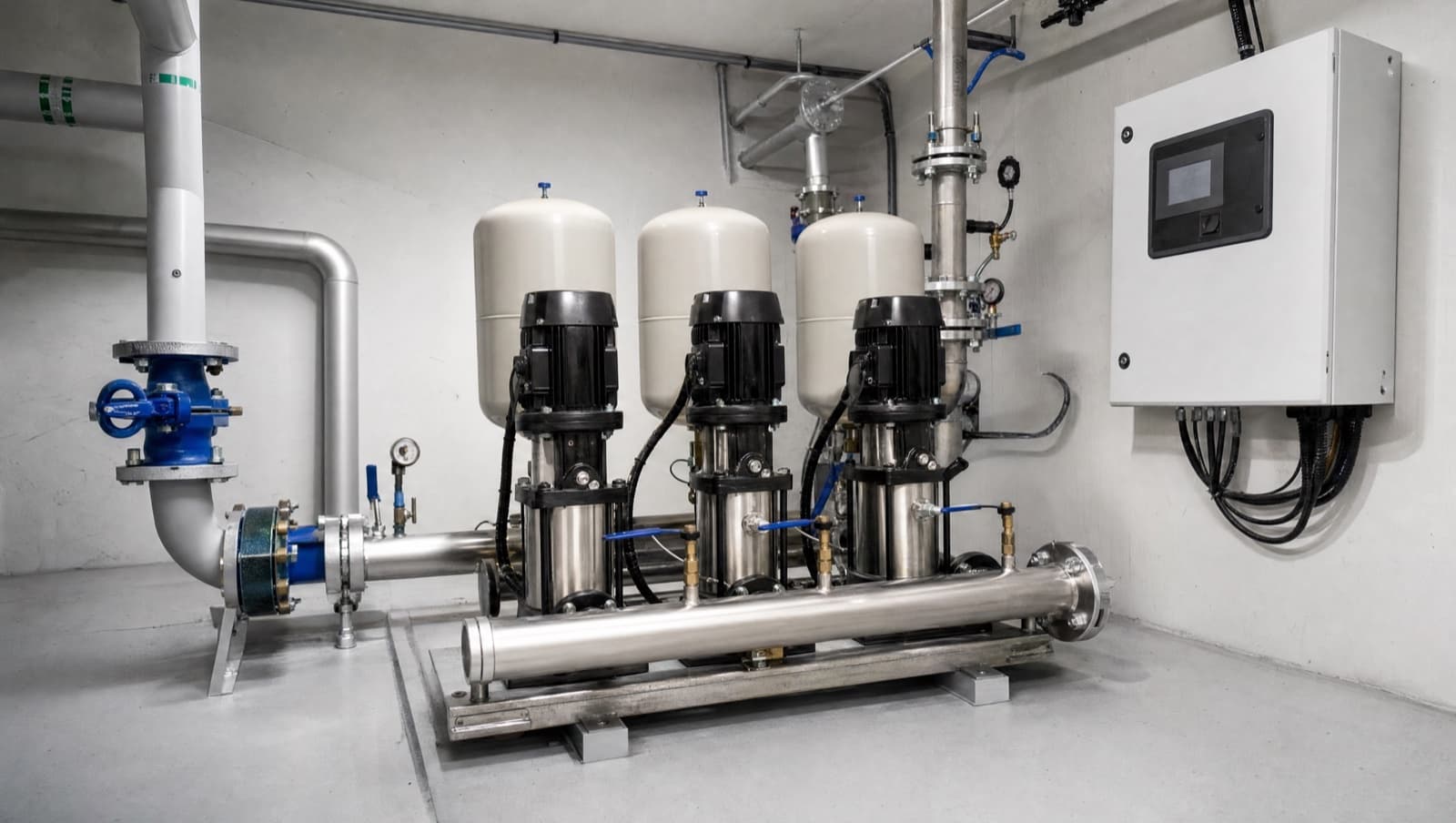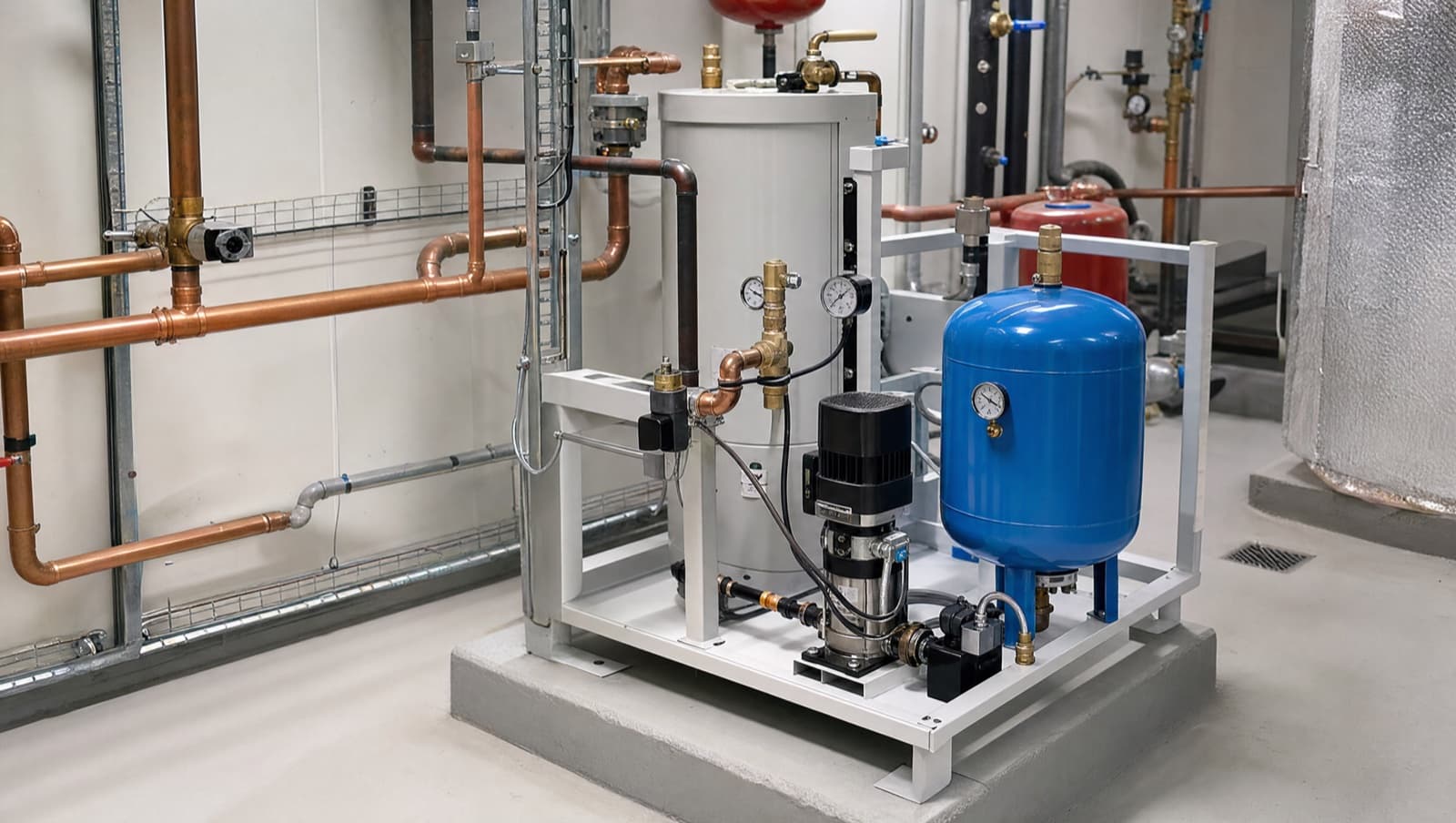

A plant room refurbishment is the single best moment to get the BMS right: the ceiling is off, the pipework is exposed, and the plant is commissioned from scratch. Get the controls integrated during installation and you typically save 20-40% of HVAC energy, with a payback of one to two years.
This guide covers the refurbishment project itself; for how every plant element hangs together under one system day to day, see our complete plant room BMS guide.
Why are BMS controls treated as an afterthought in plant room refurbishments?
On most refurbishments the mechanical scope gets the attention — new boilers, new chillers, new pumps, new pipework — and the controls are left until last. The M&E consultant specifies the hardware, the mechanical contractor installs it, and somewhere near the end of the programme someone asks "what about the BMS?" By that stage, the cable routes haven't been planned, the controller positions haven't been agreed, and the controls budget has been raided to cover mechanical overspend. The result is new plant with old controls thinking — or worse, no controls at all beyond what the equipment manufacturer's local panel provides.
This is a missed opportunity. The cost of integrating proper BMS controls during installation is a fraction of the cost of retrofitting them later. And the difference between a plant room with good controls and one without is not marginal — it is the difference between a building that runs efficiently, responds to demand, and tells you when something is going wrong, and one that burns gas and electricity regardless of whether anyone is in the building. The BMS scope should be defined for each major plant element — boilers, chillers, AHUs, pump sets, pressurisation units, and water treatment — because "put a timer on it" is not a controls strategy.
How does BMS boiler sequencing improve efficiency?
A commercial boiler house typically contains two or more boilers — often modular condensing boilers in the 100kW to 500kW range, replacing a single large atmospheric boiler that was installed in the 1990s and has been burning gas at 78% efficiency ever since. The new boilers can achieve 96% to 98% gross efficiency, but only if they are controlled properly. A condensing boiler condenses only when the return water temperature is below approximately 55°C. If the system returns water at 70°C — because the flow temperature is set too high, or because there is insufficient heat demand — the boiler operates in non-condensing mode at 88-90% efficiency. You have spent £80,000 on condensing boilers and are running them at the same efficiency as the old atmospheric unit.
The BMS controls the boilers through a cascade sequence. The primary control loop compares the flow temperature (or the building demand derived from multiple zone temperature readings) against the setpoint and calculates a heat demand signal. The cascade controller distributes this demand across the boilers: firing the first boiler and modulating it from minimum to maximum output before starting the second, then modulating both, and so on. The sequence includes anti-cycling timers (minimum on/off times per boiler, typically 5-10 minutes), lead/lag rotation (changing which boiler fires first to equalise run hours and wear), and frost protection (maintaining a minimum flow temperature regardless of time schedule to prevent freezing in exposed plant rooms and distribution pipework).
What is weather compensation and how much energy does it save?
Weather compensation is the single most impactful control strategy for boiler efficiency. The BMS reads the outside air temperature from a sensor on a north-facing wall (away from direct sunlight) and adjusts the heating flow temperature setpoint according to a compensation curve. When it is 0°C outside, the flow temperature might be 70°C. At 10°C outside, it drops to 50°C. At 15°C, it drops to 40°C. The lower the flow temperature, the more the boilers condense, and the higher the efficiency. On a well-commissioned system, weather compensation alone can reduce gas consumption by 15% to 25% compared with a fixed flow temperature setpoint.
The compensation curve needs to be tuned to the building. A heavyweight concrete building with high thermal mass responds slowly and needs a gentler curve. A lightweight curtain-wall office with low thermal mass responds quickly and can use a more aggressive curve. The BMS should allow the curve to be adjusted — slope and offset — without reprogramming the controller. Most Trend and Distech BMS platforms support weather compensation as a standard function block. If your boiler controls do not include weather compensation, you are leaving significant efficiency on the table. For more on the cost of BMS retrofit and upgrade projects, see our BMS retrofit cost guide.
What is optimum start on a BMS?
Optimum start is the BMS calculating how late the heating system can be turned on and still reach the target temperature by the time the building is occupied. Rather than a fixed 6am start regardless of the weather, the BMS monitors the building's thermal response over time and adjusts the start time automatically. On a mild October morning, the heating might start at 7:15am. On a freezing January morning, it might start at 4:30am. The BMS learns the building's thermal performance and adapts. This replaces the crude approach of setting the time clock to the worst-case start time, which means the building is overheated by occupancy on most mornings and the boilers have been running unnecessarily for an hour or more.
How does a BMS optimise chiller plant?
Chiller plant in a refurbished plant room typically consists of two or more air-cooled or water-cooled chillers, primary and secondary chilled water pumps, and — for water-cooled systems — cooling towers and condenser water pumps. The BMS controls every element through sequencing, setpoint reset, and condenser water control.
How does chiller sequencing work?
The chiller sequencing logic mirrors the boiler cascade in reverse: the BMS calculates cooling demand from the aggregate of FCU/AHU cooling valve positions across the building and stages chillers to match. The first chiller starts when cooling demand exceeds a threshold (typically when the average cooling valve position exceeds 60-70%). The second chiller starts when the first is at or near full capacity and the cooling valves are still opening. Chillers shed in reverse order as demand falls. Anti-cycling timers prevent rapid start/stop cycling, which damages compressors. Minimum run times of 15-20 minutes and minimum off times of 10-15 minutes are standard.
How much does raising the chilled water setpoint save?
The chiller's leaving water temperature setpoint — the temperature of chilled water delivered to the building — is typically fixed at design conditions (6°C or 7°C on most UK systems). But for much of the cooling season, the building does not need water this cold. Raising the chilled water setpoint by even 1°C reduces chiller energy consumption by approximately 2-3%. The BMS can implement an approach temperature reset: when the aggregate cooling demand is low (FCU valves less than 50% open on average), the chilled water setpoint is raised incrementally. When demand increases and valves open further, the setpoint is pulled back down. This optimisation is entirely software-based — no hardware changes needed — and typically saves 5-10% on annual chiller energy consumption.
What is condenser water reset on water-cooled systems?
On water-cooled chiller systems, the cooling tower cools the condenser water and returns it to the chiller. The colder the condenser water entering the chiller, the more efficiently the chiller operates. The BMS controls the cooling tower fan speed to maintain a condenser water return temperature setpoint, and resets that setpoint downward as the outside wet-bulb temperature drops. In spring and autumn when the wet-bulb temperature is 10-12°C, the condenser water can be cooled to 20-22°C rather than the design 30°C, significantly improving chiller COP (coefficient of performance). The savings from condenser water reset can be 10-20% of annual chiller energy consumption on water-cooled systems.
Ready to discuss your building? Request a free BMS survey →
What control sequences does an AHU need in a refurbished plant room?
An AHU in a refurbished plant room needs a comprehensive control sequence, not just a fan on a timer. The BMS manages multiple elements simultaneously — mixing dampers, heating and cooling coils, filters, and heat recovery — and the interaction between them determines both energy performance and occupant comfort. We set that full sequence out, element by element, in our guide to AHU controls and air handling unit control sequences.
What is the economy cycle and why does it matter?
The mixing damper section controls the proportion of fresh air and recirculated air. In mild weather when the outside air temperature is suitable for free cooling (typically 12-18°C), the BMS opens the fresh air damper to 100% and closes the recirculation damper — delivering free cooling without running the cooling coil. This is the economy cycle, and it is one of the most effective energy-saving sequences in any AHU. The BMS modulates the mixing damper position based on supply air temperature: if more cooling is needed than the outside air alone provides, the cooling coil valve opens; if the outside air is too cold, the recirculation damper opens to blend warmer return air with the cold outside air.
Getting the economy cycle right saves far more energy than most people realise. In the UK climate, the outside temperature is below 18°C for roughly 80% of the year. For most of the year, mechanical cooling should be off and the AHU should be providing free cooling from outside air alone. If the economy cycle is not working — because the damper actuator has failed, the outside air sensor is misreading, or the sequence was never commissioned properly — the chiller runs year-round. For a detailed discussion of how AHUs and FCUs work together in commercial buildings, see our guide on why modern buildings need both AHUs and FCUs.
How does the BMS sequence heating and cooling coils?
The heating coil valve and cooling coil valve operate in sequence. The BMS implements a dead-band between heating and cooling — a temperature range (typically 1-2°C wide) where neither coil operates. This prevents the system from simultaneously heating and cooling, which is pure energy waste. The sequence is: cooling coil valve opens from 0-100% as the supply temperature rises above the cooling setpoint; both valves closed in the dead-band; heating coil valve opens from 0-100% as the supply temperature drops below the heating setpoint.
The coil valves are modulating — not on/off — driven by 0-10V or 4-20mA signals from the BMS controller. Valve sizing is critical: an oversized valve operating at 5-10% open for most of its range provides poor control resolution and leads to hunting (the temperature oscillating around the setpoint as the valve hunts for the correct position). PICV (pressure-independent control valves) eliminate this problem by maintaining a constant flow regardless of system pressure variations, allowing the BMS to control temperature purely by modulating the valve position. If your refurbishment includes new AHU coils, specify PICVs — the additional cost of £200-£400 per valve is repaid in control stability and reduced commissioning time.
How does a BMS monitor AHU filters?
The AHU's air filters need monitoring. A differential pressure switch or transmitter across each filter stage measures the pressure drop. As the filter loads with particulate, the pressure drop increases. A clean G4 panel filter has a pressure drop of approximately 30-50 Pa; a fully loaded filter, 200-250 Pa. The BMS alarms when the filter differential pressure exceeds a threshold, telling the maintenance team that a filter change is needed. Without this, filters are either changed on a fixed schedule (wasteful if the filter still has life, or too late if the environment is particularly dusty) or never changed until the fan motor overloads trying to push air through a blocked filter.
How does the BMS control heat recovery?
If the AHU includes heat recovery — a rotary thermal wheel, plate heat exchanger, or run-around coil — the BMS manages its operation. A rotary wheel's speed is modulated by the BMS to control the amount of heat recovered, preventing over-recovery in mild weather (which would require the cooling coil to remove the excess). A plate heat exchanger has a bypass damper that the BMS modulates. A run-around coil has a circulation pump that the BMS starts and stops, with the pump speed modulated to control recovery rate. Heat recovery typically reduces heating energy consumption by 30-40% on a well-commissioned AHU — a figure that justifies the additional capital cost of the heat recovery section within two to three heating seasons.
What BMS monitoring do pump sets, pressurisation units, and water treatment need?
The plant room refurbishment scope extends beyond the headline plant. Pump sets — chilled water, heating, and domestic hot water — need VSD integration and duty/standby sequencing as covered in our pump room BMS controls guide. Pressurisation units maintaining system pressure need monitoring: expansion vessel pressure, fill valve status, and spill valve status. A pressurisation unit that is constantly filling indicates a system leak — the BMS can detect this by trending the fill valve open time and alarming when it exceeds a threshold (for example, more than 10 minutes of fill in any 24-hour period).
Water treatment dosing sets — for inhibitor dosing on heating and chilled water systems — can be integrated with the BMS for monitoring (chemical tank level, dosing pump run status) and in some cases for control (dosing pump speed modulated based on system makeup water flow). Chemical tank level monitoring prevents the dosing system from running dry — an empty dosing tank means untreated water in the system, which means corrosion, scale, and microbiological growth. An alarm from the BMS when the tank level drops below 20% gives the maintenance team days to order and deliver replacement chemical rather than discovering an empty tank during a routine visit weeks later.
What is the difference between a timer and proper BMS controls?
The phrase "put a timer on it" captures a mindset that treats building services as simple machines: on at 7am, off at 6pm, and everything will be fine. A timer turns things on and off. Controls make things work properly. The difference is:
A timer turns the boilers on at 6am. Controls calculate when the boilers need to start based on the current outside temperature and the building's thermal response, start only the boilers needed to meet the demand, modulate them to maintain efficiency, and adjust the flow temperature based on weather compensation — and do this differently every day because the conditions are different every day.
A timer turns the chillers on at 8am. Controls check whether the building actually needs cooling today, use free cooling from outside air when the conditions allow, start the minimum number of chillers to meet the demand, optimise their setpoints based on the actual load, and turn them off the moment the demand disappears — which might be 11am on a cool day or 8pm on a hot one.
A timer turns the AHU on at 7am. Controls start the AHU, ramp the fan speed to match the ventilation demand, modulate the mixing dampers for free cooling, sequence the heating and cooling coils to maintain the supply temperature, adjust the fresh air rate based on CO₂ levels, and shut down gracefully when the building empties — purging the building with fresh air for 30 minutes after the last occupants leave and then stopping.
The energy difference between these two approaches is typically 20-40% of the building's HVAC energy consumption. On a building spending £80,000 per year on gas and electricity for heating and cooling, that is £16,000 to £32,000 per year. The BMS controls to deliver this saving cost £15,000 to £40,000 as part of a plant room refurbishment — a payback of one to two years, after which the savings continue indefinitely.
How much should the BMS controls budget be for a plant room refurbishment?
The controls budget should be 8-15% of the total mechanical installation cost. On a £200,000 plant room refurbishment, that is £16,000 to £30,000 for the BMS scope. This covers: BMS controllers and outstations, all field sensors (temperature, pressure, humidity, CO₂, differential pressure), actuators and control valves (unless specified as part of the mechanical package), wiring and containment, programming, graphics, commissioning, and training. If the controls budget is less than 8% of the mechanical cost, corners are being cut — and the building will pay for those corners every month in wasted energy and missed maintenance for years afterwards.
The controls specification should be written at the same time as the mechanical specification, not after. The controls engineer needs to know: what plant is being installed (manufacturer, model, communication capabilities), what the control sequences will be (cascade, weather compensation, optimum start, economy cycle, heat recovery), where the BMS controllers will be located (in the plant room, in an adjacent panel room, or distributed at each piece of plant), what the cable routes will be, and what the commissioning programme looks like (controls commissioning happens after mechanical commissioning, and the programme must allow time for it).
Alpha Controls delivers BMS controls for commercial plant room refurbishments across London and the South East — from single-boiler upgrades to full chiller plant and AHU installations. We work directly with M&E consultants, mechanical contractors, and building owners to ensure the controls specification is right from day one. Request a survey or specification review, or call 01474 552200.