
Pump room BMS integration means the building controls monitor every pump's run status, fault status, and useful work, then actively control speed, sequencing, and interlocks. Done properly it delivers measurable energy savings, earlier fault detection, and longer equipment life. For a typical four-pump room, full integration with VSD retrofit costs £12,000 to £25,000.
A pump room is one part of the wider plant room — our plant room BMS guide covers how pumps, boilers, chillers and pressurisation sit together under one system.
Walk into any commercial plant room and the pump sets will be among the first things you notice — the noise, the vibration, the pipework. Chilled water pumps, heating pumps, boosted cold water sets, condensate return pumps, drainage sumps, pressurisation units. A mid-sized office building might have fifteen to twenty pump sets. A hospital or university campus, fifty or more. And in a significant number of these buildings, the pumps are running with minimal or no BMS integration — just a local motor starter, maybe a pressure switch, and a hope that someone notices when something goes wrong. This is a waste of energy, a maintenance liability, and a failure of building controls.
What Should a BMS Be Doing With Your Pumps?
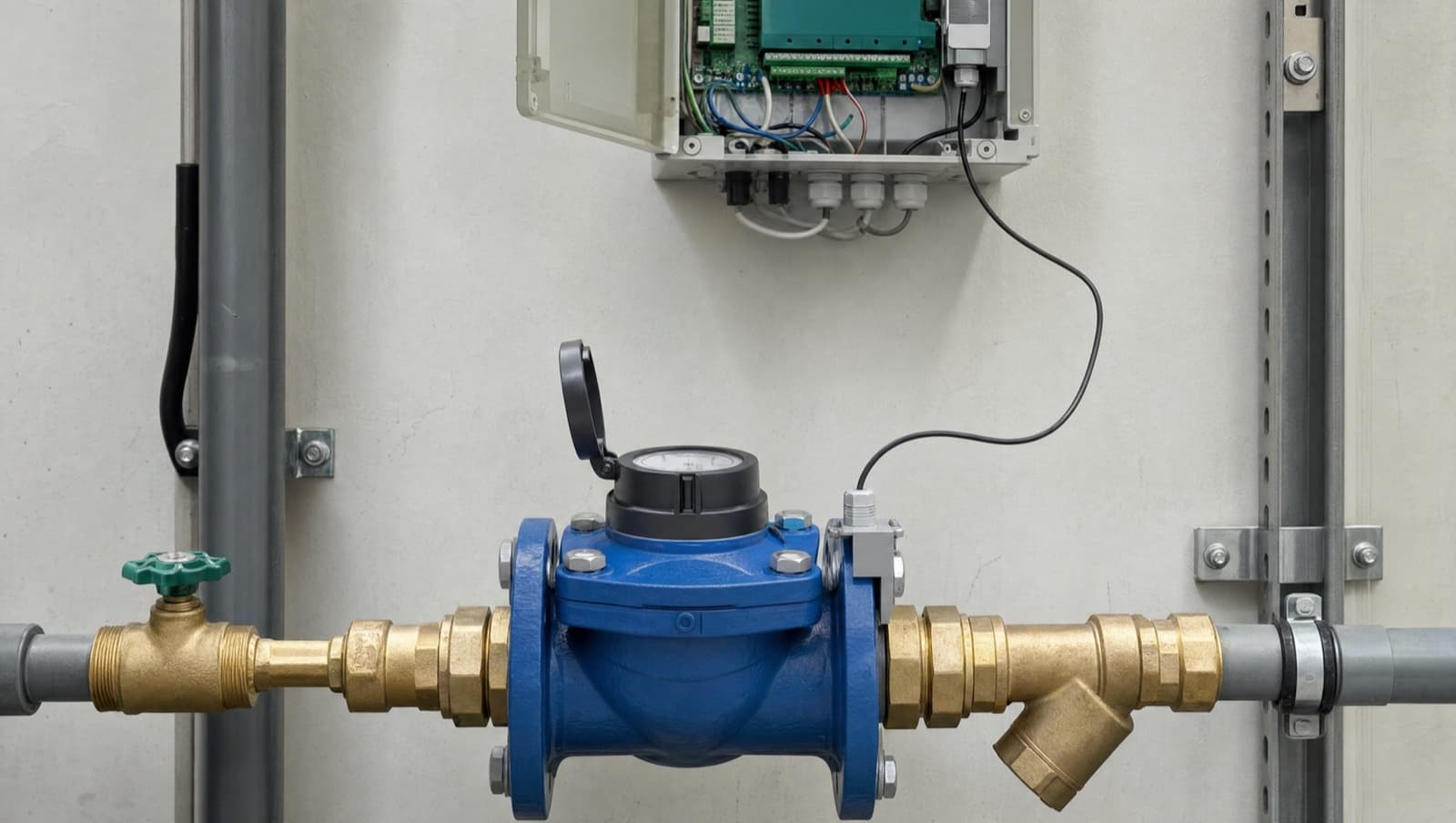
At minimum, the BMS needs to know whether each pump is running, whether it should be running, and whether it is healthy. That means monitoring run status (via an auxiliary contact on the motor contactor or VSD run relay), fault status (via the motor protection relay or VSD fault relay), and confirming that the pump is actually doing useful work (via a flow switch, pressure sensor, or current reading). Without these three signals, the BMS is blind. A pump that has tripped on overload at 2am will sit there faulty until the maintenance team arrives on Monday morning — by which time the chilled water circuit has been running on a single pump for 60 hours, the remaining pump is overloaded, and the building has been uncomfortable since Friday afternoon.
Beyond basic monitoring, the BMS should be actively controlling pump operation: starting and stopping pumps based on demand, sequencing duty and standby sets, modulating pump speed where VSDs are fitted, and managing safety interlocks. For a detailed overview of how run, fault, and HOA (hand-off-auto) signals are wired on BMS systems, see our guide to BMS wiring, run/fault, and HOA on Trend systems.
How Much Energy Does VSD Pump Control Save?
A fixed-speed pump running at full speed against a throttling valve is burning energy to create friction. The pump generates maximum flow, the valve restricts it to the actual demand, and the energy difference between what the pump produces and what the building needs is converted to heat and noise in the valve. It is the hydraulic equivalent of driving with one foot on the accelerator and one on the brake.
A variable speed drive (VSD) eliminates this waste by reducing the pump motor speed to match the actual demand. The energy savings are dramatic because pump power is proportional to the cube of speed — the affinity laws. Reducing pump speed by 20% reduces power consumption by approximately 49%. Reducing speed by 50% reduces power by approximately 87%. On a 15kW chilled water pump running 3,000 hours per year, dropping from full speed to 80% average speed saves around £2,100 per year at current electricity rates (22p/kWh). The VSD itself costs £1,200 to £2,500 installed. The payback is typically under 18 months.
The BMS controls the VSD via a 0-10V or 4-20mA analogue signal, or via Modbus/BACnet digital communication. The control loop is usually pressure-based: a differential pressure sensor across the building's distribution circuit measures the pressure difference between flow and return. As valves close across the building (because zones reach setpoint), the differential pressure rises. The BMS modulates the VSD to maintain a constant differential pressure setpoint, reducing pump speed as demand falls. This is the single highest-impact energy saving measure in most commercial pump rooms.
For more on the cost and scope of BMS upgrades that include VSD integration, see our BMS retrofit cost guide for UK buildings.
Why Does Duty/Standby Sequencing and Run Hour Equalisation Matter?
Most commercial pump installations are configured as duty/standby pairs — two identical pumps, one running (duty) and one available (standby). The standby pump starts automatically if the duty pump faults, or if the demand exceeds what a single pump can deliver (duty/assist mode). Without BMS control, the duty/standby changeover is typically wired into the pump controller locally. The problem is that whoever commissioned the system set Pump 1 as duty, and Pump 1 has been running continuously for seven years while Pump 2 has sat idle. Pump 1 has worn bearings and degraded seals. Pump 2's mechanical seal has dried out from disuse and will leak when it is eventually needed.
BMS-controlled run hour equalisation rotates the duty pump on a timed basis — typically weekly or after a defined run hour differential. The BMS tracks cumulative run hours for each pump and switches the duty assignment when the hours diverge by more than a threshold (say, 100 hours). This equalises wear, keeps both pumps exercised, and extends the overall life of the installation. It sounds simple, and it is — but an alarming number of dual pump sets in UK commercial buildings do not have this basic function implemented.
On larger installations with three or more pumps — common on district heating systems, large chilled water plants, and boosted cold water sets serving tall buildings — the BMS manages cascade sequencing. The first pump starts at minimum speed when demand is detected. As demand increases and the first pump reaches a speed threshold (typically 85-90% of maximum), the second pump starts and both pumps are speed-matched to share the load. If demand continues to rise, the third pump joins. As demand falls, pumps are shed in reverse order. The BMS needs to manage anti-cycling logic to prevent pumps from starting and stopping rapidly during transitional demand periods — a minimum run time of 5 minutes and a minimum off time of 10 minutes are typical values.
Get a Free BMS Survey
We'll assess your controls and provide a detailed quotation with energy savings estimates.
How Does a BMS Catch Pump Faults Before They Become Failures?
Dry Running Protection
A pump running without water — dry running — destroys the mechanical seal within minutes. The BMS detects dry running via a flow switch on the pump discharge (no flow despite the pump running), a suction pressure transmitter reading vacuum, or a motor current reading that drops below the expected loaded current (an unloaded pump draws significantly less current than a pump moving water). When dry running is detected, the BMS should stop the pump immediately, raise an alarm, and lock out the pump until an operator acknowledges the fault and confirms the cause has been resolved.
Overload and Motor Protection
The motor protection relay (thermal overload) trips the pump contactor when the motor current exceeds the relay setting for a sustained period. The BMS monitors this trip status and alarms it. But the BMS can go further: by reading the actual motor current via a current transformer (see our article on current transformers vs current switches in BMS systems), the BMS can trend the current draw over time. A pump whose current draw is gradually increasing month on month has a developing mechanical problem — worn impeller clearances, bearing degradation, increased system resistance from valve fouling. The BMS catches this trend weeks or months before the motor protection relay trips.
Bearing Temperature Monitoring
On larger pumps (above 15kW), bearing temperature monitoring using PT100 or PT1000 RTDs embedded in the bearing housings provides early warning of bearing failure. The BMS reads these temperatures, trends them, and alarms if the temperature exceeds normal operating range (typically 60-80°C depending on the pump and bearing type). A bearing that is running 10°C hotter than its twin on the adjacent pump is failing. The BMS gives the maintenance team days or weeks to plan the repair rather than dealing with a catastrophic failure at 3am.
Seal Failure Monitoring
Mechanical seal failure is the most common cause of pump downtime in commercial buildings. A leak detection sensor in the pump frame (a moisture sensor or float switch in the seal chamber) alerts the BMS when the mechanical seal begins to leak. Early detection means a planned seal replacement (£400-£800 per pump, done during normal working hours) rather than an emergency callout following a flooded plant room (£2,000+ plus the cost of water damage).
What Can Flow and Pressure Trending Tell You About Your System?
Beyond real-time control, the BMS stores flow and pressure data as trends — time-series records that can be reviewed over days, weeks, or months. This trending data is where the real operational insight comes from. A chilled water pump that was maintaining 2.0 bar differential pressure at 70% speed six months ago but now needs 85% speed to maintain the same pressure has a system problem: strainer blockage, valve fouling, or pipework corrosion increasing the system resistance. The trend data makes this visible before the pump reaches full speed and can no longer maintain the pressure setpoint.
Flow totalisation — the cumulative volume of water moved — provides a different kind of insight. A boosted cold water set in an office building should show a clear pattern: high flow during working hours, minimal flow overnight, and near-zero flow at weekends. If the overnight flow is consistently above zero, there is a leak in the domestic water distribution. The BMS won't tell you where the leak is, but it will tell you it exists, and it will quantify the volume being lost. On a building paying £5 per cubic metre for water (supply plus sewage charges), a continuous leak of 0.5 litres per minute costs £1,300 per year. The trend data makes the business case for finding and fixing it.
How Do You Integrate Grundfos, Wilo, and Lowara Pumps via Modbus?
Modern commercial pump sets from Grundfos (Magna3, TPE3, CRE), Wilo (Stratos MAXO, CronoLine), and Lowara (ecocirc XL, e-SV) include built-in Modbus RTU communication. This means the BMS can read directly from the pump's internal electronics: actual speed (RPM), power consumption (kW), motor temperature, run hours, fault codes, and — on pumps with integrated pressure sensors — system pressure and flow estimate. This eliminates the need for separate external sensors for many monitoring functions.
The BMS connects to the pump via a two-wire RS-485 Modbus RTU connection. Each pump on the bus has a unique Modbus address. The BMS reads holding registers and input registers to retrieve operational data, and writes to holding registers to set the speed reference and control mode. Grundfos publishes detailed Modbus register maps for each pump range — the GENIbus protocol on older Magna and TPE series, standard Modbus on current-generation pumps. Wilo's Modbus implementation follows a similar pattern. The key integration point is ensuring the BMS polling rate does not exceed the pump's communication capability — a common mistake that causes communication timeouts and erratic readings.
For BMS installations using Trend controllers, the IQ4 platform supports Modbus RTU master on its serial port, allowing direct connection to pump Modbus buses without additional gateways. For a broader discussion of BMS input and output configuration on Trend controllers, see our guide to I/O on the Trend IQ4NC and IQ ECO 412.
What Does Pump Room BMS Integration Cost?
The cost depends heavily on what is already in place. Integrating an existing pump set with existing VSDs into a BMS that is already present in the plant room is primarily a cabling and commissioning exercise: £800 to £1,500 per pump for wiring, point commissioning, graphics, and alarm setup. If VSDs need to be added to fixed-speed pumps, add £1,200 to £3,000 per pump for the VSD supply and installation, depending on motor size. If the BMS has no outstation in the pump room, add £2,500 to £5,000 for a new controller, power supply, and network connection.
For a typical commercial pump room with four pump sets (two chilled water, two heating), full BMS integration including VSD retrofit costs £12,000 to £25,000. The energy savings from VSD control alone typically pay this back within two to three years. The maintenance savings from early fault detection and run hour equalisation are harder to quantify but are real and ongoing — every pump failure prevented saves £1,500 to £5,000 in emergency repair costs, not counting the business impact of lost cooling or heating.
When Should You Upgrade Your Pump Room Controls?
If your pump room has pumps running at fixed speed with throttling valves, VSD retrofit with BMS integration is the single best investment you can make in your mechanical plant. If your pumps have VSDs but no BMS connection, you are saving energy on speed control but missing the monitoring, fault detection, and sequencing benefits that multiply the value of the VSD investment. If your BMS shows pump run/fault status but does not trend current, pressure, or flow, you have the minimum — upgrade to full monitoring for relatively modest cost.
Alpha Controls designs and installs pump room BMS controls for commercial buildings across London and the South East, including chilled water, heating, boosted cold water, and drainage pump sets. We integrate with all major pump manufacturers and BMS platforms. Request a survey or call 01474 552200 to discuss your pump room controls.
Alpha Controls Team
Specialist BMS installation, commissioning, and maintenance across London and the South East. SafeContractor Approved, BCIA Member.