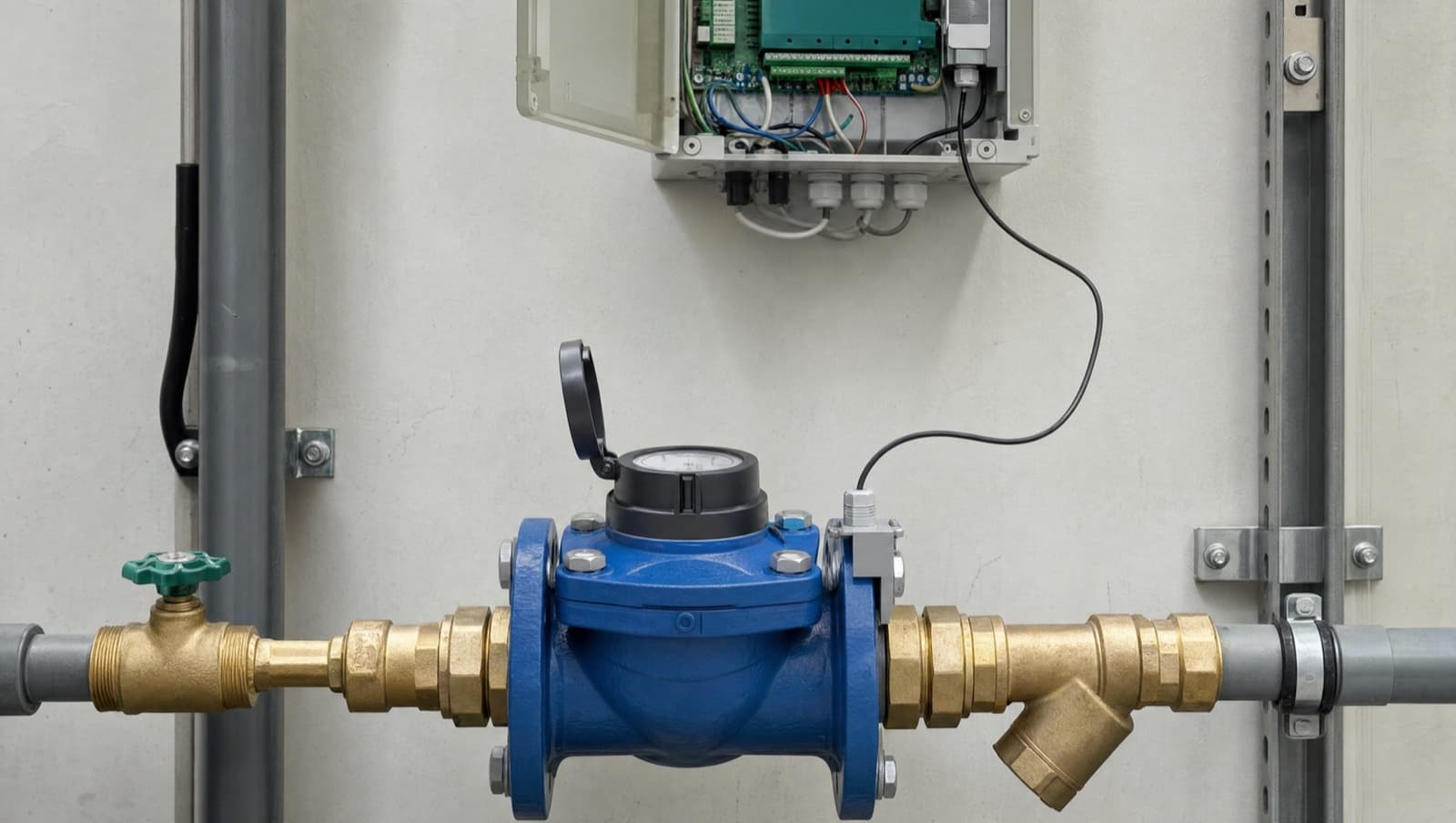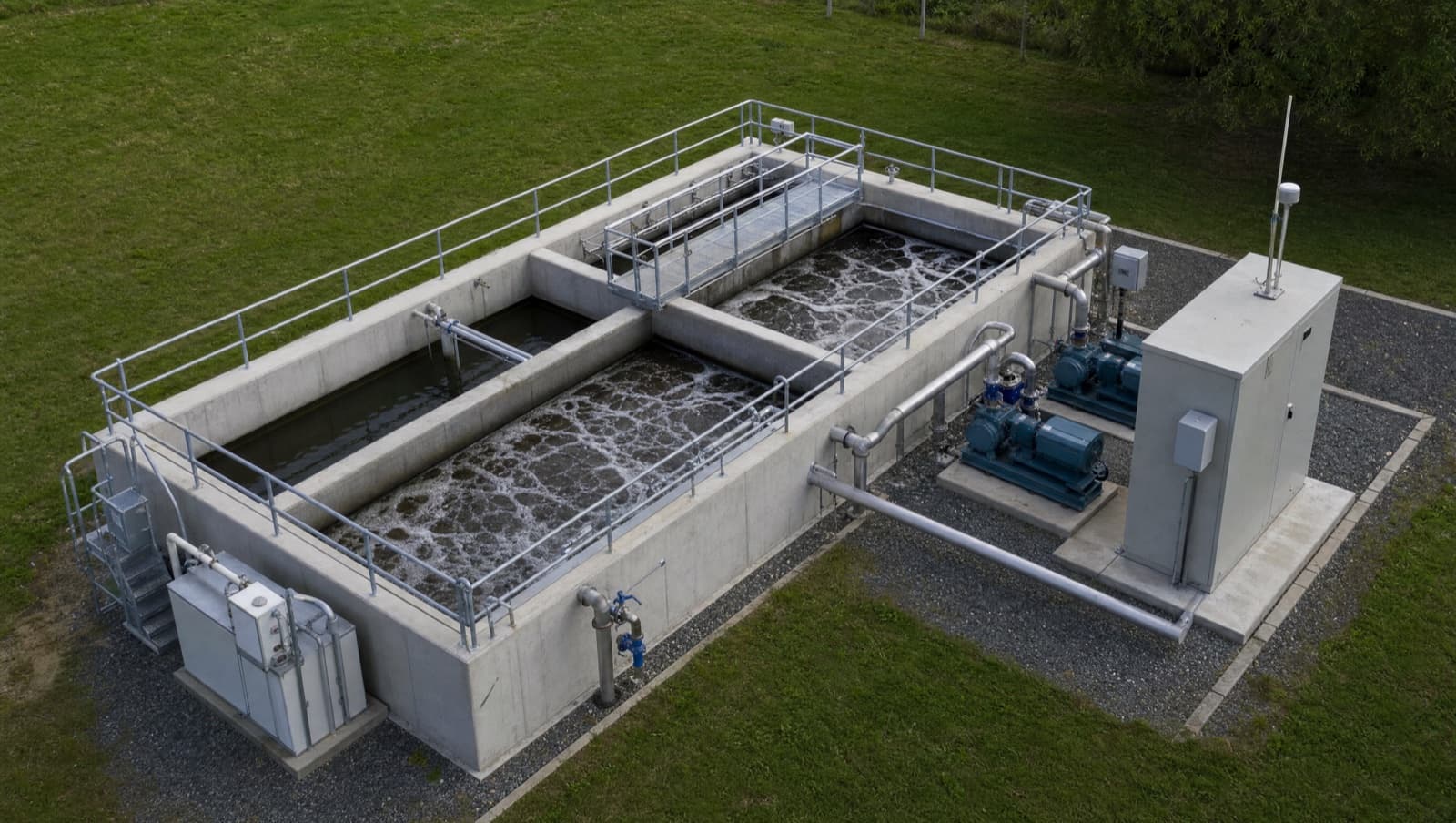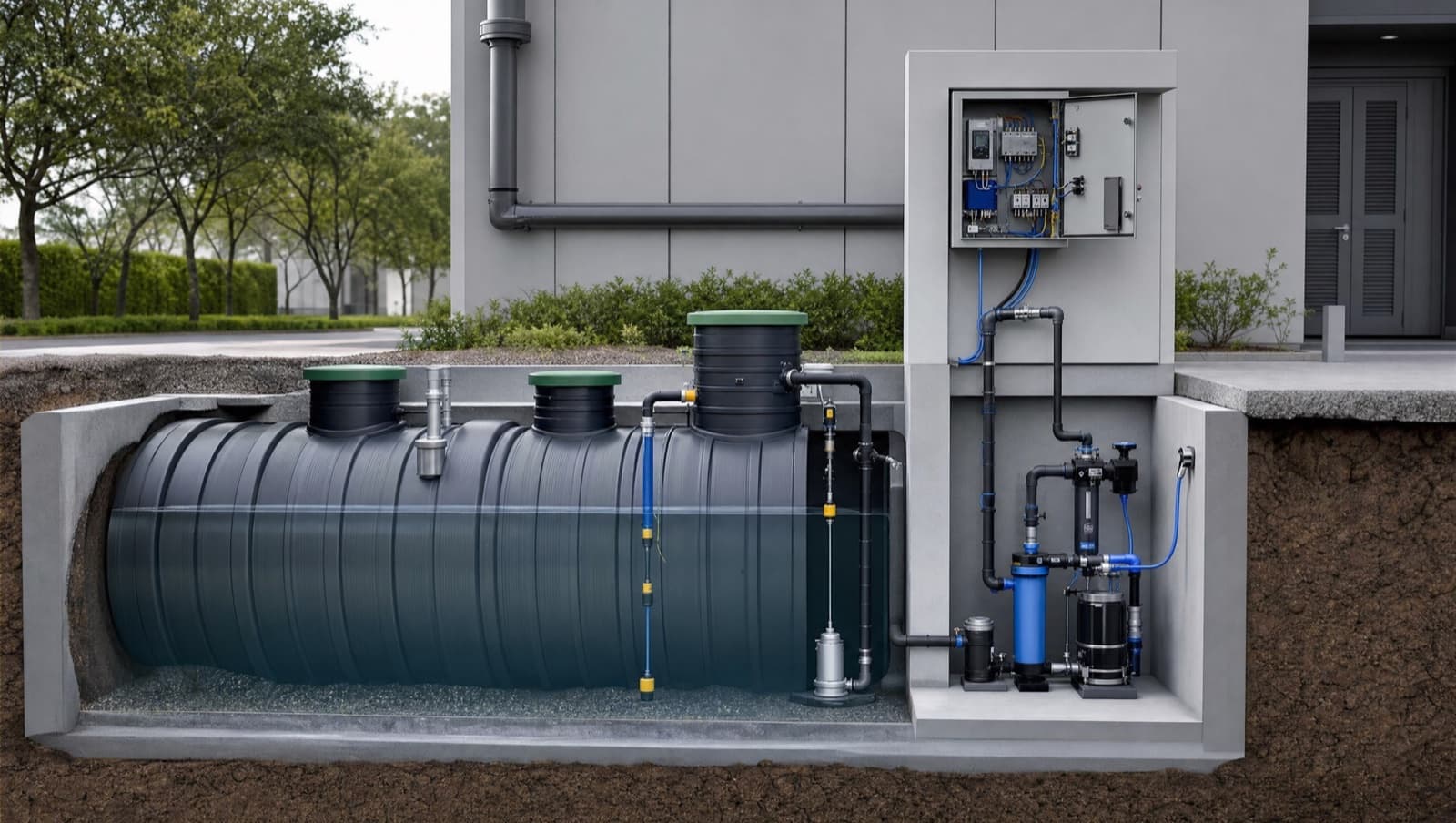

At a water treatment works, control is split across three layers: PLCs (Allen-Bradley, Siemens S7, Schneider Modicon) run real-time process control, SCADA gives operators visibility and setpoint control, and a BMS handles building services. Telemetry over GSM, 4G, or radio links unmanned remote sites back to the central SCADA.
The building-services half of that picture — boilers, chillers, pumps and pressurisation under one control system — follows the same monitoring logic at building scale, and is covered in our complete plant room BMS guide.
Water treatment works are among the most control-intensive environments in UK infrastructure. A single works serving a town of 50,000 people will have hundreds of control loops running simultaneously — chemical dosing, flow regulation, pH correction, sludge handling, aeration, filtration backwash sequencing — and every one of them needs to work reliably twenty-four hours a day, seven days a week, because the consequence of failure is not a comfort complaint from a tenant but a potential public health incident. The controls architecture that manages all of this sits at the intersection of BMS, SCADA, and telemetry — three disciplines that in most commercial buildings are separate conversations but in water treatment are inseparable. This article covers how building management and SCADA systems work together across water treatment processes, the protocols that connect them, and the practical challenges of maintaining control and visibility across sites that are often unmanned and spread across hundreds of square miles.
BMS, SCADA, and PLC — Who Does What in a Water Treatment Works?
In a typical water treatment works, the control hierarchy has three layers. At the bottom are PLCs — programmable logic controllers — handling real-time process control. These are the devices that actually open and close valves, start and stop pumps, and modulate chemical dosing in response to process variables. Allen-Bradley, Siemens S7, and Schneider Modicon are the three PLC platforms you will find in the vast majority of UK water treatment sites. The PLC operates autonomously: if the SCADA system above it fails, the PLC continues running the process based on its last valid setpoints and its own internal safety logic.
Above the PLCs sits the SCADA layer — Supervisory Control and Data Acquisition. SCADA provides the operator interface: process mimic screens showing live plant status, alarm management, trend logging, recipe management for dosing regimes, and the ability for operators to change setpoints and override automatic sequences when process conditions demand it. SCADA platforms in UK water treatment include Schneider ClearSCADA (now Geo SCADA Expert), Siemens WinCC, AVEVA (formerly Wonderware), and Serck Controls — a name that dates back decades in UK water but whose installed base remains enormous.
The BMS layer, where it exists separately from SCADA, manages the building services elements of the works: HVAC in control rooms and dosing buildings, lighting, security access control, fire detection, and environmental monitoring in enclosed spaces where chemical storage or biological processes generate hazardous atmospheres. On smaller works, the BMS functions are often absorbed into the SCADA system. On larger works — particularly those with occupied control buildings, laboratory spaces, and visitor facilities — a separate BMS running on BACnet or Trend manages the building services while the SCADA system manages the process. The interface between the two is critical and often poorly executed.
What Does the BMS/SCADA System Actually Control in the Treatment Process?
Raw Water Intake and Screening
The treatment process begins with raw water intake from a river, reservoir, or borehole. The control system manages intake pump operation (typically large submersible or vertical turbine pumps operating via VSDs), coarse and fine screen cleaning sequences (timed or differential-pressure-triggered), and flow measurement using electromagnetic or ultrasonic flowmeters. Flow totalisation is critical — the works needs to know exactly how much water it is abstracting against its Environment Agency abstraction licence. Exceed the licensed volume and the utility faces enforcement action. The SCADA system logs these totals continuously and generates alarms when daily or annual abstraction limits approach their thresholds.
Coagulation and Flocculation
Chemical dosing is where the controls become genuinely complex. Coagulant dosing (typically aluminium sulphate or ferric chloride) must respond to raw water turbidity, colour, and flow rate — a rainstorm upstream can change raw water quality dramatically within hours. The SCADA system reads turbidity from an online nephelometer, pH from a glass electrode analyser, and flow from the inlet meter, then calculates the required coagulant dose using a control algorithm that accounts for all three variables. A fixed dose rate will either overdose (wasting chemical and increasing sludge production) or underdose (failing to remove particulates, risking regulatory non-compliance at the final water stage).
The dosing pumps themselves — usually diaphragm metering pumps from Milton Roy, Grundfos, or Prominent — are controlled via 4-20mA signals from the PLC. The SCADA system displays the calculated dose rate, the actual pump stroke rate, and the chemical tank level. When the tank level drops below a threshold, an alarm tells the operator to order more chemical — or, on more automated sites, triggers an automatic delivery request to the chemical supplier.
pH Correction and Chlorination
Post-coagulation pH correction uses lime or sodium hydroxide dosing, again modulated by the SCADA system based on continuous pH measurement. pH control in water treatment is notoriously difficult because the pH scale is logarithmic — a small change in dose produces a large change in pH near the neutral point. Well-tuned PID control is essential, and many sites use cascade control where an outer loop sets the target pH and an inner loop controls the dosing pump speed. For a detailed discussion of how BMS protocol choices affect device integration across process plant, see our guide on BACnet vs Modbus for BMS protocols.
Final water chlorination maintains a disinfectant residual throughout the distribution network. The SCADA system monitors free chlorine residual using an amperometric analyser, modulates sodium hypochlorite or gaseous chlorine dosing to maintain target residual (typically 0.5 to 1.0 mg/l at the works outlet), and logs contact time to demonstrate compliance with the Drinking Water Inspectorate (DWI) regulations. Contact time — the product of chlorine concentration and the time the water spends in the contact tank — must meet minimum standards to ensure disinfection is effective. The SCADA calculates this continuously from the flow rate and tank volume.
Filtration
Rapid gravity filters (RGFs) are the workhorse of UK water treatment. Each filter bed operates on a cycle: filtering, then backwashing when the head loss across the bed reaches a threshold (measured by differential pressure transmitters) or when the filtered water turbidity rises above a trigger point. The SCADA system sequences the backwash — closing the inlet valve, opening the backwash supply, running the air scour blowers, draining the washwater, and returning the filter to service. On a works with 8 or 12 filter beds, the SCADA sequences backwashes so that no more than one or two beds are out of service simultaneously, maintaining the works' throughput capacity.
Sludge Handling
Sludge from the coagulation process and filter backwash water collects in sludge holding tanks. The SCADA manages sludge pump operation, thickener recirculation, and — on sites with mechanical dewatering — belt press or centrifuge operation. Sludge level measurement in holding tanks uses ultrasonic or radar level transmitters. The sludge blanket level in settlement tanks is measured by sludge blanket detectors — instruments that use infrared absorption to detect the boundary between clear water and settled sludge. When the blanket rises too high, the SCADA increases sludge withdrawal pump speed or triggers a desludge cycle.
How Does Telemetry Connect Unmanned Remote Sites?
A water utility's network extends far beyond the treatment works. Between the works and the customer are pump stations, service reservoirs, pressure-reducing valve (PRV) chambers, chlorine booster stations, and trunk main monitoring points. Thames Water operates around 2,500 pumping stations. Southern Water has over 3,000 assets. Anglian Water manages infrastructure across the flattest, most spread-out region in England, with pump stations serving communities of 200 people connected by 30 miles of rising main to the nearest treatment works.
These remote sites are unmanned. Most are visited by an operator only when something goes wrong. The telemetry system — a network of remote terminal units (RTUs) communicating over GSM, 4G, or private radio back to the central SCADA — is the utility's eyes and ears across this entire network. Each RTU monitors pump run status, pump motor current (to detect overload or dry running), wet well level (to control pump start/stop and duty/standby changeover), flow totalisation, pressure, and in many cases water quality parameters including turbidity and chlorine residual.
Communication protocols between RTUs and the central SCADA include Modbus RTU over serial radio, DNP3 (Distributed Network Protocol — widely used in North American utilities and increasingly in the UK), and IEC 60870-5-104 for TCP/IP-based telemetry. Newer installations use OPC-UA as the integration layer, providing a standardised, secure, vendor-agnostic interface between the RTU and the SCADA server. For more on how communication protocols impact BMS and control system integration, see our article on BACnet vs Modbus — the protocol considerations for water telemetry share many of the same trade-offs.
Get a Free BMS Survey
We'll assess your controls and provide a detailed quotation.
What Is MCERTS and Why Does the SCADA System Have to Comply?
Water treatment works discharge treated effluent and process waste under permits issued by the Environment Agency. The monitoring instruments that measure discharge quality — flow, suspended solids, ammonia, phosphorus, BOD — must comply with MCERTS (the Environment Agency's Monitoring Certification Scheme). MCERTS requires that instruments are type-approved, installed to the manufacturer's specification, calibrated at defined intervals, and that the data logging system maintains an unbroken, tamper-evident record of all measurements.
The SCADA system is the data logging platform for MCERTS compliance. It must store readings at defined intervals (typically 15-minute averages), flag any periods of instrument downtime or out-of-range readings, and generate reports that can be submitted directly to the Environment Agency. If the SCADA system loses data — due to a server failure, communication interruption, or software fault — the utility cannot demonstrate compliance during that period, and the regulator will assume non-compliance. Data integrity is not a nice-to-have in this environment. It is a legal requirement.
This is one of the reasons water utilities specify redundant SCADA servers (primary and standby), redundant communication paths to remote sites (primary 4G with radio backup), and UPS-backed RTUs that continue logging data during power outages. The MCERTS data must exist regardless of what else has gone wrong.
How Should Alarms Be Managed Across Unmanned Sites?
Alarm management in water treatment is a discipline in its own right. A large treatment works can generate thousands of alarms per day if the alarm configuration is poorly managed — a phenomenon the industry calls alarm flooding. The EEMUA 191 standard (now in its third edition) defines best practice for alarm management: a well-managed site should average no more than 6 to 12 alarms per hour during normal operation, and every alarm should require an operator action. Alarms that are informational, that cannot be acted upon, or that are consequences of other alarms (cascading alarms) should be suppressed or shelved.
For unmanned remote sites, alarm escalation is critical. The typical escalation path is: alarm triggers on the SCADA → notification sent to the on-call operator's mobile phone (via SMS or a dedicated alarm notification system such as WIN-911 or XYLEM's Sensus) → if not acknowledged within 15 minutes, escalate to the duty manager → if not acknowledged within 30 minutes, escalate to the area manager. A pump station flooding because a high-level alarm was sent to an operator who was asleep and had their phone on silent is a failure of the alarm escalation system, not of the controls.
How Do You Integrate Different Generations of PLC on One Site?
Most water treatment works have been operational for decades. The PLC systems controlling the process were installed at different times by different contractors. It is common to find three or four generations of PLC hardware on a single site — Siemens S5 (installed in the 1990s, now obsolete), Allen-Bradley SLC 500 (early 2000s), Siemens S7-300 (mid 2000s), and Schneider M340 (recent upgrades) — all needing to communicate with a single SCADA platform.
The integration challenge is connecting these disparate PLCs into a coherent system. Older PLCs communicate via Modbus RTU over RS-485 serial connections. Newer PLCs offer Ethernet/IP, Profinet, or Modbus TCP. The SCADA platform needs drivers for every protocol, and the data mapping — ensuring that a pump run status on a 20-year-old S5 PLC appears correctly on the SCADA mimic alongside a pump run status from a brand-new M340 — requires detailed engineering of the I/O mapping tables. For guidance on how BMS retrofit projects handle mixed-generation controller networks, see our BMS retrofit cost guide, which covers similar multi-generation integration challenges in commercial buildings.
OPC-UA is increasingly used as the standardisation layer. Rather than the SCADA connecting directly to each PLC via its native protocol, an OPC-UA server sits on each PLC network, translating the native protocol into a standardised OPC-UA data model. The SCADA then connects to OPC-UA servers only, regardless of the underlying PLC hardware. This simplifies the SCADA configuration enormously and makes future PLC upgrades transparent to the SCADA layer.
How Much Does a Water Treatment SCADA Upgrade Cost?
A full SCADA upgrade on a medium-sized water treatment works (20 to 50 Ml/d capacity) typically costs £200,000 to £500,000 for the SCADA software, servers, and operator workstations. PLC replacement or upgrade work on the same works adds £100,000 to £300,000 depending on the number of PLCs and the complexity of the process control sequences. Telemetry upgrades across a network of 50 to 100 remote pump stations cost £2,000 to £8,000 per site for RTU replacement and £500 to £1,500 per site per year for 4G data contracts.
These are significant capital investments, but they are dwarfed by the costs of non-compliance. An Environment Agency prosecution for a pollution incident can result in fines of £250,000 or more. A DWI enforcement notice for water quality failures damages the utility's regulatory standing and can restrict its capital programme for years. The SCADA system is not an overhead — it is the mechanism by which the utility demonstrates compliance with its legal obligations.
What Does a Well-Controlled Water Treatment Works Look Like?
A well-controlled water treatment works has clear process mimic screens that an operator can understand in seconds. Alarm rates below the EEMUA 191 benchmark. MCERTS-compliant data logging with no gaps. Telemetry to every remote site with confirmed alarm escalation paths. Chemical dosing that responds to raw water quality changes automatically, with operator intervention needed only for exceptional events. Sludge handling that runs itself. And a BMS that keeps the control building comfortable and the chemical stores ventilated without anyone thinking about it.
The opposite — and this is more common than it should be — is a works where operators spend their shifts acknowledging nuisance alarms, where dosing runs at fixed rates because the automatic control has never worked properly, where half the telemetry outstations are offline and nobody has noticed, and where the MCERTS data has gaps that the regulatory team discover only when the Environment Agency asks for it.
Alpha Controls works with utilities, process contractors, and facilities management companies on BMS and SCADA integration for water treatment, pump stations, and utility infrastructure across the South East. If you are planning a controls upgrade, telemetry rollout, or SCADA modernisation, get in touch for a technical consultation.
Alpha Controls Team
Specialist BMS installation, commissioning, and maintenance across London and the South East. SafeContractor Approved, BCIA Member.