
A BMS or PLC control system turns a sewage treatment works from a hope-and-inspect operation into a continuously monitored, alarmed, remotely operated process. It controls aeration to a dissolved oxygen setpoint of 1.5-2.5 mg/l, logs MCERTS flow and effluent data, and routes critical alarms to a duty operator by SMS and voice call.
Why do small sewage treatment works fail compliance?
There are over 30,000 private sewage treatment plants in England and Wales, serving everything from individual houses to industrial estates, holiday parks, MOD bases, and rural schools. The vast majority run with minimal or no automated monitoring. When they fail — and biological treatment processes fail gradually, not suddenly — the first sign is often a prosecution notice from the Environment Agency for breaching discharge consent conditions.
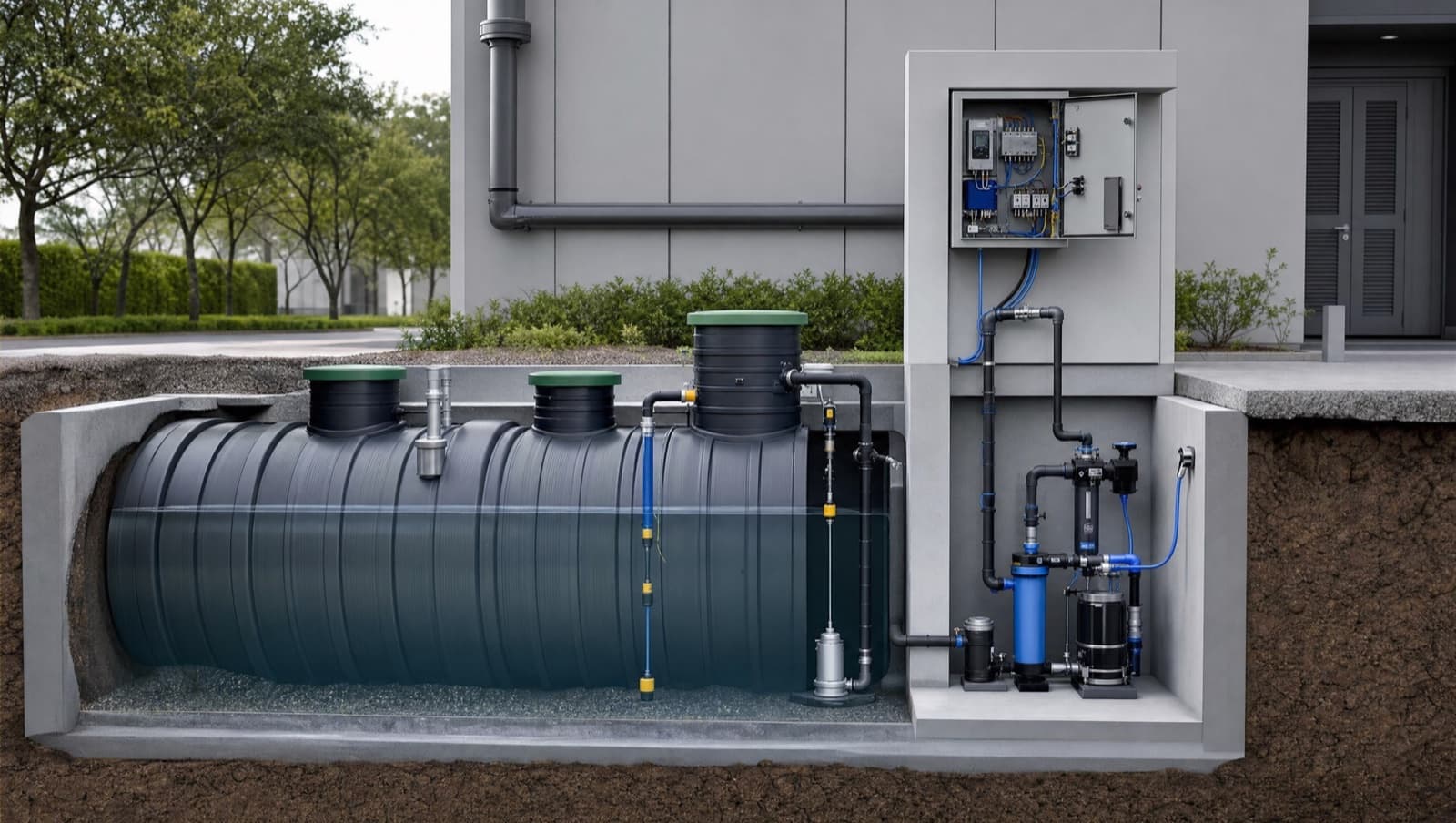
Take a typical site: a package plant — a Klargester BioDisc — serving a rural business park of 200 employees, installed fifteen years ago because there was no foul sewer connection available. It runs unattended. Nobody visits unless something smells or a resident in the neighbouring village complains. The discharge consent requires final effluent quality of 20 mg/l BOD and 30 mg/l suspended solids, with a maximum flow of 45 cubic metres per day, but nobody is monitoring whether the plant is meeting those limits. A grab sample once a quarter by the maintenance contractor tells you what the effluent quality was at 10am on one Tuesday — not what it was at 3pm the previous Friday when the RBC was tripping on overload.
The fines are significant: unlimited in the Crown Court, with personal liability for company directors under the Environmental Permitting (England and Wales) Regulations 2016. BMS and PLC controls close that gap, covering how modern controls apply to package plants and larger works, what needs monitoring, how to achieve compliance, and how remote operation of unmanned sites works in practice.
What stages of sewage treatment need to be controlled?
Treatment works vary enormously in size and technology, but the basic process stages — and the points the controls need to manage — are common.
Inlet works and screening. Raw sewage passes through screens that remove large solids — rags, plastics, sanitary items. On larger works these are automated band or drum screens with motorised raking mechanisms that deposit screenings into a skip; on package plants, screening may be a simple basket screen cleaned by hand. The BMS monitors screen differential pressure (blockage detection), rake motor status, and screenings skip level.
Primary settlement. On larger works, screened sewage flows into primary settlement tanks where heavy solids settle out as primary sludge and lighter material (fats, oils, grease) floats as scum. Primary settlement removes 50-60% of suspended solids and 30-40% of BOD before biological treatment. The BMS monitors inlet flow, sludge blanket level, sludge pump operation, and desludging schedules. Package plants typically skip this stage — sewage goes directly from screening to biological treatment.
Biological treatment. This is where the actual treatment happens: micro-organisms break down the dissolved organic matter. The three main technologies each control differently. Activated sludge uses aeration tanks where a mixed liquor of sewage and biological floc is kept in suspension by diffused air or mechanical aerators — too little dissolved oxygen and the biology dies, too much and energy is wasted, so the BMS controls blower speed or aerator operation to hold dissolved oxygen at 1.5-2.5 mg/l. Rotating biological contactors (RBCs), or biodiscs, are large plastic disc assemblies partially submerged in a trough, rotating slowly to alternately expose the biofilm to sewage and air; the Klargester BioDisc, WPL Diamond, and Kingspan Biomaster are common UK package plant RBC systems, and the BMS monitors RBC motor current (high current indicates overloading or bearing wear), rotation speed, and sometimes biofilm thickness via optical sensors. Submerged aerated filters (SAFs) are packed beds of plastic filter media through which sewage percolates while air is blown upwards; the BMS controls blower speed and monitors differential pressure across the bed, since increasing pressure indicates clogging and the need for backwashing.
Final settlement. Treated effluent flows to final settlement tanks where biological solids settle out, producing a clear final effluent discharged to the receiving watercourse. Settled sludge is returned to the biological stage (return activated sludge, RAS) or wasted (surplus activated sludge, SAS). The BMS controls RAS and SAS pump rates and monitors final effluent turbidity as a real-time indicator of treatment quality.
Tertiary treatment. Where consent limits are tight — typically in sensitive receiving waters — additional stages may include UV disinfection (monitored via UV intensity sensors and lamp hour counters), reed beds (water level and flow distribution), or sand filters (differential pressure and backwash scheduling). UV systems need particular attention: lamp intensity degrades over time, so the BMS should alarm when UV dose falls below the validated minimum for the target pathogen reduction.
Sludge handling. Primary and surplus biological sludge must be stored, thickened, and disposed of. The BMS monitors sludge tank levels, sludge pump operation, and tanker collection schedules. On sites with on-site sludge treatment (belt presses, centrifuges), the controls become significantly more complex.
What does MCERTS-compliant monitoring require?
MCERTS — the Monitoring Certification Scheme operated by the Environment Agency — defines the performance standards for monitoring equipment used to demonstrate compliance with environmental permits. For sewage treatment works with numeric discharge consent conditions, the Environment Agency increasingly expects continuous monitoring using MCERTS-certified instruments rather than relying solely on periodic grab sampling.
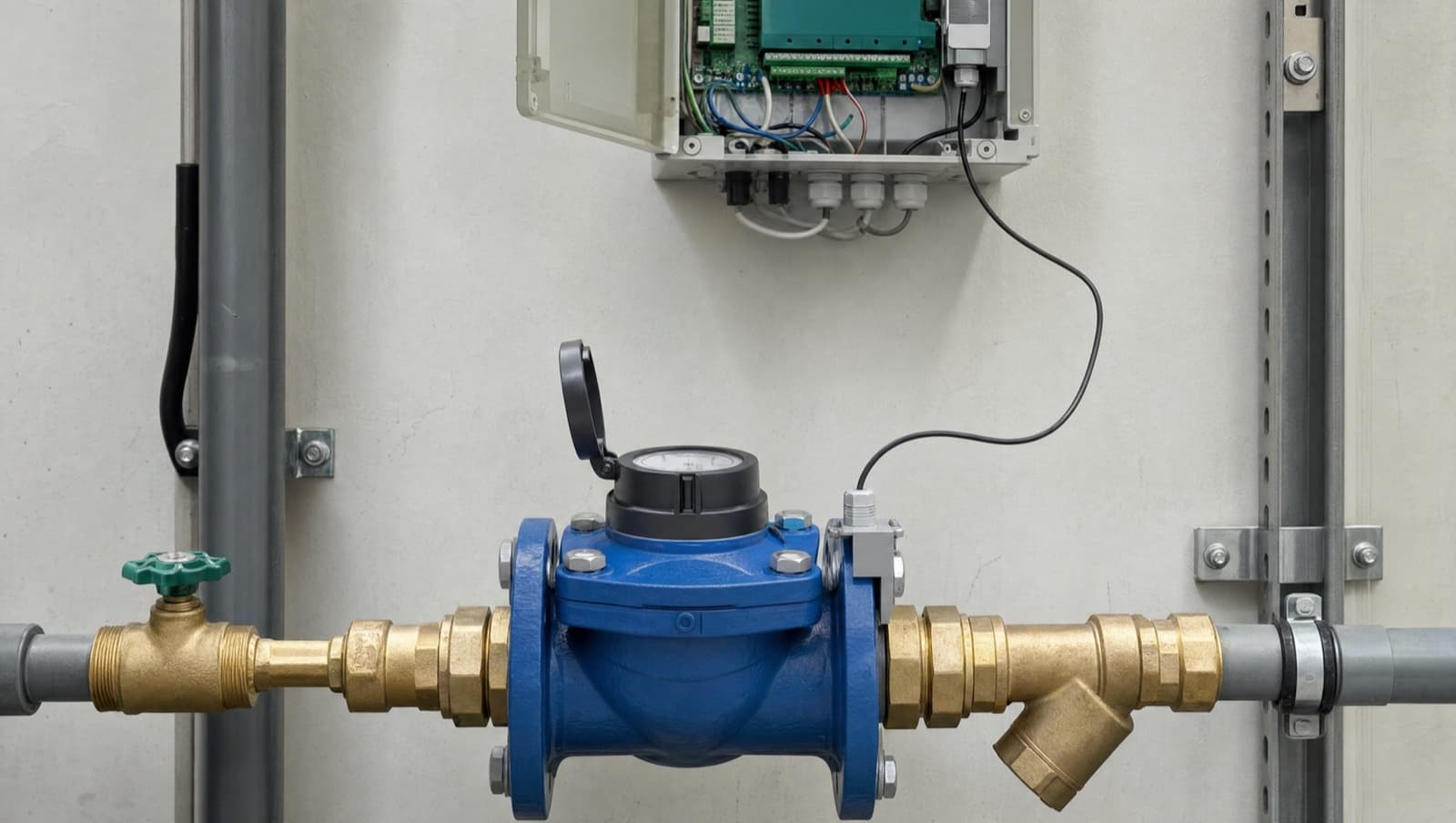
Flow measurement. An MCERTS-certified flow meter on the final effluent discharge measures the volume of treated effluent leaving the works — typically an electromagnetic flow meter (mag flow) or an open-channel ultrasonic level/velocity meter. The BMS records totalised flow (daily, weekly, monthly) and instantaneous flow rate, generating alarms if the daily permitted volume is exceeded. Flow data is the single most important compliance record — the EA will always ask for it.
Suspended solids. Continuous SS monitors use optical turbidity sensors calibrated against gravimetric laboratory analysis. The BMS trends SS continuously and alarms on exceedances. The relationship between turbidity (NTU) and suspended solids (mg/l) must be calibrated for the specific effluent — this calibration drifts over time and requires periodic re-validation against lab samples.
Ammonia. On works with ammonia consent limits, continuous ammoniacal nitrogen monitors (typically ion-selective electrode or colorimetric analysers) provide real-time nitrification performance data. The BMS uses this to adjust aeration intensity — if ammonia is rising, aeration increases to promote nitrification.
Dissolved oxygen. While not a consent parameter itself, DO is the primary control variable for aeration. MCERTS-grade DO sensors with automatic temperature compensation ensure the aeration control loop is working from accurate data.
All MCERTS instruments require documented calibration records, maintenance schedules, and audit trails. The BMS provides the data logging and alarm recording that supports the quality management requirements of MCERTS. Without a BMS or SCADA system, maintaining MCERTS compliance is a manual paperwork exercise that most small works operators find unsustainable.
Get a Free BMS Survey
We'll assess your controls and provide a detailed quotation with energy savings estimates.
How does the Environment Agency assess discharge consent compliance?
Every sewage treatment works that discharges to a watercourse or ground requires an environmental permit from the Environment Agency (or Natural Resources Wales in Wales). The permit specifies numeric limits for pollutants — typically BOD, suspended solids, ammonia, and phosphorus — along with a maximum daily volume. The permit conditions are legally binding, and breaching them is a criminal offence.
The EA assesses compliance using a look-up table based on the number of samples taken per year. For a works with 12 samples per year (the minimum for most small works), all 12 must pass for the works to be compliant. For works with continuous monitoring, the assessment uses percentile limits — 95th percentile for most parameters — which allows a small number of exceedances without failing overall compliance, provided the failures are infrequent and not extreme.
This creates a strong incentive for continuous monitoring via the BMS. With only grab sampling, every single sample must pass — there is no statistical margin. With continuous monitoring, occasional exceedances during unusual conditions (storm flows, temperature extremes) are accommodated within the percentile framework. The BMS also provides the evidence trail that demonstrates the operator was aware of and responding to any exceedances — important in enforcement proceedings, where the EA considers whether the operator exercised due diligence.
How does remote operation of an unmanned treatment works work?
The majority of small and medium sewage treatment works in the UK are unmanned — there is nobody on site except during scheduled maintenance visits, which may be weekly, fortnightly, or monthly. Remote operation via a BMS or telemetry system is the only practical way to maintain oversight of these sites.
Cellular telemetry. A PLC or RTU (remote telemetry unit) at the works communicates via 4G cellular connection to a central monitoring platform or BMS head-end. The outstation polls all instruments and control equipment locally and transmits data, alarms, and status information at regular intervals — typically every 5-15 minutes for trend data and immediately for critical alarms.
Remote control. The central system can send commands back to the outstation — starting and stopping pumps, adjusting setpoints, resetting faults, switching between duty and standby equipment. This lets the operator respond to many alarm conditions without travelling to site, reducing response times and callout costs. A blower that has tripped on a transient overload can be reset remotely in two minutes; without remote control, the same event requires a two-hour round trip for an engineer.
Alarm management and callout. Alarms are categorised by severity and routed to the appropriate people. Critical alarms — treatment plant stopped, high final effluent SS, high tank level — go to the duty operator by SMS and voice call. A callout rota ensures alarms are always directed to someone who can respond, including overnight and weekends. The BMS maintains a complete alarm log with timestamps, acknowledgement records, and response actions — essential evidence for EA compliance audits.
Data logging and reporting. The BMS logs all process parameters continuously and generates automated compliance reports — daily, weekly, monthly summaries of effluent quality, flow volumes, and plant status. These reports can be configured to match the EA's reporting requirements, reducing the administrative burden on the operator.
What is flow proportional sampling?
The EA requires that compliance samples are representative of the effluent quality over the sampling period. For works with continuous monitoring, this is inherent in the measurement. For works that rely on laboratory analysis of physical samples, flow proportional sampling is the gold standard.
A flow proportional sampler collects a small volume of effluent at intervals proportional to the flow rate — more frequent samples during high flow, fewer during low flow. The BMS controls the sampler by sending a trigger pulse for every fixed volume of flow measured by the effluent flow meter (for example, one sample for every 5 cubic metres of discharge). Over a 24-hour period, the composite sample in the sampler's refrigerated cabinet is representative of the total effluent discharge, weighted by flow. The BMS monitors sampler status, refrigeration temperature (must maintain 1-4 degrees C), and bottle capacity, alarming if the sampler fails during a sampling event.
Is it worth retrofitting BMS controls to a package plant?
Package sewage treatment plants — the Klargester, WPL, Kingspan, and Graf units that serve small developments — present specific control challenges. Most ship with simple timer-based controls: the aeration blower runs for fixed on/off periods (typically 30 minutes on, 30 minutes off on a domestic unit), the desludge pump runs once a day, and there are no process instruments at all. No DO sensor, no SS sensor, no flow meter, and no ability to adjust the process based on actual conditions.
Retrofitting BMS controls significantly improves treatment performance and compliance reliability. The minimum useful instrumentation is a DO sensor in the aeration zone (to control blower operation based on actual oxygen demand rather than fixed timers), a turbidity sensor on the final effluent (to detect treatment failures early), and a flow meter on the discharge (to measure daily volumes). Adding a PLC or BMS outstation with cellular telemetry and remote alarm capability transforms the plant from an unmonitored unit that might or might not be treating properly into a continuously monitored, remotely operated asset.
The cost of retrofitting basic BMS controls to a package STP is typically £8,000 to £15,000, including instrumentation, outstation, cellular telemetry, and commissioning. For a works serving a business park or housing development, this is a fraction of the cost of an EA prosecution (fines plus remediation costs typically £50,000 to £250,000) and a fraction of the cost of a failed treatment plant that needs emergency intervention.
BMS or SCADA — which suits larger works?
On larger sewage treatment works — those serving populations above 2,000 or with complex process configurations — the control system is typically a SCADA (Supervisory Control and Data Acquisition) system built on industrial PLCs rather than building-type BMS controllers. The distinction is partly historical (the water industry has always used PLCs and SCADA) and partly functional: the real-time process control requirements of activated sludge aeration, RAS pumping, and chemical dosing demand faster scan rates and more deterministic control than standard BMS controllers provide.
The principles are identical to BMS, though: continuous monitoring of process parameters, automated control of plant equipment, alarm management, historical data logging, and remote operation. Alpha Controls works with both BMS platforms (Trend, Distech, Siemens) and industrial PLC/SCADA platforms (Siemens S7, Allen-Bradley, Schneider M340/M580) depending on the scale and requirements of the works. For smaller works, a BMS-based approach is often more cost-effective and easier to maintain. For larger works with complex interlinked processes, a dedicated SCADA system is more appropriate.
How should treatment plant alarms be prioritised and escalated?
Effective alarm management is the difference between a well-run treatment works and one that lurches from crisis to crisis. The alarm strategy should reflect both operational priority and regulatory consequence.
- Critical (immediate response, 24/7): All aeration stopped, high final effluent SS or ammonia, inlet overflow, loss of communication with site. These represent active environmental harm or imminent breach of discharge consent.
- High priority (4-hour response): Single blower or pump fault with standby available, DO below setpoint, sludge tank high level, UV lamp failure with spare lamps available. Treatment continues but resilience is reduced.
- Medium priority (next working day): Instrument calibration drift, pump runtime imbalance, minor communication faults, sludge tanker collection overdue. These are maintenance issues that will become operational problems if ignored.
- Advisory (next scheduled visit): Runtime hour service reminders, filter media replacement schedules, long-term performance trends showing gradual deterioration.
The alarm system must include escalation — if a critical alarm is not acknowledged within 15 minutes, it escalates to the next person on the callout rota; if it is not acknowledged within 30 minutes, it escalates to management. Unacknowledged alarms at an unmanned treatment works is how environmental incidents become environmental disasters.
How much energy can BMS aeration control save?
Aeration is by far the largest energy consumer on a sewage treatment works — typically 50-70% of total site energy consumption. DO-based aeration control via the BMS, where blower speed is modulated to maintain a dissolved oxygen setpoint rather than running on fixed timers, delivers consistent savings of 20-35%. On a medium-sized works with an aeration energy cost of £40,000 per year, that is £8,000 to £14,000 per year in savings — payback on the control system investment in one to two years.
The BMS can also optimise pump scheduling (running pumps during off-peak tariff periods where process constraints allow), manage standby generator operation during power cuts, and trend overall site energy consumption against flow volumes to identify deteriorating energy efficiency. For a broader look at how energy metering and sub-metering through the BMS drives savings, see our article on energy metering, sub-metering, and data-driven savings.
What to do next
If you operate a sewage treatment works — whether a small package plant or a larger municipal works — and you do not have continuous monitoring with remote alarm capability, you are operating blind. You are relying on periodic site visits and grab sampling to confirm compliance with discharge consent conditions that apply 24 hours a day, 365 days a year. The gap between what the EA expects and what most small works operators provide is significant, and enforcement activity is increasing.
Alpha Controls provides BMS and PLC controls for sewage treatment works across London, Kent, Essex, Surrey, and the South East. We design, install, and commission control systems for package plants, small works, and medium-scale treatment facilities, including MCERTS-compliant instrumentation, remote telemetry, and automated compliance reporting. Request a free survey or call us on 01474 552200 to discuss your treatment works.
Alpha Controls Team
Specialist BMS installation, commissioning, and maintenance across London and the South East. SafeContractor Approved, BCIA Member.