
BMS and telemetry for utilities infrastructure monitor hundreds of unmanned sites — water pump stations, electrical substations and gas pressure reduction installations — using remote outstations that read levels, temperatures and pressures, communicate over cellular networks, run on solar or battery power, and escalate alarms to on-call staff who may be miles away.
Where the asset is a building rather than a chamber in a field, the same outstation-and-alarm discipline lands in the plant room — our plant room BMS guide covers how boilers, chillers, pumps and metering sit together under one system.
The challenge with utilities infrastructure is not the complexity of any individual site — it is the sheer number of them. A water utility operating across three counties might have 400 pump stations, 60 service reservoirs, 200 pressure-reducing valve chambers, 30 chlorine booster stations, and a handful of treatment works. An electricity distribution network operator manages thousands of substations, from 132kV primary substations with full-time staff down to 11kV/400V distribution substations on every other street corner. A gas distribution network has pressure reduction installations (PRIs) at every point where high-pressure transmission mains step down to medium or low pressure for local distribution.
The vast majority of these sites are unmanned. Many are visited only for scheduled maintenance — quarterly, annually, or in some cases only when something breaks. The BMS and telemetry systems that monitor and control these sites are the only continuous presence, and when they fail, the utility loses visibility of the asset until the next physical visit.
How does a BMS monitor and control a water pump station?
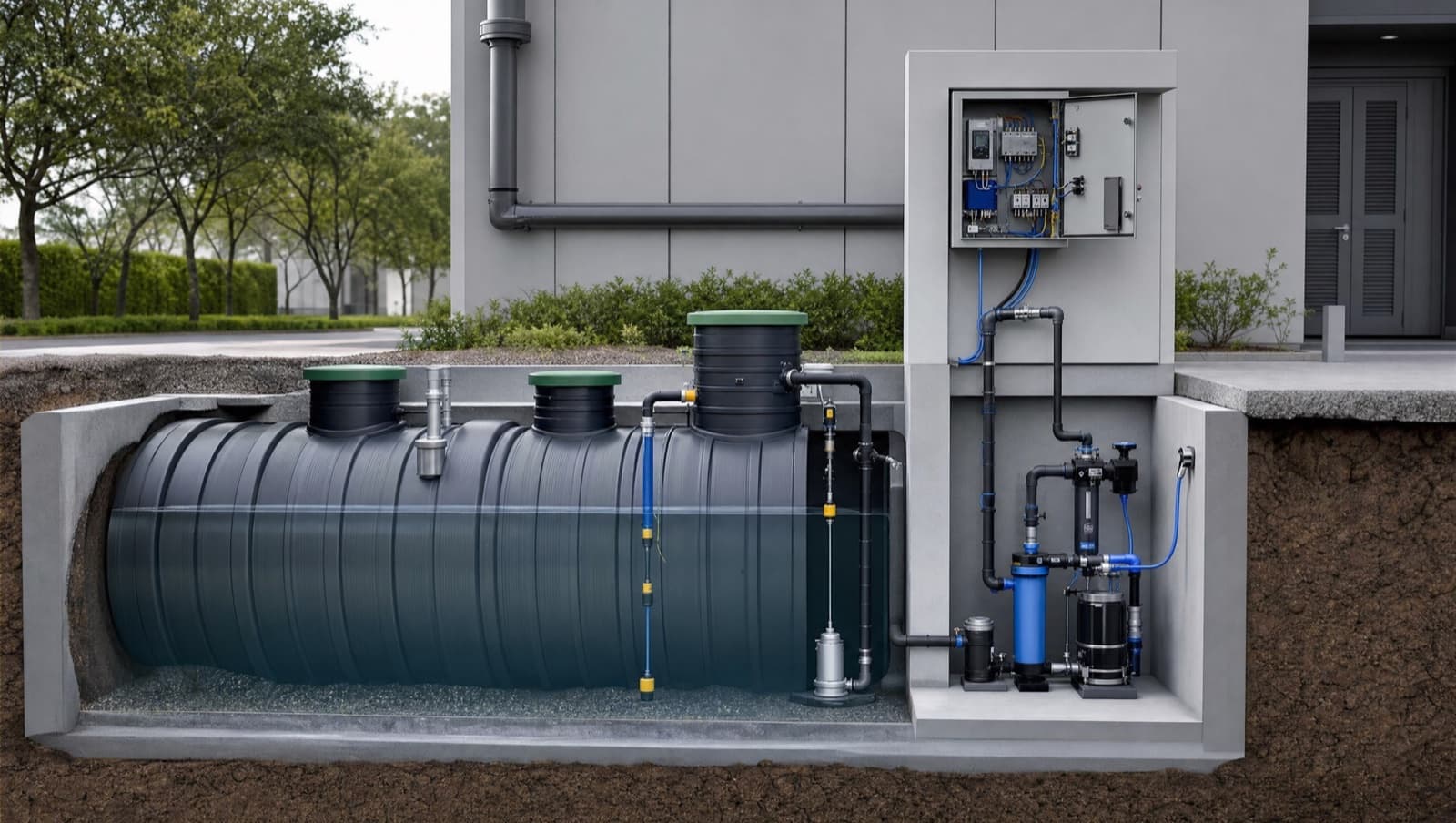
A water pump station lifts water from a low point to a high point — overcoming topography, boosting pressure in the distribution network, or pumping from a borehole to a treatment works. The typical station contains two or three pumps (duty/standby or duty/assist/standby), a wet well or break tank for suction, non-return valves and isolating valves, and an electrical control panel with motor starters or VSDs. The entire station might be housed in a brick building the size of a garage, a GRP kiosk, or nothing more than a below-ground chamber with a locked steel hatch.
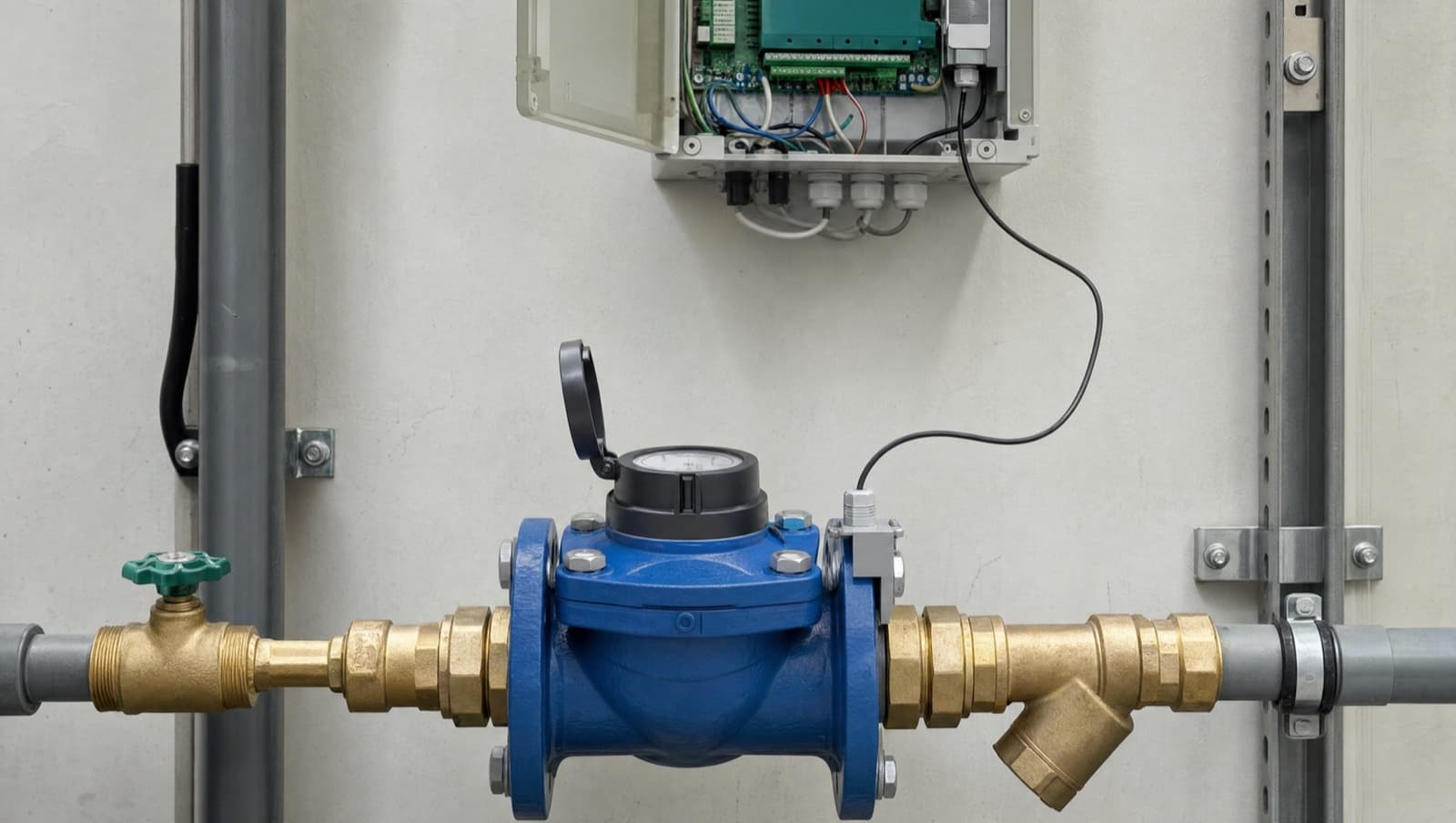
The telemetry outstation — the remote monitoring device — reads: wet well or break tank level (ultrasonic or pressure transducer), pump run status (auxiliary contacts on each motor contactor), pump fault status (motor protection relay contacts), discharge pressure (pressure transmitter on the rising main), flow totalisation (electromagnetic or insertion flowmeter), and mains power status (a volt-free contact that opens when mains power fails). On newer installations, the VSD provides additional data via Modbus: motor current, speed, power, run hours, and fault codes.
The control philosophy is straightforward: pumps start and stop based on wet well level. When the level rises to the start threshold, the duty pump runs. If the level continues to rise (indicating inflow exceeds the duty pump's capacity), the assist pump starts. If the level reaches a high-high threshold, a critical alarm is raised — the station is at risk of flooding. If the level drops to the stop threshold, pumps stop. If the level drops to a low-low threshold, an alarm warns of dry running risk and the pumps are locked out.
Duty rotation happens on a timed basis — weekly changeover is standard. Run hour totalisation for each pump feeds into the maintenance planning system. A pump that has accumulated 8,000 run hours triggers a maintenance intervention (bearing inspection, mechanical seal check, impeller clearance measurement). The telemetry system provides the data; the maintenance management system — often a separate CMMS like Maximo or SAP PM — consumes it. For more on how BMS systems handle duty/standby control and run hour tracking, see our article on pump room BMS controls.
What does a BMS monitor in an electrical substation?
Electrical substations present a different monitoring challenge. The primary concern is not flow and level but temperature, humidity, and security. Transformers generate heat. The oil inside an oil-filled transformer must be kept within a defined temperature range — typically below 95°C at the top oil and below 110°C at the winding hotspot. Exceeding these temperatures accelerates insulation degradation and shortens transformer life. Dry-type transformers in indoor substations are even more sensitive to ambient temperature because they rely entirely on air cooling.
The BMS or environmental monitoring system in a substation reads: transformer winding temperature (via embedded RTDs or the transformer's own winding temperature indicator, typically a 4-20mA output), top oil temperature (PT100 RTD in the transformer tank), ambient temperature in the substation room, humidity (capacitive humidity sensor), and ventilation fan status. Cooling fans — forced air cooling on the transformer radiators — are controlled by the BMS based on oil temperature. The sequence is typically: fans off below 65°C, Stage 1 fans on at 65°C, Stage 2 fans on at 75°C, high temperature alarm at 85°C, trip at 95°C.
Indoor substations also require ventilation for heat dissipation and for preventing the buildup of SF6 gas in the event of a leak from gas-insulated switchgear (GIS). The BMS controls motorised intake and extract louvres that open when the substation room temperature exceeds a setpoint and close when the temperature drops — preventing excessive cooling in winter that could cause condensation on busbars and switchgear surfaces. An SF6 gas detector triggers forced ventilation and an evacuation alarm if a leak is detected. This is safety-critical monitoring, not just comfort control.
What does telemetry monitor at a gas pressure reduction installation?
Gas PRIs reduce the pressure of gas from transmission or distribution mains to a level suitable for local consumption. The monitoring requirements are relatively simple: inlet pressure, outlet pressure, gas temperature (for volume correction — gas volume varies with temperature, and billing is based on corrected volume), filter differential pressure (indicating filter blockage), and slam-shut valve status. The slam-shut valve is a safety device that closes automatically if the outlet pressure exceeds a set limit, protecting downstream equipment and consumers from overpressure. If it operates, an alarm is raised and the site requires a physical visit to investigate the cause and reset the valve.
Gas telemetry adds a further requirement: intrinsic safety. All instruments, wiring, and telemetry equipment in the hazardous zone must be IS-rated (certified for use in potentially explosive atmospheres under the ATEX directive). IS barriers separate the hazardous zone instruments from the non-hazardous telemetry outstation. This significantly constrains equipment selection — not every RTU, not every sensor, and not every communication module is available in an IS-rated version.
Get a Free BMS Survey
We'll assess your controls and provide a detailed quotation with energy savings estimates.
How do remote utility sites communicate back to SCADA?
The majority of remote utility sites communicate back to the central SCADA or BMS via cellular networks — GSM, 3G, or 4G. The telemetry outstation contains a SIM card and a cellular modem. Data is transmitted either periodically (polled telemetry — the central system requests data from each outstation in sequence, typically on a 15-minute to 1-hour cycle) or on exception (event-driven — the outstation sends data only when a value changes or an alarm triggers).
The practical challenges of cellular telemetry include: coverage gaps in rural areas (a pump station in a valley in the North Downs may have no 4G signal), SIM management across hundreds or thousands of sites (which network, which tariff, which APN), data costs (modest per site but significant in aggregate), and cybersecurity (the telemetry outstation is a network-connected device sitting in an unmanned location — it is an attack surface). VPN tunnels between the outstation and the central SCADA server, certificate-based authentication, and firmware update management are all essential. For a broader discussion of BMS cybersecurity considerations, see our article on BMS cybersecurity.
Where cellular coverage is unavailable or unreliable, alternatives include private radio networks (UHF or VHF, licenced from Ofcom), satellite communication (Iridium SBD for low-bandwidth alarm-only sites), and — for sites near existing fibre infrastructure — wired Ethernet connections. Each has trade-offs in cost, bandwidth, latency, and reliability. A utility with 400 remote sites will typically use a mix of all of these, with the choice driven by site-by-site signal surveys.
How are remote telemetry outstations powered without mains electricity?
Many remote utility sites have no mains electricity supply. A water pump station powered by mains electricity will have power for its telemetry outstation as a byproduct. But a pressure-reducing valve chamber, a trunk main monitoring point, or a remote water quality sampling station may have no power at all. The options are: install a mains power supply (expensive — £5,000 to £15,000 for a new supply from the local DNO, plus a lead time of weeks or months), use batteries (limited life — primary lithium batteries last 3 to 10 years depending on the reporting rate, but are not suitable for sites that need to transmit frequently or power sensors with significant current draw), or use solar power.
A solar-powered telemetry outstation uses a photovoltaic panel (typically 10W to 50W for a telemetry-only application), a charge controller, and a sealed lead-acid or lithium iron phosphate (LiFePO4) battery bank sized to maintain operation through the worst-case winter period — in the UK, this means sizing for December and January when solar irradiance can be as low as 0.5 to 1.0 kWh/m²/day. The battery bank must sustain the outstation, cellular modem, and connected sensors through 72 hours of zero solar input (heavy overcast in midwinter). A typical installation uses a 30Ah LiFePO4 battery with a 20W panel, providing reliable operation year-round in southern England.
The constraint is power budget. Everything on the site must be low-power: the RTU itself (modern units draw 50-200mA in sleep mode and 300-500mA during transmission), the sensors (4-20mA loop-powered sensors are preferred because the RTU controls when they are energised), and the cellular modem (transmit current peaks at 1-2A on 4G). The RTU manages power by sleeping between measurement cycles, waking to read sensors, transmitting the data, and returning to sleep. Reporting intervals of 15 minutes to 1 hour are typical for solar-powered sites — more frequent reporting drains the battery faster and may not be sustainable through winter.
Why do mains-powered telemetry sites still need battery backup?
Even sites with mains power need battery backup. A pump station that loses power during a storm loses its telemetry at exactly the moment when monitoring is most critical — the pumps have stopped, the wet well is filling, and the station may be heading for a flooding event. A UPS (uninterruptible power supply) on the telemetry outstation maintains communication during power outages, allowing the outstation to report the power failure itself, continue monitoring the wet well level as it rises, and transmit high-level alarms if the situation becomes critical.
The UPS is typically a small 12V or 24V sealed lead-acid battery with a charger integrated into the telemetry outstation. Runtime varies from 4 hours (minimum) to 72 hours depending on the battery capacity and the outstation's power draw. The BMS or SCADA system should monitor the UPS battery voltage and alarm when it drops below a threshold — a battery that has degraded over years of float charging may provide only minutes of backup rather than the intended hours.
How do alarms escalate from an unmanned site to an engineer?
Alarm management for hundreds of unmanned sites is fundamentally different from alarm management for a single occupied building. In a building, the BMS displays alarms on a graphics workstation and someone is usually there to see them. For unmanned sites, the alarm must reach a person who may be anywhere — at another site, driving, at home overnight. The alarm notification system must be robust, redundant, and escalating.
A typical escalation chain: Level 1 — SMS and push notification to the on-call operator's mobile phone. Level 2 (if not acknowledged within 15 minutes) — phone call to the on-call operator via an auto-dialler. Level 3 (if not acknowledged within 30 minutes) — escalate to the duty manager's phone. Level 4 (if not acknowledged within 60 minutes) — escalate to the area operations manager. The alarm notification system must log every notification sent, every acknowledgement received, and the time between alarm occurrence and acknowledgement. This audit trail is essential for regulatory compliance and for post-incident investigation.
Critical alarms — those indicating an immediate risk of flooding, pollution, public safety hazard, or equipment destruction — should bypass the timed escalation and simultaneously notify all levels. A pump station at high-high level is not something that can wait 15 minutes for the first acknowledgement timeout.
Why do remote utility sites need CCTV and intrusion detection?
Remote utility sites are targets for vandalism, theft (particularly copper cable theft from electrical substations), and unauthorised access. CCTV cameras integrated with the telemetry system provide visual verification of alarm conditions — an operator receiving a high-level alarm from a pump station can view the CCTV feed to assess whether the station is actually flooding or whether the level sensor is faulty. Intrusion detection — door contacts, PIR sensors, vibration sensors on security fencing — triggers alarms and CCTV recording.
The bandwidth requirement for CCTV is significant compared with process telemetry data. A single IP camera streaming at 720p requires 1-2 Mbps — feasible on 4G but not on 2G/GSM. Many sites use a hybrid approach: local recording to an NVR (network video recorder) at the site, with alarm-triggered clip uploads to the central system and live streaming available on demand when an operator needs to view the site remotely.
What environmental conditions does telemetry monitor at unmanned sites?
Unmanned sites are vulnerable to environmental conditions that occupied buildings take for granted. A flood sensor on the floor of a pump station dry well detects water ingress from rising groundwater, pipe leaks, or surface water entry. A temperature sensor detects both overheating (electrical equipment in an unventilated enclosure during summer) and freezing (risk of burst pipes in unheated stations during winter). A humidity sensor detects condensation risk on electrical equipment.
The BMS or telemetry system uses these readings both for alarm purposes and for active control where possible. Ventilation fans or louvres open when the temperature exceeds a setpoint. Trace heating energises when the temperature approaches freezing. Dehumidifiers run when humidity exceeds 70% RH. On sites without mains power, these active controls are not possible and the environmental monitoring is purely for alarm and awareness — the operator needs to know that conditions at the site have deteriorated, even if remote intervention is not possible. For more on frost protection and trace heating BMS integration, see our article on trace heating and frost protection.
How do you keep hundreds of remote telemetry sites running?
The operational challenge is not any single site — it is the aggregate. When you have 400 telemetry outstations, you will always have some that are offline. SIM cards expire. Cellular networks have outages. Batteries fail. Antennas corrode. Rodents chew cables. Lightning strikes destroy outstations. The question is not whether you will have failures but how quickly you detect them and how efficiently you resolve them.
A well-managed telemetry network includes a health monitoring layer: the central SCADA or BMS tracks the last-heard-from timestamp for every outstation and alarms when a site has not reported within its expected cycle (plus a margin). A site that normally reports every 15 minutes and has not been heard from in 30 minutes is probably experiencing a communication issue. A site that has not been heard from in 24 hours is definitely offline and needs a visit. Trending the communication success rate across the network identifies sites with marginal cellular coverage that work fine in summer but lose signal in winter when atmospheric conditions change.
Firmware management across hundreds of outstations is another scale challenge. When a security vulnerability is discovered in the RTU firmware (and it will be — these devices run embedded Linux or proprietary RTOS with known CVE histories), the utility needs to update every outstation. Over-the-air (OTA) firmware updates are essential — physically visiting 400 sites to apply a firmware patch is not practical. But OTA updates introduce their own risk: a failed update that bricks the outstation leaves the site unmonitored until it can be visited. Staging updates across the network — updating 10% of sites first, verifying stability, then rolling out to the remaining 90% — is standard practice.
How much does a utility telemetry outstation cost?
A new telemetry outstation for a water pump station — including the RTU, cellular modem, antenna, sensors (level, pressure, flow), installation, and commissioning — typically costs £3,000 to £8,000 per site. Solar power adds £1,000 to £2,500. CCTV adds £2,000 to £5,000 per camera. Annual cellular data costs run £200 to £600 per site depending on reporting frequency and whether CCTV is included. Maintenance — battery replacement, sensor calibration, firmware updates, SIM management — adds £300 to £800 per site per year.
For a utility managing 200 remote sites, the total annual cost of telemetry operation and maintenance is £100,000 to £280,000. Against this, the cost of a single pollution incident (Environment Agency prosecution: £250,000+), a single flooding event (emergency response, clean-up, third-party damage claims: £50,000 to £500,000), or the reputational damage of an extended supply interruption, the telemetry system is a bargain. The sites that cause the most expensive incidents are almost always the ones with the least monitoring.
Alpha Controls provides BMS and telemetry solutions for utilities infrastructure, including water pump stations, electrical substations, and remote monitoring sites across the South East. If you are managing remote unmanned sites and need better visibility and control, contact us for a technical discussion.
Alpha Controls Team
Specialist BMS installation, commissioning, and maintenance across London and the South East. SafeContractor Approved, BCIA Member.