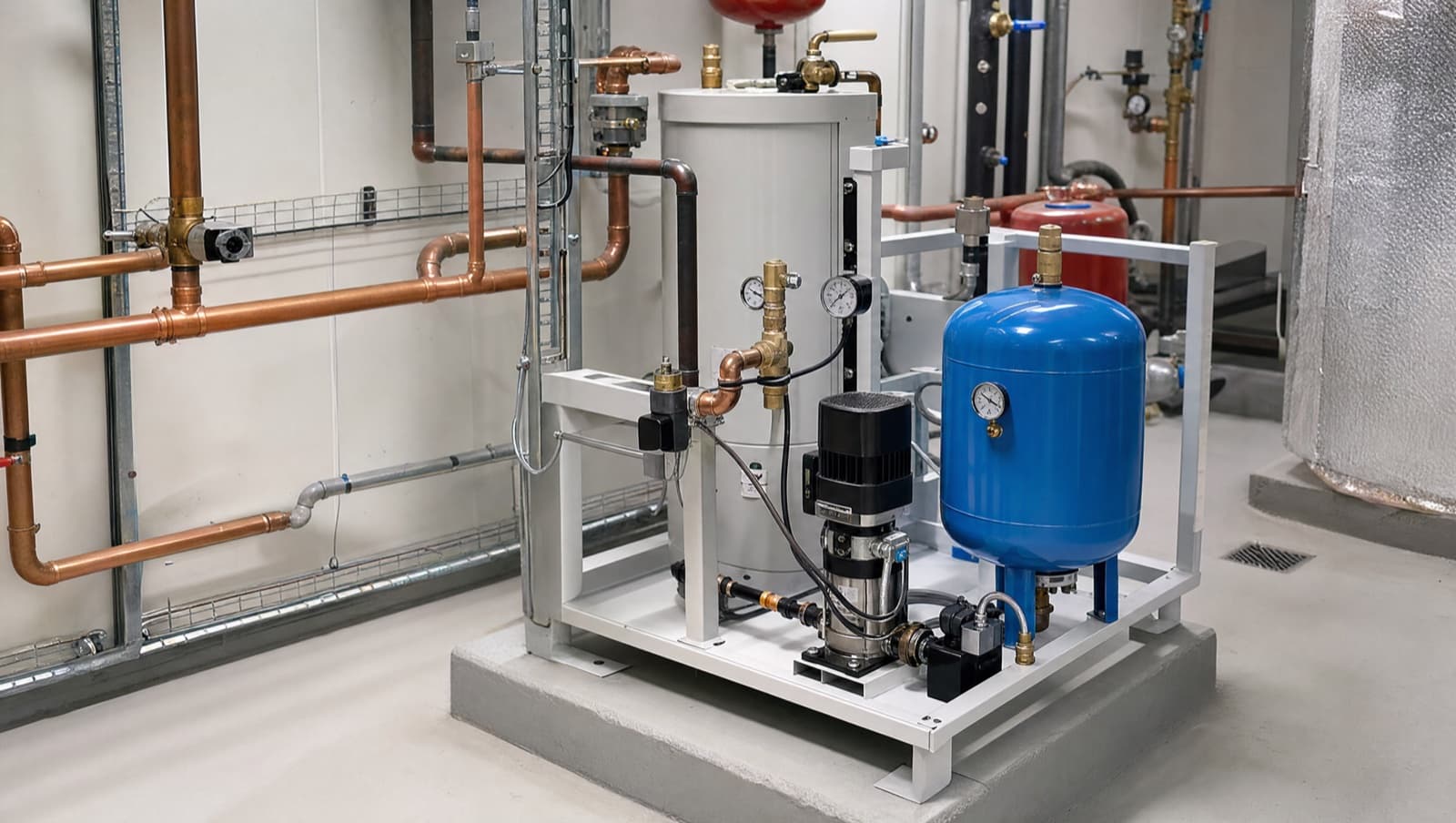

A cold water booster set should be integrated to the BMS over Modbus RTU so the building gets remote fault alarms, trended pressures and flows, and early fault detection. Both Grundfos Hydro MPC and Wilo SiBoost controllers provide Modbus RTU as standard. Retrofitting this integration typically costs between £1,500 and £3,000.
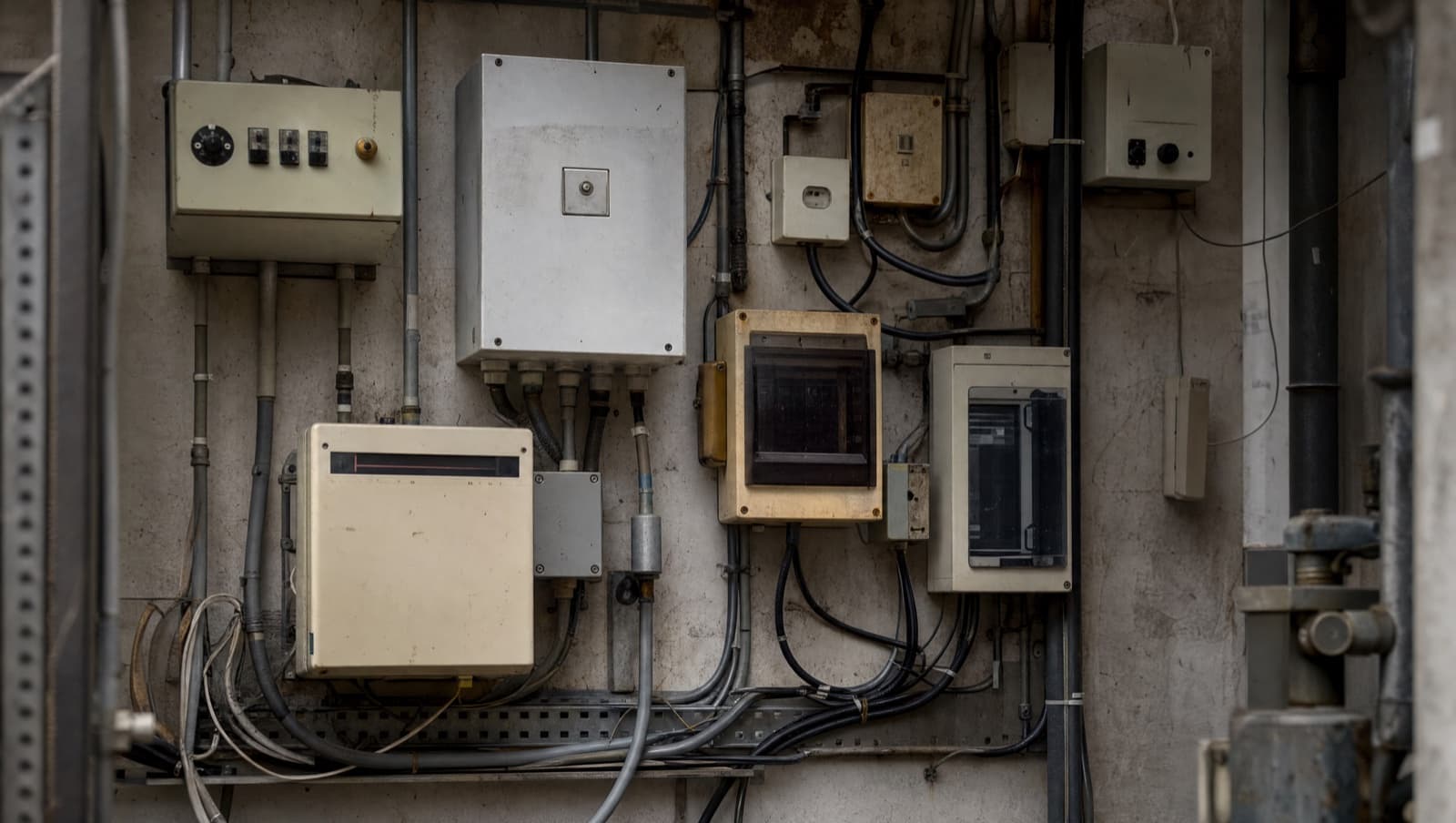
Picture the call that comes in at 7:30 on a Monday morning. Tenants on the sixth floor of a commercial office have no cold water. The facilities manager checks the plant room and finds the booster set sitting in fault — both pumps locked out, no pressure in the system. The fault happened sometime over the weekend, but nobody knew because the booster set was not connected to the BMS. There were no alarms, no notifications, no trending data to show when the problem started. The only diagnostic information available is a fault LED on the booster controller that tells them almost nothing about what actually failed. This scenario plays out across commercial buildings every week. Booster sets are critical infrastructure, yet they are routinely left as standalone equipment with no BMS integration — the controller runs its own logic, the pumps cycle through their duty/standby rotation, and the BMS has no visibility of pressures, flows, pump status, or faults. When something goes wrong, the FM team finds out from complaints, not from the building management system that is supposed to be monitoring every piece of critical plant.
What does a cold water booster set do?
A domestic cold water booster set maintains adequate water pressure to all points of use in a building where the incoming mains pressure is insufficient to serve upper floors. In UK commercial buildings, this typically means any building above three or four storeys, depending on the local mains pressure. Without one, any building taller than three or four storeys loses domestic cold water pressure to upper floors. The booster set draws water from the incoming main — either directly on smaller installations or via a break tank — and uses variable speed pumps to boost the pressure to a constant setpoint that serves all floors.
A typical commercial booster set comprises two, three, or four pumps in a duty/standby or duty/assist/standby arrangement. Under normal demand, one pump runs at variable speed to maintain the discharge pressure setpoint. As demand increases — during morning peak usage, for example — additional pumps stage in to maintain pressure. The booster controller handles this sequencing internally, rotating which pump takes the lead role to equalise runtime hours across all pumps and extend bearing and seal life.
The two dominant manufacturers in UK commercial buildings are Grundfos, whose Hydro MPC range is the most widely installed booster set in commercial new-build, and Wilo, whose SiBoost Smart range has a strong presence in retrofit and public sector projects. Both ranges use variable speed drives (VSDs) on every pump, proportional-integral pressure control, and built-in cascade logic for multi-pump sequencing. Both offer Modbus RTU as a standard communication interface for BMS integration — this is the connection point that transforms a standalone booster into a fully monitored, alarmed, and trended piece of BMS-visible plant.
Why should a booster set be connected to the BMS?
A booster set failure means loss of water to occupied floors. In a commercial office, that means toilets, kitchens, and drinking water. In a hospital, it means patient care areas. In a school, it means closing. The consequences of a booster failure are immediate, visible, and disruptive — yet most buildings have no early warning system because the booster is not on the BMS.
BMS integration provides three things that a standalone booster controller cannot: remote fault notification, historical trend data for diagnostics, and the ability to correlate booster performance with other building systems. A standalone booster controller will display a fault code on its local panel, but if nobody is in the plant room to see it, the fault goes unnoticed until tenants complain. The BMS sends alarms to the FM team's phones and email within minutes of a fault occurring. That difference — between finding out about a problem at 2am on Saturday night versus 8am on Monday when the building fills up — is the difference between a weekend callout and a building-wide disruption.
Trend data is equally valuable. A booster set that is gradually losing performance — a worn impeller, a partially blocked strainer, a VSD with developing bearing noise — will show the problem in its pressure and current trending weeks before an outright failure. Discharge pressure slowly drops, pump current slowly rises, or the standby pump starts staging in at times when it never used to be needed. Without BMS trending, this deterioration is invisible until the day the pump fails completely. For a broader look at how preventive maintenance and BMS trending reduce reactive callouts, see our guide to preventive maintenance BMS strategy.
How do you integrate a booster set to the BMS over Modbus RTU?
Both Grundfos Hydro MPC and Wilo SiBoost controllers provide a Modbus RTU interface as standard — either built into the main controller or available as an optional communication module. This is a two-wire RS-485 connection running at 9600 or 19200 baud, using the Modbus RTU protocol defined in the Modbus Application Protocol Specification. The BMS controller — a Trend IQ4, Distech EC-BOS, Siemens PXC, or similar — connects to the booster controller as a Modbus master, polling register addresses at intervals of one to five seconds.
The Grundfos Hydro MPC exposes a comprehensive Modbus register map. Key registers include discharge pressure (actual and setpoint), suction pressure, individual pump status (running/stopped/fault), pump speed as a percentage, total runtime hours per pump, and fault codes. The register map is documented in the Grundfos CU 352/CU 354 installation and operating instructions — get the correct document for the controller version installed, as register addresses vary between firmware versions. A common commissioning mistake is using a register map from a different controller generation and getting incorrect readings or no communication at all.
The Wilo SiBoost Smart uses a similar Modbus register structure. Pump status, pressure, speed, and faults are all available. Wilo also provides a BACnet interface option on some controller variants, which may be preferable on sites where the BMS is already running BACnet MS/TP or BACnet/IP. For a detailed comparison of BACnet and Modbus and when to use each, see our article on BACnet vs Modbus for BMS integration.
The physical wiring is straightforward. A screened twisted-pair cable runs from the booster controller's RS-485 terminals to the BMS controller's Modbus port. The cable screen is earthed at one end only. End-of-line termination resistors (typically 120 ohms) are fitted at both ends of the RS-485 bus if the booster is the last device on the segment. For a detailed guide to RS-485 wiring and termination in BMS installations, see our article on end-of-line resistors and termination in BMS systems. The Modbus address, baud rate, and parity settings must match between the booster controller and the BMS — this sounds obvious, but mismatched communication parameters are the single most common reason for failed Modbus integrations.
Get a Free BMS Survey
We'll assess your controls and provide a detailed quotation with energy savings estimates.
What should the BMS monitor on a booster set?
The minimum monitoring scope for a booster set on the BMS should include the following points:
Discharge pressure. This is the primary process variable — the pressure the booster set is maintaining on the distribution pipework. The BMS should trend this value continuously and alarm on both high and low deviations from the setpoint. Low discharge pressure means the booster cannot maintain the required pressure — either demand is exceeding capacity, a pump has failed, or the suction supply is inadequate. High discharge pressure can indicate a stuck VSD, a control fault, or a closed valve downstream.
Suction pressure. This is the pressure on the inlet side of the booster set, from the incoming mains or break tank. Low suction pressure is the most critical alarm on a booster set. If suction pressure drops below the pump manufacturer's minimum NPSH (Net Positive Suction Head) requirement, the pumps will cavitate — the water partially vaporises inside the pump casing, causing damage to the impeller and seals. Most booster controllers have a built-in low suction pressure cutout, but the BMS should also alarm on this independently, because a frequent low-suction condition indicates either an undersized incoming main, a faulty pressure reducing valve upstream, or excessive demand from other buildings on the same main.
Individual pump status. Running, stopped, or fault, for each pump. This allows the BMS to confirm that the duty/standby rotation is working correctly and that standby pumps are available. A common hidden fault is a standby pump that has been manually switched off at its local isolator — the booster controller may not alarm on this, but the BMS should flag that only one pump is available.
Pump speed. The percentage speed of each running pump, from the VSD. Pump speed trending reveals demand patterns — a pump running consistently at 90-100% speed indicates the system is near its maximum capacity and may not cope with future demand increases or a pump failure. A pump running at unusually low speed during periods of expected demand may indicate a control fault or a partially closed valve.
Pump fault codes. The Modbus register map typically provides specific fault codes — overcurrent, overtemperature, dry run protection, communication fault. These should be mapped to individual BMS alarm points so the FM team and maintenance contractor know exactly what has failed before they arrive on site.
Does a break tank need level monitoring on the BMS?
On installations with a break tank — required on all direct-boost installations where the Water Supply (Water Fittings) Regulations 1999 mandate backflow prevention — the BMS should monitor the tank water level. Break tanks typically use a float switch or capacitance level probe with high, normal, and low level outputs. Low level indicates the incoming fill valve has failed or the mains supply pressure is insufficient. High level indicates the fill valve is stuck open or the overflow is blocked. Both conditions require immediate attention — a low tank will starve the booster set, and a high tank risks overflow and water damage.
For larger break tanks (above 1000 litres), a continuous analogue level sensor (4-20mA or 0-10V) provides better information than simple float switches, allowing the BMS to trend water level over time and identify slow-developing problems such as a partially blocked fill valve that is not keeping up with demand during peak periods.
How does a booster set comply with the Water Supply (Water Fittings) Regulations 1999?
Every booster set installation in England and Wales must comply with the Water Supply (Water Fittings) Regulations 1999, which are enforced by the local water undertaker (Thames Water, Anglian Water, etc.). The Regulations require that any fitting connected to the public water supply does not cause waste, misuse, undue consumption, or contamination of water. For booster sets, the key compliance requirements are:
Backflow prevention. A booster set connected directly to the incoming main must include an approved backflow prevention arrangement — typically a break tank with a Type AA, AB, or AD air gap — to prevent contaminated water from the building's distribution system being pushed back into the public main. The WRAS (Water Regulations Advisory Scheme) maintains a directory of approved fittings and materials. Every component in the booster set that contacts potable water must be WRAS-approved.
Prevention of undue consumption. The booster set must not draw water from the main at a rate that reduces pressure to neighbouring properties. This is why the water undertaker requires notification of any booster set installation and may impose a maximum flow rate. The BMS can monitor instantaneous flow rate (via a pulse-output water meter on the incoming supply) and alarm if the booster is exceeding its consented draw rate.
BMS monitoring supports compliance. While the Regulations do not explicitly require BMS integration, the ability to demonstrate continuous monitoring of backflow prevention (break tank level), suction pressure (evidence that the booster is not pulling the main pressure below acceptable levels), and flow rates provides documentary evidence of ongoing compliance. This is particularly valuable during water undertaker inspections, which can happen at any time and require the building operator to demonstrate that the installation complies with the Regulations.
How should booster set alarms be prioritised and escalated?
The alarm strategy for a booster set should reflect the criticality of the plant. A booster fault means loss of water to the building — this is not a comfort issue, it is a functional failure that affects basic sanitation. Alarms should be structured in priority tiers:
Critical (immediate notification): All pumps in fault, low suction pressure cutout activated, break tank low level, no discharge pressure. These alarms should generate immediate SMS and email notifications to the FM team and the maintenance contractor, including out of hours. A building with no water at 6pm on a Friday needs a response before Monday morning.
High priority (same-day response): Single pump fault with standby available, high discharge pressure, pump running at maximum speed continuously, break tank high level. The building still has water, but resilience is compromised — if the remaining pump fails, the building loses water.
Advisory (next maintenance visit): Pump runtime imbalance (one pump has significantly more hours than others, suggesting the rotation is not working), pump speed trending upward over time (suggesting increased system resistance or pump wear), minor communication faults between the BMS and booster controller.
Should the BMS control the booster set's pump speed?
Modern booster sets with VSDs on every pump already operate at variable speed to match demand — this is inherent in the booster controller's cascade logic. The BMS does not typically need to override the booster controller's speed control, and doing so is generally a bad idea because the booster controller's PI loop is tuned specifically for the hydraulic characteristics of the pump set. However, the BMS can provide a useful energy management function by scheduling the booster set off during extended unoccupied periods — weekends on a Monday-to-Friday office, for example — and bringing it back on before occupancy resumes. This saves energy on no-load pump cycling and reduces wear on seals and bearings.
The energy consumption of a booster set is modest compared to chillers or AHUs — a typical three-pump commercial booster set might consume 3-8 kW at normal operating speeds — but the cost of unmonitored failures far exceeds the energy cost. The real value of BMS integration is not energy saving but downtime prevention and early fault detection.
What common booster faults does BMS trending catch early?
The most common booster set faults we encounter on sites where Alpha Controls provides BMS maintenance are:
Pump seal failure. Shows up in BMS trending as gradually increasing pump current at the same speed, followed by a dry-run or overcurrent fault. If caught early from the current trend, the seal can be replaced in a planned maintenance visit. If not caught, the pump fails completely and the building loses redundancy.
VSD fault. Overtemperature faults on VSDs are common in plant rooms with inadequate ventilation — the VSD's cooling fan cannot reject enough heat, especially in summer. BMS trending of VSD temperature (available on most Grundfos and Wilo controllers via Modbus) provides early warning. The solution is usually improving plant room ventilation, not replacing the VSD.
Pressure transducer drift. The discharge pressure transducer drifts out of calibration over time, causing the booster to maintain an incorrect pressure. The BMS can flag this by comparing the booster controller's reported pressure with an independent pressure sensor installed on the BMS — if the two readings diverge by more than 0.2 bar, the transducer needs recalibrating or replacing.
Suction strainer blockage. Shows up as gradually decreasing suction pressure, especially during peak demand. The strainer on the booster inlet accumulates debris from the mains supply and needs periodic cleaning. Without BMS trending, this deterioration is invisible until the low-suction cutout trips.
How much does booster set BMS integration cost?
Retrofitting BMS integration to an existing booster set with a Modbus-capable controller typically costs £1,500 to £3,000, covering the Modbus communication module (if not already fitted), RS-485 cabling to the nearest BMS controller, BMS software configuration and point commissioning, and alarm setup. On new installations where the Modbus interface is specified from the outset, the additional cost for BMS integration is £800 to £1,500 on top of the booster set supply and installation cost.
Compare this with the cost of a booster failure that goes undetected over a weekend: emergency callout (£500-£1,500), potential pump replacement (£2,000-£5,000 per pump), tenant disruption, and reputational damage. A single prevented failure pays for the BMS integration several times over.
What to do next
If your building has a booster set that is not connected to the BMS — and the majority of buildings we survey do — this is one of the simplest and most cost-effective integration projects available. The Modbus interface is already there on most modern booster controllers. The wiring is straightforward. The BMS programming is a standard integration. And the benefit — early fault detection, trend data for predictive maintenance, and compliance evidence for water regulation inspections — is immediate.
Alpha Controls provides booster set BMS integration across London, Kent, Essex, Surrey, and the South East. We work with Grundfos, Wilo, DAB, and Lowara booster sets on commercial offices, schools, hospitals, and residential developments. Request a free survey or call us on 01474 552200 to discuss your booster set integration.
Alpha Controls Team
Specialist BMS installation, commissioning, and maintenance across London and the South East. SafeContractor Approved, BCIA Member.