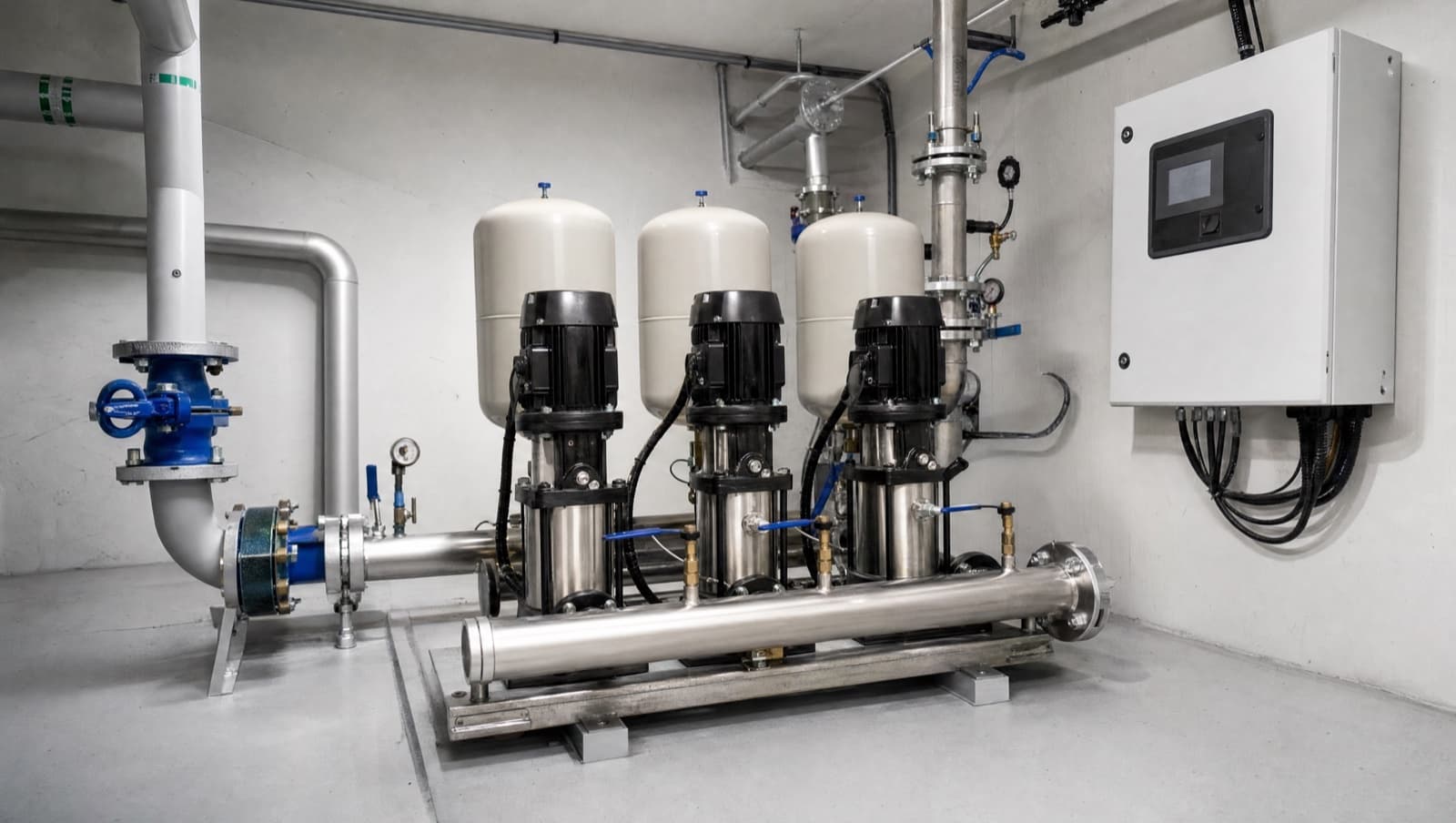

Pressurisation unit faults are the number one cause of heating system shutdowns in commercial buildings, ahead of boiler, pump, or control failures. Integrating the unit with the BMS prevents them by monitoring system pressure and make-up water volume, so a slow leak is caught weeks before the unit locks out and the system depressurises.
The pressurisation unit is one of the cheapest elements in the room to integrate and one of the most expensive to ignore — our complete plant room BMS guide sets it in context alongside the boilers, chillers and pumps it protects.
Picture a Wednesday morning in January with the heating failed across the entire building. The boilers are locked out, the LTHW pumps have tripped, and the BMS is showing low-pressure alarms on every heating circuit. The maintenance contractor arrives two hours later and finds the pressurisation unit in the plant room sitting in fault. System pressure has dropped from its normal 2.5 bar to 0.3 bar. The make-up water solenoid valve is closed because the unit's internal controller has shut it off after exceeding its maximum top-up volume — a safety feature designed to prevent flooding if there is a major leak. The system is depressurised, the boilers have locked out on low water pressure, and 400 people are sitting in a building with no heating on the coldest day of the year.
The unit had been losing pressure gradually for weeks. A small weep on a valve packing gland somewhere in the system — probably no more than a drip per minute — had been slowly draining water from the sealed circuit. The make-up valve had been topping the system up automatically, masking the leak. Nobody noticed, because the pressurisation unit was not connected to the BMS. No alarms, no trending, no visibility of how much make-up water was being added. When the make-up limit was reached, the unit locked out, the pressure dropped, and the heating failed. The overwhelming majority of these failures happen on buildings where the pressurisation unit is not monitored through the BMS.
What does a pressurisation unit actually do?
A sealed heating or chilled water system operates at a pressure above atmospheric to prevent air ingress, raise the boiling point of the water (allowing higher flow temperatures without steam), and ensure positive pressure at the highest point of the system, preventing vacuum conditions that would draw air through valve packings and vent connections. The pressurisation unit holds the correct system pressure by doing three jobs.
Accommodating thermal expansion. When water heats up, it expands. A sealed system with no expansion capacity would see pressure rise dangerously as the water temperature increases. The pressurisation unit's expansion vessel (or vessels) absorbs this expansion. On a spill-back type unit, expansion water spills into an expansion tank via a pressure relief valve and is pumped back into the system as the water cools and contracts. On a gas-charged expansion vessel type, a nitrogen or air-charged diaphragm vessel absorbs expansion directly.
Maintaining cold fill pressure. The cold fill pressure — the static pressure in the system when the water is cold — must be high enough to keep the system above atmospheric pressure at its highest point, including a safety margin. For a building where the highest radiator or AHU coil is 30 metres above the pressurisation unit, the cold fill pressure at the unit needs to be approximately 3.0 bar (30m head plus 0.5 bar safety margin). The controller monitors system pressure via a pressure transducer and opens a make-up valve to add treated mains water whenever pressure drops below the cold fill setpoint.
Providing overpressure protection. If system pressure rises above the safe working pressure — due to excessive expansion, a faulty make-up valve, or a closed valve isolating part of the system — a spill valve or pressure relief valve opens to relieve the excess. The pressurisation unit monitors for overpressure conditions and alarms accordingly.
Why do pressurisation units fail without anyone noticing?
The fundamental problem is that pressurisation units are designed to operate silently in the background, automatically compensating for small pressure changes without any operator intervention. That is a feature when everything is working correctly, but it becomes a liability when a fault develops, because the unit masks problems rather than revealing them.
The most common failure mode is a slow leak somewhere in the heating or chilled water system. Water leaks through a valve packing, a corroded fitting, a failed pump seal, or a pinhole in old pipework. The unit detects the pressure drop and opens the make-up valve to add water, and system pressure returns to normal. From the outside — and from the BMS, if it is only monitoring system pressure — nothing appears wrong. But the unit is now continuously adding treated mains water to replace what is leaking out. Over days and weeks, this continuous make-up introduces fresh dissolved oxygen into the system, which accelerates corrosion, which causes more leaks, which requires more make-up water. The system is in a deteriorating cycle that is completely invisible without make-up water monitoring.
Eventually one of three things happens. The make-up water consumption exceeds the unit's safety limit and it locks out, causing a sudden loss of pressure and system shutdown — the Wednesday-morning scenario above. Or the leak worsens to the point where it causes visible water damage: stained ceilings, wet risers, flooded plantrooms. Or the continuous oxygen ingress causes so much internal corrosion that the system becomes unreliable, with frequent blockages, failed heat exchangers, and black magnetite sludge in every component. All three outcomes are preventable with BMS monitoring.
What should the BMS monitor on a pressurisation unit?
System pressure. A 4-20mA or 0-10V pressure transducer on the system return, near the pressurisation unit connection point, provides continuous pressure data to the BMS. The BMS trends this value and alarms on high pressure (overpressure — possible expansion vessel failure or stuck make-up valve) and low pressure (possible leak or unit fault). The key diagnostic value is not the absolute pressure reading but the pressure trend over time. A system slowly losing pressure — say 0.05 bar per day — has a leak, even if the unit is successfully maintaining the setpoint by adding make-up water.
Make-up water volume. This is the single most important monitoring point on a pressurisation unit, and it is the one most frequently omitted. A pulse-output water meter on the make-up water supply lets the BMS totalise the volume of water added to the system. On a properly sealed system with no leaks, make-up consumption should be close to zero after the initial fill — perhaps a few litres per month to compensate for sampling losses, valve packing weeps, and air vent losses. If the BMS shows the unit adding 50 litres per day, there is a leak. If it is adding 200 litres per day, there is a significant leak. The make-up water trend over weeks gives the clearest possible indication of system integrity.
Pressurisation unit status. The major manufacturers — Flamco (Flexcon M-K), IMI Pneumatex (Compresso, Transfero), and Caleffi (5453 series) — all provide volt-free contact outputs or Modbus communication for BMS integration. The minimum integration is a volt-free fault output connected to a BMS digital input: when the unit enters a fault condition, the BMS generates an alarm. Better integration via Modbus provides pump status, valve positions, pressure readings, and specific fault codes, allowing the BMS to display detailed diagnostics and trend operational data.
Expansion vessel pre-charge pressure. Diaphragm expansion vessels have a nitrogen or air pre-charge on the gas side of the diaphragm. Over time, gas diffuses through the diaphragm and the pre-charge pressure drops. When that happens, the vessel can no longer absorb the full expansion volume, and system pressure rises excessively during warm-up. Checking pre-charge pressure requires a physical visit with a tyre gauge, but the BMS can flag the symptom: if the system pressure swing between cold and hot conditions is increasing over time — the gap between cold fill pressure and hot operating pressure growing — the expansion vessel pre-charge is likely low and needs re-charging.
Spill valve and make-up valve operation. On spill-back type units, the BMS should monitor whether the spill valve is opening (indicating overpressure) and whether the make-up valve is opening (indicating low pressure or a leak). The frequency and duration of valve operations, trended over time, reveals the system's health. A make-up valve that opens briefly once a week is normal. A make-up valve that opens for 30 minutes every day is a leak.
Get a Free BMS Survey
We'll assess your controls and provide a detailed quotation.
Why does glycol concentration need monitoring?
Chilled water systems and systems with frost-exposed pipework typically use a water-glycol mixture as the circulating fluid. The glycol concentration must be maintained within specification — typically 25-40% propylene glycol for frost protection to -10 to -20 degrees C. If the pressurisation unit is adding untreated mains water to replace glycol-water mixture lost through leaks, the glycol concentration gradually dilutes. Over time the frost protection threshold rises, and in a cold snap the exposed sections of the system may freeze and burst — a catastrophic failure that typically costs £50,000 to £200,000 in pipework replacement and consequential damage.
The BMS cannot directly measure glycol concentration, but it can flag the conditions that lead to dilution: excessive make-up water volume, falling system pressure that requires repeated top-ups, and — on systems with a refractometer sample point — a manual glycol concentration reading trended in the BMS. Some modern pressurisation units include a conductivity sensor that gives an approximate indication of glycol concentration, and this can be integrated via Modbus. Glycol dilution is one route to a frozen pipe; exposed pipework in unheated risers and plant rooms needs its own dedicated protection — see our guide to trace heating and frost protection through the BMS.
How does the BMS detect a leak from pressure trends?
The most powerful diagnostic tool the BMS provides for sealed system management is long-term pressure trending. A sealed system with no leaks shows a consistent pressure pattern: lower pressure when cold (overnight, weekends), higher pressure when hot (during occupied hours when heating is running). This pattern should be stable from week to week and month to month.
A system with a developing leak shows a gradual downward trend in cold fill pressure over weeks, masked by make-up water additions. The BMS detects this by comparing the minimum overnight pressure each week. If the overnight minimum is gradually dropping — even by 0.1 bar per week — there is a leak. This is the earliest possible detection of a developing problem, weeks or months before the unit locks out or visible water damage appears.
For buildings with BMS-integrated water metering, the make-up water trend and the pressure trend together give a comprehensive picture of sealed system integrity. Increasing make-up water with stable pressure means the unit is successfully compensating for a leak. Decreasing pressure with no make-up water means the unit itself has a fault — the make-up valve may be stuck closed, the water supply to the unit may be isolated, or the unit may have locked out. For a broader look at how water metering through the BMS enables leak detection and consumption management, see our article on water meter and sub-metering BMS integration.
How much does pressurisation unit BMS integration cost?
The cost depends on the existing unit's communication capability and the scope of monitoring required. There are three typical levels.
Basic integration (volt-free fault contact only): £300-£600 per unit, covering wiring from the pressurisation unit's fault relay to a BMS digital input, BMS software configuration, and alarm setup. This provides a simple fault/healthy status — better than nothing, but limited diagnostic value.
Standard integration (pressure transducer + make-up water meter + fault contact): £1,200-£2,000 per unit, covering a BMS pressure transducer on the system return, a pulse-output water meter on the make-up supply, wiring, and BMS commissioning. This delivers the pressure trending and make-up water monitoring that enables leak detection — the most cost-effective monitoring scope for most buildings.
Full Modbus integration: £1,800-£3,000 per unit, covering a Modbus communication module (if not already fitted), RS-485 wiring, BMS software configuration for all available Modbus registers, and full alarm and trending setup. This provides the most comprehensive monitoring but is only justified on critical installations or where the unit already has Modbus capability.
For context, the cost of a heating system shutdown caused by a pressurisation unit failure includes emergency callout (£500-£1,500), system re-pressurisation and re-commissioning (£1,000-£3,000), any consequential damage from the leak that caused the depressurisation (£2,000-£50,000+), and the business disruption of a building with no heating or cooling for 24-48 hours. Even at the basic integration level, a single prevented failure pays for the monitoring many times over.
Which buildings should prioritise pressurisation unit monitoring?
Every sealed heating and chilled water system has a pressurisation unit, but not every building carries the same risk. Priority for BMS integration goes to four types of site.
Buildings with old pipework. Systems more than 20 years old are significantly more likely to develop leaks from corrosion, especially if water treatment has been neglected. These systems need make-up water monitoring as a minimum.
Buildings with glycol systems. The consequence of glycol dilution through unmonitored make-up water is catastrophic pipe freezing. These systems need both make-up water monitoring and glycol concentration tracking.
Buildings with critical occupancy. Hospitals, data centres, schools — any building where loss of heating or cooling has serious consequences. These need full pressurisation unit monitoring with 24/7 alarm capability.
Buildings with multiple pressure zones. Large buildings with separate LTHW and CHW circuits, multiple risers, or multiple pressurisation units need each unit monitored independently. A fault on one zone may not affect others, but without per-zone monitoring the FM team cannot identify which zone has the problem.
How do I check if my pressurisation unit is monitored?
Walk into your plant room and look at the pressurisation unit. Is it connected to the BMS? Can you see the current system pressure on the BMS front end? Can you see how much make-up water has been added this week? If the answer to any of these is no, your building is vulnerable to the most common cause of heating system failure and you have no early warning system. For guidance on how BMS monitoring and regular inspection prevent reactive callouts and unplanned shutdowns, see our guide to preventive maintenance BMS strategy.
Alpha Controls provides pressurisation unit BMS integration across London, Kent, Essex, Surrey, and the South East. We work with Flamco, IMI Pneumatex, Caleffi, and all other major pressurisation unit manufacturers. Request a free survey or call us on 01474 552200 to discuss your pressurisation unit monitoring.
Alpha Controls Team
Specialist BMS installation, commissioning, and maintenance across London and the South East. SafeContractor Approved, BCIA Member.