
EC-Net is Distech's building management supervisor built on Tridium's Niagara 4 framework — the same engine behind Trend IQVISION. The ECLYPSE field controllers underneath it do not run Niagara at all: they are open BACnet/IP devices. In practice, lock-in lives at the supervisor tier — licences, station backups and passwords — not in the framework itself.
You're reviewing a controls spec, a tender return or an O&M manual, and there it is: "EC-Net 4 supervisor." If you've not lived inside the Distech ecosystem, the obvious questions follow fast. Is this some proprietary Distech platform? Is it the same Niagara the consultant keeps mentioning? If we appoint this contractor, can anyone else ever touch the system? We get asked this constantly — usually by consultants and FM teams who've inherited or been quoted a Distech system and can't find a straight answer that isn't a vendor datasheet. Here's the straight answer, including the part the datasheets don't dwell on: what actually determines whether you're locked in.
What is Distech EC-Net?
EC-Net is Distech's supervisory software platform — the layer that provides graphics, alarm management, trend logging, scheduling and user management above the field controllers. The current generation, EC-Net 4, is built on the Niagara 4 framework and is stated plainly in Distech's own documentation: EC-Net is "powered by the Niagara Framework," networking Niagara-based EC-BOS series controllers alongside ECLYPSE IP devices. Licensing is sized by Niagara network connections — versions run from small supervisors up to unlimited-connection estates — which is why our published guidance puts EC-Net 4 supervisory licensing at £3,000–£12,000 depending on the number of connected devices. Like any Niagara platform, a software maintenance agreement is typically expected to keep the station current.
Is EC-Net the same thing as Niagara?
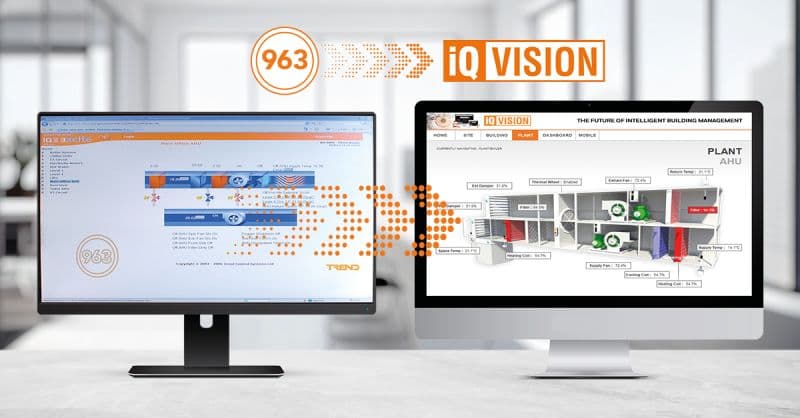
Functionally, yes — EC-Net is Niagara wearing a Distech badge. The Niagara Framework is developed by Tridium, a Honeywell subsidiary, and licensed to OEMs who ship it under their own brands: Distech's is EC-Net, Trend's is IQVISION, and Honeywell sells it under its own name. Same engine, different branding, different driver bundles and support channels. This is worth internalising because it cuts both ways on a spec: a consultant who writes "Niagara N4 supervisor" will get compliant bids on EC-Net, IQVISION and vanilla Niagara that look like different products but share their core — and a building that runs EC-Net today is running the same framework a Trend house would maintain as IQVISION. One caution on a common mix-up: Schneider's EcoStruxure Building Operation is not Niagara-based — it's Schneider's own platform, whatever the spec's "or equivalent" clause implies.
Do ECLYPSE controllers run Niagara? No — and that matters
The field tier is where Distech diverges from the Niagara story, and it's the most misunderstood part of the architecture — we've corrected it in our own earlier writing. ECLYPSE controllers do not run an embedded Niagara runtime. They run Distech's own platform: IP-native BACnet controllers with an embedded web server and graphics, a RESTful API, and native BACnet/IP, BACnet MS/TP, Modbus RTU/TCP and M-Bus support. The Niagara-based hardware in Distech's range is the separate EC-BOS series, which plays the same role a JACE does elsewhere. The distinction is good news for building owners: because the ECLYPSE tier is open BACnet, your field layer is portable regardless of what happens at the supervisor. A sound ECLYPSE estate can sit under EC-Net, under a Trend IQVISION, or — on smaller sites — under nothing at all, serving its own graphics from the controller. For what the platform is model-by-model, see our full Distech ECLYPSE and EC-Net guide.
Get a Free BMS Survey
We'll assess your controls and provide a detailed quotation with energy savings estimates.
So are you locked in?
Less than you fear, more than the datasheet admits. What's genuinely portable: the BACnet field layer (per BS EN ISO 16484-5, any compliant supervisor can read it), and the Niagara station itself — a competent Niagara engineer can take over an EC-Net station the way they'd take over any N4 system. What actually locks buildings in is operational, not architectural: station backups that were never handed over, licences registered to the installer rather than the building, admin passwords nobody wrote down, and driver configurations that exist only on the contractor's laptop. OEM licensing and certified-partner arrangements add friction too — an EC-Net licence is administered through Distech's channel, so the pool of engineers who can service the supervisor is the pool trained on that channel. None of this is unique to Distech; it's the standard shape of BMS vendor lock-in, and the defence is the same: contractual handover of licences, backups and credentials, written into the spec before anyone is appointed.
What usually goes wrong on EC-Net sites
The pattern we see most often is the inherited station. A building changes FM provider or owner, the incumbent controls contractor moves on, and what's left is a running EC-Net supervisor with no station backup, no licence paperwork and no admin credentials — a system that works perfectly and can't be touched. Recovery is possible but slow and costly, and it's entirely preventable at handover. The second pattern is spec-stage confusion: "Niagara supervisor" on the tender, three returns quoting EC-Net, IQVISION and plain N4 at different prices, and nobody in the room normalising them as the same framework with different badges and support networks. The third is takeover work priced as replacement work — a contractor who doesn't know Distech quoting to rip out a healthy ECLYPSE estate because the supervisor brand is unfamiliar. If you've just inherited one of these buildings, our guide to inheriting a Distech BMS walks through the triage.
What does the EC-Net tier cost?
Using our published UK ranges: EC-Net 4 supervisory licensing typically adds £3,000–£12,000 depending on connected device count, on top of equipment-level ECLYPSE controllers at £1,200–£2,800 each including programming and commissioning. A complete small-building Distech installation — controllers, sensors, cabling, EC-Net 4, commissioning and documentation — typically lands at £30,000–£75,000. Two cost behaviours are worth a QS's attention: the supervisor licence scales stepwise with connection count, so point-count assumptions move the software line, not just hardware; and on smaller single-system sites the ECLYPSE embedded web server can remove the supervisor line entirely. That second one is a genuine saving — interrogate any return that includes a full supervisor for a site that doesn't need one. Our BMS cost-per-point guide covers how to carry these allowances defensibly.
Standards: the openness is real, but it lives at the protocol layer
Two standards anchor the portability argument. BS EN ISO 16484-5 defines BACnet, which ECLYPSE controllers implement natively — that's the layer that guarantees a compliant supervisor of any brand can communicate with the field estate, and it's what makes the "locked to one contractor" outcome an operational failure rather than a technical necessity. And CIBSE Guide H — the UK reference for building control systems, which specifies 0.6 K sensor accuracy for zone air temperature measurement and treats the control tolerance as a design input the specification must state — sets the commissioning and documentation bar any supervisor migration or takeover should be handed over against. A takeover that ends without Guide H-standard documentation and a verified station backup has just recreated the lock-in it was meant to remove.
Where we stand: we work both sides of this fence
Alpha Controls installs and maintains both Distech and Trend systems, and we're experienced in Niagara deployment, configuration and support — which in practice means EC-Net and IQVISION stations as well as the controllers beneath them. We've integrated ECLYPSE controllers into buildings running Trend supervisors and vice versa, precisely because the BACnet layer allows it. That's also why our advice on the EC-Net question is unexcitable: the framework is not the risk. The risk is a handover that leaves the licences, backups and passwords with someone else. Get those into the contract and either badge of Niagara will serve the building well; leave them out and even a fully open system becomes one company's property in practice.
When to act
Three triggers. If a tender in front of you says "EC-Net" or "Niagara" and the returns don't look comparable, normalise them before you score them — same framework, different badges, different support pools. If you've inherited an EC-Net site and can't produce the station backup, licence record and admin credentials today, treat that as a live risk and close it before anything fails. And if you're specifying now, write the handover deliverables — licences assigned to the building, station backup lodged, credentials escrowed, driver documentation — into the employer's requirements, where they cost nothing. All three are quick pieces of work; all three are much more expensive after a failure or a contractor dispute.
Get a straight answer on your Distech or Niagara system
If there's an EC-Net supervisor in your building — or one in a tender you're evaluating — and you want an independent view of what you'd own, what you'd be tied to and what it should cost, talk to us. We'll tell you whether the estate is portable, what's missing from the handover, and what a takeover or migration would actually involve. Get in touch or request a survey and quote.
Alpha Controls Team
Specialist BMS installation, commissioning, and maintenance across London and the South East. SafeContractor Approved, BCIA Member.