
A Distech BMS system is an open-protocol, IP-native building controls platform from Distech Controls, now part of Acuity Brands. It pairs ECLYPSE series controllers at field level with the EC-Net 4 supervisory platform, all communicating natively over BACnet IP and BACnet MS/TP and conforming to BS EN ISO 16484-5.
What is a Distech BMS system?
Distech Controls is a Canadian building automation manufacturer, founded in 1995 and now part of Acuity Brands. It has built its reputation on open-protocol, IP-native building controllers designed from the ground up for modern BACnet networks. Unlike manufacturers that retrofitted BACnet support onto legacy hardware, Distech's ECLYPSE platform was designed with BACnet IP as its primary communication protocol — not an afterthought bolted onto a proprietary bus.
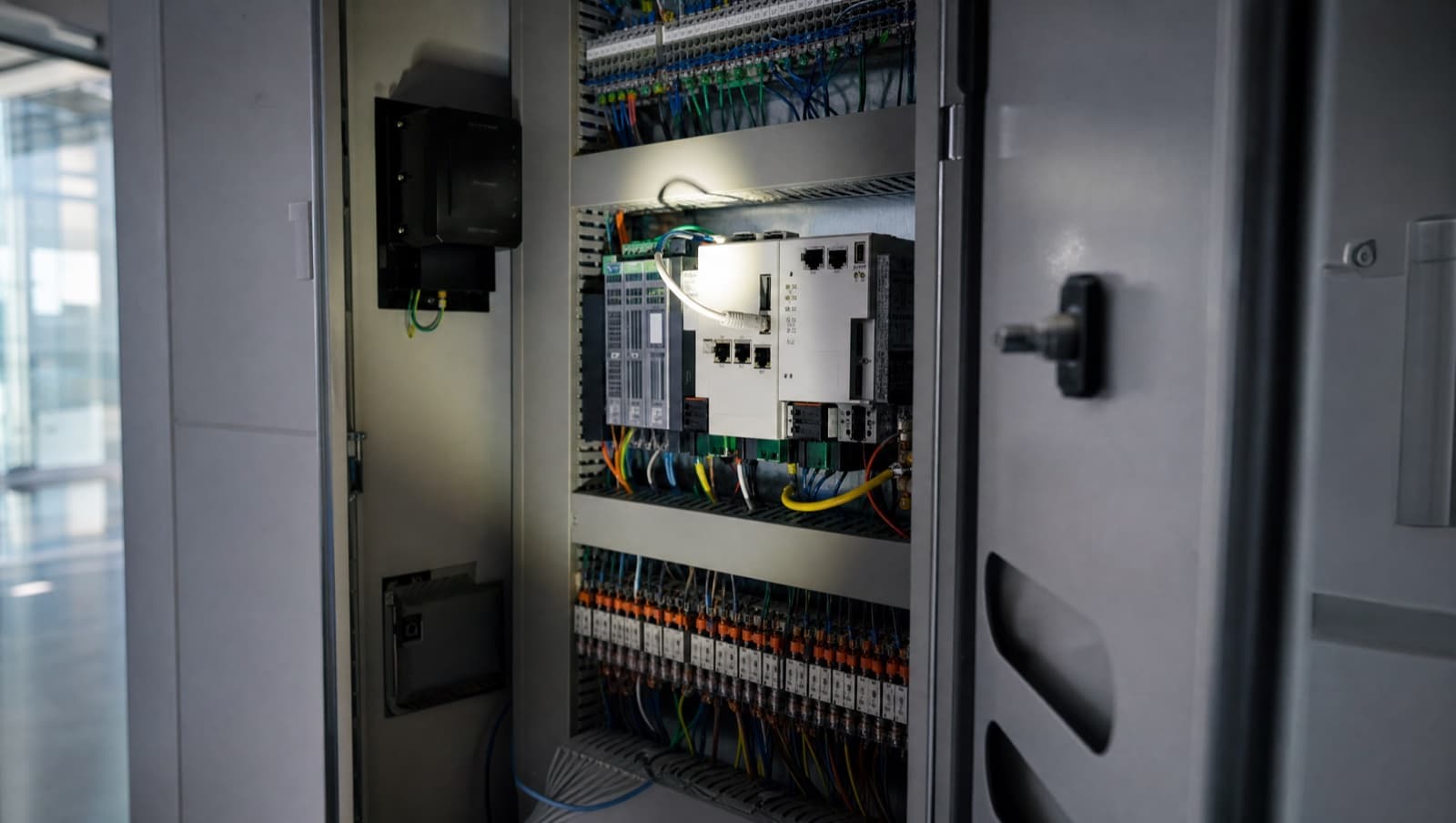
A typical Distech BMS installation consists of ECLYPSE series controllers at the field level, connected via a standard IP network to an EC-Net 4 supervisory platform for centralised monitoring, alarm management, scheduling, and trend logging. Distech also manufactures the Allure range of room controllers and touch-screen interfaces that give occupants direct interaction with their local environment — temperature adjustment, fan speed selection, and occupancy indication — while feeding data back to the central BMS.
All Distech controllers communicate natively using BACnet IP and BACnet MS/TP, conforming to BS EN ISO 16484-5 (the BACnet standard, also published as ASHRAE 135). This means a Distech system can integrate with any BACnet-compliant device from any manufacturer without proprietary gateways or protocol converters — a critical advantage in multi-vendor buildings.
Why is Distech winning specifications on new-build commercial projects?
Over the last three years, Alpha Controls has seen a significant shift in BMS specifications for new-build and major refurbishment projects. Where Trend and Honeywell once dominated every tender, Distech Controls is now appearing on an increasing number of consultant specifications — particularly for projects where IoT readiness, native IP architecture, and open API access are priorities. The consulting engineers driving this shift are not choosing Distech because it is cheaper. They are choosing it because the platform architecture is genuinely modern, the BACnet implementation is clean, and the RESTful API gives building analytics teams direct access to BMS data without the middleware headaches that come with legacy platforms.
That said, Distech is not the right answer for every building. If you have an existing Trend estate, bolting Distech onto the side of it adds unnecessary complexity. If your FM team is Trend-trained, switching platforms creates a skills gap. The question is not whether Distech is better than Trend — it is whether Distech is the right choice for your building, your team, and your project requirements.
What are the ECLYPSE controller models and their capabilities?
The ECLYPSE series is Distech's current-generation controller platform and represents a fundamentally different approach to BMS hardware compared to traditional controller architectures. Every ECLYPSE controller runs an embedded Linux operating system, includes an integrated web server, supports BACnet IP and BACnet MS/TP, and provides RESTful API access for IoT and cloud integration.
The ECLYPSE Connected (ECY-S1000) is the supervisory-level controller designed for small to medium applications. It functions as both a BACnet IP supervisory controller and a field controller with integrated I/O, making it cost-effective for single-system or small-building applications where a separate EC-Net supervisor would be overkill. It can manage up to 100 BACnet objects and serve as the standalone front end for compact installations.
The ECLYPSE Connected+ (ECY-PTU) is the higher-performance model with additional processing power, expanded memory, and support for larger point counts and more complex control strategies. This is the controller specified for larger buildings, multi-system plant rooms, and applications requiring advanced scheduling, trend logging, and alarm management at the controller level.
The ECLYPSE Edge controllers are designed for equipment-level control — individual AHUs, fan coil units, heat pumps, VAV boxes, and chiller/boiler plant. They come in various I/O configurations to match different equipment types, with models specifically designed for common HVAC applications. These controllers execute the real-time control strategies that keep equipment running efficiently while reporting data upstream to the supervisory platform.
Get a Free BMS Survey
We'll assess your controls and provide a detailed quotation.
What is EC-Net 4 and what does the supervisory platform do?
EC-Net 4 is Distech's web-based supervisory platform — the layer that sits above the field controllers and provides centralised monitoring, management, and reporting. It runs as a web application accessible from any HTML5 browser, with no client software installation required.
EC-Net 4 provides graphical floor plans with live data overlays, comprehensive alarm management with configurable notification routing (email, SMS, API webhook), trend logging with data export to CSV and integration with analytics platforms, time scheduling with calendar management and exception handling, multi-level user access controls with audit logging, and BACnet device discovery and management tools. EC-Net 4 can also integrate non-Distech BACnet devices, making it a practical supervisory option for multi-vendor sites where Distech controllers manage some systems while other manufacturers' controllers manage others — all visible through a single interface.
For larger campus environments, EC-Net 4 supports multi-site architecture with centralised monitoring across multiple buildings from a single dashboard. This is particularly valuable for portfolio managers, retail chains, university estates, and healthcare trusts managing multiple facilities.
What do Allure touch screens and room controllers do?
The Distech Allure range provides the occupant-facing interface for the BMS. The Allure EC-Smart-Vue is a touch-screen room controller that allows occupants to adjust temperature setpoints, select fan speeds, and indicate occupancy — while feeding real-time data back to the central BMS. The design is modern and intuitive, which matters because tenant-facing interfaces directly affect occupant satisfaction and the perceived quality of the building.
Allure controllers communicate with ECLYPSE field controllers via BACnet MS/TP and include onboard temperature and humidity sensors, reducing the need for separate room sensors. They also support configurable display modes — allowing the building owner to restrict adjustments (for example, limiting tenant setpoint adjustment to a defined range) while still giving occupants a sense of control over their environment. This balance between central management and local autonomy is exactly what most commercial landlords need.
What usually goes wrong with Distech installations?
Distech hardware is reliable and the platform architecture is sound, but the same operational failures that affect every BMS platform apply here too. The most common issue we encounter on Distech sites is underutilisation — EC-Net 4 installed but only used for basic scheduling, with trend logging not configured, alarms not rationalised, and the RESTful API capability completely untapped. The building has a modern BMS platform capable of feeding data to analytics engines and cloud dashboards, but it is being used like a glorified time clock.
Another common problem is integration commissioning. Distech plays well with other BACnet devices, but "BACnet-compliant" does not mean "plug and play." BACnet object types, instance numbers, COV subscriptions, and priority arrays all need to be correctly configured for reliable communication. We see failed integrations where the Distech controllers were configured correctly but the third-party equipment's BACnet implementation was incomplete or non-standard. Alpha Controls verifies interoperability during commissioning by testing every integration point against the requirements of BS EN ISO 16484-5, not just checking that devices appear on the network.
What standards and compliance apply to Distech BMS systems?
Distech BMS installations in UK commercial buildings must comply with the same standards as any other BMS platform. CIBSE Guide H: Building Control Systems remains the primary UK design and specification reference, covering system architecture, control strategies, commissioning requirements, and documentation standards regardless of manufacturer.
BS EN ISO 16484-5 defines the BACnet protocol that underpins all Distech communication. Distech's commitment to BACnet is thorough — their controllers carry BTL (BACnet Testing Laboratory) certification, which means they have been independently tested for protocol conformance. This matters because BTL-listed devices are significantly more reliable in multi-vendor integrations than devices that merely claim BACnet compatibility without independent testing.
Approved Document L requirements for zone control, optimum start/stop, weather compensation, and energy monitoring are delivered through the ECLYPSE controller control strategies and EC-Net 4 supervisory features. Alpha Controls ensures every Distech installation meets Part L requirements and provides the compliance documentation needed for Building Control sign-off.
Distech vs Trend: when should you choose which platform?
This is the question we get asked most frequently by consulting engineers and facilities managers, and the honest answer is that both platforms are excellent — the right choice depends on your specific circumstances.
Choose Trend when: you have an existing Trend controller estate and want to upgrade the supervisor or extend the system; your FM team is already Trend-trained; the specification mandates Trend; or you need the IQVISION/Niagara integration layer for a complex multi-protocol site with LON, KNX, or legacy systems alongside BACnet.
Choose Distech when: you are starting from scratch on a new-build or complete refurbishment; native IP architecture is a priority for your network team; you need RESTful API access for building analytics, IoT platforms, or custom cloud integration; you want modern occupant-facing interfaces (Allure); or the specification calls for a platform with BTL-certified BACnet compliance.
Alpha Controls works with both platforms and advises based on what the building needs, not what generates the highest margin. In many cases, the two platforms coexist in the same building — Trend managing existing systems, Distech managing new additions — with integration via BACnet IP. The key is choosing a contractor who understands both platforms deeply enough to make the integration work properly.
Where do Distech BMS systems work best in the real world?
Distech ECLYPSE controllers are particularly well-suited to several application types that Alpha Controls encounters regularly across London and the South East. For facilities managers inheriting Distech systems, the HTML5 web interface and structured EC-Net 4 platform make it relatively straightforward to get operational visibility without specialist tools.
In multi-tenanted office buildings, the combination of ECLYPSE controllers for central plant and AHU management with Allure room controllers for tenant interaction delivers both centralised efficiency and local comfort control. The BACnet IP backbone means the entire system runs on standard IT network infrastructure — no separate BMS cabling required for the communication layer.
For organisations investing in smart building strategies, the RESTful API on every ECLYPSE controller means building analytics platforms like IES, Demand Logic, or custom dashboards can pull real-time data directly from the controllers using standard HTTP/HTTPS requests. This eliminates the middleware and protocol conversion layers that add cost, complexity, and failure points to legacy BMS integrations. In our comparison of Distech ECLYPSE and Trend IQ, the native API access is one of the most significant practical differences between the two platforms.
When should you act on your Distech BMS?
If you have a Distech system that is not being fully utilised — trend logging not configured, API not enabled, EC-Net 4 capabilities unexploited — you are leaving performance and efficiency gains on the table. If you are specifying a new BMS for a build or refurbishment project and want to understand whether Distech is the right platform, Alpha Controls can provide an objective assessment based on your building's requirements, existing infrastructure, and long-term maintenance strategy.
For buildings with existing non-Distech BMS systems considering a partial migration or extension using Distech controllers, we can design and commission the integration to ensure reliable BACnet communication between platforms. And for any existing Distech installation that needs maintenance, recommissioning, or extension, our Distech-trained engineers provide the same level of support as we do for Trend systems — full documentation, unrestricted access, and transparent reporting. Get in touch for a site assessment or specification review, or request a quote for your project.
Frequently Asked Questions About Distech BMS Systems
What does a Distech ECLYPSE controller cost?
Equipment-level ECLYPSE controllers (for AHUs, FCU groups, plant rooms) typically cost £1,200-£2,800 per controller including programming and commissioning, depending on I/O count and control complexity. The ECLYPSE Connected and Connected+ supervisory controllers range from £2,500-£5,000. EC-Net 4 supervisory software licensing adds £3,000-£12,000 depending on the number of connected devices. These are installed costs including Alpha Controls' design, programming, commissioning, and documentation — not just hardware prices.
Can Distech work alongside our existing Trend BMS?
Yes. Both Distech ECLYPSE and Trend IQ4/IQ5 controllers communicate via BACnet IP, so they can coexist on the same network. New Distech controllers can be added for new plant or extensions while the existing Trend system continues to manage legacy equipment. Either EC-Net 4 or Trend IQVISION can serve as the unified supervisory platform, integrating both manufacturers' controllers into a single monitoring interface. Alpha Controls designs and commissions these multi-vendor integrations regularly, as covered in our Trend IQ4 vs Distech ECLYPSE comparison.
Is Distech suitable for retrofit projects or only new builds?
Distech is suitable for both. On retrofit projects, ECLYPSE controllers can replace legacy controllers from any manufacturer, connecting to existing sensors and actuators where the field wiring is compatible. The IP-native architecture actually simplifies retrofit in some cases because you can use existing IT network infrastructure rather than running new dedicated BMS cabling for the communication backbone. Alpha Controls has installed Distech controllers on retrofit projects ranging from single-AHU replacements to multi-floor commercial refurbishments.
What training does our FM team need for a Distech system?
EC-Net 4 is browser-based and reasonably intuitive for day-to-day operations — schedule changes, alarm acknowledgement, setpoint adjustments, and trend data review. Alpha Controls provides hands-on training during commissioning, covering all operational tasks the FM team will need to perform. For organisations that want to make their own programming changes, Distech offers manufacturer training courses. However, most clients prefer to have their BMS contractor handle programming changes as part of a maintenance contract.
How does Distech handle cybersecurity?
ECLYPSE controllers run embedded Linux with configurable user authentication, HTTPS support, and role-based access controls. EC-Net 4 supports TLS encryption, multi-factor authentication, and audit logging. The RESTful API can be secured with API keys and certificate-based authentication. Distech's cybersecurity approach is robust for a BMS platform, though as with any networked building system, the overall security depends on the network architecture — proper segmentation, firewall rules, and access policies are as important as the controller-level security features. Alpha Controls designs network architectures that follow NCSC guidance for operational technology security.
Does Distech support BACnet MS/TP as well as BACnet IP?
Yes. While ECLYPSE controllers communicate primarily via BACnet IP, they also include BACnet MS/TP ports for connecting downstream devices — room controllers, VAV boxes, sensors, and other field devices that use the lower-cost MS/TP bus. This hybrid architecture (IP backbone with MS/TP branches) is standard practice for BMS installations that need the performance of IP communication between main controllers while keeping field-level wiring costs down conforming to BS EN ISO 16484-5. Alpha Controls specifies the appropriate mix of IP and MS/TP based on each project's requirements and budget.
What documentation should we receive after a Distech BMS installation?
Alpha Controls provides a complete handover package for every Distech installation: as-built schematic drawings, a full BACnet points schedule with object types and instance numbers, control strategy descriptions for every system, EC-Net 4 configuration backup, ECLYPSE controller program backups, BACnet device profiles (PICs files), commissioning test results, user training records, login credentials, and O&M manuals. This documentation package meets CIBSE Guide H and BSRIA BG 11/2010 handover requirements and ensures you are never locked into using Alpha Controls for future maintenance.
Alpha Controls
Specialist BMS installation, commissioning, and maintenance across London and the South East. SafeContractor Approved, BCIA Member.