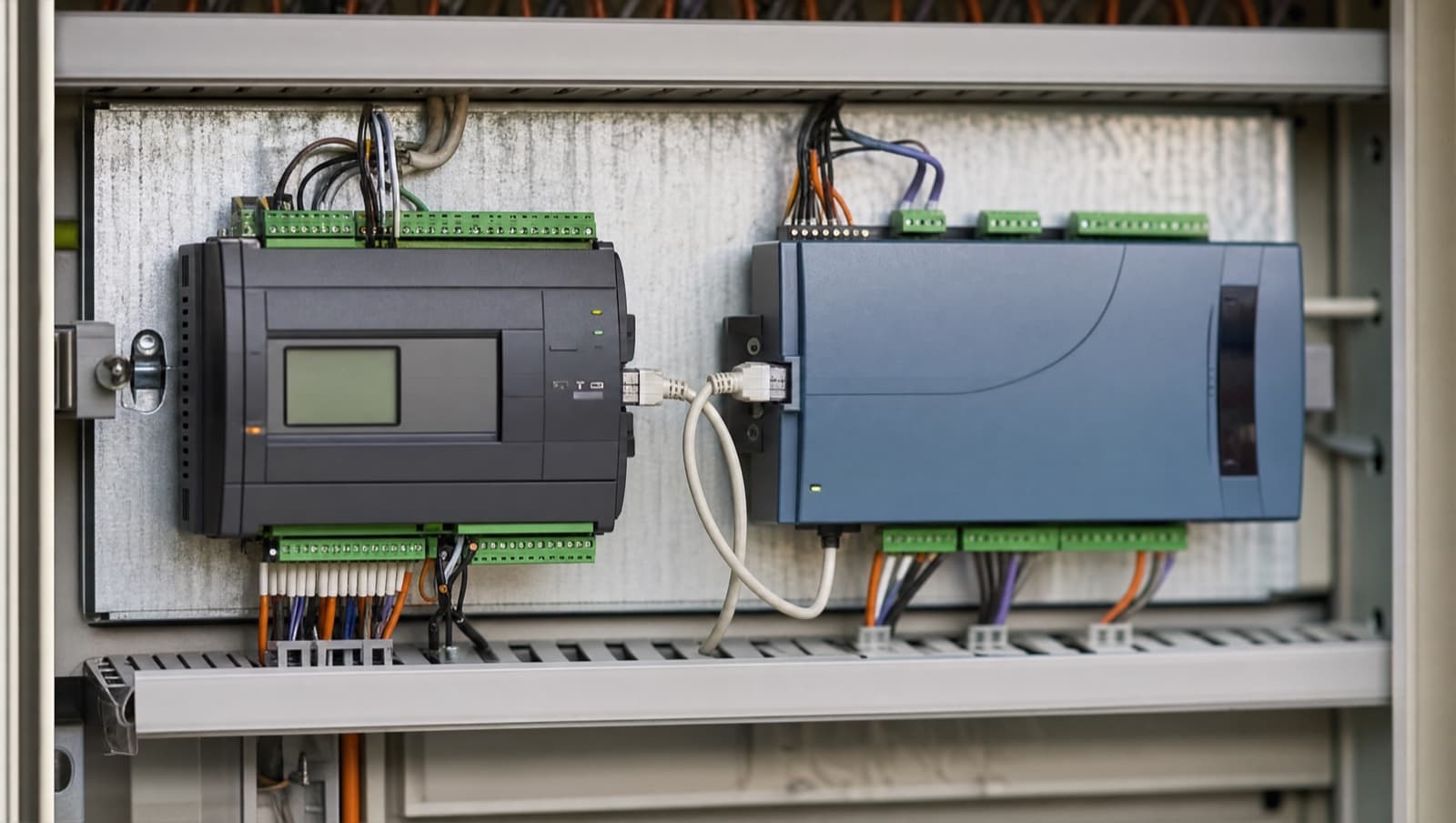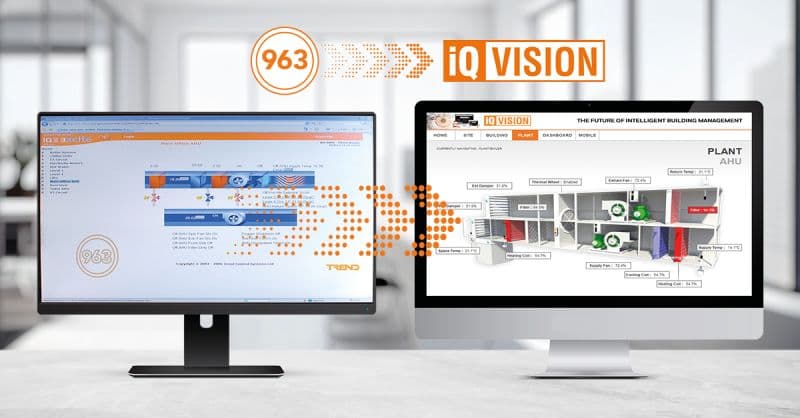

The Trend IQ3 controller range is discontinued — no longer manufactured, with Honeywell product support running down. That does not mean every IQ3 needs ripping out. IQ3 controllers connect natively to a modern IQVISION supervisor, and a survey-led, phased migration typically costs £1,500–£3,000 per controller actually replaced — not a wholesale rip-and-replace bill.
If you look after a building fitted out any time from the early 2000s to the early 2010s, there's a fair chance the plant is running on Trend IQ3 controllers. And somewhere in the last year or two, somebody — a maintenance contractor, a consultant, a salesperson — has probably told you they're "end of life" and quoted you a number that made your eyes water. We see the fallout from those conversations constantly: building owners scared into wholesale replacement programmes they don't need, and, at the other extreme, estates left to limp along on failing hardware until a controller dies mid-January with no spare on the shelf. Both outcomes are avoidable. This guide explains what end of life actually means for the IQ3, which controllers genuinely need replacing, and how to phase the spend so obsolescence stays a planned line in the budget rather than an emergency.
Is the Trend IQ3 discontinued?
Yes. Trend Controls — part of Honeywell Building Technologies — no longer manufactures the IQ3 range, and Honeywell's own product listings mark the IQ3 web-enabled controller as discontinued, with product support continuing only for a limited published period. The IQ3 had a long run: launched in the early 2000s, it was the mainstream Trend controller for the best part of a decade, and there are thousands of UK buildings still running on it today. Discontinued doesn't mean the controllers stop working — an IQ3 that's been running your AHUs faultlessly for fifteen years will carry on doing exactly that. What changes is everything around it: no new units, a shrinking spares pool, and a support clock that is already counting down. BMS outstation controllers typically give 15–20 years of service before genuine obsolescence — withdrawn spares, firmware and programming-tool support — catches up with them, and the earliest IQ3 installations are past that point now.
The specific dates matter when you are building a replacement programme. Our Trend controller end-of-life register lists the published withdrawal date for each withdrawn IQ controller alongside the suggested replacement, and works the support position out from Trend's stated policy intervals — regular security updates ending 18 months after withdrawal, critical functionality fixes at two years, and the ten-year reasonable-endeavours commitment. On that basis every controller in the published withdrawal table, the IQ3XCITE and IQ3XACT XNC variants included, passed the ten-year point on 30 April 2026. Each row shows the source it came from and whether a date was published by the vendor or derived from the policy.
Trend IQ3 or Trend 963 — which end of life are you actually dealing with?
This trips people up constantly, so let's separate the two. The 963 Supervisor is the head-end — the software your FM team logs into. Trend withdrew all support, licensing and updates for the 963 in January 2025; that end of life is total and already in force, and the answer is a supervisor migration, covered in our Trend 963 to IQVISION upgrade guide. The IQ3 is a field controller — the hardware in the plant room and ceiling voids actually running the plant. Its end of life is a slower burn: discontinued manufacture, dwindling spares, but controllers that keep operating and, crucially, keep communicating with current Trend supervisors. Plenty of buildings face both at once, and the sequencing matters: the supervisor migration is urgent and self-contained, while the controller estate can usually be phased over several budget years behind it. If a quote bundles the two into one undifferentiated "system replacement" number, ask why.
Do all IQ3 controllers need replacing?
No — and this is the point most of the scare quotes skip. IQVISION, Trend's current Niagara 4-based supervisor, communicates natively with IQ3 controllers over BACnet or the Trend network. A sound IQ3 can sit under a brand-new supervisor and carry on running its plant, which is why a supervisor-first migration that retains the existing controller estate is the most cost-effective route for most buildings. What determines keep versus replace is condition and exposure, not the badge: a dry plant-room IQ3 with a stable strategy and healthy I/O is a keeper for now; an IQ3 in a hot riser that's already dropped comms twice this year, on a critical system with no spare available, is at the top of the replacement list. The honest answer comes from a controller-by-controller survey, not a blanket policy — the same retrofit-or-replace logic we apply to every legacy estate. On most IQ3 sites we survey, a phased plan replaces the worst third early and sweats the rest against a monitored risk register.
Get a Free BMS Survey
We'll assess your controls and provide a detailed quotation with energy savings estimates.
What goes wrong when IQ3 estates are left to fail
The failure mode we're called into most often isn't dramatic — it's a single controller dying and taking a floor's heating or an AHU with it, followed by the discovery that nobody can source a replacement IQ3 quickly. That's when the eBay-and-decommissioned-stock roulette starts: second-hand boards of unknown history, no warranty, and an engineer burning a day coaxing an old strategy onto them. Emergency replacements after a failure typically cost two to three times what the same work costs as a planned upgrade, because you're paying for reactive callout, expedited hardware and out-of-hours labour all at once. The other classic is the half-done migration: a new supervisor dropped on top of an ageing estate with no integration work, so the front end shows values but half the controllers are effectively running open-loop underneath it. Our obsolete BMS panel upgrade guide covers the warning signs in detail — the short version is that if spare processor boards are no longer available from the manufacturer, the clock is already running.
What is the IQ3 to IQ4 upgrade path?
The good news: Trend designed the current range to make this migration incremental rather than big-bang. Existing IQ3 control strategies can be imported into IQSET and converted to run on IQ4 controllers, so the control logic your building has been refined on for years doesn't get rewritten from scratch. Sensor and actuator wiring is not controller-specific — in most cases the existing field wiring terminates straight onto the new controller, which matters because rewiring is typically 30–40% of the cost of a full installation. The IQ4 range (the IQ412 and IQ422 workhorses) brings native BACnet IP alongside MS/TP, far more memory and an onboard web server; the newer IQ5 adds IEC 62443-aligned cybersecurity and — usefully for phased work — I/O bus support that lets it work with existing IQ3 I/O modules during migration. If you're specifying new controllers anyway, it's worth reading our comparison of Trend IQ4 vs Distech ECLYPSE before defaulting to like-for-like: staying Trend keeps the strategy-conversion advantage, but it's a decision worth making deliberately rather than by inertia.
How much does a Trend IQ3 upgrade cost?
Realistic UK numbers, based on what we quote week in, week out. Replacing an individual IQ3 with an IQ4 typically runs £1,500–£3,000 per controller including programming and commissioning. A supervisor-only migration to IQVISION that retains the existing IQ3/IQ4 estate typically lands between £8,000 and £25,000 depending on controller count and graphics complexity. A full controller replacement across a medium commercial building — 10–20 controllers, 500–1,000 points — sits in the £80,000–£200,000 bracket, which is exactly why phasing matters: spread over three annual phases, that becomes £30,000–£70,000 per phase, prioritised by risk. Occupied-building retrofit work runs 20–40% above new-build rates once survey time, legacy removal and access constraints are priced in — our guides to BMS retrofit costs and BMS installation costs break the drivers down. If you're a QS or consultant building a cost plan around an IQ3 estate, the per-point method in our BMS cost-per-point guide is the defensible way to carry the allowance.
Standards, MEES and why ageing controls are becoming a compliance problem
Two standards frame what an IQ3-era estate is measured against. CIBSE Guide H — the UK reference for building control systems — specifies the sensor accuracy good control depends on (0.6 K over the 15–25°C range is suitable for zone air temperature measurement), and commissioning to Guide H is the benchmark any replacement controller should be handed over against. BS EN ISO 16484-5 defines the BACnet protocol that both the IQ3 (MS/TP) and its IQ4/IQ5 successors (IP and MS/TP) implement, which is precisely what makes phased, mixed-generation estates workable — old and new controllers holding a conversation under the same open standard. The regulatory backdrop is tightening too: under the MEES trajectory, privately rented commercial buildings over 1,000 m² are expected to reach EPC B by 2031 where cost-effective, and a control estate that can't hold setpoints, log plant performance or support proper optimisation is a direct drag on the rating. An IQ3 estate that was compliant on day one isn't exempt from where the bar is moving.
A real one: 16 floors of fan coils on a live Trend estate
The Pinsent Masons project is the shape of most IQ3-era upgrades we deliver: a 16-floor office FCU upgrade on Trend controllers, integrated with LightFi occupancy data, with weekend-only access because the floors stayed occupied throughout. That last constraint is the one that actually drives the programme on jobs like this — the controls work itself is well-understood, but every floor had to be surveyed, stripped, terminated, downloaded and proven within access windows, with the building handed back running every Monday morning. It's exactly why we phase controller replacement floor-by-floor and system-by-system rather than proposing a shutdown-everything programme: on a live building, the migration plan matters more than the hardware. The strategy conversion path from IQ3-generation logic onto current controllers is what makes that phasing clean — each floor cuts over individually, and the rest of the building neither knows nor cares.
What good looks like: managed obsolescence, not emergency replacement
A well-run IQ3 estate in 2026 looks like this. There's a current, controller-by-controller asset register: model, location, condition, strategy backup status, spares exposure, criticality of the plant it serves. The supervisor is current — IQVISION or equivalent — so the front end, alarming and logging are modern even where field hardware isn't. Every strategy is backed up off the controller, because the worst version of an IQ3 failure is one where the logic dies with the hardware. There's a phased replacement plan, budgeted over two to four years, that replaces controllers by risk rather than by age alone. And the documentation and software access sit with the building, not locked up with a contractor — no proprietary lock-in, full client access. That's managed obsolescence: the IQ3s that remain are a known, monitored, deliberate risk rather than a surprise waiting in a ceiling void.
When should you act on an IQ3 estate?
Now, if any of these apply: you're still on a 963 supervisor (that end of life has already happened); you've had an IQ3 failure in the last twelve months; you have no strategy backups; or nobody can tell you how many IQ3s the building actually has. The economics are blunt — planned replacement at £1,500–£3,000 per controller versus emergency replacement at two to three times that, plus the downtime. A survey costs a fraction of either and turns the whole question from anxiety into a costed, phased programme. The buildings that get caught out are never the ones with old controllers; they're the ones with old controllers and no plan.
Talk to us before the scare quote wins
The IQ3 reaching end of life is real, but it's a planning problem, not an emergency — and it's certainly not a reason to sign off a wholesale replacement quote unchallenged. Alpha Controls engineers are Trend-trained on IQ3, IQ4, IQ5 and IQVISION. We survey IQ3 estates across London and the South East, tell you which controllers can stay, which need to go and in what order, and put fixed prices against each phase. Get in touch or request a survey and quote — the honest version of the end-of-life conversation costs you nothing.
Alpha Controls Team
Specialist BMS installation, commissioning, and maintenance across London and the South East. SafeContractor Approved, BCIA Member.