Fault detection and diagnostics (FDD) software checks BMS data against engineering rules and flags plant that is running wrong. On a Trend system it can run inside IQVISION, which includes 25 analytic points, or on a cloud platform. Few vendors publish prices. In US studies, staff time costs more each year than the software.
Most buildings already log enough data to show where energy and comfort are being lost. Nobody looks at it until a tenant complains or something trips. Fault detection and diagnostics software is built to close that gap, and much of it is now sold as AI.
The options vary a lot in cost, in what they actually do, and in how much work they create for whoever runs the building. This guide covers the platforms, what the published figures say about cost and savings, what engineers who use it say, and when it is worth paying for. For the background on bolting analytics onto Trend controllers, see our guide to adding fault detection to an existing Trend IQ system.
Which fault detection and diagnostics software works with an existing BMS?
These are the platforms that came up most in our research. Prices are shown only where the vendor publishes them. Check UK support and Trend experience with each vendor before you shortlist.
| Option | How it gets the data | Where it runs | Published price | Worth knowing |
|---|---|---|---|---|
| Niagara Analytics in Trend IQVISION | Inside the IQVISION station | On site | 25 analytic points included with every IQVISION licence; larger licences sized by analytic points | Nearly 50 predefined algorithms plus your own rules; can also adjust control strategies and setpoints; needs IQVISION v2.30 or later |
| Demand Logic | Their own connection to the BMS; the vendor says it is made in one visit of no more than 3 hours | Cloud | Not published | London-based; lists Trend among its integrations; CIBSE Journal reported in 2016 that Land Securities had trialled it on a Trend BMS |
| SkySpark (SkyFoundry) | Set up by the integrator; built around Project Haystack tagging | Edge device, local server or cloud; can be hosted by a partner | Not published | Rules engine sold through integrators, with several UK partners |
| Clockworks Analytics | Software gateway | Cloud | "An annual software subscription scoped to the equipment connected to the platform"; quoted per project | Rules-based diagnostics with machine learning and language models alongside |
| Baudrate AI Advisor | Runs on the Niagara supervisor, read-only | Your own AI provider account, or a local model | $600 a year (Lite: chat assistant, 5 library checks, 1 Niagara device); $2,400 a year (Standard: scheduled checks, out-of-hours alerts, up to 10,000 points) | AI provider account not included |
| Honeywell Connected Solutions | BACnet controller integration | Cloud (Honeywell Forge) | Not published | Launched June 2025; ask Trend whether it is offered for your building |
If you are replacing a Trend 963 with IQVISION, the first row is worth a look before anything else. Rule-based fault detection is already in the licence for 25 points, and the data stays on site. Our guide to upgrading a Trend 963 to IQVISION covers the supervisor side.
How much of FDD software is actually AI?
Clockworks Analytics describes its platform as "expert systems at the core, machine learning for asset inference, and large language models for document parsing and orchestrated workflows". In that design the diagnosis comes from engineering rules. Machine learning helps work out how the equipment is related, and the language models handle documents and workflows. Baudrate's AI Advisor uses a large language model to read the Niagara station and run checks on it; scheduled checks need its Standard tier.
Check whether the platform only reads your data or can also write to it. Niagara Analytics can adjust setpoints and control strategies, and some cloud products write back to controllers too. Decide at the start whether you want that, and get a written sequence for any point a platform is allowed to change. Our article on what AI in a BMS actually delivers covers the wider picture.
How does BMS data get to an FDD platform on a Trend system?
On a Trend estate, the controllers decide the route. The IQ5 range (IQ500 and IQ528) is BTL-listed as BACnet Building Controllers, so an edge device can read them over BACnet/IP. The IQ4E has BACnet/IP as standard. IQ41x and IQ422 controllers, and IQ3s, only have it in their /BAC versions, factory-fitted or added by upgrade.
Controllers without BACnet can still be read over the Trend network. IQVISION's Trend driver reaches IQ1 to IQ5, IQECO and IQL controllers through virtual CNCs, so on an older system the supervisor is often the cleanest place to take data from, either into its own analytics or out to a cloud platform. That is a good reason to design the front end and the analytics together.
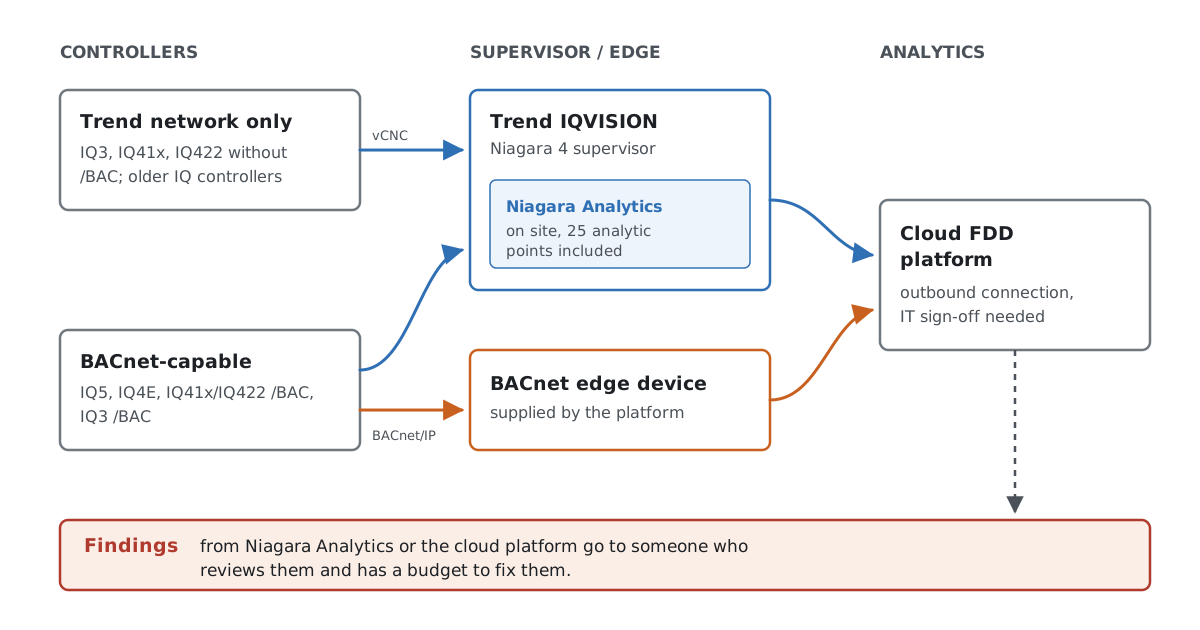
Figure 1. Three routes from a Trend BMS to FDD software. Trend-only controllers reach analytics through IQVISION. BACnet-capable controllers can also be read by a platform's own edge device. Either way, the findings need an owner.
Point names need checking too. FDD rules work on tags, and a strategy written fifteen years ago with labels like "S12 T" has to be tidied before any platform can make sense of it. Ask early where the data will be hosted, who owns it, and whether the building's IT team will open the outbound connection a cloud platform needs.
Book a BMS Survey
We'll assess your controls and provide a detailed quotation.
How much does fault detection and diagnostics software cost?
Few vendors publish prices, and most public figures are American. Treat them as a guide to scale.
Researchers at Lawrence Berkeley National Laboratory (Lin, Kramer and Granderson, Building and Environment, 2020) collected costs from 27 FDD users. The median cost of software installation and configuration was $8 per monitoring point, with $2.70 per point per year for software and $8 per point per year for labour, in-house or contracted. The median implementation was about 1,300 points, and the median number of buildings was six. Per building, the medians were about $12,500 to install and configure, $4,000 a year for software and $15,000 a year for labour. Labour is the largest recurring cost.
Nexus Labs' FDD buyer's guide puts subscriptions at $0.22 to $1.29 per m² per year, plus a one-off setup of $0.32 to $1.08 per m². For a 5,000 m² building that is $1,100 to $6,450 a year, plus $1,600 to $5,400 to set up.
At the low end, Baudrate's AI Advisor Lite is $600 a year, plus your own AI account. In IQVISION, the first 25 analytic points come with the licence.
None of these prices cover the engineering: surveying the points, replacing faulty sensors, renaming the strategy so the rules can read it, and acting on what the platform finds. Budget for that from the start.
Does FDD software save energy?
The same 2020 study found median energy savings of 8% across 26 organisations and 550 buildings using FDD. LBNL's Smart Energy Analytics Campaign report (Kramer et al., 2020) found that, after two years, FDD users (18 organisations, 509 buildings) had median savings of 9%, against 3% for organisations using energy information systems.
Those figures come from organisations that kept using the software.
What do engineers say about FDD software?
In a thread on r/BuildingAutomation in November 2026 about what building analytics has actually delivered, one engineer wrote: "#1 issue I've always run into with FDD applications for customers is the lack of support from their BMS/mechanical providers to actually repair or improve on the issues the analytics finds." Another said: "I have yet to see a meaningful, impactful, or a deployment the customer actually wants and likes." A third named the practical blocker as "working with IT getting correct ports open".
Plan around the first comment. Someone has to own each finding and have a budget to fix it, or the platform turns into another screen of alarms.
Is fault detection required by building regulations in England?
Approved Document L, Volume 2 (2021 edition incorporating 2023 amendments), paragraphs 6.66 and 6.67. In England, a building with a space heating or air-conditioning system with an effective rated output over 180 kW should have a building automation and control system (BACS). This applies to new buildings and where a BACS is replaced or installed in an existing building. Paragraph 6.69 explains how effective rated output is worked out. Paragraph 6.72(c) lists, among the functions the BACS should be capable of: "Benchmarks the building's energy efficiency, detects losses in efficiency of heating, ventilation and air conditioning systems, and informs the person responsible for the facilities or building management about opportunities for energy efficiency improvement." The document never uses the words "fault detection", but that is close to what FDD software does. The 2026 edition keeps the 180 kW threshold, renumbered as paragraphs 5.76, 5.77 and 5.84. It takes effect on 24 March 2027, or 24 September 2027 for higher-risk building work.
BS EN ISO 52120-1:2022. This replaced EN 15232-1 and lists the building automation functions that contribute to energy performance. Function 7.3 is "detecting faults of technical building systems and providing support to the diagnosis of these faults". The 2021 Approved Document L notes that a BS EN 15232 Class A system meets the paragraph 6.72 requirements; the 2026 edition points to BS EN ISO 52120-1 Class A.
ASHRAE Guideline 36. The ASHRAE guideline for high-performance HVAC sequences sets out automatic fault detection for air-handling units, with 15 defined fault conditions for VAV air-handling units. It is a useful checklist when a vendor says their platform detects AHU faults. Ask which conditions it covers.
Approved Document L is free on GOV.UK. If you are replacing a supervisor on a large system, check it at design stage.
Is it safe to connect a BMS to an analytics platform?
In July 2025 Nozomi Networks published 13 vulnerabilities in the Tridium Niagara framework, which IQVISION runs on. Nozomi said they were "fully exploitable if a Niagara system is misconfigured, thereby disabling encryption on a specific network device", and an attacker needed access to the same network. The US National Vulnerability Database lists versions before 4.10u11, 4.14u2 and 4.15u1 as affected.
Any project that adds remote access or a cloud connection should specify a patched release, keep encryption on, and keep the software maintenance agreement current so updates keep coming. Read-only connections, a separate network for the BMS and IT sign-off of the outbound connection belong in the specification. AI assistants that send data to a cloud language model, or alerts through a messaging app, add another route out of the building that IT should approve. The NCSC guidance on operational technology is a good starting point, and our BMS cyber security guide covers the building controls side.
Example: a 963 replacement with fault detection on top
Take a Trend site that still runs a 963 supervisor, which Trend announced it would stop supporting at the end of 2024, where fault detection is wanted as part of the upgrade. Start with a survey. Which controllers are in the plant rooms? How many points are there, what is already logged and how is it named? Are the controllers BACnet-capable or Trend-only?
The answers decide the design. Trend-only controllers point towards analytics in IQVISION, or a cloud platform fed from it. BACnet-capable IQ4s and IQ5s can also be read directly by a platform's own BACnet device. Agree the maintenance side at the same time: someone reviews what the platform flags every month and gets it fixed. Our guide to BMS maintenance contract costs shows how that cover is usually priced.
When is FDD software worth it, and when isn't it?
It is usually worth it when:
- someone, in-house or under a maintenance contract, will review the findings and has a budget to fix them
- the BMS controls enough plant for faults to cost real money: central air handlers, chillers, boilers or heat pumps
- you are already replacing the front end or controllers, so point naming and sensor checks happen in the same job
- you need to show operational energy performance as well as design ratings
It is probably not worth it yet when:
- nobody owns the findings
- the sensors and point names are poor and there is no budget to sort them
- the building is small with simple plant, where a good planned maintenance visit and the 25 analytic points in IQVISION may cover it
- the platform wants to write setpoints and you cannot get a written sequence for every point it touches
Getting fault detection right
Fault detection and diagnostics software earns its cost when it is part of how the building is run. On a Trend system, start with the data: what the controllers hold, how it is named and how it will get out. Then choose the platform, and decide who acts on the findings before you sign a subscription. If you are replacing a 963 or looking at analytics on an existing Trend BMS, talk to us. We will quote a survey visit and tell you which route fits.
Alpha Controls Team
Specialist BMS installation, commissioning, and maintenance across London and the South East. SafeContractor Approved, BCIA Member.