
BMS commissioning is the phase that proves every controlled device, control strategy and alarm performs as designed, while graphics build the operator interface. Done properly it transforms a building's energy performance and gives the FM team genuine operational insight; done badly it generates false alarms, confusing dashboards and a maintenance contract that costs more than it should.
You can have the best controller hardware on the market, panels built to aerospace standards, and wiring that would pass any inspection — but if the commissioning is rushed and the graphics are an afterthought, the FM team gets a system they don't trust, don't understand, and eventually stop using. That's not a BMS. That's an expensive collection of hardware doing nothing useful. Commissioning is where the control strategies come alive, the alarms get configured, and the operator interface gets built.
What does BMS commissioning actually involve?
Commissioning is the systematic process of verifying that every controlled device operates as specified, every control strategy performs as designed, and the complete system works as an integrated whole. CIBSE Commissioning Code M sets out the framework: commissioning is not testing (which verifies individual components), and it's not snagging (which identifies defects). It's the process of proving that the system delivers the performance the client was promised.
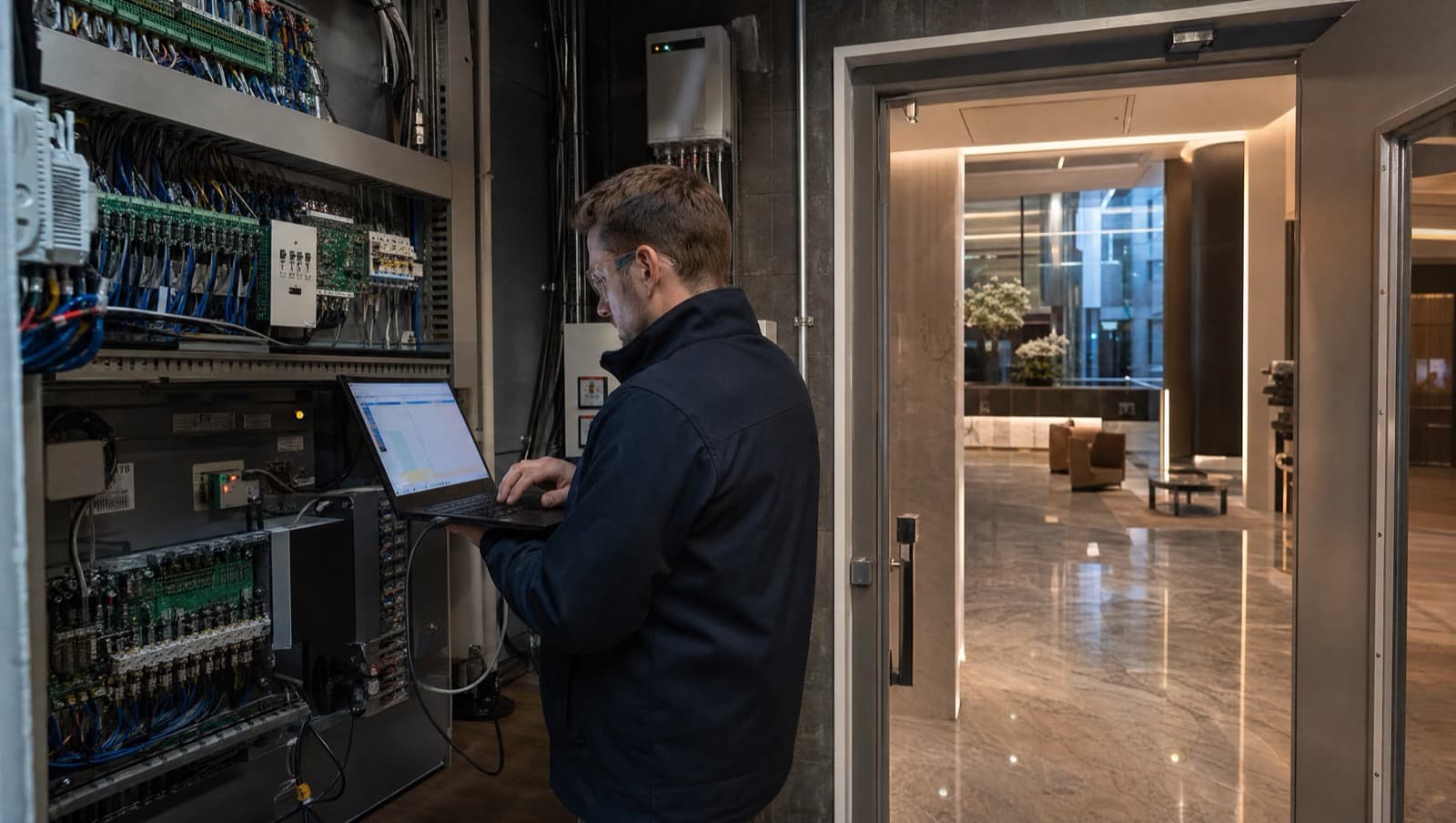
At Alpha Controls, commissioning follows a structured sequence. We start with individual controller checkout — verifying that every I/O point on every Trend IQ4E controller reads the correct value, responds to the correct range, and drives the correct output. A Pt1000 temperature sensor connected to an analogue input should read within ±0.5K of a calibrated reference instrument. A 0–10V valve actuator should stroke smoothly from fully closed to fully open when driven from the controller output, with the correct signal-to-position relationship. A fan contactor should switch reliably from the digital output, and the run status feedback should change state within the expected time delay.
Once every individual point is verified, we move to strategy testing. This is where the control software — the application strategy loaded into the IQ4E — gets exercised under real conditions. For an AHU, that means testing the heating and cooling sequences, verifying that the mixed air dampers modulate correctly in economy mode, checking that the frost protection strategy actually cuts the fan and opens the heating valve when the frost stat or low-limit sensor is triggered, and confirming that the fire mode strategy responds correctly to a fire alarm input by closing the dampers and stopping the fan.
BSRIA BG 11/2010 — the Soft Landings framework — recommends that commissioning includes seasonal testing where practical, so the system is verified in both heating and cooling modes rather than just the mode that happens to be active on commissioning day. This is particularly important for changeover systems where a procedural error during seasonal switchover can leave a building with no heating in January or no cooling in July.
How are BMS control strategies written and configured?
The control strategy is the software logic that tells the controller how to respond to changing conditions. For a Trend IQ4E, strategies are written in Trend's SET (Strategy Edit Tool) or the newer 963 Supervisor's built-in strategy editor. The strategy defines everything from basic PID loop parameters to complex cascaded control sequences, time schedules, optimum start calculations, and conditional logic for plant sequencing.
A well-written strategy is readable, maintainable, and does exactly what the cause-and-effect documentation says it should do. A badly written strategy is opaque, fragile, and full of hard-coded values that nobody remembers the purpose of three years later. We've taken over systems where the strategy has conditional branches that test for conditions that can never occur, PID loop parameters that were clearly left at default values (proportional band of 100%, integral time of zero — a recipe for oscillation), and time schedules that still have the commissioning engineer's test schedule loaded instead of the client's actual occupancy pattern.
Approved Document L (2021) requires that the BMS provides optimum start/stop functionality, which adjusts the plant start time based on external temperature and building thermal mass. The Trend IQ4E has a built-in optimum start module, but it needs to be properly configured with the right parameters for the building — the thermal response time, the target temperature, and the acceptable pre-heat period. If these are left at defaults, the system either starts too early (wasting energy) or too late (delivering complaints from cold occupants at 9am).
How should BMS alarms be configured to avoid nuisance trips?
Alarm configuration is the most overlooked aspect of BMS commissioning, and it's the one that has the most direct impact on the FM team's day-to-day experience. A system with 500 alarm points, no prioritisation, and no dead-banding is a system that generates hundreds of alarms a day, most of which are nuisance trips or transient conditions that resolve themselves. The FM team learns to ignore the alarms, which means they also ignore the genuine critical alarm buried in the noise.
Good alarm configuration starts with a structured alarm philosophy. CIBSE Guide H recommends categorising alarms into at least three tiers: critical (requires immediate action — freezestat trip, fire mode, loss of communication), warning (requires investigation within a defined period — high space temperature, filter differential pressure approaching limit), and information (logged for trend analysis but doesn't generate an alert — outside air temperature, energy meter pulse count). Each alarm needs appropriate dead-banding — a high temperature alarm set at 25°C should not clear until the temperature drops to at least 24°C, otherwise the alarm will chatter on and off as the temperature oscillates around the setpoint.
Time delays are equally important. A supply air low temperature alarm on an AHU shouldn't trigger during the first five minutes of plant start-up, when the coil is still warming up. A fan status alarm shouldn't trigger within the first 10 seconds after a start command, because the contactor needs time to pull in and the auxiliary contact needs time to change state. These delays are basic commissioning parameters, but we regularly encounter systems where they haven't been set, resulting in a flurry of false alarms every morning when the schedules turn on.
Get a Free BMS Survey
We'll assess your controls and provide a detailed quotation.
What makes good BMS graphics and dashboards?
BMS graphics are the operator's window into the system. The traditional approach was static mimic diagrams — schematic representations of plant with dynamic values overlaid. The modern approach, particularly with Trend's 963 Supervisor and web-based platforms, is a combination of system overview dashboards, plant-specific detail pages, and data visualisation tools that let the FM team spot trends, compare performance, and investigate anomalies.
The key principle is that graphics should serve the operator, not impress the consultant. A beautifully rendered 3D isometric of the plant room looks impressive in a presentation, but it's useless at 7am when the FM manager needs to quickly identify which floor has a heating problem. Good graphics are clean, hierarchical, and fast to navigate. A site-level overview showing the status of every major plant item (running, stopped, fault, override) with colour coding. Click through to a plant-level page showing the AHU schematic with live values. Click through again to a detail page showing trend logs, setpoints, and alarm history for a specific controller.
Every graphic page should show the information the operator needs and nothing more. Display the supply air temperature, the setpoint, the heating valve position, and the cooling valve position on the AHU page. Don't display the PID tuning parameters, the network address, or the controller firmware version — those belong in the engineer's commissioning tools, not on the operator dashboard.
Trend's 963 Supervisor platform delivers web-based graphics accessible from any browser, which means the FM team can check the system from a tablet on site, a laptop in the office, or a phone on the commute. The dashboards can include trend graphs, energy consumption summaries, alarm lists, and KPI widgets. Getting these right at commissioning means the FM team actually uses the system from day one, rather than reverting to spreadsheets and manual checks within a month of handover.
What does a proper BMS handover include?
BSRIA BG 11/2010 makes the point that handover is not an event — it's a process. A good handover includes operator training (not a 30-minute walkthrough on handover day, but structured sessions covering system navigation, alarm response, schedule editing, and basic troubleshooting), as-built documentation (updated points schedules, schematic drawings, strategy printouts, network diagrams, and test records), and a defined aftercare period where the commissioning team remains available to fine-tune the system as the building settles into its operational pattern.
The documentation matters enormously. A BMS that's been handed over with accurate as-built drawings and a comprehensive operation and maintenance manual is a system that the FM team can manage, maintain, and adapt. A BMS that's been handed over with "the drawings are coming" is a system that will be an impenetrable black box within 12 months, and any future work — by Alpha Controls or anyone else — will take twice as long because the engineer has to reverse-engineer the installation before they can start work.
At Alpha Controls, we provide a complete handover package including all strategy printouts, graphics screenshots, alarm schedules, network architecture diagrams, test certificates, and a plain-English operating guide. We also offer a 12-month aftercare support period to cover seasonal commissioning, strategy tweaks, and any teething problems that emerge as the building transitions from construction to occupation.
What does a well-commissioned BMS deliver?
A well-commissioned BMS with properly designed graphics is a system that the FM team actively uses and trusts. The alarms that come in are genuine and actionable. The dashboards give real-time insight into building performance. The trend data enables proactive maintenance — spotting a valve that's sticking before it causes a comfort complaint, or identifying a boiler that's cycling excessively before the heat exchanger fails. The energy data shows whether the building is performing against its design target, and the time schedules can be adjusted without calling out a specialist engineer.
That's what commissioning and graphics are for. Not to tick a box on the handover certificate, but to deliver a building that performs, a team that's empowered, and a controls investment that pays for itself through energy savings and reduced reactive maintenance.
Ready for Commissioning?
If you're approaching the commissioning phase of a BMS project, or you've inherited a system where the commissioning was incomplete and the graphics are unusable, talk to Alpha Controls or request a quote. We provide full commissioning and graphics development services for Trend-based systems, including retrocommissioning of existing installations that were never properly set up. For the full picture of how a BMS project comes together, read our guides on consultation and energy audits and wiring and integration, or explore the complete Trend BMS guide.
Darren Pettit
Specialist BMS installation, commissioning, and maintenance across London and the South East. SafeContractor Approved, BCIA Member.