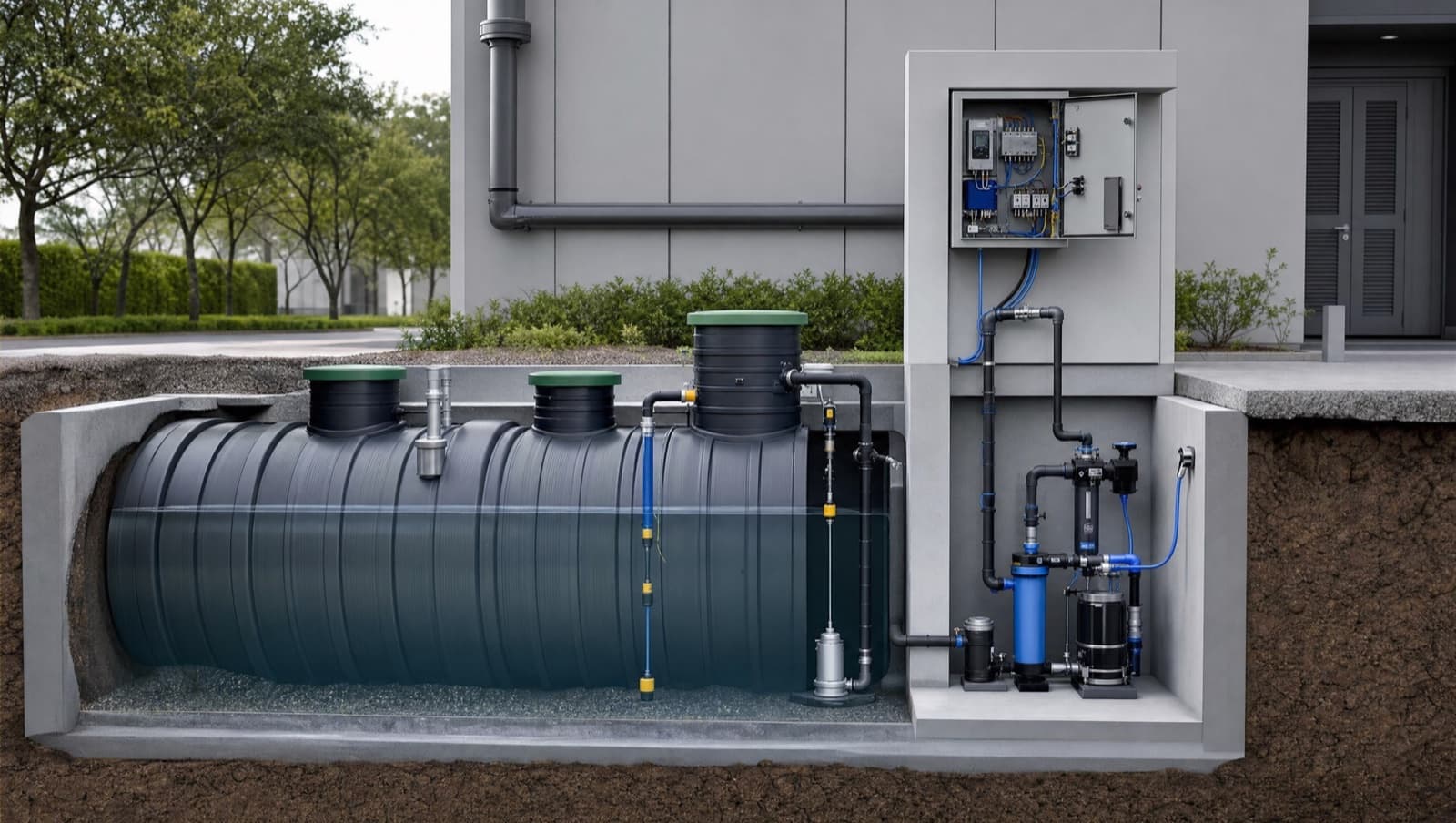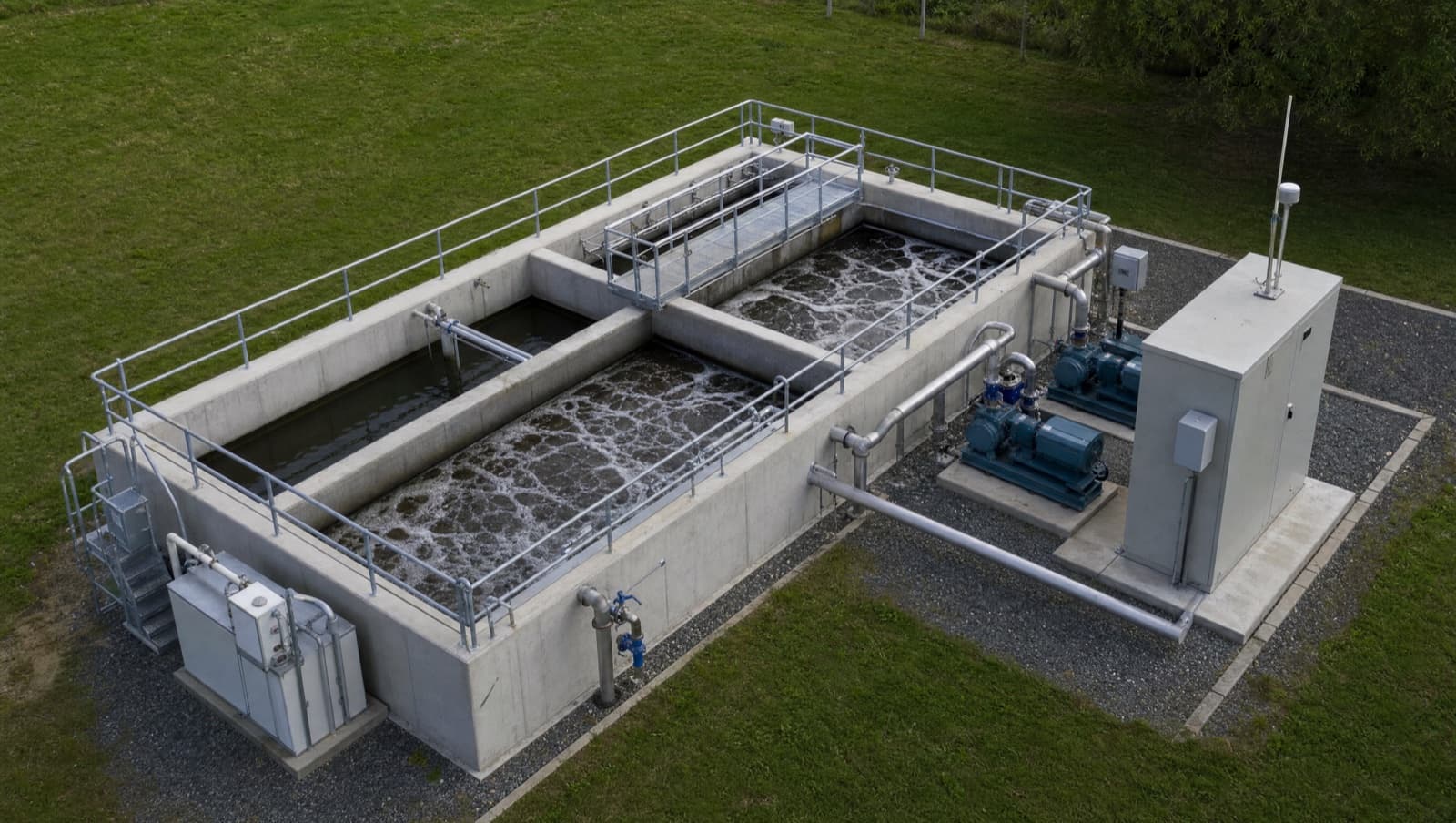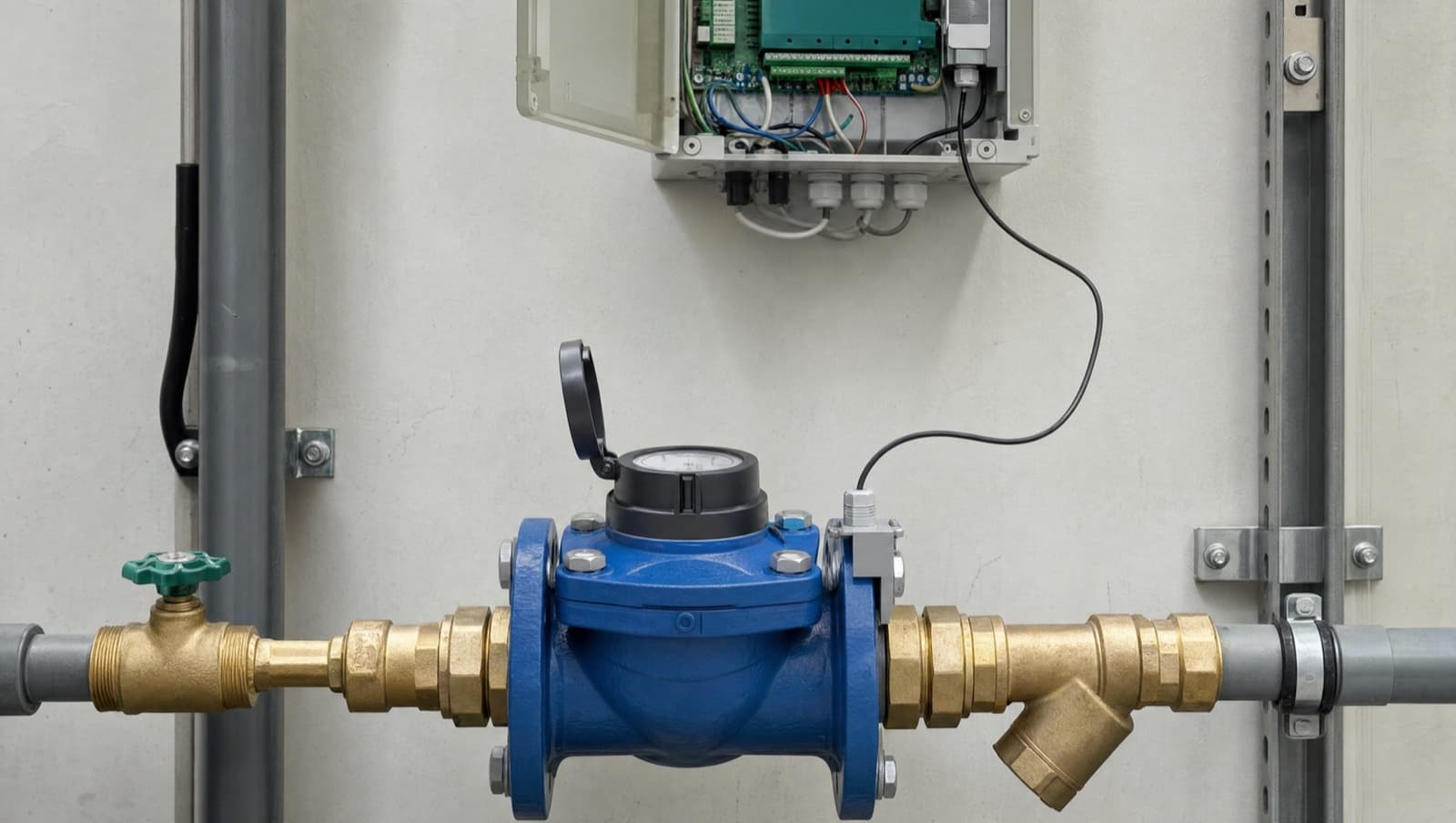

A cold water tank level sensor tells the BMS how much water is in a storage cistern. Most commercial installations use a two-level float switch wired to a digital input, giving high and low level alarms. Under the Water Supply (Water Fittings) Regulations 1999, Schedule 2, paragraph 16, every storage cistern needs a means of warning of impending overflow.
Cold water storage tanks are the most ignored plant in a commercial building. They sit in a roof room or a loading bay cupboard, behind a door that gets opened twice a year, and as long as water comes out of the taps nobody asks a single question about them.
Then a float valve sticks open at two in the morning, the overflow can't cope, and you find out where the water goes. Or the opposite happens — the inlet fails closed, the tanks draw down overnight, and the first anyone knows about it is a hotel full of guests with no shower and a duty manager who has run out of apologies.
Both of those failures are detectable hours before they become incidents. The detection itself is a float switch and a cable — technically trivial, and cheap. What it costs you depends almost entirely on where the tank sits in relation to the panel, which is a different question and the one this post keeps coming back to. The reason so many buildings still don't have it is not cost or technology — it's that the tanks were installed without level switches decades ago, and no refurbishment since has been the one that picked it up.
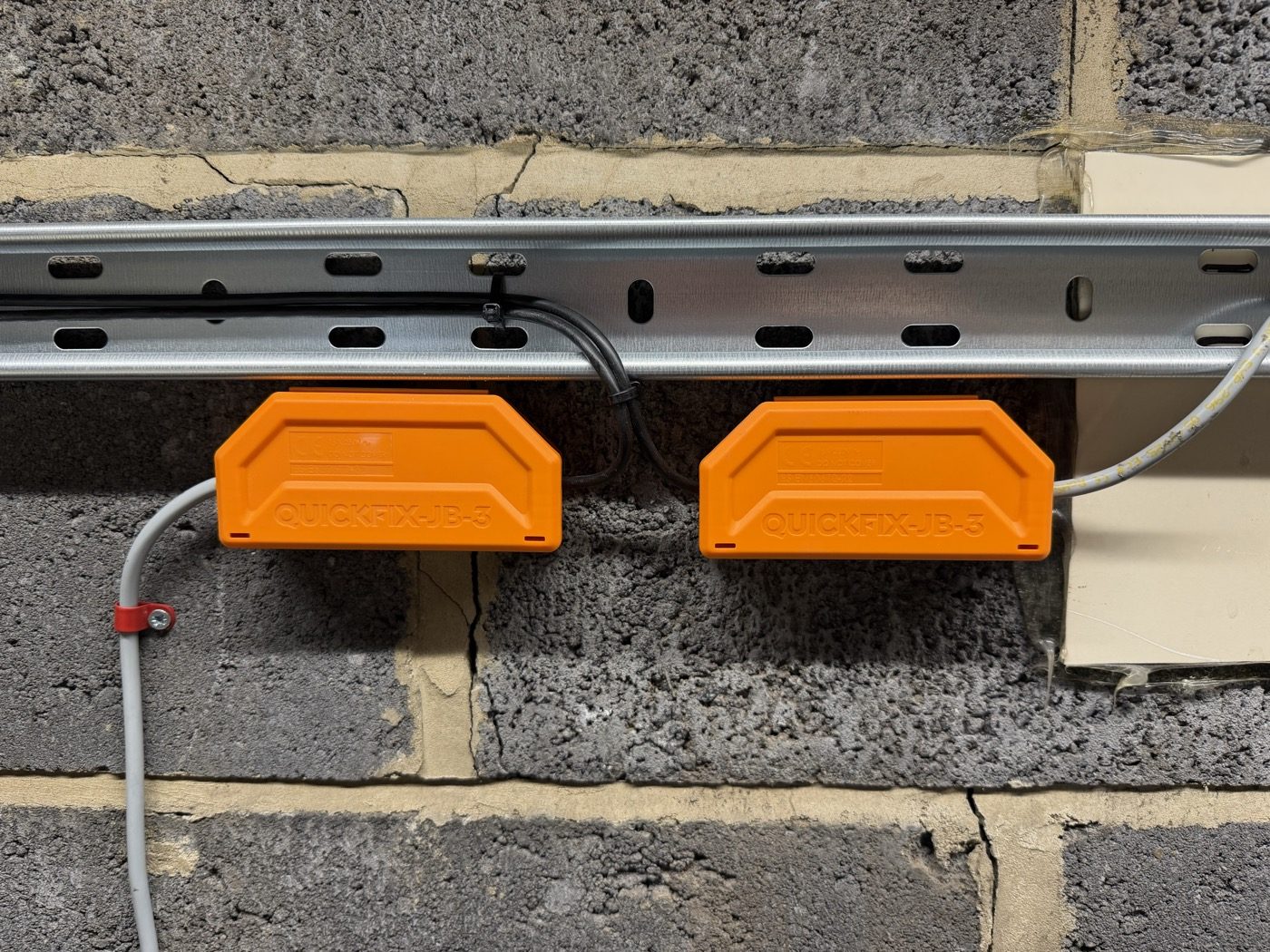
We fitted exactly this on a live hotel in Hertfordshire, and the job is a decent illustration of why the sensor is the cheap part and everything else isn't. More on that further down.
What is a cold water tank level sensor?
A cold water tank level sensor is a device that reports the water level inside a storage cistern to a control system — normally the building management system.
In commercial buildings what you will nearly always find fitted are float switches: a sealed, buoyant casing hanging on its own cable that tilts as the water surface rises and falls, operating a microswitch inside. They are volt-free contacts. They don't measure anything — they tell you the level has crossed a line, and which side of it you're now on.
A two-level (high/low) float switch gives you two of those lines from one device: a high alarm set below the overflow, and a low alarm set above the outlet. That is the standard specification for a storage cistern, and it's what we install unless there's a reason not to. Single low-level-only versions exist and are cheaper, but you lose the overflow warning, which is usually the failure that costs money.
The units we fitted on the hotel job are KARI Float Switches, made by Kari-Finn Oy of Lahti, Finland — a firm that has been building float switches since 1965. The alarm variant is type 2HL, high and low level alarm: three cores, carrying two alarm circuits that share a common. The float casing is 170 mm diameter polypropylene, rated IP 67, with a standard 5 m cable. The switching elements are rated 6–250 V AC, 6 A resistive, and SGS FIMKO — the Finnish electrical inspectorate — has approved the device under the Low Voltage Directive for use in non-flammable liquids at 250 V.
Continuous level sensors — ultrasonic, hydrostatic pressure, radar — give you an actual depth reading as an analogue value, typically 4–20 mA or 0–10 V. They're the right answer where you need to trend consumption, calculate remaining hours of storage, or control a fill pump proportionally. They are also more expensive, need an analogue input rather than a digital one, and give you more ways to be wrong. For a straightforward "tell me before it overflows and tell me before it runs dry", a float switch is the better engineering decision, not just the cheaper one.
Do cold water storage tanks legally need level monitoring?
Not in the sense of a regulation that says "fit a BMS level sensor". But the requirement that sits behind it is real.
The Water Supply (Water Fittings) Regulations 1999, Schedule 2, paragraph 16 requires that every pipe supplying water connected to a storage cistern is fitted with an effective adjustable valve capable of shutting off the inflow of water at a suitable level below the overflowing level of the cistern, and that every storage cistern is fitted with an overflow pipe, with a suitable means of warning of an impending overflow, which excludes insects.
Read that wording carefully, because it is more useful than it first looks. The Regulations require a means of warning — they do not prescribe what that means has to be. A high-level float switch reporting to the BMS is one perfectly good way of providing it. Industry guidance on the Regulations makes a related point about the inflow control, noting that on larger cisterns it may be a float switch operating an electrically actuated valve or pump rather than a simple float-operated valve. That is commentary on the Regulations rather than the text of them — the regulation itself names no switch, valve type or pump — but the duty it comments on is real, and a level sensor is one of the ways you discharge it.
The other driver is water hygiene. HSE guidance HSG274 Part 2, which sits under the ACOP L8 framework, sets the temperature control regime for hot and cold water systems: cold water should be below 20°C within two minutes of running the outlet, checked at sentinel outlets monthly, with cold water storage tanks inspected annually as part of the written scheme. The same guidance says stored cold water volume should be minimised and should not normally exceed one day's water use. Level monitoring isn't itself a legionella control — but a tank that is drawing down and refilling erratically, or an oversized tank that barely turns its contents over, is a stagnation and temperature problem, and level data is how you see it. BS 8558:2015 — the guide to the design, installation, testing and maintenance of services supplying water for domestic use within buildings — sits alongside BS EN 806 as the complementary UK guidance on the same systems.
The practical position: it isn't a tick-box legal duty, but if you are running a written scheme under L8 and you have no idea what your storage is doing between monthly visits, you are managing that risk blind.
Why tank level monitoring matters in a real building
The commercial case is not the sensor, it's the alarm arriving somewhere a human will see it.
For an FM provider, a high-level alarm is the difference between a mop and an insurance claim. Cold water storage is almost always at high level — roof plant rooms, tank rooms above occupied floors — so an overflow finds its way through several storeys of finishes before it reaches a drain. In a hotel or a serviced office, those are revenue-earning rooms taken out of service for weeks.
For a building owner or estates manager, low-level alarms are business continuity. Loss of stored water in a hotel, a care setting or a school is not an inconvenience, it's a closure. Even a short warning is usually the difference between isolating the problem quietly and explaining it to a floor full of guests.
For an M&E consultant or main contractor, tank level is two of the cheapest points on the points list and among the most frequently value-engineered out at tender stage — then written back in as a variation once the client's insurer asks the question. It's worth holding onto.
Tank level pairs naturally with leak detection and with booster set integration — the three of them together give you the whole cold water story from incoming main to outlet, and they usually share the same containment route.
Get a Free BMS Survey
We'll assess your controls and provide a detailed quotation.
What usually goes wrong with tank level sensors
There are no spare inputs. This is the one that decides the price of the job, and it's found at survey, not at quote. A digital input for a float switch costs nothing if the controller has one free. If it doesn't, you're adding an I/O module, which means panel space, a power supply that can take it, a controller with capacity on its bus, and configuration. The survey at this hotel covered two plant rooms and got two different answers. One panel had four spare digital inputs on an existing 8-channel module and needed nothing added. The panel these works later ran from had only two spare universal inputs, so the survey identified a four-input module as required there. Identified, not fitted — that module belongs to the connection and commissioning stage, which is still outstanding on this job. Same sensor, very different scope.
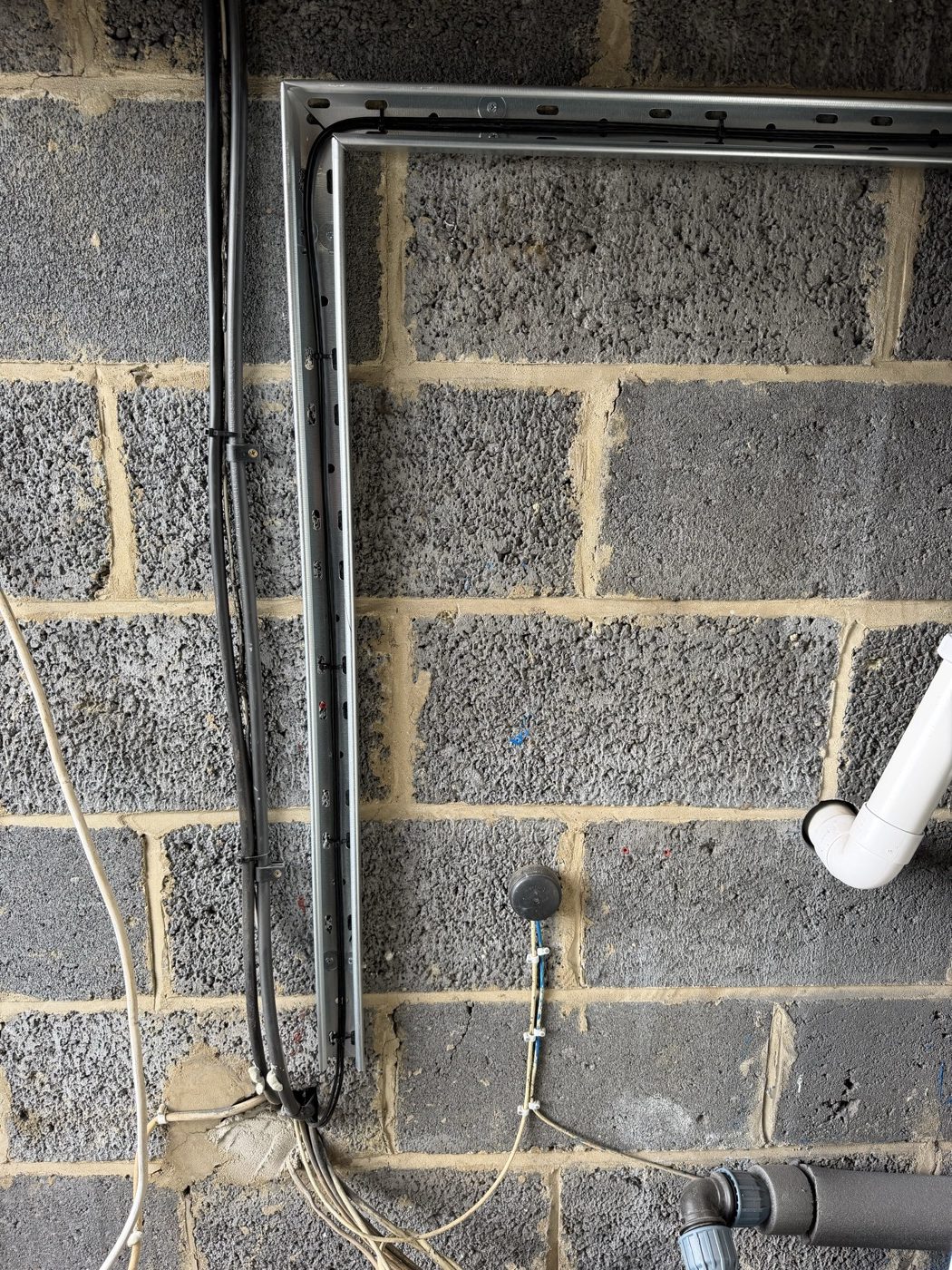
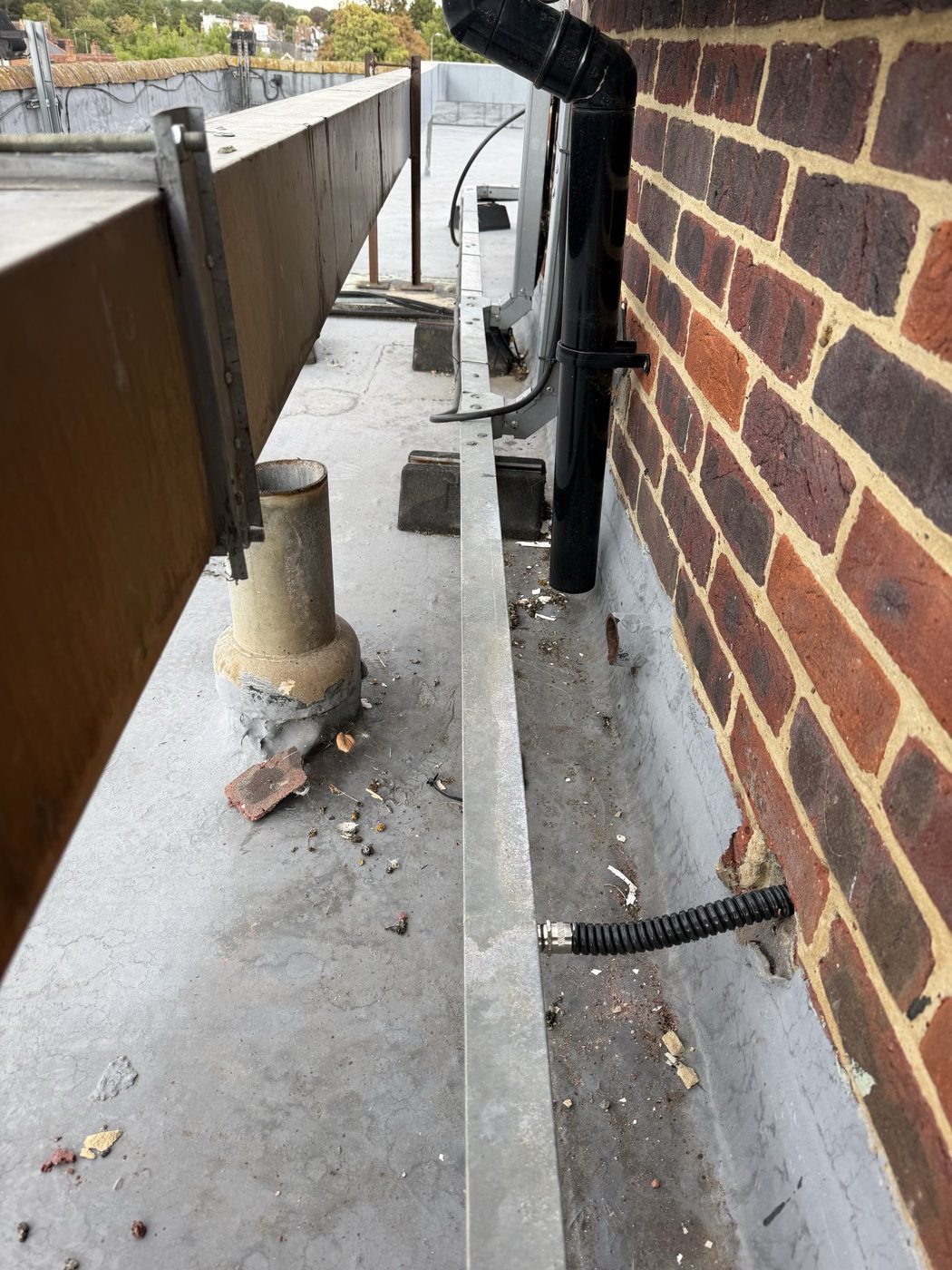
The cable run is the job. Storage tanks are never near the panel. On this job the tank room was roughly 50 metres of route from the rooftop plant room panel, and getting two four-core cables there meant new 20 mm conduit down a wall and across a ceiling, a Kopex connection through an existing roof penetration, a run through existing 50×50 mm rooftop trunking, and around six metres of new 50×50 mm tray inside the tank room itself. Two runs over that route came to around 120 metres of duct-grade cable installed — route length and cable length are not the same number, and it is the second one you pay for. The float switches were the smallest line on the delivery note.
The contacts are specified for the wrong duty. A float switch like the 2HL carries a mains rating — 6 A resistive at up to 250 V AC — because its bread-and-butter job is switching pumps and solenoid valves. A BMS digital input is the opposite duty: a few volts and a few milliamps. That is precisely why KARI's order codes include a gold-plated contact option rated 1 mA to 100 mA, and why the contact specification is worth settling at order stage — including checking that your supplier actually lists it — rather than discovering a marginal, intermittent point at commissioning. Note the rating's lower bound: 1 mA. Specify the input side so the contact is actually carrying current in that band rather than sitting below anything the manufacturer rates it for.
The differential is never set. This is the detail most installations get wrong, and it isn't about where the float hangs. On a KARI switch the height at which it hangs sets where it operates, but the switching differential — the gap between the operate and release levels — is set by sliding the cable weight along the cable, clamped with a wedge. On the standard product that differential is adjustable up to 1200 mm, and it is at its narrowest with the weight closest to the float — the manufacturer's manual puts the minimum-differential position at around 10 cm from the tip of the float's strain relief. Check the range against the manual for the exact unit you have, because the published lower bound differs between manufacturer and supplier documentation for these switches. Get that wrong and you either get an alarm that chatters every time the tank refills, or one so wide it clears only when the tank is nearly empty.
The float gets trapped. The manufacturer is explicit that the float must hang freely from its own cable and that the installation position must be chosen so it cannot catch under or sit on top of a structure, or foul anything else in the tank. GRP sectional tanks are full of internal ties and baffles. It's also why you don't tie the cable off near the float to a pipe or an ascension riser — it shortens cable life and stops the float doing its job.
The junction box gets put somewhere wet. Same manual, same section: keep the junction box in a dry environment, and if that isn't possible, protect the cable ends or use an IP68 box. A row of terminals sweating away above an open tank is a fault waiting for a damp winter.
The alarm goes nowhere. A point that sits on a graphic nobody opens is not monitoring. If there's no out-of-hours routing to a phone or an alarm receiving centre, the 2 a.m. failure is still discovered by the ceiling.
A real example: two GRP tanks, a rooftop tank room, and a building that never closed
An earlier site survey at a hotel we work on found what a lot of surveys find: in the rooftop tank room, two GRP cold water storage tanks, in service, feeding the building — and no level switches fitted to either tank. Nothing had failed. Nobody had asked. The building had simply never had the monitoring.
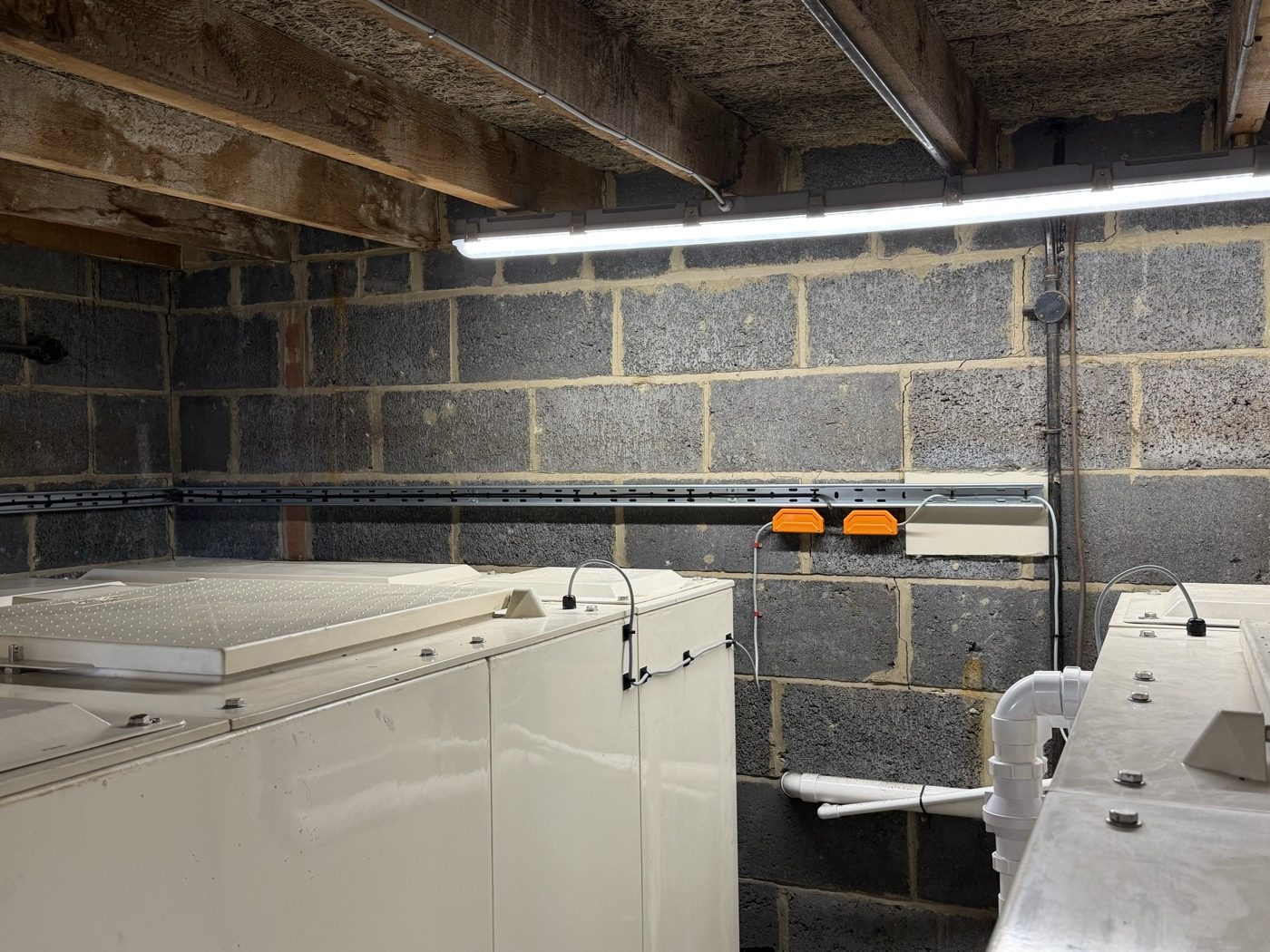
The remedial installation ran later, two of our engineers on site for the day, covering the rooftop plant room and the tank room. The scope was:
- Two runs of duct-grade four-core Belden cable from the rooftop plant room panel to the tank room. The route between the two is roughly 50 metres; by the time both runs had followed the containment, dropped down the wall, crossed the ceiling and been dressed in, around 120 metres of cable had gone in. Four cores to a three-core device, so there's a spare in each run.
- New 20 mm conduit from the existing plant room containment, down the wall, across the ceiling and down to the existing roof penetration, with Kopex through the penetration into the existing low-level 50×50 mm rooftop trunking.
- New 50×50 mm cable tray inside the tank room — roughly a metre vertically from the penetration, 2.5 metres across to the adjacent wall, then 2.5 metres around the back of the tanks.
- Two junction boxes mounted around 500 mm apart on the wall beneath the tray — dry side, off the tanks — with the Beldens and sensor tails terminated inside on lever connectors.
- Tank tops drilled and stuffing glands fitted, one KARI 2HL high/low float level switch installed into each tank.
The switches were set on site to the manufacturer's method — hang height for the operating levels, cable weight position for the switching differential, clamped with the wedge — with final confirmation of the levels against the design to be signed off at commissioning. Worth noting because "set the float" is not a single adjustment, and a switch that has only been hung has not been set.
What makes this one worth writing up isn't the containment — it's that the hotel never closed. There were live events running in occupied areas through the day. Everything that needed to be in the work areas was moved in beforehand, because a trolley of tray and conduit crossing a function room in use is not something you get to do twice. The rest of the day was managed the same way: noise controlled, routes planned, work areas kept tidy, materials moved when the building allowed it rather than when we wanted to.
That is the actual skill in hotel work, and it is not on any drawing. Anyone can pull a cable 50 metres. Doing it through a live building on one of the worst possible days for guest movement, and finishing the day with the venue's events untouched, is what the job is.
Current status, stated plainly: the containment, cabling and sensors are installed, and the cables are dressed and terminated ready for connection. Connection to the panel and commissioning of the points remain outstanding, and the float switches have not yet been functionally tested in service. The alarms are not live yet. We'll update this post when they are — the site got its first fix, not its finished system, and there's no point pretending otherwise.
What good tank level monitoring looks like
Good tank level monitoring is boring, and that's the point.
Two-level float switches in every storage cistern, hung with real headroom below the overflowing level and real margin above the outlet, and with the switching differential actually set rather than left where it came out of the box. Contacts specified for the duty they'll do — low-current BMS inputs, not pump starting. Volt-free contacts to digital inputs on the nearest controller with genuine spare capacity, confirmed at survey rather than assumed at tender. Containment that follows an existing route wherever possible, because new penetrations through a roof are the expensive and risky part. Proper glands into the tank, insect-proof, no compromise on the potable side. Junction boxes on a dry wall, not over open water. Points named on the graphic in language a duty manager understands — "Tank 1 High Level", not "DI 3-4".
And then the part that most installations miss: the alarm has a destination. Somebody's phone, an ARC, a monitored inbox. Tested at commissioning by actually lifting the float, not by forcing the point in software.
If the tanks are being touched anyway — a plant room refurbishment, a tank replacement, a pump room upgrade — that is the moment the level points cost almost nothing, because the access, the containment and the panel work are already being paid for.
When to act
Fit level monitoring when you're already in there. The marginal cost of two digital inputs during a wider project is a rounding error; the cost of the same two points as a standalone job is dominated entirely by containment and access, and can easily be many times the material value.
Bring it forward if any of these are true: your storage tanks sit above occupied or revenue-earning space; you have no out-of-hours cover on site; your written scheme under L8 relies on monthly visits and nothing in between; your building is a hotel, care setting, school or anywhere loss of water means closure rather than inconvenience; or you genuinely don't know whether your tanks have switches at all. That last one is more common than people expect — at the hotel above, nobody could say what was fitted to those tanks until an engineer was sent specifically to go and look.
The short version
A cold water tank level sensor is usually a two-level float switch, wired volt-free to a digital input, giving high and low level alarms on the BMS. The Water Supply (Water Fittings) Regulations 1999 already require a means of warning of impending overflow on every storage cistern, and HSG274 Part 2 puts your storage under a monitoring regime whether you have instrumentation or not.
The sensor is cheap. The cable route, the spare I/O and the tank entry are the job — and all three are decided at survey, which is why a survey that skips the tank room produces a quote that changes later.
Cold water tank level sensors: frequently asked questions
What is a cold water tank level sensor?
A device that reports the water level in a storage cistern to the BMS. In commercial buildings it is normally a two-level float switch giving volt-free high and low level alarm contacts, wired to digital inputs on a BMS controller.
Is tank level monitoring a legal requirement in England and Wales?
There is no regulation mandating a BMS level point specifically, but in England and Wales the Water Supply (Water Fittings) Regulations 1999, Schedule 2, paragraph 16 requires every storage cistern to be fitted with an overflow pipe, with a suitable means of warning of an impending overflow, which excludes insects. The Regulations do not prescribe what that means of warning has to be, so a high-level float switch reporting to the BMS is one way of providing it.
Float switch or continuous level sensor — which should I specify?
A two-level float switch for alarm duty, with high level below the overflow and low level above the outlet. A continuous sensor such as ultrasonic, hydrostatic or radar, with a 4-20 mA or 0-10 V output, only where actual depth is needed for trending, storage-hours calculation or proportional fill control. The float switch uses a digital input; the continuous sensor needs an analogue one.
How do you set the level on a float switch?
It is two adjustments, not one. The height at which the switch hangs from its cable sets where it operates. The switching differential, the gap between operate and release, is set by sliding the cable weight along the cable and clamping it with a wedge. On the standard product the differential is adjustable up to 1200 mm, narrowing as the weight moves closer to the float. Check the exact range against the manual for the unit you have.
Can level sensors be retrofitted without draining the tank?
Usually yes. The tank top is drilled and a stuffing gland fitted with the tank in service, and the float is lowered in and set to its operating level. The constraint is normally access and containment to the tank room rather than the tank itself.
Why is retrofitting tank level monitoring more expensive than the sensor suggests?
Because the cost sits in the cable route and the spare I/O. Storage tanks are rarely near a panel — a recent hotel installation needed around 120 metres of cable, new conduit, an existing roof penetration reused and new tray in the tank room. If the controller has no spare digital inputs, an additional I/O module, panel space and configuration are required before a single point can be created.
If you don't know whether your cold water storage is monitored, that's the question worth answering this month. Get in touch and we'll tell you what's actually fitted, or request a quote if you already know the answer is nothing.
Alpha Controls Team
Specialist BMS installation, commissioning, and maintenance across London and the South East. SafeContractor Approved, BCIA Member.