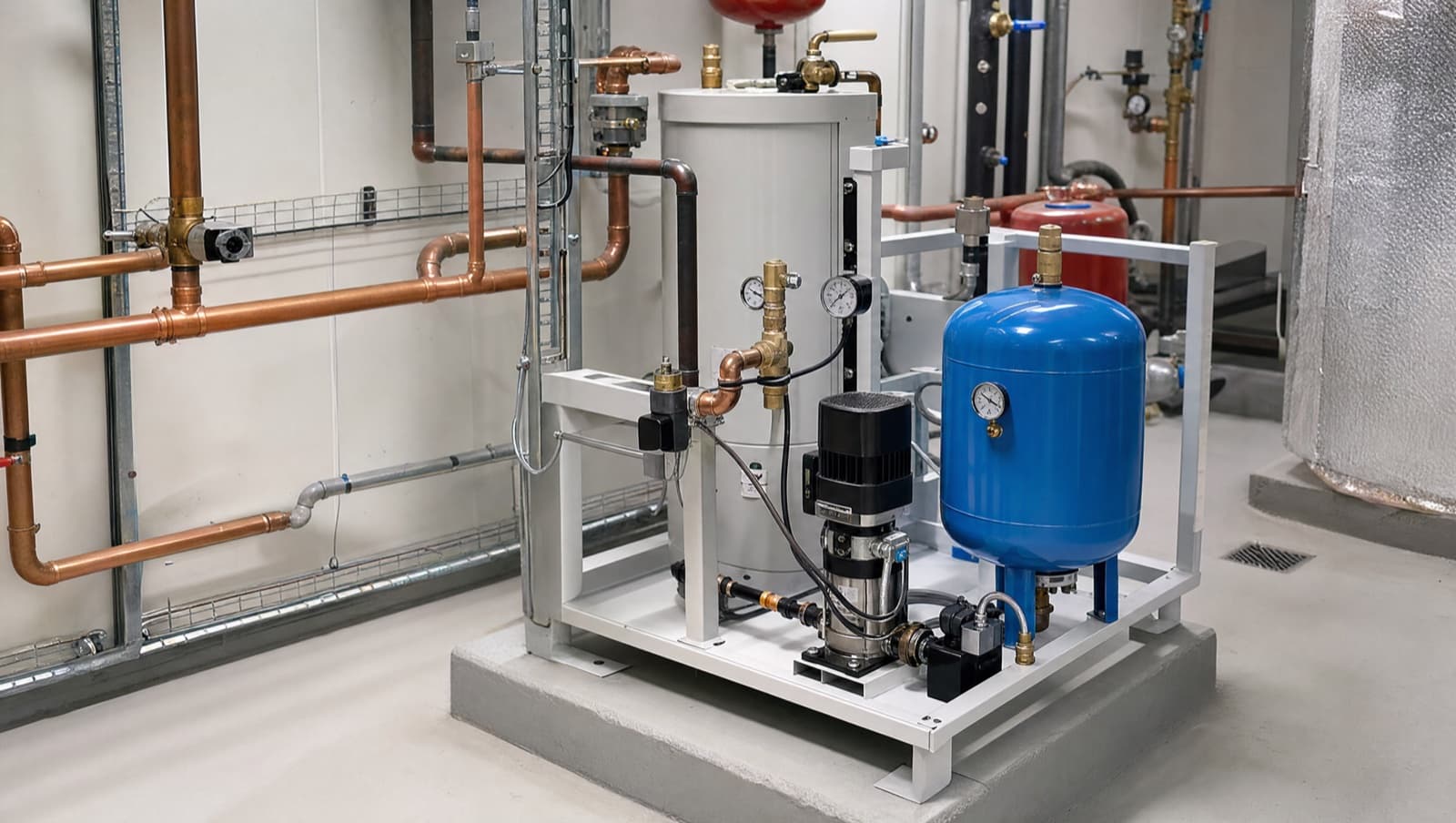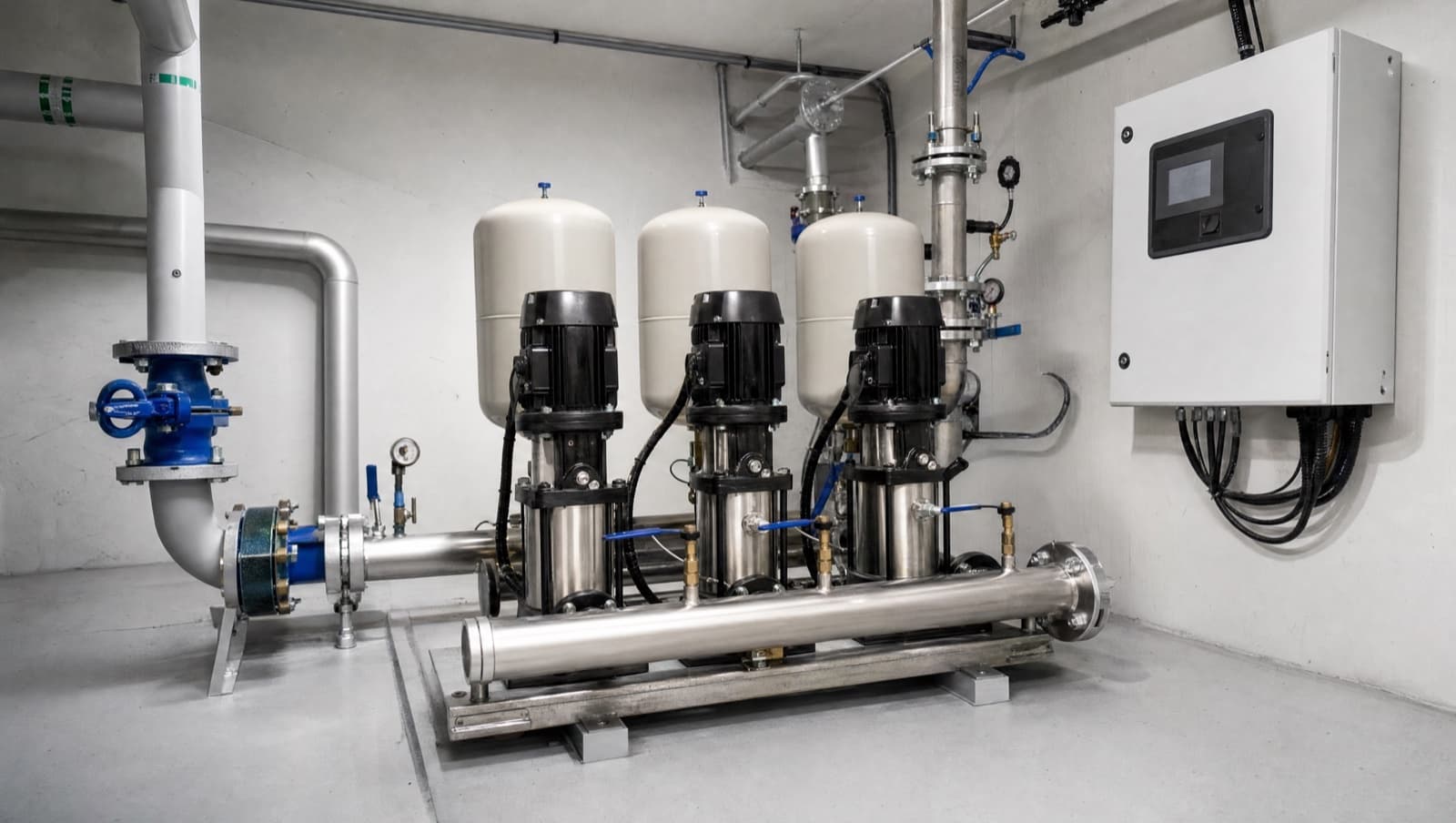

A plant room BMS is the control layer for everything mechanical in the building's engine room: it sequences boilers, stages chillers, drives pumps and AHU plant on variable speed, watches pressurisation, metering and leaks, and alarms before failures become outages. Controls integrated properly during plant work typically save 20–40% of HVAC energy, with payback in one to two years.
Walk into most commercial plant rooms and you can read the building's history in the panels: three generations of controls, a boiler cascade that half-works, a chiller that runs flat out because nobody trusts the staging, pumps at fixed speed because the VSDs were never wired back to anything, and a pressurisation unit whose only fault signal is the FM finding the heating off. Every element in that room can be controlled, monitored and protected by the BMS — and the gap between a plant room that is merely wired and one that is properly integrated is where most of a building's avoidable energy spend and most of its avoidable 2am callouts live. This is our complete guide to what a plant room BMS should be doing, element by element, with the UK figures we price against.
What does a plant room BMS actually control?
Everything with a motor, a burner, a compressor or a sensor. The heating plant: boilers, heat pumps, heating pumps, weather compensation and frost protection. The cooling plant: chillers, cooling towers, condenser water. Air handling plant and its dampers, fans and coils. Pump sets, booster sets and pressurisation units. Metering — heat, water and electricity. And the protective layer: leak detection, plant fault alarms, run-status monitoring and trend logging. The BMS ties them into one system with one front end, so the plant runs as a coordinated whole rather than a room full of independent boxes — the plant-room half of what a building management system does for the building overall.
Boilers and heating plant: sequencing is where the money is
Modern commercial boiler plant is typically a cascade of modular condensing boilers, and the BMS decides how many run, in what order, and at what flow temperature. Weather compensation — dropping the flow temperature as outside temperature rises — is the single most impactful boiler control strategy, because condensing boilers only condense when return temperatures are low enough. Add optimum start, proper sequencing to balance run hours, and lockout/fault monitoring per boiler, and the heating plant stops being the building's quiet money pit. Heat pumps change the details but not the principle: they reward low flow temperatures and stable control even more strongly, which is why we cover heat pump BMS integration and heat pump performance monitoring — watching delta-T and COP rather than just run status — as their own disciplines. And because heating plant lives alongside pipework that freezes, trace heating and frost protection belong on the same system: a burst pipe costs £10,000–£50,000 in damage against a few hundred pounds of monitored protection per zone.
Chillers and cooling plant: staging, setpoints and free cooling
Chilled water plant rewards the same discipline. Leaving-water setpoint sits at 6°C or 7°C on most UK systems — and every degree it can be safely raised at part load is compressor energy saved. Staging decides how many chillers run and when; condenser water control decides how hard the cooling towers work. The cube law makes cooling tower fans one of the best savings in the plant room: reducing fan speed by 50% cuts fan power by roughly 87%, which is why VSD control against approach temperature beats on/off fans everywhere it's fitted. UK sites below about 18°C outside air for roughly 80% of the year can exploit free cooling strategies aggressively. And cooling towers carry a statutory duty the BMS should be helping with: Legionella grows between 20–45°C with an optimum of 35–40°C, and HSE guidance — HSG274 Part 1 and ACOP L8 — expects temperature monitoring and management — our guide to cooling tower BMS integration and Legionella monitoring covers the control and compliance sides together.
Get a Free BMS Survey
We'll assess your controls and provide a detailed quotation with energy savings estimates.
Air handling units: the biggest fans in the building
AHUs are usually the largest motors in the plant room after the chillers, and the BMS runs the lot: supply and extract fans on VSDs, damper control, frost and filter protection, heating and cooling coil valves, and the control loops that hold supply air conditions. The wins are the same shape as everywhere else — variable speed against demand rather than fixed speed against a guess, and monitored faults rather than discovered ones. Why buildings depend so heavily on this plant — and what happens when it's neglected — is covered in why modern buildings need AHUs and FCUs and, for tightly sealed modern buildings where the AHU is the only fresh air path, sealed buildings and essential fresh air.
When an AHU fan on a VSD does trip, the code on the drive does not always describe the physical fault — our case study on an ABB ACH580 reporting Fault 3381 output phase loss traced to incorrect motor delta links is a practical example of why systematic downstream testing matters. The general method — separating supply, control, motor-circuit and mechanical causes before anything is replaced — is set out in our AHU fan VSD fault-finding guide. The same discipline applies when the controls themselves go dark rather than the plant: our case study on a Trend IQView4 that would not power up traces a dead BMS display to a failed UPS in the 24 V control supply.
Pumps, booster sets and pressurisation: the quiet workhorses
Pump integration is monitoring plus control: run status, fault status and useful work per pump, then speed, sequencing and interlocks. VSD savings follow the pump cube law, and bearing-temperature monitoring earns its keep on anything above 15 kW. For a typical four-pump room, full integration with VSD retrofit runs £12,000–£25,000 — our pump room BMS guide breaks that down. Booster sets get the same treatment for cold water. Pressurisation units are the most neglected item in the room, and the cheapest to fix: integration tiers run from a volt-free fault contact at £300–£600 per unit, through transducer and meter at £1,200–£2,000, to full Modbus at £1,800–£3,000 — against £500–£1,500 per avoidable shutdown callout when an unmonitored unit takes the heating down. The tiers are compared in our pressurisation unit integration guide.
Metering: the plant room is where the readings live
Most of a building's meaningful meters are in or near the plant room — heat meters on the boiler and chiller circuits, water meters on the incoming main and cold water services, electricity metering on the big plant. Wired into the BMS, they turn the plant room from a set of machines into a measured system: energy per circuit, consumption against occupancy, leaks showing up as overnight flow that shouldn't exist. Our guides to sub-metering commercial buildings and water meter integration cover the metering architecture the plant room should feed.
Leak detection and frost: protecting the room itself
Plant rooms are where water, electricity and expensive equipment share a floor, which is why they are the first place we specify leak detection — under pipework runs, around pressurisation and booster equipment, at the base of risers. Integrated with the BMS, a leak alarm arrives while it's a puddle rather than an insurance claim; our comparison of integrated versus standalone leak detection and the dedicated plant room leak detection guide cover placement and integration, and our leak detection service handles design through commissioning.
Controls, panels and integration: the room's nervous system
All of the above lands in the control panels — the controllers, relays and terminals that everything is wired back to. Panel condition is destiny in a plant room: obsolete controllers with no spares turn every fault into an emergency, and undocumented panels turn every modification into archaeology. If the panels are the weak point, our end-of-life BMS panel upgrade guide covers the repair-retrofit-replace decision, and our controls service covers design, panel building and installation. Protocol matters here too: plant equipment increasingly arrives with BACnet or Modbus interfaces per BS EN ISO 16484-5, and integrating those native interfaces beats hardwiring every point twice.
Controller, panel and network architecture in the plant room
Someone has to decide how many controllers the room needs, where they sit and how they talk to each other — an architecture decision that only gets expensive years later. Controller sizing starts from the points schedule: total the inputs and outputs the plant actually needs, then size for that plus genuine spare capacity, because the point added later is never the one anyone planned for. A mid-sized office typically needs 6 to 20 controllers across the site, and a single overloaded controller carrying an entire plant room takes heating, cooling and pumps down together when it fails.
Panel layout follows the same logic: segregate field bus, power and sensor cabling, label terminals to match the points schedule, and leave enclosure space for the modules added later. Hand/Off/Auto switches on plant starters should have their Hand and Off positions wired back as digital inputs so the BMS can alarm a switch left in Hand after maintenance. Omit those inputs to save a few pounds per starter and overrides become invisible, persisting for weeks while the BMS runs schedules against plant that is not listening.
The network layer is where most plant-room comms faults are born. BACnet/IP is the sensible backbone; BACnet MS/TP over RS-485 remains the workhorse for field devices and packaged plant, and its rules are not optional. Daisy chain only — no stars, no spurs. 120Ω end-of-line resistors at both ends of the trunk and nowhere else. Screened twisted pair, correct polarity, and trunks under about 300 m at 76,800 baud, extending toward the 1,200 m practical limit only at a slower baud rate. A segment carries up to 127 devices, but loading one to its limit on a long trunk is how you get dropouts nobody can reproduce.
Alarms, trend logging and graphics: making the plant room legible
A plant room that controls well but reports badly is half a system, and alarms are the most commonly botched part. Every boiler lockout, pump fault, low-pressure switch, leak zone and filter differential is a candidate alarm point; give them all the same priority and you get alarm flooding — hundreds of notifications a week, most meaningless, and an FM team that acknowledges without reading. EEMUA 191, now in its third edition, is the reference, and the principle it enforces is prioritisation: critical faults routed out of hours to someone who can attend, day-shift faults on the front end and in a daily digest, informational events logged but never notified. If nobody can say what a person does when it raises, it is not an alarm — it is a trend point.
Trend logging is where the diagnostic value lives, and the sampling interval decides whether the data is worth keeping. Slow-moving values — space temperatures, meter totals, tank levels — are fine at fifteen-minute intervals. Anything used for fault diagnosis needs a sample every few minutes, or the short-cycling you are hunting for averages itself out of existence before it reaches the log. The set worth having from day one: run hours and starts per boiler and chiller module, flow and return temperatures with delta-T on every circuit, pump speed against differential pressure, system pressure on every sealed circuit, and heat and water meter totals.
Graphics are the part the client sees and the part that gets rushed. A plant room schematic should show the real pipework arrangement rather than a generic template, with live values, colour-coded plant status, and setpoints editable only by those entitled to change them. If the FM cannot find system pressure and boiler run hours in two clicks, the graphics have failed.
How plant room controls actually fail
Plant rooms rarely fail dramatically. They degrade, and the degradation is silent because the BMS reports that everything is running — true, and beside the point. The modes we find most often on survey:
The override that never came back. A starter goes into Hand for a test and is never reversed. Where the Hand position is not wired back as a digital input, the BMS runs schedules against plant that is not listening — months of unnecessary run hours, presenting as an energy bill rather than an alarm.
Sensor drift. Temperature sensors creep out of calibration by 3–5°C over two or three years, and every loop downstream controls to the wrong number. A flow sensor reading low keeps the boilers firing harder than they need to; a return sensor reading high suppresses condensing operation entirely.
The compensation curve nobody set. Weather compensation is on the controller and the outside air sensor is wired, but the curve sits at a factory default. The plant then runs at a fixed high flow temperature all year — the most common reason a condensing boiler installation never condenses.
Plant fighting itself. Simultaneous heating and cooling — a passing valve, an actuator stuck in an intermediate position, or a dead band never set between heating and cooling setpoints — is invisible from a comfort perspective because conditions are met. We have audited buildings where it accounted for 20–30% of total HVAC energy consumption.
Obsolescence found too late. BMS outstation controllers typically give 15–20 years, and the failure mode is the day one dies being the day you learn spares are no longer made. Reactively sourced parts carry premiums of 20–40% over the same components bought as planned spares, before downtime is counted. Our guide to BMS lifecycle planning turns that into a register rather than a surprise.
Beyond the building: infrastructure plant
The same discipline scales past commercial plant rooms. Substations and pump stations need infrastructure telemetry and controls; water treatment sites run on SCADA and telemetry systems that carry the same monitoring logic at process scale. If your estate includes utility infrastructure as well as buildings, the controls strategy should treat them as one discipline, not two suppliers.
What a plant room controls survey actually produces
None of this can be priced from a photograph. Every figure in this guide is a range, and a survey's job is to turn ranges into a number for your building. Four deliverables, and you should refuse a proposal that lacks them.
A controller and plant register. One row per item of plant and one per controller: what it is, where it is, make and model, approximate age, what it serves, its current control and monitoring status, and its condition — plus, for controllers, operating-system version and support status, strategy backup status and spares exposure. Everything else is built on this register, and it is the deliverable most often missing.
A points schedule for the proposed scope. One row per point: description, plant item, controller, point type (AI, AO, DI, DO), signal type, and the attribute columns that get neglected — alarm limits, trend interval, whether it appears on graphics, and the associated setpoint. Our guide to the BMS points list and I/O schedule covers why those columns are worth more than the point count.
A per-element price list. Not one lump sum for "plant room controls" but a line per element — this pressurisation unit at this tier, these four pumps with VSD retrofit, this boiler cascade, this leak detection zone — so you can buy what pays back first and defer the rest. Where a point count is the more useful basis, UK retrofit work runs around £300–£600 per point all-in; our cost-per-point guide explains what moves that figure.
A written control philosophy. What each item of plant will do, in plain English, before anyone writes a line of strategy — sequencing rules, setpoints and compensation curves, interlocks, and the intended behaviour on each failure. This is what commissioning tests against; without it there is no defensible basis for claiming the system works.
Commissioning and handover: proving the room works
Commissioning is where plant-room controls projects are won or quietly lost, and it is the first line squeezed when a programme slips. CIBSE Commissioning Code M is explicit that it is a distinct project stage with its own programme and resource, not an activity that absorbs whatever time is left, and BSRIA BG8/2024 sets out what the commissioning record should contain. Codes B and W are the benchmarks for boiler and water-system commissioning, and BSRIA BG 29/2012 covers the flushing and pressure testing of variable flow pipework that must happen first.
Point-to-point testing proves the installation: every point on the schedule read back against the plant, every actuator driven, every alarm raised deliberately and confirmed at the front end. Loop testing proves the strategy: cascade staging under load, chiller staging and setpoint reset, pump speed against differential pressure, pressurisation make-up and lockout behaviour, leak-zone alarm routing. A system that passed point-to-point and was never loop-tested is one where the wiring is right and the behaviour is unknown.
Handover is a document set, and it belongs in the contract: as-built drawings in editable and PDF form; the commissioning record per BSRIA BG8; the points schedule at as-commissioned status; the control philosophy as built; strategy and database backups for every controller, in a format the client can hand to a different contractor; network topology; and an O&M manual specific to this building rather than a folder of manufacturer PDFs. Without the backups, the next contractor starts by reverse-engineering the system and you pay for it twice.
Then the part almost everyone skips. A plant room commissioned in June has had its cooling proved and its heating assumed. BSRIA BG 11/2010, the Soft Landings framework, requires commissioning to continue through the first year of operation for exactly that reason, and seasonal visits in spring and autumn — reviewing schedules, optimum start parameters and heating/cooling changeover — are where the largest savings usually turn up. Our guide to the signs a BMS needs recommissioning covers what it looks like when this never happened.
Maintenance and what it all costs
A commissioned plant room only stays commissioned if it is maintained — schedules drift, sensors drift, and overrides accumulate. On cost: plant-room controls work is priced per element, and the figures through this guide are the ranges we quote against — from a £300 fault contact on a pressurisation unit to £12,000–£25,000 for a fully integrated pump room, with a whole plant room refurbishment typically recovering 20–40% of HVAC energy on a one-to-two-year payback, as covered in our plant room refurbishment guide. Keeping it that way is a maintenance question — our guide to BMS maintenance contract costs covers what protecting the investment should cost per year.
When to act on your plant room
Three prompts. If plant is being replaced anyway — a boiler swap, a chiller replacement, a refurbishment — that is the cheapest moment controls will ever be, because the disruption is already paid for. If your reactive callouts cluster in the plant room, the monitoring gap is telling you where the money is going. And if you can't currently see plant energy, run hours and faults from one screen, the integration gap is measurable. A survey produces the register, points schedule and per-element price list described above — the same transparent basis every figure in this guide comes from — and our BMS installation and upgrade service takes it from there through design, panel work, installation and commissioning. Get in touch or request a plant room survey — we'll tell you which elements pay back first.
Alpha Controls Team
Specialist BMS installation, commissioning, and maintenance across London and the South East. SafeContractor Approved, BCIA Member.