
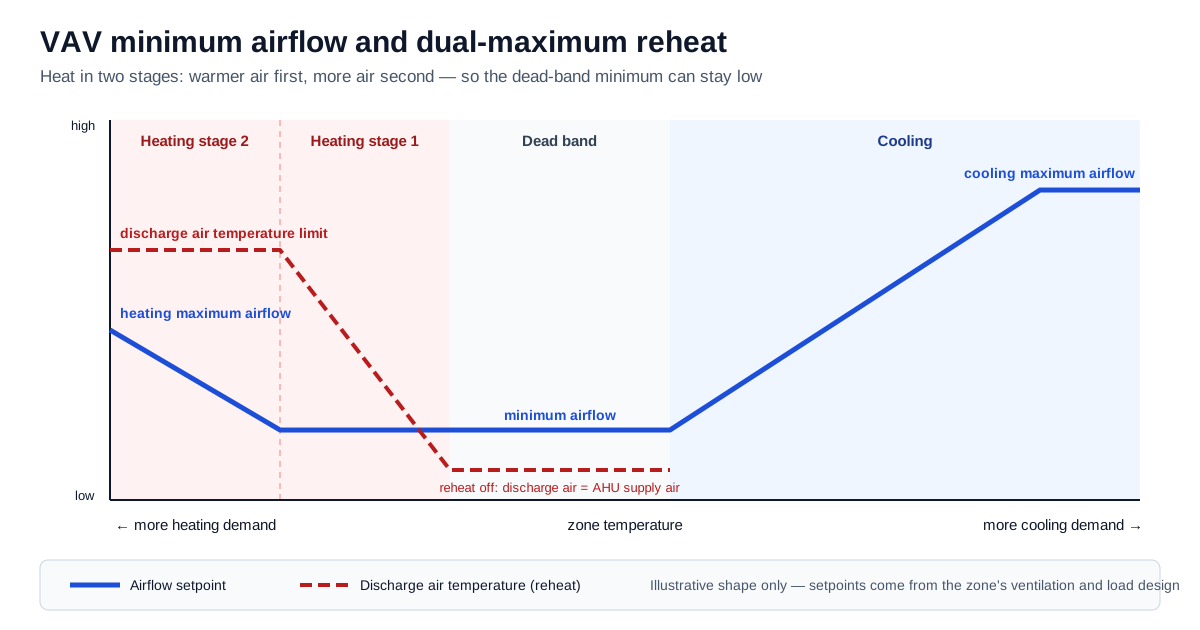
A VAV box's minimum airflow is the least air it supplies while a zone is occupied. Set it from the zone's ventilation requirement and the diffuser and flow sensor limits, never a flat percentage. Reheat warms that air when the room is still cold; a dual-maximum sequence heats in two stages, allowing a lower minimum and less simultaneous heating and cooling.
Ask an FM team what their biggest VAV energy waste is and most will say the AHU fan. On a lot of systems the bigger leak is quieter: boxes that sit at a high minimum airflow all day, delivering cold air to zones that do not want it, while reheat coils warm that same air back up again. The building is cooling and heating the same air at the same time, the gas and chiller meters both tick over, and every occupant is comfortable enough that nobody complains. It usually starts innocently. A stuffy meeting room gets its minimum raised, a cold perimeter office gets its reheat setpoint nudged up, a controls engineer copies "30% of maximum" across every box because the template said so. Ten years later the whole floor is running that way. This guide explains how VAV minimum airflow and reheat should work, and how to get them back under control without trading an energy problem for an air quality one.
Why does a VAV box need a minimum airflow?
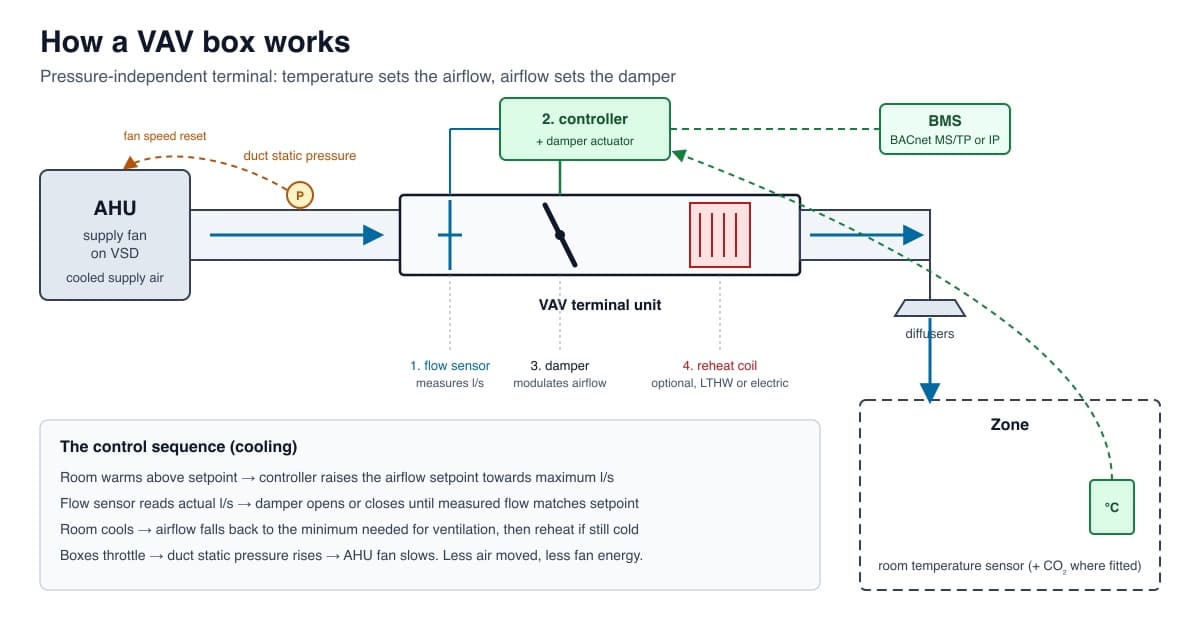
A VAV box needs a minimum airflow for three separate reasons, and a good setpoint satisfies all three. The first is ventilation. Where the VAV system is also the fresh air system, the zone's outdoor air arrives mixed into its supply air, so if the box closes to nothing when the room is cool, the room stops being ventilated. The second is air distribution. Ceiling diffusers are selected to throw air along the ceiling at a particular range of flows; below the bottom of that range the jet detaches and cold air drops onto the people underneath, which is the "cold draught at my desk" complaint that can follow an energy-saving tweak. The third is measurement. The flow sensor's velocity pressure signal falls with the square of the airflow, so at very low flows the signal can fall below what the controller can measure and control reliably. Each manufacturer publishes a minimum controllable airflow for each box and sensor size.
The minimum setpoint is therefore the highest of three numbers: the zone's ventilation requirement, the diffuser's minimum workable flow, and the controller's minimum controllable flow. None of those is "30% of maximum". A flat percentage is a guess that will be too high in most zones and too low in a few, and it hides the reasoning that the next engineer needs. For the fundamentals of how the box measures and controls airflow, see our guide to what a VAV system is and how VAV boxes work.
How do you calculate VAV minimum airflow for ventilation?
In England, the ventilation starting point for offices is Approved Document F Volume 2. Paragraph 1.32 asks for outdoor air to occupiable office rooms at 10 l/s per person or 1 l/s per m² of floor area, whichever is higher. A 100 m² zone designed for twelve people therefore needs 120 l/s of outdoor air. The catch is that the VAV box supplies mixed air, not pure outdoor air, so the box minimum depends on the fraction of outdoor air in the AHU supply. Taken zone by zone, with the AHU at 25% outdoor air the box would need four times that requirement in supply air, 480 l/s, to deliver 120 l/s of fresh air, which is often more than the zone's cooling maximum. That simple view overstates the problem, because on a multi-zone system surplus outdoor air from lightly loaded zones returns to the AHU and is recirculated to everyone, but it shows why so many VAV systems end up with high minimums. The proper multi-zone calculation, set out in ASHRAE 62.1's ventilation rate procedure, is driven by the zone that needs the highest proportion of outdoor air in its supply, the critical zone, and that zone's minimum ends up setting the AHU outdoor air intake for the whole system.
There are two ways out of that trap. One is to raise the AHU's outdoor air fraction, which costs heating and cooling energy at the coil but lets box minimums come down. The other is to vary the minimum with actual occupancy, using CO₂ or occupancy sensors so that a zone gets its full ventilation minimum when it is full and a lower one when it is empty. ASHRAE Guideline 36 builds this in: where a zone has an occupancy sensor, shows the room is empty and occupied-standby mode is permitted, the sequence sets the zone's ventilation minimum to zero until someone comes back (Guideline 36-2021, section 5.2.1.3). Before any minimum is lowered on a UK building, somebody should check it against the design ventilation calculation, and ideally against CO₂ data; our guide to indoor air quality and BMS CO₂ monitoring covers what that data should look like.
How does VAV reheat work?
VAV reheat is a heating coil fitted on the discharge side of the terminal unit, either an LTHW coil with a two-port control valve or an electric heater battery with staged or modulating control. It exists because the AHU supplies air cool enough for the zone with the highest cooling load, and at minimum airflow that cool air can still over-cool a zone with a low load, such as a north-facing office in January or an internal room at night. When the room drops below its heating setpoint and the box is already at minimum airflow, the controller brings on the reheat to warm the supply air.
In a classic "single maximum" sequence, the box stays at its minimum airflow in heating and the reheat simply modulates the coil to hold the room temperature. That is simple, but it has a limit: to put enough heat into the room at low airflow, the discharge air has to be very warm, and hot air from a ceiling diffuser at low velocity tends to stay at the ceiling and short-circuit straight back to a ceiling return. The room stratifies, the thermostat on the wall reads cold, and the reheat runs harder. Many UK VAV buildings avoid this problem by heating the perimeter separately with LTHW radiators, trench heating or perimeter fan coils, and using VAV reheat only for trim, which is worth knowing before you assume every box on a drawing needs a coil.
Get a Free BMS Survey
We'll assess your controls and provide a detailed quotation.
What is a dual-maximum VAV reheat sequence?
A dual-maximum sequence gives the box two maximum airflows, one for cooling and a lower one for heating, and it heats in two stages. As the room drops below its heating setpoint, the controller first raises the discharge air temperature at minimum airflow, up to a limit above the room setpoint. Guideline 36-2021 (section 5.6.5.3) points to the ASHRAE 90.1-2016 limit of 11°C above space temperature for overhead supply, for example 32°C supply air into a 21°C room, specifically to minimise stratification. Only if that is not enough does it increase the airflow from minimum up towards the heating maximum, with the discharge air held at that limited temperature. The result is that heating air leaves the diffuser warm rather than hot and at enough velocity to mix into the room, which reduces stratification and means the box can run a lower minimum airflow in the dead band between heating and cooling.
The energy case comes from that lower dead-band minimum. In a single-maximum sequence the minimum often has to be set high enough to carry the full heating load, so the zone is supplied with more cool air than it needs for most of the year and reheat makes up the difference. In a dual-maximum sequence, the minimum can drop to what ventilation and diffuser selection actually require, because the extra airflow for heating is only called for when it is needed. ASHRAE Guideline 36 uses dual-maximum logic as its standard VAV reheat zone sequence, and the same logic can be implemented on UK controller platforms.
What usually goes wrong with VAV minimum airflow and reheat?
The common faults are nearly all variations on simultaneous heating and cooling. Minimums raised to fix one-off complaints and never reviewed. Minimums set as a flat percentage from a controller template. LTHW reheat valves that pass when closed, so a coil warms air all year while the box compensates with extra cool air. Reheat enabled in summer because the heating plant is left available and the reheat setpoint overlaps the cooling setpoint. Electric reheat stages cycling on and off far too often because the loop has no minimum on and off times, which wears out relays and contactors and is behind documented cases of melted and burnt relays on electric reheat boxes. Whatever does the switching, electric reheat must only run with airflow proved and with its high-limit and manual-reset cut-outs working and never bypassed. And supply air temperature resets at the AHU that raise the supply temperature on mild days without anyone checking that the warmest zones still have enough cooling at their maximum airflow.
Almost all of these are invisible without trends. A box sitting at minimum airflow with reheat active looks normal on a graphic; it only looks wrong when you trend a week of reheat output against outside air temperature and see the coil working through a heatwave. Our VAV box problems fault-finding guide sets out the order to work through these on site.
Which standards apply to VAV minimum airflow and reheat in the UK?
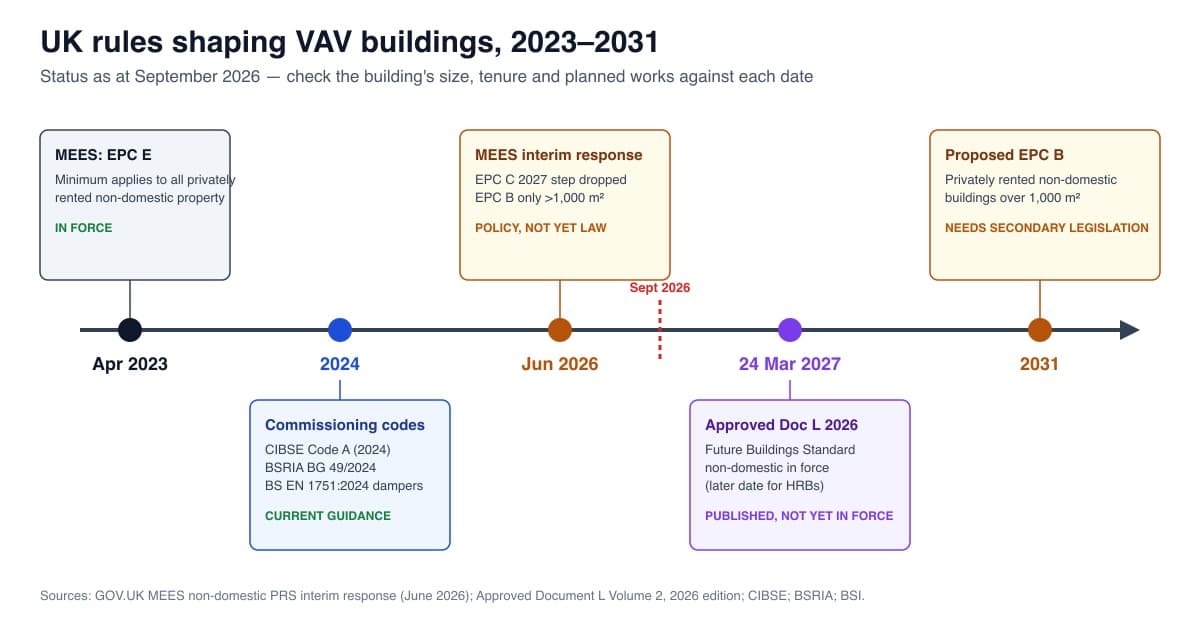
Approved Document F Volume 2 is the statutory guidance in England on the ventilation rates a VAV system should deliver to meet Part F, including 10 l/s per person or 1 l/s per m² for offices, and it is the document to check before any box minimum is lowered. Approved Document L Volume 2 covers the energy efficiency of fixed building services, and it is blunt about the problem in this article: paragraphs 5.11 and 6.35 of the 2021 edition say that where both heating and cooling are provided to the same space, the controls should prevent them operating simultaneously; its next edition, implementing the Future Buildings Standard, is due to take effect on 24 March 2027, and our guide to VAV systems and UK regulations in 2026 covers the changes. For commissioning, CIBSE Commissioning Code A: Air distribution systems (2024) and BSRIA BG 49/2024 Commissioning Air Systems set the expectations for regulating terminal units and recording their minimum and maximum airflows at handover.
For the control sequences themselves, ASHRAE Guideline 36-2024 is the most detailed published reference. It is American, and its ventilation logic is written around ASHRAE 62.1 rather than Approved Document F, so a UK design should take the sequence structure (dual maximum, occupied-standby, request-based resets) and set the ventilation numbers from UK requirements, not copy the US figures across.
What does good VAV minimum airflow and reheat control look like?
Good practice starts with a schedule. Every box has a recorded ventilation minimum, a diffuser minimum and a controller minimum, with the setpoint equal to the highest of the three and the reasoning written down. Heating and cooling setpoints have a proper dead band between them, so reheat and full cooling can never be demanded at the same time. Reheat is locked out above a sensible outside air temperature unless a specific zone has a documented need. Electric reheat has minimum on and off times. LTHW reheat boxes have discharge air temperature sensors so a passing valve shows up on a trend. And the BMS reports the number of boxes with reheat active alongside AHU supply air temperature, so the operator can see simultaneous heating and cooling at building level rather than box by box.
On an existing system, getting there is mostly a controls exercise rather than a capital project: survey the boxes, rebuild the minimum airflow schedule from the ventilation design, rewrite the zone sequence to dual maximum where the hardware allows, add reheat lockouts and fix passing valves. Where the controllers are too old to support that logic, it becomes part of a wider controls upgrade; our guide to whether to retrofit or replace a legacy BMS covers that decision.
When should you review VAV minimums and reheat?
Review them whenever gas and chilled water consumption both stay high through spring and autumn, whenever reheat is active in summer, after any fit-out that changes zone layouts or occupancy, and before any energy-saving change to minimum setpoints. A change of tenant, an EPC or MEES review and a planned AHU replacement are all natural points to do it properly.
VAV minimum airflow and reheat settings largely decide whether a building heats and cools the same air, which makes them one of the biggest influences on a VAV system's energy use. Set minimums from the ventilation design rather than a template, heat in two stages rather than one, and make simultaneous heating and cooling visible on the BMS. Alpha Controls audits existing control strategies and reconfigures setpoints, schedules and sequences, including VAV and AHU sequence programming on Trend, Distech and Siemens systems and other open-protocol platforms, across London and the South East. Talk to our engineers or request a quote for a VAV sequence review.
VAV minimum airflow and reheat FAQs
What should a VAV minimum airflow be set to?
The highest of three limits: the zone's ventilation requirement, the diffuser's minimum workable flow, and the controller's minimum controllable airflow. It should not be a flat percentage of maximum, and the reasoning should be recorded.
What is the ventilation rate for offices in the UK?
In England, Approved Document F Volume 2, paragraph 1.32, asks for outdoor air to occupiable office rooms at 10 l/s per person or 1 l/s per m² of floor area, whichever is higher. On a VAV system that outdoor air is delivered through the boxes, so box minimums form part of the ventilation design.
What is dual-maximum VAV control?
A reheat zone sequence with separate cooling and heating maximum airflows. In heating it first raises discharge air temperature at minimum airflow, up to a limit, then increases airflow towards the heating maximum. It reduces stratification and allows a lower dead-band minimum.
Why is VAV reheat running in summer?
Common causes are minimum airflows set too high, heating and cooling setpoints without a proper dead band, reheat not locked out at high outside temperatures, or an LTHW reheat valve passing when closed. Trending reheat output against outside temperature shows it.
Can I lower VAV minimums to save energy?
Only after checking the ventilation calculation and ideally CO2 data. Lowering a minimum that carries a zone's outdoor air swaps an energy problem for an air quality one. Occupancy-based resets are the safer way to reduce minimums.
Who can review VAV reheat sequences on a Trend or Distech BMS?
Alpha Controls audits existing control strategies and reconfigures setpoints, schedules and sequences, including VAV and AHU sequence programming on Trend, Distech, Siemens and other open-protocol platforms, across London and the South East.
Alpha Controls Team
Specialist BMS installation, commissioning, and maintenance across London and the South East. SafeContractor Approved, BCIA Member.