
Most VAV box problems are not the box. They are lost airflow calibration (a wrong K-factor, split sensor tubes, a drifted transducer), a minimum airflow that no longer suits the zone, misbehaving reheat, or a fit-out that moved the room sensor. Check the BMS trend first, then flow measurement, damper, setpoints and reheat.
The complaint rarely says "VAV". It says the meeting room on four is an icebox, the corner office is too warm every afternoon, or there is a draught of cold air landing on someone's desk. The FM team resets a setpoint, the problem moves somewhere else, and a month later the same ticket is back. Meanwhile the air handling unit fan is running harder than it should, reheat is on in a heatwave, and the energy report shows nobody why. A front end can easily hide a dozen boxes reporting zero airflow that nobody has looked at in years, because the building still "sort of works". This guide sets out a logical order for fault-finding VAV box problems on site, so the fault gets fixed at its cause rather than chased round the floor.
How do you troubleshoot a VAV box?
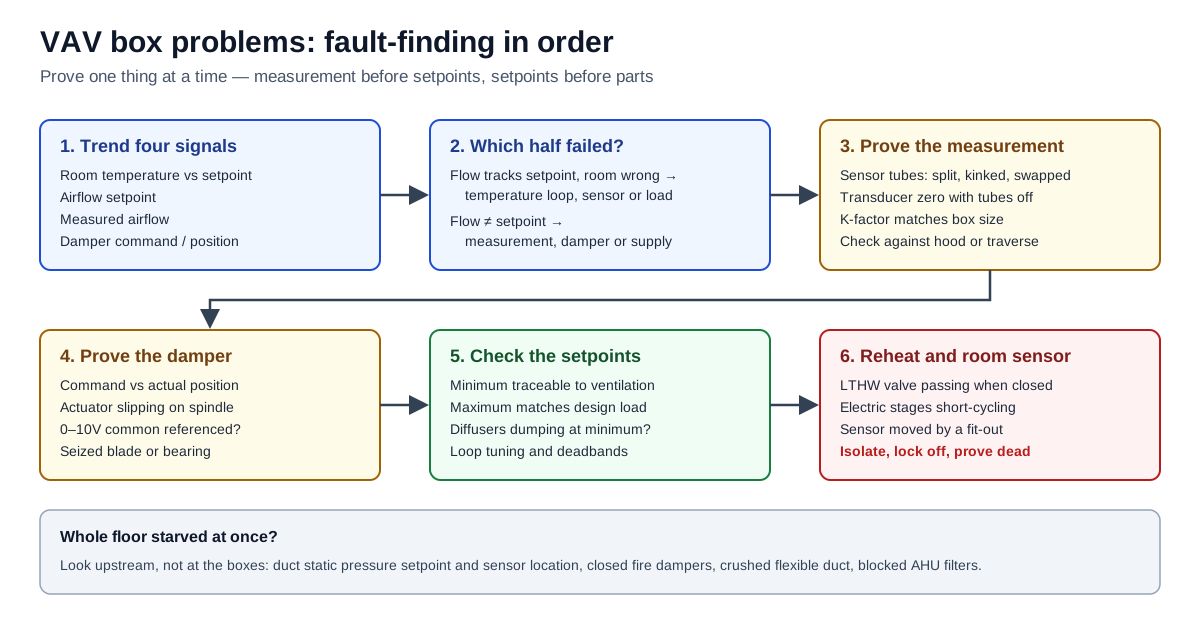
Start at the BMS, not the ceiling tile. Before anyone goes up a ladder, pull a trend of four values for the problem box over at least a full occupied day: room temperature against setpoint, airflow setpoint, measured airflow and damper position (or damper command, if there is no feedback). Those four lines tell you which half of the cascade has failed. If the airflow setpoint is at maximum and measured airflow is well below it with the damper at 100%, the box is starved, and the problem is upstream: duct static pressure, a closed fire damper, a crushed flexible duct or an undersized AHU. If measured airflow tracks the setpoint perfectly but the room is still wrong, the air side is doing exactly what it has been told, so the problem is the temperature loop, the room sensor or the load. If measured airflow is flat at zero or jumps around while the damper moves, the flow measurement itself is the suspect.
Once the trend points at a half, go to the box with a manometer or a calibrated airflow hood and the manufacturer's data sheet. In buildings built before 2000, check the asbestos register before lifting ceiling tiles or working in the void. Every step after this is about proving one thing at a time rather than changing three settings and hoping. For a wider view of how a VAV terminal and its control loops fit together, our pillar guide on what a VAV system is and how VAV boxes work covers the fundamentals.
VAV box problems: why does a box show zero airflow?
A box reporting zero or near-zero airflow while the damper is open is almost always a measurement fault, not a real absence of air. The flow sensor at the inlet produces a velocity pressure that can be only a few pascals at low airflow, carried to the controller's transducer on two small plastic tubes. Those tubes split, kink, get pulled off during ceiling works or get swapped high-to-low by whoever reconnected them, and any of those gives a zero, negative or nonsensical reading. The transducer itself can drift, and some controllers auto-zero the transducer periodically by closing the damper, which fails silently if the damper does not actually close. Check the tubes, check the polarity, check the zero with the tubes disconnected, then check the reading against a hood or traverse.
If the measurement is physically sound but the number is still wrong, look at the K-factor. The controller calculates airflow as K multiplied by the square root of the velocity pressure, so a K-factor for the wrong box size, a default value left from the factory template or a units error between imperial and metric data will scale every reading. On retrofits where controllers have been replaced but boxes retained, one easy mistake is copying the same K-factor to every box on a floor from one template, regardless of inlet size. Recording verified airflow for each terminal is part of regulating an air system under CIBSE Commissioning Code A (2024) and BSRIA BG 49/2024.
Why is my VAV zone too cold?
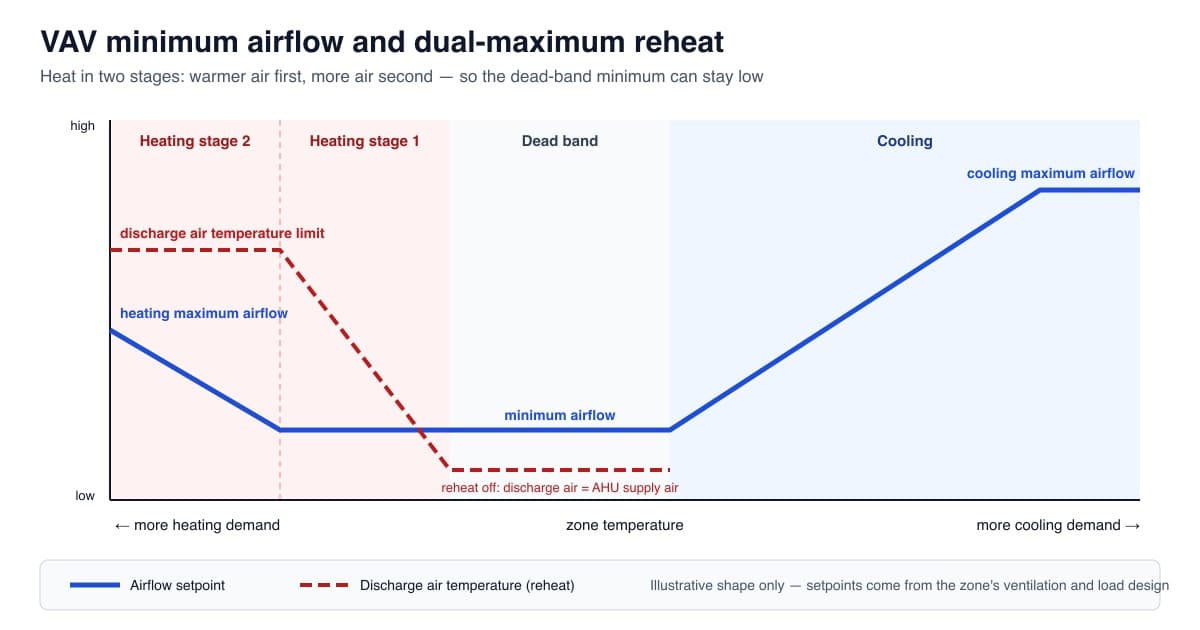
A zone that is too cold with the box sitting at minimum airflow is usually a minimum setpoint problem. Somebody raised the minimum to cure a stuffiness complaint, or the commissioning minimum was set as a percentage of maximum rather than from the ventilation requirement, and at light load the box is now supplying more cool air than the room can use. If the box has reheat, the coil fights that cold air all winter and burns energy; if it has no reheat, the room just gets cold. Before lowering a minimum, check what it is there for. Where the VAV system carries the ventilation air, in England Approved Document F Volume 2 asks for 10 l/s per person or 1 l/s per m² in offices, whichever is higher, and the minimum may be doing that job. Lowering it without checking the ventilation calculation swaps a comfort complaint for an air quality one.
The other common cause of cold zones is diffuser dumping. At low airflow the discharge velocity from a ceiling diffuser drops below what is needed to hold the jet along the ceiling, so cold air falls straight down onto the occupants. The room temperature sensor on the wall may even read normal while the person under the diffuser is freezing. That is a design and selection issue as much as a controls one, and the fix is often a combination of a revised minimum, a different diffuser or a change to how many diffusers each box serves. Our guide to VAV minimum airflow and reheat control covers the setpoint side in detail.
Get a Free BMS Survey
We'll assess your controls and provide a detailed quotation.
Why is my VAV zone too hot?
A hot zone with the airflow setpoint pinned at maximum is a starved box or an undersized one. Check the damper first: if the actuator is commanded to 100% but the damper is not moving, the actuator may have failed, slipped on its spindle, or be fighting a seized bearing. Where the actuator has position feedback, compare commanded and actual position on the trend; where it has none, you have to go and look. Our guide to integrating Belimo VAV actuators with Trend IQ412 controllers covers the floating-common wiring fault that produces erratic damper positioning and looks like a control loop problem.
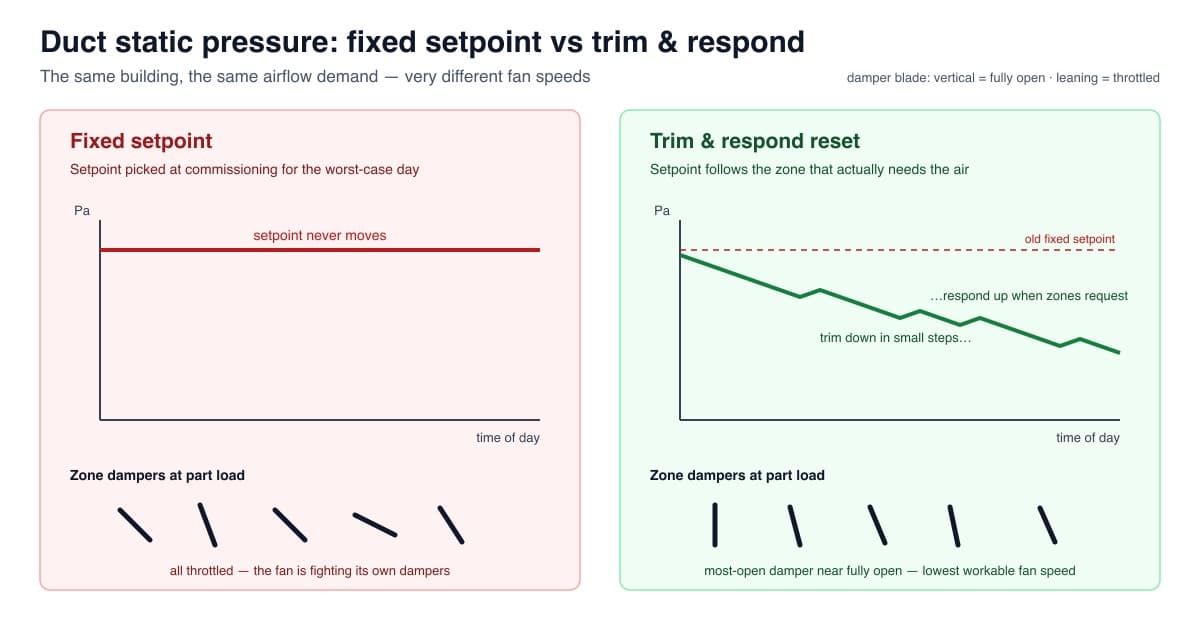
If the damper is genuinely open and the airflow is still short, look upstream. A duct static pressure setpoint that has been reset too low, a static pressure sensor in the wrong place, a closed motorised fire damper, a disconnected or crushed flexible duct above the box, or an AHU with blocked filters can all starve the boxes at the far end of the index run. If a whole floor goes warm at the same time, the problem is almost certainly central. Our guide to VAV static pressure reset explains how box demand should drive the AHU, and why a reset without a request-based feedback loop can starve zones.
Why does a VAV damper hunt?
A damper that swings open and closed every few minutes is almost always a tuning or interaction problem. The flow loop inside the controller is usually fast; the temperature loop outside it should be much slower. When they are tuned too close together, or the flow loop's deadband is smaller than the noise on a low velocity pressure signal, the damper never settles. Hunting is worst at low airflow, where the velocity pressure signal is smallest relative to its noise, so it often appears only at light load, such as early mornings or mild days. Increasing the flow loop deadband, adding signal filtering, and slowing the temperature loop is the right order of attack.
Hunting across a whole floor at once points to the AHU instead. If the static pressure loop and the supply air temperature reset are both acting on the same boxes without being coordinated, they can fight each other: the pressure loop slows the fan, the boxes open, the temperature reset lowers the supply temperature, the boxes close, the pressure rises, and round it goes. Actuator drive time plays into this too. Typical VAV actuators take a minute or more to drive full stroke, and a sequence written for fast actuators will overshoot on slow ones. Engineers argue about this on forums precisely because the answer is "it depends on the sequence", which is why the sequence has to be written for the hardware actually installed.
What goes wrong with VAV reheat?
Reheat is where the energy and the safety problems live, and it comes up more than any other VAV topic on the engineering forums where controls and HVAC technicians swap notes. On LTHW reheat, the classic fault is a two-port valve that passes when closed, so the coil heats all year while the box pumps extra cool air to compensate; you find it by trending discharge air temperature against valve command, or by checking the coil with an infrared thermometer in August. On electric reheat, the classic fault is premature failure of the relays or contactors switching the heater stages. When a control loop cycles a heater stage on and off every minute, the contacts wear out far faster than their rating suggests, and a worn contact on a heater load can overheat. Stage cycling limits and minimum on and off times are the controls fixes, but the first step is recognising that repeated relay failures on the same system are a controls fault, not bad luck. Whatever switches the stages, the heater must only be enabled with airflow proved, and its high-limit and manual-reset thermal cut-outs must be working and never bypassed. Solid-state relays usually fail closed, which makes those protections the last line of defence, so any change to how heater stages are switched is electrical design work, not a controls tweak.
Electric reheat also means mains voltage in the ceiling void. Before any engineer opens the heater section of a VAV box, the circuit has to be isolated at the correct point, locked off and proved dead by a competent person, using a voltage indicator that meets HSE guidance GS38 and is checked on a known source before and after, following the safe isolation procedure in HSE's HSG85, Electricity at work: Safe working practices. That is how duty holders meet regulations 12 and 13 of the Electricity at Work Regulations 1989, which cover the means of isolation and the precautions for work on equipment made dead. Training someone by having them open a live heater section is not training. On many buildings the heater supplies are grouped on distribution boards that do not obviously match the box schedule, so identifying the right isolation point is part of the job, not an afterthought.
What does good VAV fault-finding look like?
Good fault-finding on a VAV system is systematic. The BMS trends room temperature, airflow setpoint, measured airflow and damper position for every box, and ideally discharge air temperature on reheat boxes. Alarms flag the patterns that matter, such as airflow persistently below setpoint, reheat active while the zone is above setpoint, or a damper that never moves. ASHRAE Guideline 36 includes terminal-unit alarms such as low airflow against setpoint, airflow sensor calibration and leaking damper, and even on a UK system that does not follow Guideline 36 sequences, similar rules can be written into a Trend, Distech or Siemens strategy. Every fix is recorded against the box, so the next engineer knows that box 4-17 had its K-factor corrected rather than rediscovering it.
Where a building has lived with a lot of these faults for years, the most cost-effective route is usually not individual callouts but a structured recommissioning of the air side: verify every box's calibration and setpoints against the design, prove the AHU static pressure sensor and setpoint, fix the network, and hand back a system that is documented. The network matters more than people expect; a large MS/TP network of VAV controllers with overloaded segments or poor termination will drop devices intermittently, and our guide to end-of-line resistors and VAV termination covers how to prove it.
When should you call in a specialist for VAV box problems?
If the same zones keep generating tickets after setpoint changes, if more than a few boxes show implausible airflow, if reheat relays or contactors keep failing, or if the AHU fan never drops below high speed, it is time for a proper survey rather than another callout. A controls specialist should come away with trend data, a box-by-box fault list and a clear split between what can be fixed in software, what needs a part and what is a design issue for the mechanical engineer.
VAV boxes are simple devices, and the faults on them follow a small number of well-worn patterns. To fix VAV box problems for good, find which half of the cascade has failed, prove the measurement before touching the setpoints, isolate reheat properly before working on it, and record what you did. Alpha Controls diagnoses BMS and VAV control faults across London and the South East by interrogating the BMS, checking control sequences and testing actuators and sensors at field level, and recommissions and maintains the controls afterwards. If you have zones that will not behave, get in touch with our engineers or request a quote for a VAV survey.
VAV box troubleshooting FAQs
Why does my VAV box show zero airflow on the BMS?
Usually a measurement fault: split, kinked or reversed flow sensor tubes, a drifted transducer, or a wrong K-factor. Check the tubes and polarity, zero the transducer with the tubes disconnected, then compare the reading with a hood or duct traverse.
What is a VAV K-factor?
The K-factor is the box-specific constant a VAV controller uses to convert the flow sensor's velocity pressure into airflow: airflow equals K times the square root of velocity pressure. A wrong K-factor scales every airflow reading on that box.
Why is one VAV zone always too cold?
Most often the minimum airflow is too high for the zone's light-load condition, or diffusers dump cold air at low flow. Check the minimum against the ventilation calculation before lowering it, and check whether reheat is fighting the cold air.
Why does a VAV damper keep hunting?
Hunting is usually tuning: flow and temperature loops too close in speed, a flow deadband smaller than signal noise at low airflow, or AHU static pressure and supply temperature resets fighting. Widen the flow deadband, filter the signal and slow the temperature loop.
Why do electric reheat relays on VAV boxes keep failing?
Repeated failures across one system usually mean the control loop is cycling heater stages on and off too often, wearing contacts faster than their rating suggests. Add minimum on and off times, keep airflow proving and high-limit cut-outs working, and treat any switching change as electrical design work.
Can Alpha Controls survey a VAV system with recurring comfort complaints?
Yes. Alpha Controls diagnoses BMS and VAV control faults across London and the South East by interrogating the BMS, checking control sequences and testing actuators and sensors at field level, then recommissions and maintains the controls.
Alpha Controls Team
Specialist BMS installation, commissioning, and maintenance across London and the South East. SafeContractor Approved, BCIA Member.