
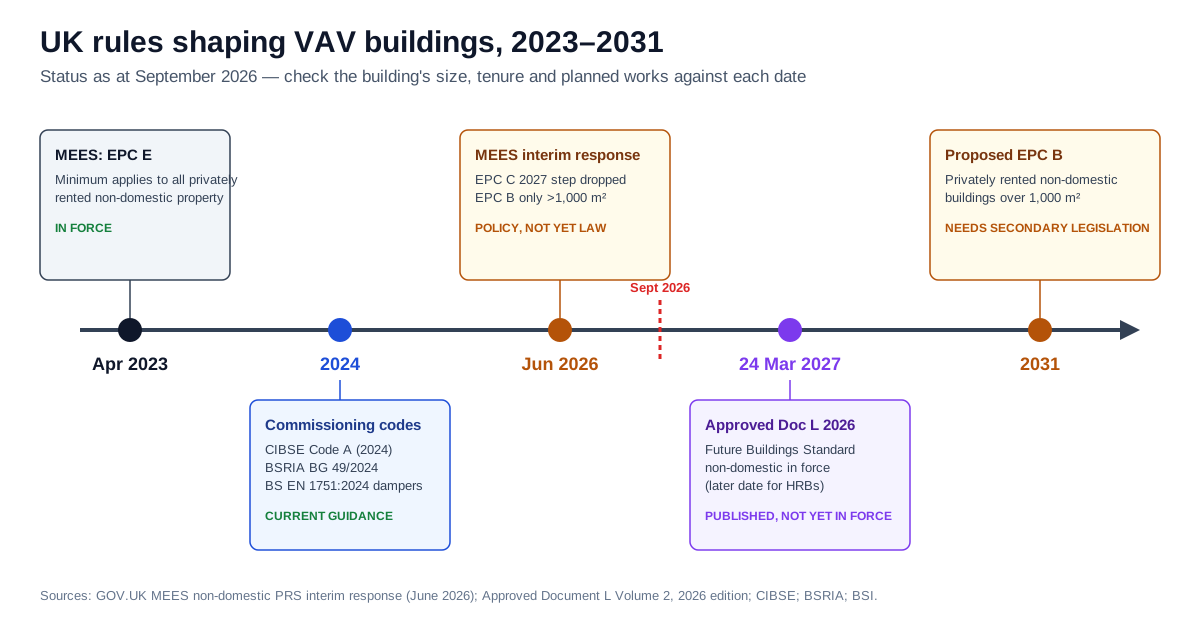
In 2026, UK VAV buildings are shaped by five things: MEES, where a June 2026 response dropped the EPC C 2027 step and proposed EPC B by 2031 for buildings over 1,000 m²; Approved Document L 2026, in force 24 March 2027; Approved Document F ventilation; TM44 inspections; and the 2024 commissioning codes.
If you own, manage or lease a VAV building, the regulatory ground has moved twice in the last two years, and a lot of what is still circulating is out of date. Plenty of landlords are working to an "EPC C by 2027, B by 2030" plan that the government no longer proposes. Consultants are writing specifications against an Approved Document L that is about to be replaced. And commissioning managers are still quoting a 2015 BSRIA guide that has been superseded. None of that matters much until a lease event, a refurbishment or a controls upgrade forces a decision, and then it matters a great deal, because the difference in cost between a controls-led improvement and a plant replacement can be very large. This guide sets out where the rules actually stand in September 2026 for buildings with VAV air conditioning, what they mean for the controls, and what to do about them. The Approved Documents referred to below are statutory guidance for England; Wales, Scotland and Northern Ireland publish their own building regulations guidance, while MEES and the air conditioning inspection rules described here apply in England and Wales.
What changed with MEES for commercial buildings in 2026?
The Minimum Energy Efficiency Standards (MEES) for privately rented non-domestic property in England and Wales currently require at least an EPC E. Since 1 April 2023 that has applied to all privately rented non-domestic properties, even where there has been no change in tenancy, unless the landlord has registered a valid exemption. What changed in 2026 is the future trajectory. On 18 June 2026 the government published its interim response on non-domestic MEES. The previously proposed interim EPC C milestone for 2027 will not be taken forward. From 2031, it is proposed that privately rented buildings over 1,000 m² will need to reach EPC B where cost effective, while buildings below 1,000 m² stay on the current EPC E minimum. The EPC B change only takes effect once secondary legislation passes through Parliament, so in September 2026 it is confirmed policy direction, not law. Our MEES update on the dropped EPC C milestone covers what BMS controls still do for a rating.
For a VAV building, the practical point is that the EPC calculation for non-domestic buildings is driven by the HVAC system as well as the fabric. The national calculation method, SBEM, takes account of the heating, cooling and ventilation system type, design fan power and certain controls features, so the specification of the VAV plant and its controls affects the rating. Before accepting a plant-replacement case, check whether a controls-led improvement is available first. Our guide to BMS energy audits in the UK covers how that assessment is done.
What does Approved Document L 2026 mean for VAV systems?
The 2026 edition of Approved Document L Volume 2, which implements the Future Buildings Standard for buildings other than dwellings, has been published alongside the Building Regulations etc. (Amendment) (England) Regulations 2026 (S.I. 2026/335). It comes into force on 24 March 2027 for most building work in England, with a later date for higher-risk buildings, and transitional arrangements mean it will not apply where a building notice, initial notice or full plans application was given before 24 March 2027, provided the work starts on site before 24 March 2028. For VAV systems the practical effect lands on projects that replace or substantially alter air handling plant, fans and controls after that date: the specification should be written against the 2026 guidance, and anyone designing a VAV refurbishment now for delivery in 2027 or later should check which edition will apply at the point of application.
Until then, the 2021 edition (incorporating 2023 amendments) applies, and it already contains several requirements that bite on VAV systems. Paragraph 6.66 says a new building with a space heating or air conditioning system above 180 kW effective rated output should have a building automation and control system, and paragraph 6.67 applies the same specification to a BACS being replaced or installed in an existing building above that size; paragraph 6.72 describes a BACS that monitors, logs and analyses energy use and notes that a BS EN 15232 Class A system would meet it. Paragraph 6.48 says air handling systems should achieve a specific fan power at 25% of design flow no greater than at 100%, paragraph 6.49 calls for variable speed drives on general air distribution fans rated above 1100 W, and paragraph 6.35 says that where heating and cooling serve the same space, the controls should prevent them operating simultaneously. A VAV system with reheat fighting cold air all day is a long way from that intent. Note that the 180 kW figure is the UK Approved Document threshold; the 290 kW and 70 kW thresholds often quoted in BACS articles come from the EU Energy Performance of Buildings Directive, which does not apply in England.
What does Approved Document F require for VAV ventilation?
Approved Document F Volume 2 (2021 edition) is the statutory guidance on meeting the Part F ventilation requirement in non-domestic buildings in England. For occupiable rooms in offices, paragraph 1.32 asks for outdoor air at 10 l/s per person or 1 l/s per m² of floor area, whichever gives the higher rate. The same edition introduced indoor air quality monitoring for new buildings: paragraph 1.21 says occupiable rooms in offices, among other room types, should have a means of monitoring indoor air quality, paragraph 1.22 excludes rooms up to 50 m² or over 320 m² floor area, and paragraph 1.23 says CO₂ monitors should be NDIR type, mains powered and placed at breathing height away from windows, doors and ventilation openings. Approved Document F does not set a pass or fail CO₂ number, but its Appendix C and HSE guidance treat CO₂ consistently above 1,500 ppm in an occupied room as a sign of poor ventilation.
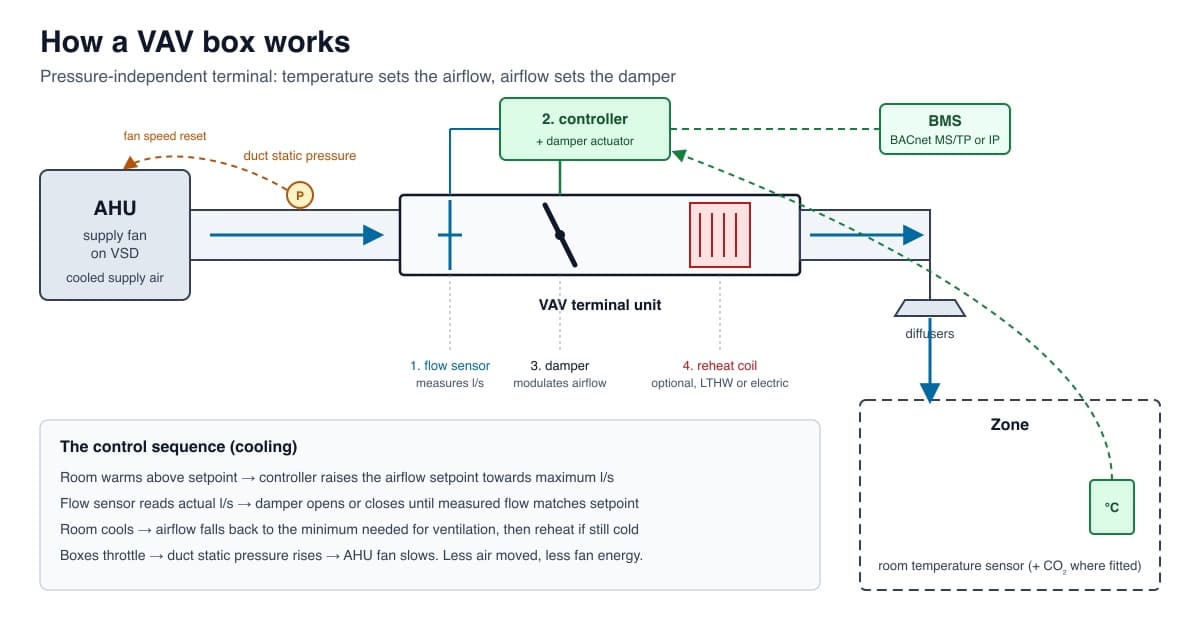
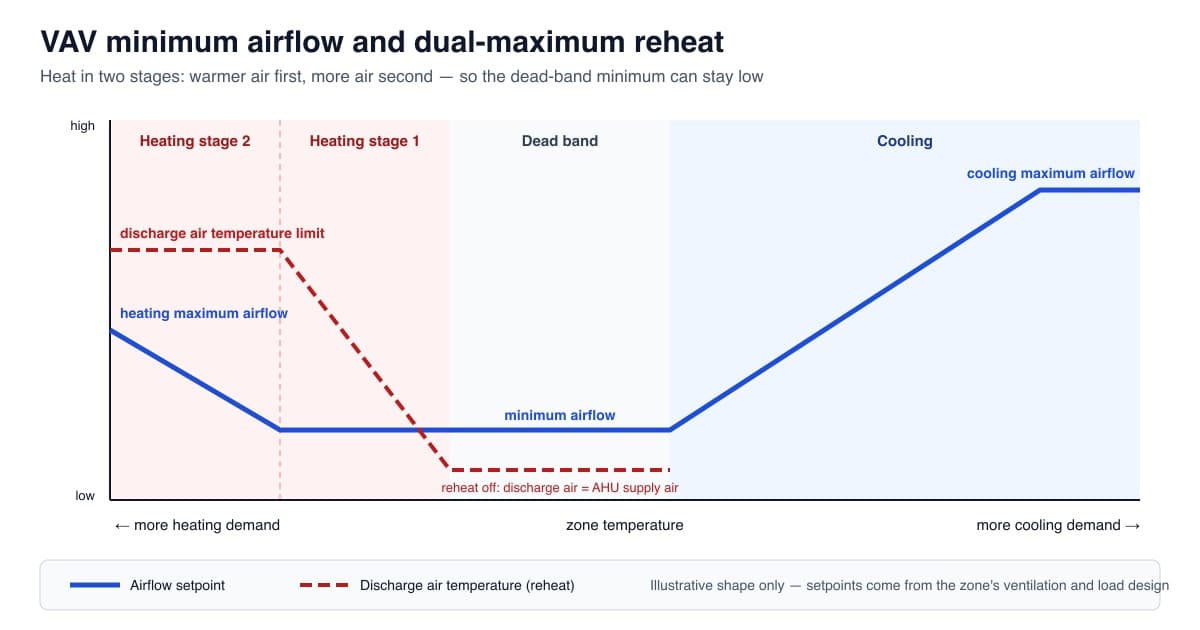
For VAV systems this matters directly, because, as our guide to what a VAV system is and how VAV boxes work explains, the VAV boxes usually deliver the building's ventilation air as well as its cooling. Every box minimum airflow is part of the ventilation design, and a minimum lowered on the front end to save energy can take a zone below its ventilation rate without anybody noticing until CO₂ readings or occupant complaints show it. Our guide to VAV minimum airflow and reheat control explains how to set minimums from the ventilation requirement rather than a template.
Get a Free BMS Survey
We'll assess your controls and provide a detailed quotation.
Do VAV air conditioning systems need TM44 inspections?
Yes, if the system is large enough. Under the Energy Performance of Buildings (England and Wales) Regulations 2012, regulations 17 and 18, the person who controls an air conditioning system with an effective rated output of more than 12 kW must have it inspected by an energy assessor at intervals not exceeding five years. The inspection is carried out to CIBSE TM44 and looks at the refrigeration plant, the air handling and distribution system, and the controls. On a VAV building the controls findings are where the useful recommendations usually sit: time schedules, setpoints, static pressure control, simultaneous heating and cooling, and whether the BMS data exists to show how the system runs. A TM44 report that has sat in a drawer for years is often a ready-made starting list for a controls upgrade.
Which commissioning standards apply to VAV systems in 2026?
Two of the key commissioning documents for VAV systems were revised in 2024, and specifications still quoting the older editions should be updated. CIBSE Commissioning Code A: Air distribution systems was revised in 2024 and sets the standard for setting to work, regulating and functionally testing ventilation and air conditioning air systems, which includes regulating VAV terminal units. Its companion, BSRIA BG 49/2024 Commissioning Air Systems, replaced BG 49/2015 and sets out the practical procedures that satisfy the Code. For the dampers inside terminal units, BS EN 1751:2024 is the current edition of the aerodynamic test standard for dampers and valves, including the closed-blade leakage classes manufacturers declare against it.
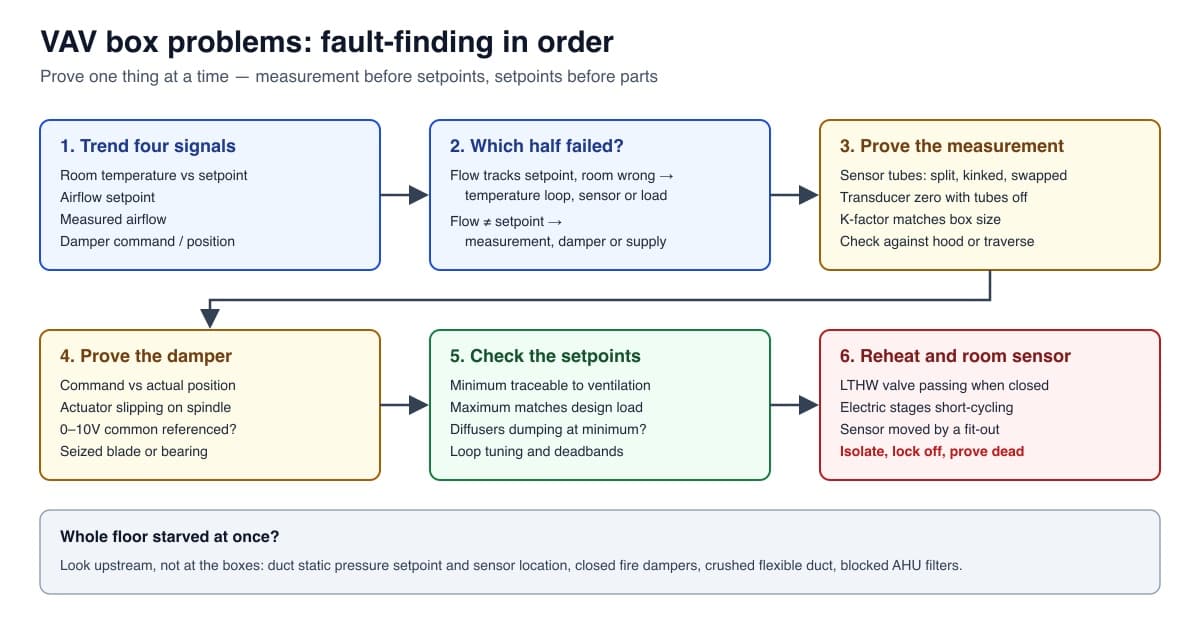
For the controls, the commissioning record should show every box's verified airflow calibration, its commissioned minimum and maximum airflows, the AHU static pressure sensor location and setpoint strategy, and the functional test results for the zone sequences. That record is what an EPC assessor, a TM44 inspector or an incoming tenant's surveyor will ask for, and it is what most inherited VAV buildings cannot produce. Our overview of the signs a BMS needs recommissioning explains when a full recommission is the better route than fixing faults one at a time.
What other 2026 rules affect VAV buildings?
For work on higher-risk buildings, the Building Safety Regulator has been the building control authority since the new regime began, and on 27 January 2026 it became a standalone body separate from the Health and Safety Executive. Where VAV or controls work in a higher-risk building is building work that needs the regulator's approval, it sits inside that regime's design and completion evidence requirements, so documentation and commissioning records matter even more than usual. For large organisations, ESOS energy audits are another route by which HVAC and controls opportunities get identified, and on a VAV site fan energy and control strategy are obvious places for an auditor to look.
There is also a voluntary standard worth knowing about. The UK Net Zero Carbon Buildings Standard, developed by a coalition that includes BBP, BRE, the Carbon Trust, CIBSE, IStructE, LETI, RIBA, RICS and UKGBC, launched Version 1 on 10 March 2026 after a pilot version released in September 2024. CIBSE describes it as enabling the built environment to robustly prove that buildings are decarbonising in line with the UK's carbon and energy budgets. It is voluntary, not a legal requirement. Operational energy performance is central to it, and on a VAV building that means fan energy, simultaneous heating and cooling and controls performance all show up in the numbers. Our guide to the UK Net Zero Carbon Buildings Standard and BEMS covers what it asks of the building management system.
What usually goes wrong when VAV buildings face compliance deadlines?
A common sequence runs like this. A lease event or refinancing triggers an EPC, the rating comes back poor, and the first proposal on the table is replacing the air handling units or the whole air conditioning system. Sometimes that is right. Often, nobody has looked at how the existing VAV system is actually running: the supply fan is at full speed all day on a fixed static pressure setpoint, half the boxes have lost their airflow calibration, reheat is fighting cold air, and the controllers are an obsolete platform with no trend logs. Fixing those issues does not always change the EPC inputs by itself, because SBEM models the system as designed and specified rather than as operated, but it reduces real energy use, supports an operational rating route such as the Net Zero Carbon Buildings Standard, and gives the upgrade case solid data instead of assumptions.
The other common mistake is treating compliance documents as the controls specification. An EPC recommendation that says "improve HVAC controls" tells you nothing about static pressure reset, dual-maximum reheat or occupancy-based ventilation. The controls scope needs to be written by someone who has surveyed the system, and it needs to be commissioned and verified against the 2024 commissioning codes rather than signed off from the front end.
What does a good VAV compliance and upgrade plan look like?
A good plan starts with evidence. Trend the existing system for a few weeks, survey a representative sample of VAV boxes, check the AHU controls and meter what can be metered. Then split the findings into three groups: faults to fix now, controls improvements such as static pressure reset with trim and respond and dual-maximum reheat, and plant or platform replacements that are genuinely needed. Sequence the work around lease events and the regulatory dates that apply to the building, so the MEES position, any Approved Document L 2026 obligations on replaced plant, and the next TM44 inspection are all planned rather than discovered. And commission everything to CIBSE Commissioning Code A (2024) and BSRIA BG 49/2024, with a record that will satisfy the next assessor.
Where the controllers themselves are the problem, because they are end-of-life, unsupported or too limited to run modern sequences, the decision between retrofitting and replacing the BMS comes into play. Our guide to legacy BMS upgrades: retrofit or replace and our BMS retrofit cost guide cover both.
When should VAV building owners act?
Act now if the building is over 1,000 m², privately let and likely to be caught by an EPC B requirement if the proposed 2031 standard is legislated; if a lease event, refinancing or sale is coming in the next two to three years; if AHUs, controllers or VAV boxes are due for replacement before or after 24 March 2027; or if the last TM44 inspection is more than five years old. Each of those turns a regulatory date into a real deadline, and controls work is far cheaper to plan than to rush.
The UK regulations affecting VAV buildings in 2026 are narrower than some earlier proposals suggested, but they are real, and they reward owners who know how their systems actually run. Get the MEES position right for your building size, plan around Approved Document L 2026, keep ventilation rates intact and commission to the current codes. Alpha Controls surveys, upgrades and commissions BMS and VAV controls across London and the South East, working with landlords, FM providers and consulting engineers. Talk to our engineers or request a quote for a VAV controls survey.
VAV regulations FAQs
Do commercial landlords need EPC C by 2027?
No. The government's 18 June 2026 interim response dropped the proposed EPC C milestone for 2027. The current legal minimum for privately rented non-domestic property in England and Wales remains EPC E unless a valid exemption is registered.
When will EPC B apply to commercial buildings?
The government proposes EPC B from 2031 for privately rented non-domestic buildings over 1,000 m², where cost effective. Buildings below 1,000 m² stay on EPC E. The change needs secondary legislation before it becomes law.
When does Approved Document L 2026 come into force?
In England, the 2026 edition of Approved Document L comes into force on 24 March 2027 for most building work, with 24 September 2027 for higher-risk building work. It does not apply where an application was given before 24 March 2027 and work starts before 24 March 2028.
What is the BACS threshold in Approved Document L?
In England, the 2021 edition of Approved Document L Volume 2 says new buildings with space heating or air conditioning above 180 kW effective rated output should have a building automation and control system, and applies the same specification to a BACS replaced or installed in an existing building of that size.
How often does a VAV air conditioning system need a TM44 inspection?
Air conditioning systems with an effective rated output above 12 kW must be inspected by an energy assessor at intervals not exceeding five years under the Energy Performance of Buildings (England and Wales) Regulations 2012.
Which commissioning standards apply to VAV systems in 2026?
CIBSE Commissioning Code A: Air distribution systems (2024) and BSRIA BG 49/2024 Commissioning Air Systems, which replaced BG 49/2015. Specifications quoting older editions should be updated.
Alpha Controls Team
Specialist BMS installation, commissioning, and maintenance across London and the South East. SafeContractor Approved, BCIA Member.