
VAV static pressure reset lowers the duct pressure setpoint whenever the terminal boxes do not need it, so the AHU supply fan runs slower. Trim and respond, the method in ASHRAE Guideline 36, trims the setpoint in small steps and raises it only when zones request more air. It is usually a software change.
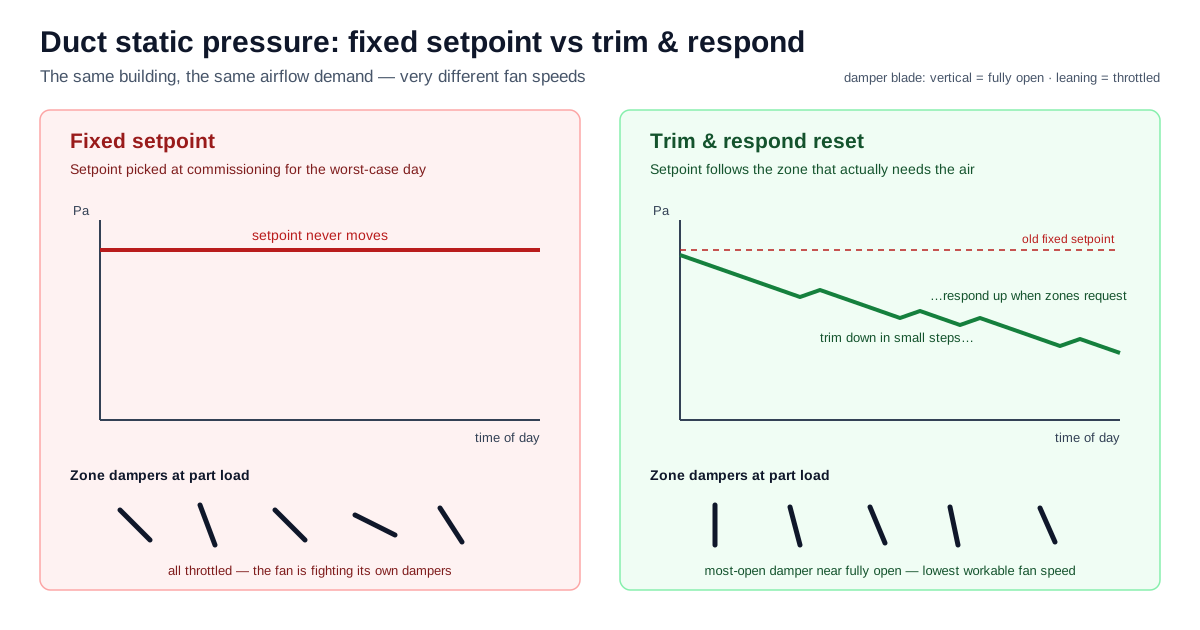
Walk into the plant room of a typical VAV building mid-morning in April and look at the supply fan drive. On many systems with a fixed setpoint it will be running at or near full speed, holding a duct static pressure setpoint that somebody chose during commissioning, on a hot day, to make sure the worst zone on the top floor got its air. Out on the floors, nearly every VAV damper is sitting part-closed, throttling away pressure the fan has just spent electricity creating. The system is working, the tenants are comfortable, and the fan is burning a large slice of its annual energy fighting its own dampers. That picture is the reason static pressure reset exists. This guide explains how VAV static pressure control works, how trim and respond logic resets it, where resets go wrong, and what a UK building owner should expect when it is done properly.
What is duct static pressure control on a VAV system?
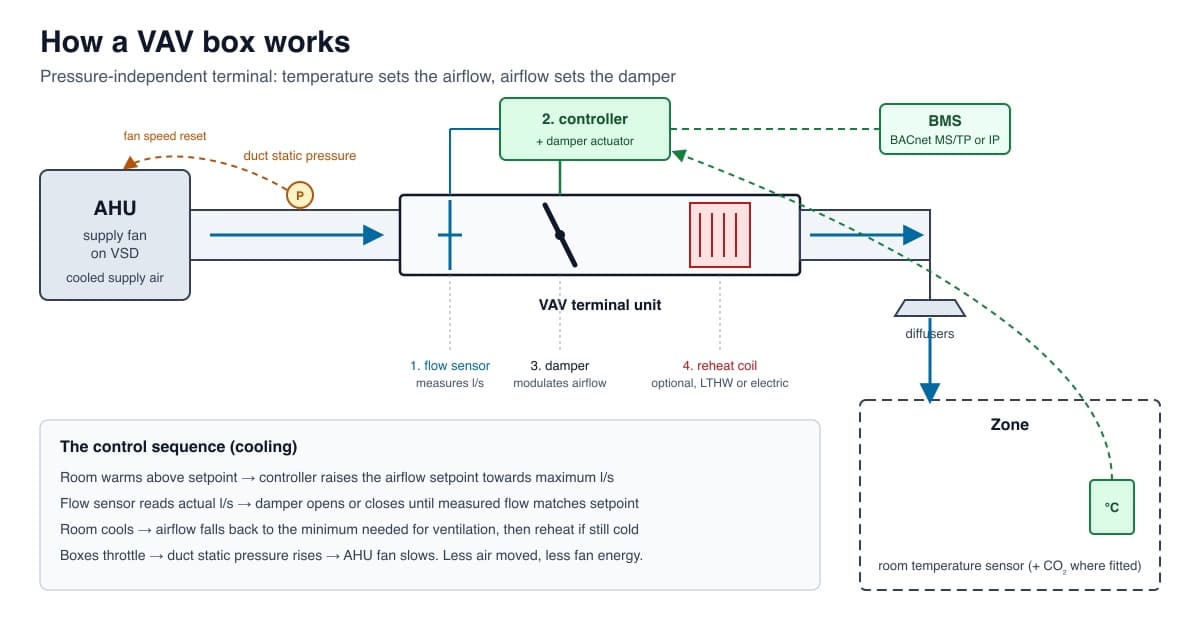
On a VAV system the AHU supply fan does not know how much air the building needs. The VAV boxes do, but they only control their own dampers. The link between the two is duct static pressure. A pressure sensor out in the supply ductwork measures the static pressure, the BMS compares it with a setpoint, and a control loop adjusts the supply fan's variable speed drive to hold that setpoint. When boxes open, pressure falls and the fan speeds up; when they close, pressure rises and the fan slows down. As long as there is enough pressure at every box inlet for the box to reach its airflow setpoint, every zone is satisfied.
The problem is the phrase "enough pressure at every box". A fixed setpoint has to be high enough for the worst-case box on the worst-case day, which means that on every other day it is too high. The surplus pressure is destroyed across part-closed dampers, generating noise as well as wasting fan energy. Because fan power rises steeply with speed, holding a higher pressure than necessary costs disproportionately more electricity than the airflow alone would suggest. For the fundamentals of how the terminal boxes themselves measure and control airflow, see our guide to what a VAV system is and how VAV boxes work.
How does VAV static pressure reset work?
Static pressure reset makes the setpoint follow the boxes. The ideal is a setpoint just high enough that the box needing the most pressure has its damper nearly fully open while still achieving its airflow setpoint. At that point, any lower pressure would starve that box, and any higher pressure would just be throttled away. Older reset strategies tried to get there by polling every box's damper position and resetting from the most-open damper, which works on paper but is fragile in practice: one box with a failed actuator, a stuck damper or a bad flow sensor reports 100% open forever and holds the whole system at maximum pressure.
Trim and respond logic, formalised in ASHRAE Guideline 36, High-Performance Sequences of Operation for HVAC Systems, deals with that fragility. Instead of reading damper positions directly, each zone generates "requests" when it is genuinely short of air, because its damper is nearly fully open and its measured airflow is still below setpoint. Guideline 36-2021 (section 5.6.8.2 for reheat boxes) grades them: three requests if the damper has been more than 95% open for a minute with airflow below 50% of setpoint, two if below 70%, and otherwise one request once the damper passes 95% open, held until it drops below 85%. At each time step the AHU controller counts the requests. If the count is at or below a configured number of requests to ignore, it trims the setpoint down by a small fixed amount. If the count is above that number, it responds by raising the setpoint in proportion to the excess requests, up to a maximum step. The setpoint drifts down until zones start asking for more, then settles around the lowest value that keeps them satisfied. The ignore count stops the odd marginal request from driving the fan. A box with a failed flow sensor can still send enough requests on its own to hold the pressure up, so Guideline 36 gives each zone an importance multiplier that the operator can set to zero until the fault is fixed, while the box is flagged as a fault.
How much energy does static pressure reset save?
A frequently cited ASHRAE Journal paper by Steven Taylor, "Increasing Efficiency with VAV System Static Pressure Setpoint Reset" (June 2007), puts fan energy savings from static pressure reset at 30% to 50% against a fixed setpoint, although other studies report much lower figures depending on the starting point. The physics explains why the numbers can be that large. Under the fan affinity laws, fan power varies roughly with the cube of speed, so a fan running at 80% speed needs around half the power it draws at full speed. Every step down in static pressure setpoint lets the fan slow, and small speed reductions compound into large power reductions.
The saving depends almost entirely on the starting point. A system already running a sensible reset, or one where the static pressure sensor is so far down the duct that the fixed setpoint was already low, will save less. A system with a high fixed setpoint, a sensor next to the AHU outlet and oversized fans will save more. That is why any serious proposal should start with trend data: supply fan speed, duct static pressure and damper positions for a representative sample of boxes over at least a couple of weeks. If you are building a wider case for reducing energy through controls, our guide to reducing commercial building energy costs with a BMS covers the other big levers.
Get a Free BMS Survey
We'll assess your controls and provide a detailed quotation.
What goes wrong with VAV static pressure reset?
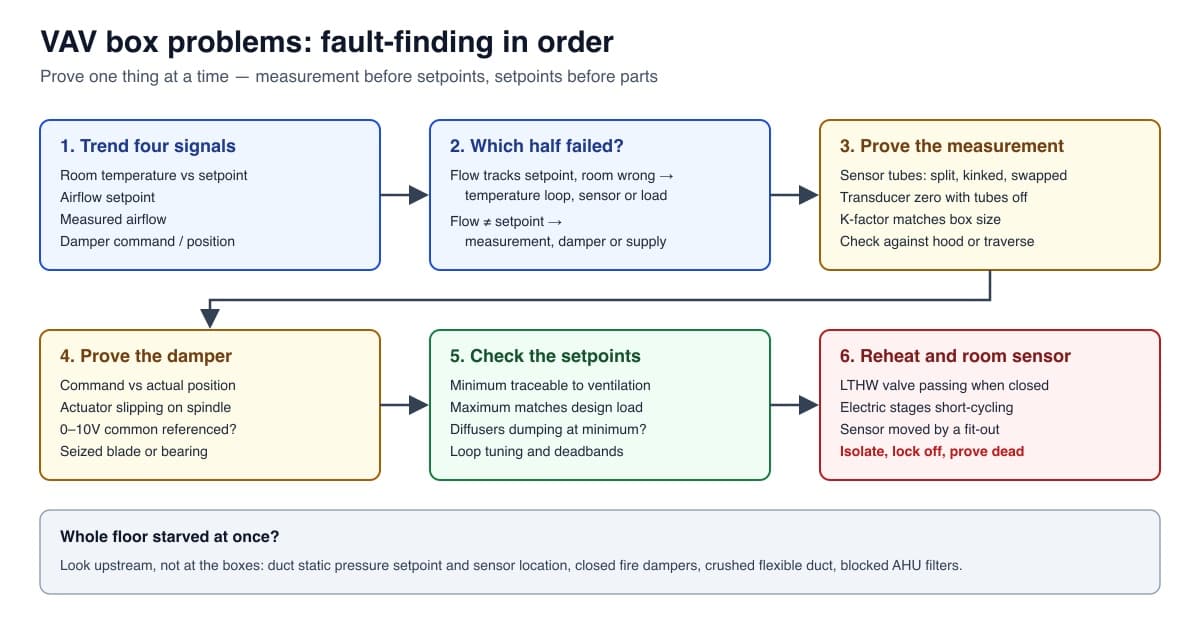
Most failed resets fail for one of four reasons. The first is bad zone data. If a handful of boxes have broken flow sensors, wrong K-factors or failed actuators, they generate false requests and the reset never gets off the maximum, or they report satisfied when they are starved and the reset takes pressure away from zones that need it. A reset is only as good as the boxes feeding it, which is why fixing the boxes comes first; our VAV box problems fault-finding guide sets out how. The second is interaction with supply air temperature reset. If the AHU raises supply air temperature on a mild day to save cooling energy, the boxes need more air to do the same cooling, so they open and ask for more pressure, and the two resets can fight unless the sequence coordinates them. Engineers argue about this one constantly, and the right answer depends on the relative cost of fan energy and cooling energy in that building.
The third reason is tuning. Trim steps that are too large, response steps that are too aggressive or time steps that are too short make the setpoint oscillate, and every oscillation shows up as damper movement across the floor. Slow VAV actuators, which can take a minute or more to drive full stroke, make this worse if the reset was tuned on paper for faster hardware. The fourth is the sensor. A static pressure sensor with a blocked or split tube, one fitted in turbulent air just after a bend, or one next to the AHU outlet where it barely responds to box demand, will make any strategy behave badly. None of these are reasons not to reset. They are reasons to commission the reset properly and trend it afterwards.
Does ASHRAE Guideline 36 apply in the UK?
ASHRAE Guideline 36 is an American guideline, not a UK regulation, and nothing in the Building Regulations requires it. It is still the most complete published set of standardised sequences for VAV systems, and the current edition, Guideline 36-2024, includes trim and respond resets for AHU static pressure and supply air temperature, zone request logic, and automated fault detection and diagnostics for AHUs and terminal units. its sequences can be adapted for UK projects, and its logic can be implemented on any capable controller platform, including Trend IQ4, Distech ECLYPSE and Siemens Desigo, without Guideline 36-branded hardware.
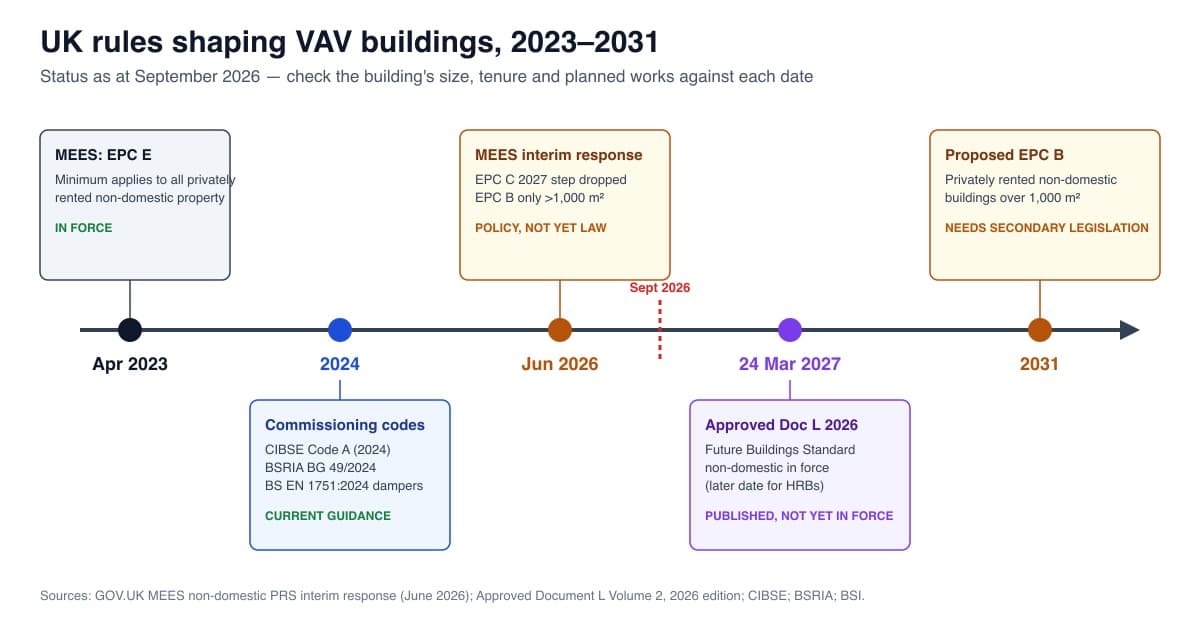
The UK documents that sit alongside it are Approved Document L Volume 2 and the commissioning guidance in CIBSE Commissioning Code A: Air distribution systems (2024) and BSRIA BG 49/2024 Commissioning Air Systems. The 2021 edition of Approved Document L Volume 2 is directly relevant to part-load fan performance: paragraph 6.48 says air handling systems should achieve a specific fan power at 25% of design flow no greater than at 100% of design flow, and paragraph 6.49 says fans for general air distribution rated above 1100 W should have variable speed drives. A fan that turns down but then holds an unnecessarily high duct pressure is working against the intent of both. When a reset is introduced, the air system's performance at the new operating points should be verified and recorded rather than assumed. For how the Future Buildings Standard and the latest MEES position affect VAV upgrades, see our guide to VAV systems and UK regulations in 2026.
What does a good static pressure reset project look like?
A good project runs in a clear order. First, trend the existing system for long enough to establish a baseline of fan speed, static pressure, energy where it is metered, and box behaviour. Second, survey and fix the boxes, because a reset built on bad zone data will fail. Third, check the static pressure sensor location and calibration, and move it if it is in the wrong place. Fourth, write the trim and respond logic with the ignore count, trim and respond steps, time step and minimum and maximum setpoints documented as named, adjustable parameters, not buried constants. Fifth, commission it with the mechanical engineer's agreement on minimum and maximum pressure limits, and trend it for several weeks across different weather before signing off. Finally, add alarms for the situations that break it: a zone generating requests continuously for hours, the setpoint pinned at maximum, or the fan at full speed with the setpoint at minimum.
Done in that order, the result is a supply fan that follows the building's actual demand, fewer noise complaints from dampers throttling excess pressure, and a BMS that tells you which zones are really struggling. The field network deserves attention too, because a reset relies on reliable data from every box; a large MS/TP network of VAV controllers with overloaded segments or poor termination will drop requests intermittently, and our guide to end-of-line resistors and VAV termination covers how to prove the network.
When should you consider static pressure reset?
If your VAV supply fan runs at high speed for most of the occupied day, if the static pressure setpoint has not changed since commissioning, if occupants complain about air noise at diffusers or in the ceiling, or if the building is facing an energy review, an EPC or MEES assessment or an ESOS audit, a static pressure reset belongs near the top of the list. It is also worth doing as part of any controller upgrade, because the logic is far easier to implement properly when the strategy is being rewritten anyway.
VAV static pressure reset is one of the highest-value, lowest-disruption energy improvements available on an existing VAV system, but it rewards doing the groundwork first. Fix the boxes, prove the sensor, write the trim and respond logic properly and trend the result. Alpha Controls programmes, commissions and optimises VAV and AHU controls, including duct static pressure optimisation, on Trend, Distech and Siemens systems and other open-protocol BMS platforms across London and the South East. Talk to our engineers or request a quote for a VAV energy review.
VAV static pressure reset FAQs
What is trim and respond logic?
A reset method from ASHRAE Guideline 36. Zones send requests when short of air; each time step the controller trims the setpoint down if requests are at or below an ignore count, or raises it in proportion to the excess requests, up to a maximum step.
How much fan energy does static pressure reset save?
A frequently cited 2007 ASHRAE Journal paper by Steven Taylor puts savings at 30% to 50% of fan energy against a fixed setpoint, but other studies report much lower figures. Actual savings depend on the starting setpoint, sensor location and fan sizing, so trend the system first.
Where should the duct static pressure sensor be installed?
Out in the supply duct where it responds to box demand, commonly well along the main run, in straight duct away from bends and fittings. A sensor at the AHU outlet barely responds to box demand and forces a higher setpoint.
Why does static pressure reset not work on some VAV systems?
Usually bad zone data from broken flow sensors or failed actuators, conflict with supply air temperature reset, poor tuning for slow actuators, or a badly placed or blocked pressure sensor. Fix the boxes and sensor before commissioning the reset.
Is ASHRAE Guideline 36 used in the UK?
It is not a UK regulation, but its sequences can be adapted for UK projects and implemented on Trend IQ4, Distech ECLYPSE, Siemens Desigo and other capable controllers.
Can Alpha Controls add static pressure reset to an existing VAV system?
Alpha Controls programmes, commissions and optimises VAV and AHU controls, including duct static pressure optimisation, on Trend, Distech, Siemens and other open-protocol platforms across London and the South East. Whether a reset can be added depends on the existing controllers and sensors, which a survey establishes.
Alpha Controls Team
Specialist BMS installation, commissioning, and maintenance across London and the South East. SafeContractor Approved, BCIA Member.